
Home » Posts tagged 'language'
Tag Archives: language
A Dream Called Home–search for happiness
A Dream Called Home
by Reyna Grande

Torn between two countries, immigrant Reyna Grande seeks to find herself. Is she Mexican or American? Will she ever fit into either culture? Is she destined to metaphorically straddle the border for a lifetime? When her first book was published in 2006, one of her dreams had come true and she had begun “a lifelong quest to advocate for the Mexican immigrant community by sharing our stories with the world.” What she found in the aftermath of its publication, however, is that her story resonates with other immigrant communities as well and even with Native Americans who feel the same struggles to maintain a dual identity, language, and culture.
Reyna’s difficult, abusive childhood is discussed at various points in her memoir A Dream Called Home as it plays a strong and recurrent role in her efforts to work through the emotions of her turbulent past through her writing. She makes mistakes along the way as a college student and as a young adult, but she learns from them and decides to experience them as a part of the growth that shaped her into “a unique individual with a unique voice.”
The memoir is filled with stories of her personal relationships. She realizes that she is subconsciously seeking out the love of her father that she never felt under his roof or when he left his family in poverty to earn money in the United States. Reyna and her siblings wrestle with so many decisions in the U.S., and Reyna has to accept that the pathway to healing and success for her is not the right one for them. Fortunately, she has Chicana professors that become lifelong mentors. Even though Reyna is a talented writer, she also has to learn the difficult business end of publication.
Her stint as an untrained middle school teacher in Los Angeles is both sad and predictable for those familiar with teaching in that climate. She experiences unsupportive parents, disrespectful students, and ever changing assignments and curriculum. A bright light for Reyna is her introduction to folklórico. It revives her own interest in her Mexican heritage and renews an enthusiasm in Mexican culture for her students, many of whom, like Reyna, feel displaced and unsettled.
Reyna’s story can not be summarized in a review. My job is to tell you that A Dream Called Home is a book you should read; it should be a part of your mental catalogue. Regardless of your position on the influx of immigrants currently overwhelming the U.S. and its broken political system, you will find Reyna Grande’s perspective both informative and enlightening if you want to understand the struggles of people desperate to emerge from poverty who are clinging to the hope of the American dream.
Rating: 5/5
Category: Memoir
Notes: Includes pictures that personalize Grande and her experiences
Publication: 2018—Atria
Memorable Lines:
My biggest virtue and my biggest flaw was the tenacity with which I clung to my dreams, no matter how futile they might seem to others. The dream of having a true relationship with my parents was the one I had clung to the most because it was the first dream I’d had, and the farthest from my reach.
“Being in a new country, learning a new language, a new culture, takes time. You will learn. It doesn’t feel that way now, but one day you will be just as comfortable speaking English as you are speaking Spanish. But no matter what, don’t ever forget where you came from, and don’t ever be ashamed of who you are.”
I was finally beginning to understand that it takes as much courage to leave as it does to stay, and that being a parent was way more complicated than I had ever imagined.
Why God Calls Us to Dangerous Places–taking the Good News around the world
Why God Calls Us to Dangerous Places
by Kate McCord
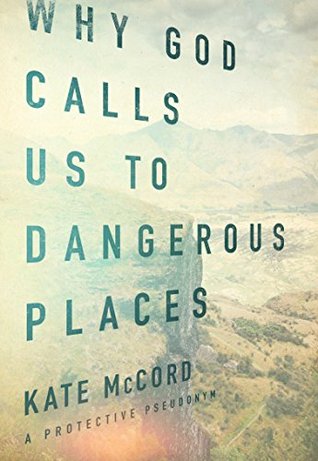
If you have ever wondered what it is like to be a missionary or why people would answer the call of God to go live in a hostile environment, then read Why God Calls Us to Dangerous Places. Author Kate McCord was a “business process consultant in global biopharmaceuticals.” She had a comfortable life and enjoyed her material blessings, friends, and church. In 2000, God started a process in her heart that led her four years later to Afghanistan to work for an NGO (nongovernmental organization). She became a project manager working to improve the lives of the people around her and share Jesus with her neighbors. She learned the language and the culture and relied on God through the Holy Spirit to help her negotiate the minefields of talking about Jesus in such a way that it would not result in her expulsion or execution.
Chapter by chapter McCord helps us dive deeper and deeper into an understanding of God’s calling and how it affects the person feeling the pull to devote themselves and their talents solely to the work of God. She describes how these decisions also affect their friends, families, and churches. McCord explores the kinds of people who are called, the places where they minister, and the difficulties and stress of living in a different culture under uncomfortable living conditions along with spoken and implied threats of violence. She relates all of this through descriptions of her own experiences and testimonies of others living in various countries. She backs up her discussion with stories from the Bible and with Scriptural references to support her theological underpinnings.
It is one thing to write about the missionary life; it is another to live it. McCord has done both and is able to share the calling and journey in a way that draws the reader into her story. I recommend this book for Christians who want to explore the call of Jesus on them personally or those they care about. I also recommend it for non-Christians seeking to understand what it is about this Jesus that makes people want to follow Him through the good times and the bad, enjoying an abundant life on earth with the assurance of an eternal life with Him in heaven.
Rating: 4/5
Category: Christian, Nonfiction
Publication: September 1, 2015—Moody Publishing
Memorable Lines:
We ask our question from the experiences of living in places of chronic stress, sporadic trauma, and brutal martyrdom. Both we who go, and those who love those who go, face the deep evil in the world and turn to God with all our human fragility. We ask the question: why does God call us to dangerous places?
Jesus calls us to dangerous places because He loves people who live in dangerous places. he loves the perpetrators of violence and the victims of violence. he loves the children and the old, the men and the women, the rich and the poor.
Yet they had heard those warnings, just as we, before we boarded airplanes to dangerous places, understood that we were walking into a darkness so deep it might someday overwhelm us. We counted the cost, at least as well as we could. We each said, “He’s worth it. Jesus is worth it.”
 education pathways