Home » Posts tagged 'king'
Tag Archives: king
The Storyteller’s Tale–making words come to life
The Storyteller’s Tale
by Judith Bouilloc
translated from French by Madeline S. White
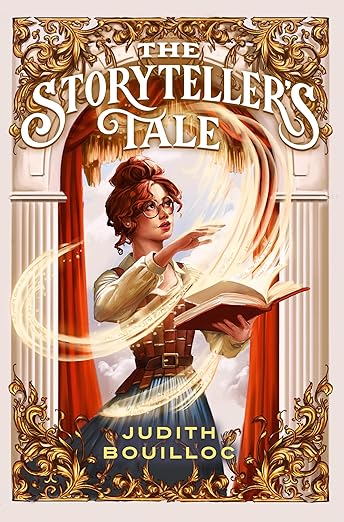
You’ve heard the expression “make words come to life”? In The Storyteller’s Tale, the librarian Iliad Livrani can do that. She is so talented that the queen invites her to come to the palace to perform. During this same period, a messenger arrives from the palace with an offer of marriage from Lord Tarlyn. The immediate complication to this generous offer is that there are several gentlemen at court with that name. Which one might he be? Iliad is chaperoned by her fire-breathing Granny Cassandra as they travel to the castle and have many adventures.
Iliad can create visible words that become images and this talent is useful to the king as he tries to transform his kingdom into a parliamentary monarchy. There is the usual infighting in the court and within the royal family. Magical creatures like a flying bird-deer populate this story. Lovers of literature will find pleasure in the various classical choices Iliad makes for her readings. Lord Tarlyn is a mystery man, and there are difficulties because of his character, abilities, and goals. There are reasons for his secrecy, but they are only gradually revealed.
I enjoyed the fantasy world the author created, especially the magic with words. The various creatures and plants were also interesting. There is a romantic hero and a villain, a mystery and a challenge. Iliad and her sisters are strong women with an equally strong sense of right and wrong. Democratic principles are important to them as are reconciliation and feelings. One of the themes is that character is more important than outward appearance.
I received a complimentary copy of this book in exchange for an honest review. Opinions expressed in this review are completely my own.
Rating: 4/5
Category: Middle Grades, Fantasy, Teens and Young Adult
Notes: All of Iliad’s book choices have footnotes to note the author and explain briefly what the work is about.
Publication: August 21, 2024—Rivka Publishing
Memorable Lines:
“The term snatchwords refers to a person who can make sentences detach themselves from paper by reading them aloud. They internalize each word turning them into moving figures and setting by sheer force of imagination.”
The Livrani women were known to express their feelings with great exuberance. Some might say it was their greatest weapon against ill-fortune.
“What I think is that Balthasar is an aristocrat by birth but a democrat by opinion, and as such, he is likely to change things.”
Kita–Part I: Princess of Orith
Kita
Art and story by William Brenner
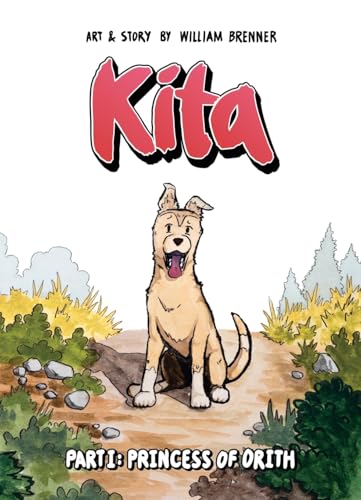
The protagonist of Kita is Tommy, a boy full of imagination. He fantasizes about the Kingdom of Orith. After school one day, he and his stuffed friend, Mr. Bear, head to the imaginary Green Root where they become involved in a conflict with wolves who are trying to take over the town. Mr. Bear is the last living Keeper, and Tommy is the last member of the King’s Guard. Their roles are to locate the rightful heir to Orith’s throne.
The divisions of the novel are:
Chapter 1: Kingdom in Crisis—attacks and a council meeting to determine Orith’s future
Chapter 2: Royal Lineage—Thaddius, Chief Librarian of the archives, leads the team on an adventure to prove there is a descendent of the previous leaders
Chapter 3: Adoption—the warrior princess Kita needs a home.
Kita is a graphic novel written and illustrated by the very talented Will Brenner. The story is told with an appropriate combination of drawings and text; sometimes only illustrations are needed to move the story forward. The graphics are very detailed and show well the expressions and moods of the characters. The story moves between Tommy’s real life and the life he creates in his dreams and in his imagination. Although those worlds are very different, they also overlap. For example, the wolves bully the other animal characters, and Tommy’s cousin Ricky and some of Tommy’s classmates bully Tommy. Some of the characters are likable, and others are villains. Kita’s original owner is a prime example of an uncaring pet owner. Tommy’s parents want to be supportive, but are not always successful at trying to understand him. Perhaps they are just overstretched in their responsibilities. I base that perception on the dinners served—mom brings home takeout for their meals.
This is a fun graphic novel that lets the reader escape into a fantasy world. I think middle graders, teens, and young adults would particularly enjoy this trip to Orith. The Epilogue has a great hook to attract readers to return to the series for Kita: Part 2 which is still in the preparation stages.
Rating: 5/5
Category: Graphic Novel, Fantasy
Notes: Middle Grades (ages 10+)
Publication: April 7, 2025—Great Bellows
Memorable Lines:
“Many things aren’t as they should be. But hang on to hope, young Guard of the King. It will be made right, even if it looks different than you expect. And how exciting that you may yet play a part in that.”
The Beatryce Prophecy–finding home
The Beatryce Prophecy
By Kate DiCamillo
Illustrated by Sophie Blackall
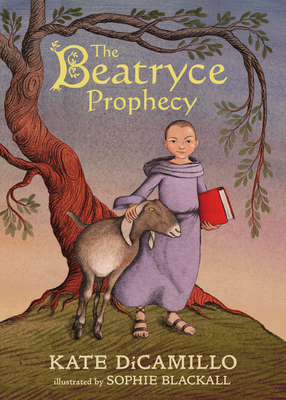
I read The Beatryce Prophecy and then listened to the audio version; I found both delightful. A hard-headed, fearsome goat Answelica and Beatryce, a girl whose family is targeted for destruction by a king, share the protagonist role in this medieval fantasy. Strong supporting roles are found in Jack Dory, a young man who was orphaned as a child, and Brother Edik, an outcast of sorts within his own monastery. They befriend Beatryce and help her find her “voice.”
In the society of this book, women and peasants are not legally allowed to learn to read and write. Since Beatryce can do both, while she is recovering from illness and trauma in the refuge of the monastery, she is urged to disguise herself as a mute member of the order with a shaved head.
The plot of The Beatryce Prophecy centers on a prophecy received by Brother Edik and recorded by him in the Chronicles of Sorrowing. In addition to sharing the prophecies that come to him as he works, Edik’s main job is to illuminate the first letter of each page of that book. For him it is an opportunity for his creative, often fanciful, side to be displayed. Throughout this novel, name is very important as part of a person’s identity. Because the Order of the Chronicles of Sorrowing have the task of recording events of war and violence, there is a dark side to the book, but there are sprinklings of humor, especially through the goat, and there is a lot of positivity in many of the other characters.
The importance of various kinds of love is a strong theme throughout the book. Trust is also discussed and prized by the characters. The evils of war and of greedy rulers are apparent as is the determination of certain classes to control others by withholding literacy. These are themes that middle schoolers can understand and adults can also appreciate. Although no one can restore dead family members to Bernyce and Jack, the ending of the book shows how society can change and individuals can make good choices.
The book is well written and quite lyrical, especially when read aloud. It has beautiful descriptions and philosophical thoughts. As a storyteller, Bernyce contrives fanciful tales within her own story. The black and white illustrations are perfect to accompany this book which also starts each chapter with an illuminated letter.
Rating: 5/5
Category: Children’s Fantasy, Adventure
Notes: 1. Recommended by the publisher for ages 8 and up. Recommended by Amazon customers for ages 9-12. Amazon lists it as appropriate for grades 3-7.
2. Audio version: Finty Williams (Narrator), Listening Library (Publisher)
Publication: September 28, 2021—Candlewick Press
Memorable Lines:
They had walked through a door hewn into the side of a massive tree, and they were inside it now. For the rest of his life, Jack Dory would remember the wonder of it: what it was like to open a door and enter another world, a world hidden inside of the world he already knew—the impossibility of it, the rightness of it.
“Kings,” said Cannoc, “do not know what they want. Except for one thing, of course: they want to keep being kings.”
We shall all, in the end, be led to where we belong. We shall all, in the end, find our way home.
The Princess and the Goblin–multi-layered fairy tale for all ages
The Princess and the Goblin
by George MacDonald

Ready for another, good-for-all-ages fairy tale? My book club read The Princess and the Goblin by George MacDonald, a Scottish minister, poet, and novelist, who inspired and influenced many authors through the ages including C.S. Lewis, Lewis Carroll, J.R.R. Tolkien, G.K. Chesterton, and Madeleine L’Engle. Like The Chronicles of Narnia, The Princess and the Goblin is first and foremost a fun fantasy tale, beautifully written. As it progresses, layers of symbolism are added with themes of courage, honor, belief, trust, virtue, and faith. As any good fairy tale does, The Princess and the Goblin differentiates between good and evil. Children and adults are living in a rather messy world today where ethics often are blurred, but there are still truths that need to be valued. There are morals that hold us to a standard that forms a good society.
With the author’s great descriptive powers, all of the characters are detailed both physically and morally. The goblins are all evil with designs on the full destruction of the human race. The humans in the story are not perfect, but demonstrate character development based on their experiences.
Irene is a little princess who lives in a country castle. Her noble king-papa visits her regularly as he tours his kingdom staying in touch with his people. Irene discovers her great-great-grandmother living in a section of the castle. No one else has seen her or her rooms. She acts as a God figure in the story, guiding Irene to safety and to belief. A very wise woman, she helps Irene understand that not everyone is ready to believe at the same time. This is apparent in Lootie, Irene’s nurse, who has responsibility for the child’s safety and in Curdie, a clever and brave young miner who befriends and helps Princess Irene. The goblins desire the little princess as a mate for their prince.
There is a lot of adventure in this tale as Curdie works underground (literally) to discover the goblin plots and thwart them. The Princess and Curdie are at odds as he does not initially see what Irene sees because the great-great-grandmother does not actually disclose herself to him.
The settings include a castle with lots of hallways, some beautiful mountains, a small miner’s cottage, pitch black caves where miners toil away picking out ore, and goblin caverns and tunnels. These are the backdrops for the dramatic action of the goblins’ convocation, the Princess’ wanderings, and Irene and Curdie’s courageous rescues of each other. The battle scenes are well played out as Curdie defeats them with poetry and foot stomping.
This is a book that I am sorry I missed earlier in my life. I would love to have shared it with my children and grandchildren when they were younger, but I am happy to pass on the word now to new generations looking for well-written books with substance and value. I look forward to reading The Princess and Curdie, which was written eleven years later, as well as some of MacDonald’s other works (numbering over 50) which encompass a variety of genres. I believe that even reading a biography of this author’s life and influence would be quite interesting as his work did not take a straight forward path. He and his family were plagued with health issues, and despite his success and the admiration of his colleagues, he was not always financially solvent.
Rating: 5/5
Category: Fairy Tale, Fantasy
Publication: November 16, 2010—Project Gutenberg (which includes beautiful illustrations by Jessie Willcox Smith from the 1920 version.
First published by Strahan & Co. 1872
Also published by David McKay Co. 1920
Memorable Lines:
Her fear vanished: once more she was certain her grandmother’s thread could not have brought her there just to leave her there…
“But it wasn’t very good of him not to believe me when I was telling him the truth.” “People must believe what they can, and those who believe more must not be hard upon those who believe less. I doubt if you would have believed it all yourself if you hadn’t seen some of it.”
…Lootie had very foolish notions concerning the dignity of a princess, not understanding that the truest princess is just the one who loves all her brothers and sisters best, and who is most able to do them good by being humble toward them.
 education pathways