Home » Posts tagged 'Iran'
Tag Archives: Iran
The Teacher of Nomad Land–a child’s survival
The Teacher of Nomad Land: A World War II Story
by Daniel Nayeri
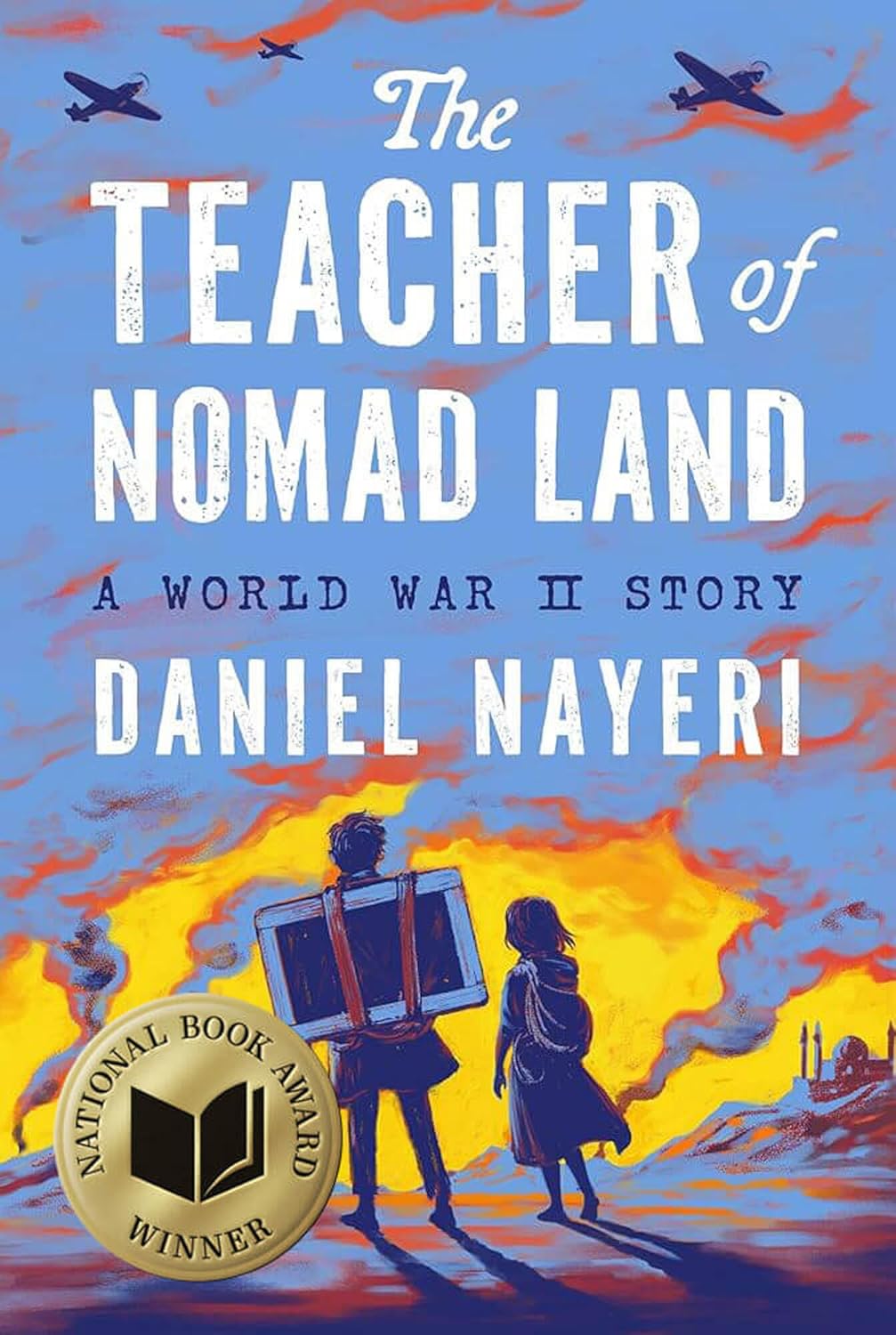
This is the story of two Iranian siblings, thirteen year old Babak and eight year old Sana, orphaned and separated during a time when their neutral country is being invaded by forces competing for Iranian oil—British, Soviet, and German. Add to that mix the Poles, the Jews, and the native nomads who don’t recognize any country as delineated on a map. Their various languages play an important role in this story. Babak has two goals—to become a teacher like his father and to take care of and stay with his sister.
Written for children, this is a fast read for adults. Instead of the horrors of concentration camps, The Teacher of Nomad Land focuses on the lives of the children as they to try to find “family” and dig within themselves to find what it takes to survive. In the Traveler, a friend of their father, they discover a kind man who tries to help. There is also a British soldier they bond with. Their lives are complicated by a mysterious man who is seeking a Jewish boy. All three children are put in danger by this situation. Babak’s resourcefulness is successful in dealing with the Soviets who halt the progress of the nomads in transitioning their herds to their winter home thus demonstrating his value to the nomads.
This is an age appropriate book that does not go into detail about concentration camps and home invasions. On the other hand, it does not shy away from the hunger the children suffer and the danger they face from other people. It highlights the communication problems when there are so many languages; and it shows how, despite being part of an army, individual soldiers can be nice to the local population. While Babak, as the older child, has much of the spotlight in this book, Sana also shines in certain situations with her creativity and ability to step up when things go bad. I was impressed by both characters at their positive attitudes, not allowing themselves to be overpowered by a victim mentality even when cold, hungry, tired or aching from long walks or sleeping on the hard ground.
Rating: 4/5
Category: Historical Fiction, Middle Grades
Notes: 1. Written for children Ages 8-12. Even though the reading level is for that age group, it may be too advanced in terms of understanding the political, geographical, linguistic, and social backgrounds. Discussion with an adult would be helpful for some children.
2. Included some helpful additions: a map, author’s notes about the political setting and the language barrier, and information on the Persian alphabet.
3. The book ends with “Further Reading” which lists nonfiction books for various ages.
Publication: 2025—Levine Querido
Memorable Lines:
“It might have been fair, but it wasn’t right.”
Everything is all at once. Our lives, these moments that change our lives, they all happen so fast.
Teaching is like sitting with a young person and encouraging them to only listen to the good angels in their mind and not the evil ones. But you can’t force them.
Everything Sad is Untrue–memories are culture carriers
Everything Sad is Untrue
by Daniel Nayeri
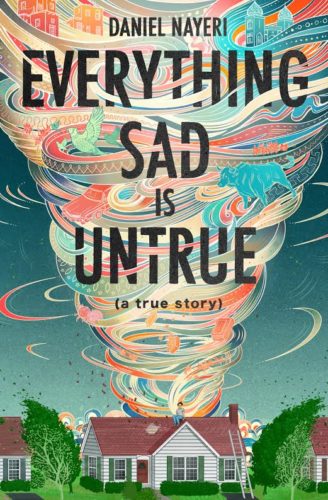
Daniel Nayeri’s Everything Sad is Untrue is part memoir and part storytelling where he fills in the things he doesn’t remember exactly from his childhood. The first part of the book is a mixture of three kinds of stories—myth, legend, and history—that attempt to place the reader in Daniel’s past and his ancestry as it happened and as he imagined it might have happened. He relates “story” in this way to help the reader understand the very different Persian culture he started his life in and which formed his beliefs and attitudes.
Although there are no chapters in this book, the reader can clearly tell when the story pivots from providing background to relating the events from the time his mother became a Christian on a visit to the West. She embraced Jesus and her faith in Him wholeheartedly. Christianity in Iran is a capital offense, so she had to take her children and flee. She traded a comfortable life as a respected physician married to a successful dentist for the life of an impoverished refugee, looked down on because of her language, menial job, and poverty. But she had Jesus, and no one could take that away from her.
Some of the book tells about the year they spent in a refugee camp in Italy. It was not actually a camp with tents, but a concrete building with small rooms and a bathroom. The residents were refugees from many countries, all waiting for the U.N. to find a place that would accept them. They had nothing and there was no access to books, media or recreation. It was made even harder by the refugees’ inability to converse with each other and by impatient workers who processed each refugee’s mound of paperwork.
A lot of Daniel’s story tells what life was like for him as a child in Edmond, Oklahoma, where they eventually settled. He experienced bullying, but came up with tricks for avoiding the worst of it. There was culture shock around every corner as he tried to fit into a very different mindset. Fortunately, he had an outstanding teacher in Mrs. Miller who encouraged him without babying him. The librarian in Edmond was kind too, and so Daniel spent many Saturdays there devouring books. His mom ended up in the emergency room several times thanks to his stepfather Ray, a black belt. Despite lots of difficult times, Daniel never seems to plead for sympathy from the reader and always points to his mother as the strongest person he knows.
Everything Sad is Untrue is a book I recommend. It is a challenging read as the author’s life is presented through the eyes of a child, but with some of the understanding of an adult. Memories are an important theme of this book as Daniel says, “Memories are always partly untrue.” and “A patchwork story is the shame of a refugee.” This is a book ripe with principles and beliefs worth pondering and a story and characters who will remain in the reader’s thoughts long after the last page is turned.
Rating: 5/5
Category: Autobiographical novel/fictionalized memoir
Notes: 1. This is a hard book to categorize which may, in part, be a critical factor in making it a very good book.
2. It has been rated for children 12+ on Amazon. Some readers refer to it as a Young Adult book. To me, it is probably more appropriate for adults. Some of the fascination with “poop,” however, in Daniel’s childhood classroom would attract the attention of middle school boys.
3. This book has won many awards.
4. I thought not having chapters would be a negative for me, but it does fit the style of Everything Sad is Untrue.
Publication: 2020—Levine Querido
Memorable Lines:
Memories are tricky things. They can fade or fester. You have to seal them up tight like pickles and keep out impurities like how hurt you feel when you open them. Or they’ll ferment and poison your brain.
And here is the part that gets hard to believe: Sima, my mom, read about him and became a Christian too. Not just a regular one, who keeps it in their pocket. She fell in love. She wanted everybody to have what she had, to be free, to realize that in other religions you have rules and codes and obligations to follow to earn good things, but all you had to do with Jesus was believe he was the one who died for you. And she believed.
Imagine you’re in a refugee camp and you know it’ll be a tough year. But for the person who thinks, “At the end of this year, I’m going somewhere to be free, a place without secret police, free to believe whatever I want and teach my children.” And you believe it’ll be hard, but eventually, you’ll build a whole new life….But if you’re thinking every place is the same, and there will always be people who abuse you, and about how poor you’ll be at first, the sadness overtakes you….But what you believe about the future will change how you live in the present.
The Wind in My Hair–compulsory hijab
The Wind in My Hair
by Masih Alinejad with Kambiz Foroohar

In her memoir The Wind in My Hair, Masih Alinejad, in exile first in Great Britain and later in America, tells the struggles she had and all Iranian women still endure with laws in Iran that make wearing the hijab compulsory from age seven. The “morality police” in that country take this law over what women wear to the extreme. Women can be beaten, flogged, and jailed if even a strand of hair escapes the hijab. Women who have resisted this compulsory law have had acid splashed in their faces and have been incarcerated, tortured, and sometimes raped.
Masih tells her personal story of an impoverished, but mostly happy, rural childhood with conservative parents. Always a bit of a rebel, Masih was expelled from high school in her final semester and jailed for belonging to a small anti-government secret society. Later as a parliament reporter, she was banned from the parliament building for asking the wrong questions.
In exile Masih worked tirelessly and sometimes under threats of violence for the rights of women in Iran. There are more issues involved than compulsory hijab, but that is a visible sign of the control men have over women in Iran. Masih used the tools of social media, especially Facebook and Twitter, to broadcast her positions in Iran where the government controls television and newspapers. The movements she started were given exposure internationally via the Internet.
Masih is highly critical of female politicians and government employees who visit Iran but are unwilling to bring up women’s rights in official discussions and wear some version of head covering during their visit. Masih made recordings of Iranian families’ stories about their dead or missing loved ones called The Victims of 88. Brave women flooded her social media accounts with pictures of themselves without the hijab in the interest of freedom. The Wind in My Hair is well-written by a journalist-storyteller who has lived the story she tells. It will grip you and not release you as you ponder the freedoms you currently enjoy in your own country.
Rating: 5/5
Category: History, Memoir
Notes: Perhaps because she was not raised American, perhaps because she is a journalist, Masih’s perception of current politics and reporting in the U.S. seem somewhat skewed. She clearly understands that you can’t trust reports in Iran, but does not seem to realize that there is censorship in the U.S. by big business, politicians, and the media working in concert. That viewpoint does not change the importance of her analysis of the Iranian government’s control over its people following the deposition of the Shah.
Publication: May 29, 2018—Little, Brown, & Co.
Memorable Lines:
“The Americans are coming to steal Iran away. They’ll kill us all.” I really thought we’d face another war immediately. It was not rational, but, like millions of Iranians, I had been brainwashed by the daily propaganda on the national television and radio stations. I thought it was only Khomeini who was strong enough to stand up to the greedy U.S. capitalists. Many years later, I discovered that Khomeini was a coldhearted dictator who ordered the execution of thousands of Iranians.
I didn’t even know what charges I faced. No one had read the complaint against me. I had no lawyer to defend me. I was forced into giving a confession, and now all that remained was for this judge to pass a sentence. It didn’t sound very just. Later in life, I discovered that there is not much justice in the Islamic Republic.
There is a predictable cycle in Iranian politics, as predictable as the weather. Every year, for a few months, the government relaxes its grip and some actions are tolerated—women can show a few inches of hair under their head scarves, or men and women can actually walk together without being married, or the newspapers can publish mildly critical articles. Then, just like the dark clouds that gather in late autumn, the freedoms are taken away and transgressors are punished.
 education pathways