Home » Posts tagged 'India'
Tag Archives: India
The Covenant of Water–Indian multigenerational saga
The Covenant of Water
By Abraham Verghese
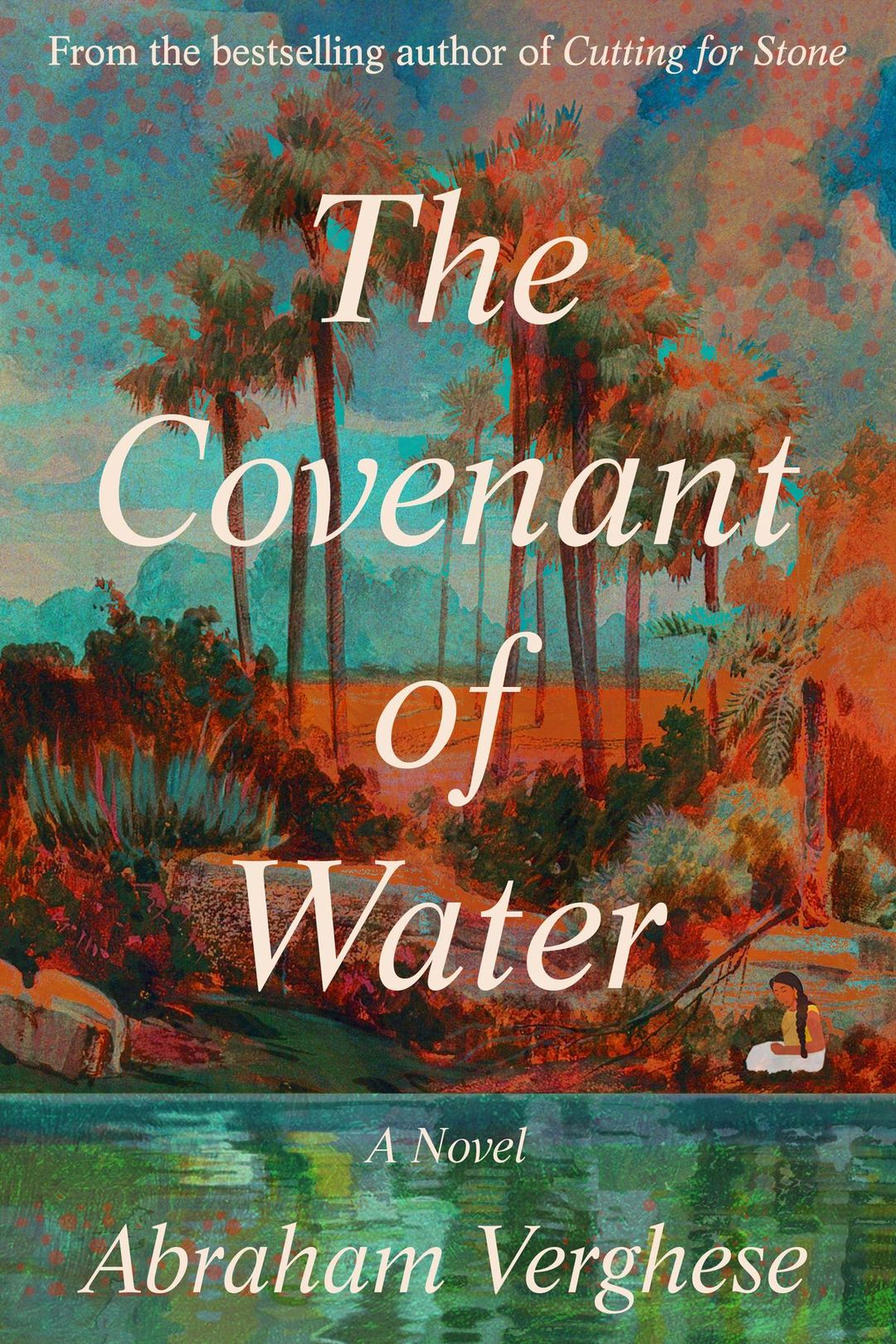
Fourteen years in the making, 724 pages long, this saga that mainly takes place in India will stay with readers long after they have finished reading it. This story spans the years 1900 to 1977 and begins with the arranged marriage of a twelve year old girl who is given years to mature and grow into her role before the marriage is consummated. She becomes the matriarch of the family and is known as Big Ammachi. The family has a secret, a curse they refer to as The Condition. At least one person, usually male, in each generation has died of drowning in a country where water is everywhere.
The reader takes a deep dive into the relationships that occur over the years in this area inhabited by St. Thomas Christians. The people in the community have a Christian faith, but it is interwoven with other cultural traditions. Big Ammachi’s husband Thamb’ran has the condition and was not allowed to travel by water to school. Therefore, he is an intelligent man, but has never learned to read. He also has a hearing loss.
Just when the reader has a grasp on these characters and the plot, the story jarringly transitions to Glasgow, Scotland, in 1919, where we meet Digby Kilgour, a surgeon, and become acquainted with the caste system. Although the transfer seems sudden, the plot soon moves back to Parambil in India where it is discovered that beloved Baby Mol suffers from a medical situation that will leave her childlike all of her life.
The Covenant of Water is too long for a reviewer to detail all of the events concerning the many characters. The plot is intricate and seemingly unconnected threads are eventually woven into other threads to create beautiful scenes full of emotion and love which cross many generations. There are tragedies and victories, happiness and great sadness. Heroic actions save lives and cause personal suffering. Writing and art are tools for healing. The World War brings death to many as Japan bombs Madras in India, but also inspires Indians to seek their freedom from Great Britain. There are births under primitive conditions, the arrival of electricity, and the release of Nehru after three years of imprisonment. Fire causes permanent damage as does leprosy, but with an undercurrent of faith, there is also healing and joy. Water is a powerful theme as the water flows through the land uniting all the characters with none of them having to stand alone because they are connected by the water—physically and emotionally. Story is important to this author and more important than themes and messages. As the story unfolds, however, Verghese reveals deep meanings and understandings of human nature in his beautiful writing. Although he labored over this saga for years, the telling seems to be effortless and replete with memorable lines and phrases. It is a masterpiece of fiction that readers will want to discuss and revisit for years to come.
Rating: 5/5
Category: Fiction
Notes: I am not normally a fan of celebrity book clubs, but I listened to Oprah Winfrey’s six part discussion (available on YouTube) of The Covenant of Water with author Abraham Verghese. It is a great interview and includes Verghese reading some passages from the book. It offers interesting insights into the writing process. I don’t usually listen to audio books because of hearing issues, but I could tell that Verghese’s reading of his book would be a positive addition to the enjoyment of The Covenant of Water.
It is a long book, but I think most people in my book club enjoyed it. One member shared a 5 page list of characters she found online. Because the book is so long, I would suggest readers explore that possibility or create their own list as they read.
Publication: May 2023—Grove Press
Memorable Lines:
The grandmother is certain of a few things: A tale that leaves its imprint on a listener tells the truth about how the world lives, and so, unavoidably, it is about families, their victories and wounds, and their departed, including the ghosts who linger; it must offer instructions for living in God’s realm, where joy never spares one from sorrow. A good story goes beyond what a forgiving God cares to do: it reconciles families and unburdens them of secrets whose bond is stronger than blood. But in their revealing, as in their keeping, secrets can tear a family apart.
“Are we not doing some good here, Honorine?” he asks gently. She looks at him kindly. “Aye, bonny lad, you are! Us all are! Our hospital, the railways and telegraphs. Plenty good things. But it’s their land, Digby, and we take and take us. We take tea, rubber, take their looms so they must buy our cotton at ten times the cost…”
“Half my life is spent on trains. Strangers of all religions, all castes getting on so well in a compartment. Why not same outside train? Why not simply all getting along?” Arjun looks out of the window and swallows hard.
The Secret Garden–delightful classic
The Secret Garden
by Frances Hodgson Burnett
Illustrated by Tasha Tudor
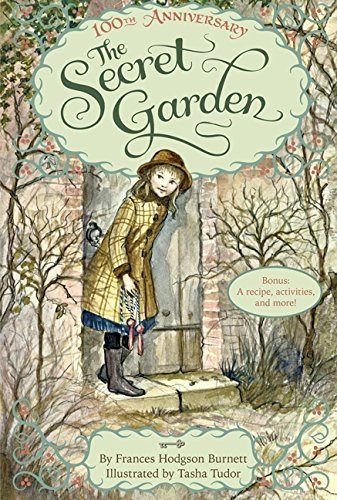
An avid reader as a child, I am surprised that I somehow missed out on the classic children’s tale The Secret Garden written by Frances Hodgson Burnett. For this reading with my book club, I chose an edition with delightful illustrations added to this 1911 book by Tasha Tudor in 1962. The Secret Garden is recommended by the publisher for ages nine and up, but I strongly recommend it for all readers. Please don’t relegate it to the “kiddie lit” genre.
The Secret Garden is the kind of book that instructs the reader in positivity without being preachy. Ten year old Mistress Mary (as in “quite contrary”) is a child who is both spoiled and neglected in her upbringing in India where she does not experience love. Things are not much better for her when her parents die, and she is shipped to Yorkshire to be under the care of her uncle. There she is still not loved as her uncle, Mr. Craven, has not dealt well with the death of his wife ten years prior and the illness of his son Colin who is physically cared for but also is not loved.
When Mary discovers that the mysterious crier in the night is Colin, she gradually creates a bond with her cousin. She is a curious girl who is given little freedom in the house, but almost total freedom in the gardens. She discovers the benefits of fresh air, sunshine, and natural exercise, and she explores the grounds looking for a secret garden that has been hidden away since Colin’s mother died.
Mary and Colin meet so many interesting people during the spring and summer. Dickon is a twelve year old who can converse with animals and plants. His older sister Martha is a sweet young lady who works at Misselthwaite Manor as a housemaid and helps take care of Mary. She has one day a month off, and she travels home by foot to help her kindly mother with laundry and baking. She gladly gives her mother her earnings to help support her large family of twelve happy siblings. Ben Weatherstaff is an elderly gardener who knew Colin’s mother and is eager to help restore the secret garden. While this tale is not full of goody two-shoes, it does have characters the reader will enjoy getting to know and in the cases of Mary and Colin watching their physical and emotional growth.
The Secret Garden is a pleasant read that begins with difficulties for the characters but progresses to a magical time in their lives. The author’s descriptions are wonderful to read as spring approaches in the garden. It is a book I would reread for the pleasure of the story and the language of the author.
Rating: 5/5
Category: Children, Fiction, Classics
Publication: 1911—Harper Collins
Memorable Lines:
The rainstorm had ended and the gray mist and clouds had been swept away in the night by the wind. The wind itself had ceased and a brilliant, deep blue sky arched high over the moorland. Never, never had Mary dreamed of a sky so blue. In India skies were hot and blazing; this was of a deep cool blue which almost seemed to sparkle like the waters of some lovely bottomless lake, and here and there, high, high in the arched blueness floated small clouds of snow-white fleece. The far-reaching world of the moor itself looked softly blue instead of gloomy purple-black or awful dreary gray.
“Half-witted!” said Colin angrily. “Who thought that?” “Lots o’ fools,” said Ben. “Th’ world’s full o’ jackasses brayin’ an’ they never bray nowt but lies.”
He had made himself believe that he was going to get well, which was really more than half the battle, if he had been aware of it.
My Several Worlds: A Personal Record
My Several Worlds: A Personal Record
by Pearl S. Buck
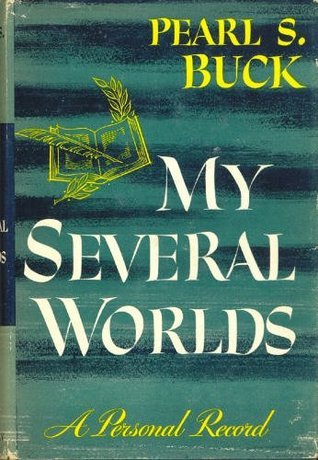
WHAT IS MY SEVERAL WORLDS?
It is a collection of essays integrated into a memoir. Author Pearl S. Buck, as she writes this tome, considers herself midway in her writing career. She presents it as a “record of the age in which I lived” and “as nearly an autobiography as I shall ever write.” It is not a linear book. The place she is located when she writes each section is noted, but not the date because it is such a combination of times. Although a confusing style at first, it makes sense because as she is writing about her current life in the United States, she will suddenly revert to recounting her younger years in China and historical world events or advance her opinions on a variety of subjects from practical to esoteric.
WHO WAS PEARL S. BUCK (1892-1973)?
She was a prolific author, primarily a novelist, and the winner of both the Pulitzer Prize in 1932 and the Nobel Prize in Literature in 1938. The child of Christian missionaries, she spent much of her life in China until politics forced Americans to leave. Completely bilingual, Pearl was an astute translator of Chinese and had great admiration for Chinese social structure and love for the Chinese people. When she returned to the United States, she found that she lived in two separate worlds and never felt quite at home in either. She was well-traveled and had friends from all over the world.
WHERE DID BUCK GET HER INSPIRATION?
Buck’s source material was mainly her observations of people. In her travels, she paid attention to people, listening more than talking. Her focus was more on the common man and woman than the famous people who wanted to entertain her as a celebrity.
WHAT ARE SOME OF BUCK’S “SEVERAL WORLDS”?
Buck watched various political groups attempt takeovers in China. This land she loved and which helped shape her was subject to political strife from inside the country and by forces from the outside. She was witness to Western influences on young Chinese who studied in the United States and tried to bring change to ancient Chinese customs. These endeavors were not always positives for the Chinese people.
As an American adult with Chinese training, Buck experienced disparate worlds in the United States. Looking past geopolitical issues, Buck also had several worlds on a personal level. Although equipped to mingle in high society circles, she preferred a rural lifestyle with a large household of adopted children who learned life and family skills on their farm. She had a long, unhappy marriage to an agricultural missionary in China followed by a long, happy marriage to her publisher in the U.S. Although a teacher and primarily a writer, Buck devoted her talents to social enterprises as well. She opened The Welcome Home for U.S.-born children of Asian descent whose mixed-race status made them “unadoptable” according to adoption agencies. She also advocated for appropriate care for the disabled, a cause close to her heart as her first child was unable to live independently.
WHAT IS YOUR OPINION OF MY SEVERAL WORLDS?
This is not an easy read; there is no fluff to it. In My Several Worlds you will discover a lot of Chinese history since, as Buck points out, the Chinese civilization is very old. She refers to many events in China’s past without details as she feels they have already been discussed thoroughly in books she and others have written. Her thoughts on the various subjects she examines are interesting although I do not always agree with all of them. They are informed by her unique background of living a cosmopolitan life. She was homeschooled by Christians but tutored by a Confucian. She went to college in the United States, but despite altering her clothing never felt like she fit in.
Buck is an excellent writer, but the reader needs to approach this non-fiction work with a desire to learn—to learn more about China, about adults who have grown up in more than one culture, and about the fascinating Pearl S. Buck. Having read this memoir, I think a good follow up would be to read one of her many novels.
Rating: 5/5
Category: Memoir, Nonfiction
Publication: 1954—John Day Co.
Memorable Lines:
But I had never known what hatred was. I had neither been hated nor had I ever hated anyone. I could not understand why we, who were still ourselves and unchanged, should be lumped with unknown white men from unknown countries who had been what we were not, robbers and plunderers. It was now that I felt the first and primary injustice of life. I was innocent but because I had the fair skin, the blue eyes, the blond hair of my race I was hated, and because of fear of me and my kind I walked in danger.
No people can be educated or even cultivated until books are cheap enough for everybody to buy.
I went back to my own resurrected home with a heavy heart indeed, for I knew that from that day on the new government was doomed in the end to fail. Why? Because it had failed already in understanding the people whom it purposed to govern and when a government does not rule for the benefit of those ruled, sooner or later it always fails, and history teaches that lesson to every generation whether or not its rulers can or will understand.
Shadow Among Sheaves–sacrifices
Shadow Among Sheaves
by Naomi Stephens
 The Biblical story of Naomi and her daughter-in-law Ruth is known and quoted as an example of devotion. Upon the death of her husband and sons, Naomi encourages her daughter-in-laws to return to their home countries, but Ruth says: “Entreat me not to leave thee, or to return from following after thee, for whither thou goest, I will go; and where thou lodgest, I will lodge: thy people shall be my people, and thy God my God.” (Ruth 1:16).
In Shadow Among the Sheaves author Naomi Stephens uses this story in a new setting. Nell (Lady Hawley) and her daughter-in-law Rene move from India back to England in the glory days of the British Empire. Rene, from the highest caste in India, has promised to take care of Nell, but because of discrimination against Indians, they are treated as outcasts and beggars. Stephens’ story follows the same general lines as the Biblical story but is fleshed out with a deeper plot and extensive character development. Using the complexities of the ethnic divide and the social and class norms in Britain at that time, Stephens weaves a riveting tale of love and conflict.
I would like to extend my thanks to netgalley.com and to Barbour Publishing (Shiloh Run Press) for giving me the opportunity to read this book in exchange for an honest review.
Rating: 5/5
Category: Christian, Romance
Notes: You do not have to be familiar with the Bible story of Ruth and Naomi to enjoy this book, but if you would like to read it, the book of Ruth is found in the Old Testament and is only four chapters long.
Publication: April 1, 2019— Barbour Publishing (Shiloh Run Press)
Memorable Lines:
An aching belly, an empty room, skin pulled tight over hungry bones—all of these sacrifices were worth it, she knew, if it meant staying with Nell, if it meant her family would be her family forever.
Thomas had never been a monster, exactly, though he had always been monstrously arrogant.
Music began tumbling across the now barren fields. The notes were thick and plucky, sticking to the window like hands pressed up against the glass.
 education pathways