
Home » Posts tagged 'hardship'
Tag Archives: hardship
Green Leaf in Drought–a missionary story
Green Leaf in Drought
by Isobel Kuhn
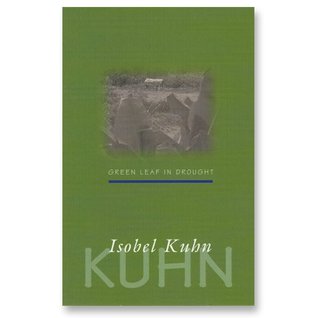
Arthur and Wilda Mathews and their baby spent a frustrating two years trying to discern and follow God’s will as missionaries for the China Inland Mission, a group spread widely over mainland China. Under the Communist regime, they were not allowed to witness to people about Jesus or to help people in need. They were eventually confined to their meager and uncomfortable quarters and socially isolated. Their living situation was desperate as the authorities tried to starve them and forced them to live in unhealthy conditions. Why had God brought them to this place? Why wouldn’t the authorities allow them to leave? Having arrived with enthusiasm, they eventually suffered through round after round of seeking God’s will in the midst of despair. Their little girl was a bright note as she absorbed and repeated the songs and Scriptures that sustained her parents during the difficult times.
If you are inspired by missionary stories or want to read about God working in the hearts of His children when times are hard, then you would probably find Green Leaf in Drought to your liking. The content is very interesting. Stylistically speaking, this book is not in the excellent category. Author Isobel Kuhn had very difficult resource materials to work with, mainly the writings of Arthur and Wilda Mathews. Their compositions were letters intended for family and recordings on paper of their thoughts, prayers, and poetry, which we would refer to today as journaling, often written in tiny script on thin airmail paper. Others were involved in deciphering and organizing the events which Kuhn then transformed into a readable narrative. As Kuhn tries to translate the couple’s thoughts into dialogue, the result is somewhat stilted. The descriptions, however, are well executed. Kuhn maintains the integrity of a biography. She does not veer off into historical fiction and is to be commended for that. Readers who want a more in depth character study will not find that because it was not provided in the source materials.
Rating: 4/5 (3/5 for writing style, 4/5 for interest and historical veracity)
Category: Christian, Biography
Publication: January 1, 2007—OMF International (first published in 1957)
Memorable Lines:
The bamboo curtain shouts and bellows as it descends, boasts and preens itself. The Feather Curtain of God falls silently. It is soft and comforting to the sheltered one; but intangible, mysterious and baffling to the outsider.
Amazing how we plan everything so carefully and then God walks sovereignly right across the lot with something far better.
The slow wearing down of the human spirit is a species of torture which the communists delight to use and have found very productive for their purposes.
Death Comes for the Archbishop–New Mexico frontier
Death Comes for the Archbishop
by Willa Cather

Every well-read person should have read at least one book by Willa Cather, an American Pulitzer Prize winning author famous for her novels set in the frontier. When my book club decided recently to read Death Comes for the Archbishop, I had not read any of Cather’s books. I was delighted that the choice was one that focused on the history of the Catholic church in New Mexico where I currently live. The novel provides as a backdrop a tour of cities, towns, pueblos, and open deserts inhabited by foreign priests, Mexicans, and Indians. Cather paints beautiful word pictures of the landscapes while depicting the difficulties of life, and especially travel, as two French priests attempt to revive the Catholic religion in the region. Churches had been planted over three hundred years earlier but did not receive much attention from Rome. With the annexation of new territories by the U.S., things begin to change in a land viewed as “wild” for many reasons. It is ruled over by the Bishop of Durango located in Mexico, fifteen hundred miles away from Santa Fe where the missionaries headquartered.
Jean Marie Latour, a parish priest based in the Lake Ontario region is elevated to bishop arriving in New Mexico in 1851 after a difficult and dangerous year long journey. He is accompanied by his childhood friend Father Joseph Valliant. Despite its title, Death Comes for the Archbishop is not a murder mystery nor does it focus on the death of the Archbishop. Instead, it is a triumphant tale of strong, wise, and intelligent men who against all odds form friendships with peoples of various tribes, cultures, and languages in a harsh but beautiful land. The descriptive language is exquisite and serves to enhance and further the plot. This book celebrates the usually successful struggles for survival and the somewhat successful attempts to share the Catholic religion. In the Archbishop’s passing, it becomes evident that he was much loved and respected by the peoples of the many cultures in his diocese.
Death Comes for the Archbishop is a tale I would enjoy rereading for the breadth of its descriptions and the depth of its topics. The two Fathers were men I would enjoy meeting. Quite unalike physically and in disposition, they were fast and loyal friends with different means of evangelism, but suitable to their characters. Although this book has a specific setting in terms of time period and location and has characters with a religious profession, its themes of devotion, strength, and friendship transcend the New Mexico frontier of the 1850’s and the Catholic priesthood. Although the specifics were interesting and an effective vessel for the themes, the novel proves Cather to be, above all, an able storyteller. I had no regrets in reading this work of historical fiction based on the lives of two missionaries, and I highly recommend it.
Rating: 5/5
Category: Historical Fiction
Publication: June 15, 1927—Reading Essentials
Memorable Lines:
Everything showed him to be a man of gentle birth—brave, sensitive, courteous. His manners, even when he was alone in the desert, were distinguished. He had a kind of courtesy toward himself, toward his beasts, toward the juniper tree, before which he knelt, and the God whom he was addressing.
There was a reassuring solidity and depth about those walls, rounded at doorsills and windowsills, rounded in wide wings about the corner fireplace. The interior had been newly whitewashed in the Bishop’s absence, and the flicker of the fire threw a rosy glow over the wavy surfaces, never quite evenly flat, never a dead white, for the ruddy colour of the clay underneath gave a warm tone to the lime-wash.
This mesa plain had an appearance of great antiquity, of incompleteness; as if, with all the materials for world-making assembled, the Creator had desisted, gone away and left everything on the point of being brought together, on the eve of being arranged into mountain, plain, plateau.
 education pathways