Home » Posts tagged 'Great War'
Tag Archives: Great War
Murder Most Fair–grief
Murder Most Fair
by Anna Lee Huber

What is the best way to grieve? Murder Most Fair weaves that theme throughout a captivating mystery by Anna Lee Huber. This novel has its basis in the spy and undercover operations of the Great War (WWI). The espionage secrets of that period are held close by those involved because of the Official Secrets Act which binds them through honor and legalities. It is in this atmosphere that Verity Kent, a spy, and her husband Sidney Kent, a war hero also engaged in undercover work, pursue what appears to be the frivolous, carefree lifestyle of the young rich.
In reality, like so many of that period, Verity and Sidney are working through grief—for Verity, the personal loss of her beloved brother Rob and for both of them, the witnessing of many soldiers and civilians killed or maimed in the conflicts. The couple is also struggling to avoid the clutches of the evil Lord Ardmore in a different type of war fallout. Meanwhile, we get a first hand view of the hatred many in England felt for all Germans. Verity’s great-aunt Ilse manages to obtain legal entry to Great Britain along with her German maid. Ilse is but a shell of her former self after surviving the war in a country where even if you had money, there was nothing to buy. Malnutrition and starvation were rampant.
The mystery becomes deadly as it progresses. Sidney and Verity are asked to investigate on the side as the local law officer has never handled a murder case. Verity’s relationship with her family is highly stressed as she has not been home in five years, including for her brother’s funeral. Her absence was quite painful for her mother.
Huber’s descriptions are outstanding, evoking a visual and emotional picture. She places the reader in the middle of the setting along with the characters. Her plot is intricately crafted with threads that seem to go nowhere…until they do. This is a good historical novel with suspense to keep you turning pages.
I received a complimentary copy of this book in exchange for an honest review. Opinions expressed in this review are completely my own.
Rating: 5/5
Category: Historical Fiction, Mystery
Notes: #5 in the Verity Kent Mystery Series. I haven’t read all the books in this series, but Huber provides needed background information, so this book could be read as a standalone.
Publication: August 3, 2021—Kensington
Memorable Lines:
I wrapped my juniper-green woolen jumper tighter around me and breathed deeply of the air tinted with the smoke from the hearths burning inside, the earthy aroma of autumn decay, and a faint tinge of saltiness from the sea a short distance away. The breeze sawed gently through the trees overhead, rustling the leaves like castanets…
“Well, the Jerries weren’t happy to sit in their mudholes and cesspits any more than we were. We were both just cogs caught up in the higher-ups’ wheels of madness.”
Most of the war dead, of course, had not been repatriated, instead being buried in France, Belgium, Gallipoli, Palestine, and other far-flung places on the globe. But nonetheless I could feel their absence like the missing notes of a song or the lost verse of a poem.
Murder Between the Lines–mystery with a backdrop of women’s suffrage
Murder Between the Lines
by Radha Vatsal
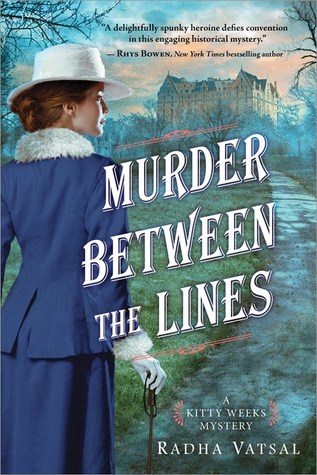 Murder Between the Lines is the second novel by Radha Vassal about Kitty Weeks, a beginning journalist in an age when the rare female journalist is by default a writer for the women’s pages. The setting is 1915-1916, the U.S. has not yet entered the Great War, Woodrow Wilson is president, and women do not have the right to vote.
The “Kitty” in the first third of the book is a flat, undeveloped character. At first I thought this problem was a reflection of the way women were treated by men and by other women as a social norm. Later in the book, however, Kitty takes on some depth as the plot picks up its pace.
There are several plot threads. They deal with women’s suffrage, political intrigue and an anti-war movement, women as journalists, women’s education, Edison’s inventions, and several deaths. The author manages to tie the threads together, but some resolutions seem forced.
The author researched the era well, and the information was interesting. Of particular note was the apparent frailty of the “weaker sex” and doctors’ views on women’s health and recovery from accidents.
It is difficult to sort out attitudes about the characters given the freedoms and responsibilities women in the U.S. have today. Are the women in the book weak or are they victims of the time? I think the answer may be a little of both. Women were generally dependent financially on men, but there have been women of every era who were powerful and knew how to wield that power. In Kitty’s case, she has to break down social barriers to achieve financial independence.
I would like to extend my thanks to netgalley.com and to Sourcebooks (Landmark) for giving me the opportunity to read this book in exchange for an honest review.
Rating: 3/5
Category: Mystery, Historical Fiction
Notes:
1. At the end of the book, the reader will find Author’s Notes that stress the author’s use of primary sources as well as suggestions for further reading.
2. Beautiful cover art!
Publication: May 2, 2017—Sourcebooks (Landmark)
Memorable Lines:
“Half of our population cannot be treated as less than the other. The cause requires publicity as well as a definite program. My program is to champion a federal amendment to the constitution and to use my wealth and my position in society—for in the end, no one turns their back on money—to create news, to create publicity for us all.”
As far as Kitty could tell, men were just as petty as women, but when they didn’t get their way, they didn’t resort to intrigues—they started wars.
When it came to matters he cared about, the president didn’t hesitate for a moment to campaign around the country to sway hearts and change minds. But when it came to woman suffrage, he took refuge behind states’ rights. Somehow, war warranted the exercise of his powers of persuasion, while campaigning for half his citizens’ rights did not. No wonder so many women were enraged. No wonder so many felt they must browbeat and threaten, take matters into their own hands.
 education pathways