Home » Posts tagged 'Germans'
Tag Archives: Germans
The Swiss Nurse–refugees from war
The Swiss Nurse
by Mario Escobar

I am so glad that I had read other books by Mario Escobar, because this work of historical fiction started off roughly for me. I feel sure the fault was my own. I am shamefully unfamiliar with the Spanish Civil War, and I started the book too late in the evening. I persevered the next day, however, and was quickly immersed in a tale of evil hearts and the strength of some good people who worked to help others in dire circumstances.
When Franco and his troops were successful in this war, they were determined to obliterate the Republicans fighting for their freedom and anyone associated with them. The result was a massive exodus of refugees into southern France which was not prepared for the influx and did not welcome them with open arms. The “camps” they provided were sandy beaches with no structures. There was little food and no potable water; the refugees were not allowed outside the camp.
This book is about the refugees in that war which was followed up by the events of World War II and the further torment of innocents by the French Vichy government which was a puppet government of the Nazis, and then by the Nazis themselves. Much of the story describes the horrible conditions of the refugee camps and the strength and boldness of Elisabeth Eidenbenz, a Swiss woman whose focus was orphans in Spain until she was forced relocate to southern France where she opened a hospital taking in pregnant women and giving them a safe place to deliver their babies. The other main character is Isabel, a Spanish lady who married Peter, an American who fought with the Spanish for their liberation. Their lives intersect when Isabel gives birth to her precious daughter Lisa at the Elne Maternity Hospital. With Peter held in various prisons and concentration camps and conscripted into the army for manual labor, Isabel stays to help in the maternity hospital.
The author pulls the reader into the horrible conditions and the faith and courage of characters who stand up for what is right. As a reader, you want everything to turn out great for the sympathetic characters. This is, however, a work of historical fiction, so not everyone has a happy ending. It is important to read works like this so that we are not duped yet again by politicians who promise good things and deliver nothing, creating untenable situations. History like this must not be allowed to repeat itself.
I received a complimentary copy of this book in exchange for an honest review. Opinions expressed in this review are completely my own.
Rating: 5/5
Category: Historical Fiction, Multicultural, Fiction
Notes: Additional material includes: References, Clarifications from History, Timeline, Discussion Questions, and Information about the Author and the Translator
Publication: April 14, 2023—Harper Muse
Memorable Lines:
Gazing off into the distance, their gaunt faces reflected the weary sadness of their souls. Their cheeks were sunken with hunger, and their skin was pallid from exhaustion and malnourishment.
An entire generation had been killed for naught: anonymous heroes on both sides, idealists attracted by the siren songs of their leaders who stayed safe in the rear guard. The only hope was to erase those painful years from their lives and try to start over from scratch.
Argelès-sur-Mer had been both refuge and jail. It had stamped out of us the hope of recovering our lives one day. We were now flea-infested riffraff with bones aching from damp nights spent on hard sand with thin blankets. The starry sky had been our prison roof.
“Sometimes we have to feel our way in the dark in order to find the path, but beyond the fog the sky is still blue, and the sun is still shining.”
The Sound of Light–Denmark in WWII
The Sound of Light
by Sarah Sudin
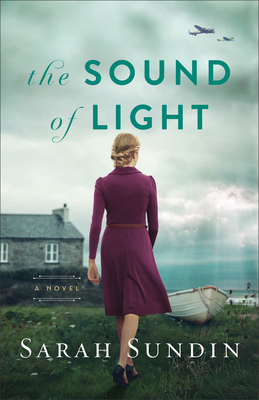
Through the fictional characters of Baron Henrik Ahlefeldt and Dr. Else Jensen, a physicist working in the lab of the famed Niels Bohr, Sarah Sudin tells the story of the German occupation of tiny Denmark. Initially, freedoms are not as restricted by the Nazis as in the rest of occupied Europe, but many Danes resist through sabotage, work slowdowns, and underground newspapers. Henrik assumes several identities and uses them to hide covert activities; he also uses his skills as an Olympic rower to transfer messages from Denmark to Britain. Else, while fighting her personal battles of discrimination as a female in a traditionally male field, becomes involved in helping the underground cause.
There are a lot of subplots and threads that are woven into this story. Henrik is working as a laborer in his estranged father’s shipyard. Henrik portrays himself as barely literate instead of the well-educated nobleman he is. He and Else live in the same boarding house but are unable to share their identities or secrets with each other because of the confidential nature of the underground. The final straw for the Danes is when the Germans begin to round up Jews for deportation. Many Danish citizens quickly rise up to protect their Jewish friends and neighbors. I will leave it to the author to share what happens to the Jews and to Henrik and Else as they grapple with the question of whether it is “right to do wrong (i.e. to break the law) to do right.”
I highly recommend The Sound of Light. I didn’t feel like I needed to be an expert on Danish history to appreciate the story. I did learn a lot about Denmark’s wartime experiences. The book is fast-paced, and there is good character development. It contains a good plot, scenes tense with intrigue, and a Christian viewpoint on good versus evil.
I received a complimentary copy of this book in exchange for an honest review. Opinions expressed in this review are completely my own.
Rating: 5/5
Category: Historical Fiction, Christian, Romance
Notes: Includes historical notes by the author, pronunciation guide and glossary, and discussion questions.
Publication: February 7, 2023—Revell
Memorable Lines:
Henrik, on the other hand, hadn’t endured Far’s anger. He’d absorbed it, every biting word. For fourteen years, he’d absorbed the anger, and it had fermented inside, loathsome and noxious, until at last, in one moment of clarity, he’d turned from his father and all he stood for.
She was one small individual in a sea of people. But if each person did just one thing to help, a lot of good could be done.
On the deck, the captain sprinkled powder, a mixture of dried blood and cocaine, developed by a Swedish scientist. If the Germans brought police dogs on board, the compound would deaden the dogs’ sense of smell so they couldn’t detect the passengers below.
The Guernsey Literary and Potato Peel Pie Society–comeback from World War II
The Guernsey Literary and Potato Peel Pie Society
by Mary Ann Shaffer and Annie Barrows
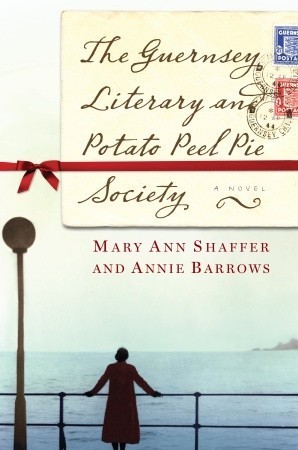
I approach epistolary fiction with a bit of trepidation. Can a story really be told effectively through a series of letters? In the case of the unusually named The Guernsey Literary and Potato Peel Pie Society, that is probably the best way to relate the events of the Nazi occupation of Guernsey and to present the characters and how the war affected them.
Juliet Ashton is a budding author with one successful book based on a column she wrote. Her publisher, Sidney, and his younger sister, Sophie, are friends of Juliet; their letters are part of the correspondence that moves the story along. The heart of this tale begins when a letter finds its way to Juliet in London from Guernsey where Dawsey Adams has bought a book by Charles Lamb with her name and address. Dawsey seeks more books by Lamb as well as information about him. Their correspondence leads to a discussion of the local book club which began during the Nazi Occupation.
Most of the book club characters are quite likable and work together because of, or in spite of, their idiosyncrasies and the hardships they have endured. They welcome the opportunity to share their stories with Juliet for potential publication. They are quite open to her personally as well. Juliet grows as a writer, her maternal instincts emerge, and she shows strength of character as she discovers what is important to her.
The Guernsey Literary and Potato Peel Pie Society is well-written with detailed settings and empathy for the characters. It is both a gentle and a strong book and gives a fair depiction of Nazi soldiers, most of whom suffer deprivation in Guernsey along with the locals. Some Nazis are depicted as brutal and a few as humane. Some citizens are supportive of each other and a few are treacherous. The accounts also included Todt slaves, brought in by the Germans. They suffer the most in this book. The Guernsey Literary and Potato Peel Pie Society has deservedly caused a lot of buzz among readers and has been made into a movie.
Rating: 5/5
Category: Historical Fiction
Publication: July 29, 2008—Dial Press
Memorable Lines:
I turned to a man sitting against a fence nearby and called out “We’re saved! It’s the British!” Then I saw he was dead. He had only missed it by minutes. I sat down in the mud and sobbed as though he’d been my best friend.
All those people I’ve come to know and even love a little, waiting to see—me. And I, without any paper to hide behind….I have become better at writing than living…On the page, I’m perfectly charming, but that’s just a trick I learned. It has nothing to do with me.
Dawsey was seeing to my bags and making sure that Kit didn’t fall off the pier and generally making himself useful. I began to see that this is what he does—and that everyone depends upon him to do it.
Souvenirs from Kyiv–devastation of war
Souvenirs from Kyiv
by Chrystyna Lucyk-Berger
I want to believe Chrystyna Lucyk-Berger’s stories in Souvenirs from Kyiv are more fiction than history, but I know that is not true. She has researched and conducted interviews with survivors of World War II and its aftermath. She has compiled their memories into composite stories that share brutal truths about war. Her goal Is to “make it clear that conflict is not about two teams meeting on the battlefield—one called ‘good’ and one called ‘bad.’ There are no winners in this story.”
These tales are emotionally hard to read; I put aside the book several times to regroup. Because the author is Ukrainian-American, I expected the book would be slanted towards the Ukrainians. While they are certainly the focus, they are not depicted as guiltless. The barbarism of war is demonstrated in acts performed by Germany, Poland, the USSR, Ukraine, and the United Nations. “Sides” were not clear cut and people had to quickly change their nationalism based on necessity for survival.
In Ukraine’s War of Independence (1917-1921), a chant was popular:
Glory to Ukraine.
Glory to the heroes!
Death to the enemies.
It was revived in the 1940’s as a partisan group struggled to “ ‘purify’ Ukraine of Jews, of Poles, of Nazis, of Soviets.” The Organization of Ukrainian Nationalists (OUN) was founded after WW I. It fractured into two groups, each fiercely loyal to its leader. They expended energy which would have been better used in fighting their common enemy. That is an easy position to take from my safe twenty-first century armchair.
The author creates believable, fictional characters. Through them she makes real:
–the desperation of those in labor camps
–the hard work required just to survive each day
–the quick adjusting of priorities for those fleeing
–the raw, animalistic violence that emerged during the fight for survival—whether to get a place in a bomb shelter or to grasp a stale piece of bread.
There are also shining lights:
–parents sacrificing for children
–the kindness of a German officer leading a refuge family to safety during a bombing
–everyday citizens risking their lives by sharing their homes and what little food had been left for them by ravaging soldiers.
These are all stories that need to be told, but the tale goes further. When the dust of battle settles, what happens to the survivors? To what country will they claim allegiance? Even those captured by an army and put in uniform or forced into slave labor, can be blacklisted as traitors in their home country. There is the unimaginable prospect of labor camps once more. If these threats are not realized, the survivors still have to overcome physical and mental hurdles of reintegrating into a society, perhaps not the one of their birth. During and after the war, Ukraine Diaspora occurred in the U.S. and in Europe.
Although this book is historical fiction, I learned a lot about the strife between Ukraine and its neighbors. Conflict is not new in that area. The author made history come alive with characters caught up in a war not of their making. It is important to read the forward. The first story slowly immersed me into the time period. Then the rest of the book sped by quickly. This author has written other books, and I am interested in reading them as well. Although Souvenirs from Kyiv is about Ukraine, its theme, the devastation of war, has worldwide applications.
I would like to extend my thanks to NetGalley and to Bookouture for giving me the opportunity to read this book in exchange for an honest review.
Rating: 5/5
Category: Historical Fiction, General Fiction (Adult)
Notes: 1. A map of Ukraine is included.
2. The book ends with a letter from the author and also a valuable glossary. Some foreign language words are defined within the story, but the glossary is helpful for the other terms.
Publication: April 22, 2022—Bookouture
Memorable Lines:
I think of the Germans picking up and fleeing, the Red Army laying claim to the scorched land, and I know that one oppressor is no better than the next.
[Pretend death notification letter composed by an enlisted Ukrainian forced into the German army.] As we waited for our weapons to thaw, your son took a bullet. He did not die a hero. He did not kill many Red Army troops. He was shot, and others have died of TB, frozen to death, or have simply lost hope. You may stop sending blankets. They go to the officers, anyway. You could send clubs and knives, for we have been forced to turn into primitive cavemen. Our weapons are useless in this frozen land.
…if he has learned anything on this journey, it is this: he will give up everything—including his principles, including his painting, his life—to keep his family alive.
 education pathways