Home » Posts tagged 'garden'
Tag Archives: garden
The Secret Garden–delightful classic
The Secret Garden
by Frances Hodgson Burnett
Illustrated by Tasha Tudor
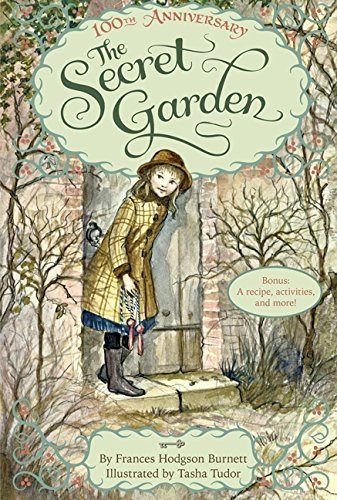
An avid reader as a child, I am surprised that I somehow missed out on the classic children’s tale The Secret Garden written by Frances Hodgson Burnett. For this reading with my book club, I chose an edition with delightful illustrations added to this 1911 book by Tasha Tudor in 1962. The Secret Garden is recommended by the publisher for ages nine and up, but I strongly recommend it for all readers. Please don’t relegate it to the “kiddie lit” genre.
The Secret Garden is the kind of book that instructs the reader in positivity without being preachy. Ten year old Mistress Mary (as in “quite contrary”) is a child who is both spoiled and neglected in her upbringing in India where she does not experience love. Things are not much better for her when her parents die, and she is shipped to Yorkshire to be under the care of her uncle. There she is still not loved as her uncle, Mr. Craven, has not dealt well with the death of his wife ten years prior and the illness of his son Colin who is physically cared for but also is not loved.
When Mary discovers that the mysterious crier in the night is Colin, she gradually creates a bond with her cousin. She is a curious girl who is given little freedom in the house, but almost total freedom in the gardens. She discovers the benefits of fresh air, sunshine, and natural exercise, and she explores the grounds looking for a secret garden that has been hidden away since Colin’s mother died.
Mary and Colin meet so many interesting people during the spring and summer. Dickon is a twelve year old who can converse with animals and plants. His older sister Martha is a sweet young lady who works at Misselthwaite Manor as a housemaid and helps take care of Mary. She has one day a month off, and she travels home by foot to help her kindly mother with laundry and baking. She gladly gives her mother her earnings to help support her large family of twelve happy siblings. Ben Weatherstaff is an elderly gardener who knew Colin’s mother and is eager to help restore the secret garden. While this tale is not full of goody two-shoes, it does have characters the reader will enjoy getting to know and in the cases of Mary and Colin watching their physical and emotional growth.
The Secret Garden is a pleasant read that begins with difficulties for the characters but progresses to a magical time in their lives. The author’s descriptions are wonderful to read as spring approaches in the garden. It is a book I would reread for the pleasure of the story and the language of the author.
Rating: 5/5
Category: Children, Fiction, Classics
Publication: 1911—Harper Collins
Memorable Lines:
The rainstorm had ended and the gray mist and clouds had been swept away in the night by the wind. The wind itself had ceased and a brilliant, deep blue sky arched high over the moorland. Never, never had Mary dreamed of a sky so blue. In India skies were hot and blazing; this was of a deep cool blue which almost seemed to sparkle like the waters of some lovely bottomless lake, and here and there, high, high in the arched blueness floated small clouds of snow-white fleece. The far-reaching world of the moor itself looked softly blue instead of gloomy purple-black or awful dreary gray.
“Half-witted!” said Colin angrily. “Who thought that?” “Lots o’ fools,” said Ben. “Th’ world’s full o’ jackasses brayin’ an’ they never bray nowt but lies.”
He had made himself believe that he was going to get well, which was really more than half the battle, if he had been aware of it.
The Enchanted April–looking for happiness
The Enchanted April
by Elizabeth Von Arnim

In an exceptionally rainy and dreary March in England, four strangers decide to get away by sharing the rent on a medieval castle in sunny Italy for the month of April. Lotty Wilkins, who can “see” or visualize people at their best and happiest initiates the effort, recruiting Rose Arbuthnot. Both in their early thirties, they do not have happy marriages. Lady Caroline is a little younger and extremely attractive, but is tired of the superficial cloying of people bewitched by her good looks. The very authoritative Mrs. Fisher in her sixties is still wearing mourning blacks years after her husband’s death and focuses her thoughts and conversations on childhood memories of encounters with famous people, particularly authors. This fictional account relies strongly on character development as these ladies’ situations are examined and they react to each other and to their temporary environment for the month. As I reread the many lines I had highlighted, I found that the writing is indeed exquisite.
The Enchanted April is the kind of book that holds beauty and introspection and gently insists that readers immerse themselves in the deliciousness of a sunny month of flowering plants and enticing foods. There are humorous situations thrown in as Lotty and Rose speak no Italian and the other two ladies don’t want to undertake the bother of dealing with the servants or managing the finances. There are also some surprising plot twists at the end of the tale. If you join the ladies in their Italian castle, your only regret will be saying “Arrivederci” at the end of the stay.
Rating: 5/5
Category: Fiction
Notes: Originally published in 1922.
Publication: July 19, 2005—Project Gutenberg
Memorable Lines:
She wanted to be alone, but not lonely. That was very different; that was something that ached and hurt dreadfully right inside one. It was what one dreaded most…Was it possible that loneliness had nothing to do with circumstances, but only with the way one met them?
“Oh, but in a bitter wind to have nothing on and know there never will be anything on and you going to get colder and colder till at last you die of it—that’s what it was like, living with somebody who didn’t love one.”
In heaven nobody minded any of those done-with things, one didn’t even trouble to forgive and forget, one was much too happy.
Death and Daisies–magic and murder in Scotland
Death and Daisies
by Amanda Flower
 Fiona, who has inherited a home in Scotland, a magic garden, and most importantly the position of Keeper of the Garden from her godfather, Ian, is joined in the book by her much younger, at-loose-ends sister Isla. Fiona is opening her flower shop named the Climbing Rose Flower Shop after the 300 year old rose growing in her magic garden in Duncreigan. Some townspeople are welcoming and friendly like Raj and Pasha, twins in their sixties with calming and wise ways. Others view the sisters with suspicion for their strange Tennessee accents and ways and their association with the magic garden. The local minister is so opposed to Fiona that he publicly bans her from the church.
Death and Daisies by Amanda Flower centers around a murder, threatening notes, an abusive spouse, and drugs. Fiona is compulsive about investigating despite a scary vision that might potentially foretell her death and the warnings of Chief Inspector Neil Craig who is afraid she will be hurt.
Death and Daisies is a fun and fascinating cozy mystery you will not want to put down. Filled with interesting characters and lots of twists and turns in the plot, this tale has room for character development and an interesting setting. The murderer and the reason for the murder surprised me. The author has another surprise for Fiona and the reader toward the end of the book on a very personal level. There is closure to this book, but also several issues that deserve further attention. I can’t wait for the next book in the series.
I would like to extend my thanks to netgalley.com and to Crooked Lane Books for giving me the opportunity to read this book in exchange for an honest review.
Rating: 5/5
Category: Mystery
Notes: #2 in the Magic Garden Mystery Series but works well as a standalone
Publication: November 23, 2018—Crooked Lane Books
Memorable Lines:
“St. Thomas Church, as it stands today, is much younger. It was built in the seventeenth century.” She said this like the seventeenth century was last week. If anything was over one hundred years old back in Nashville, they turned it into a museum and built a fence around it. In Scotland, “old” had quite a different definition than I was accustomed to.
I didn’t want to break it to her, but no one had their life figured out at twenty-two. I didn’t have it figured out at thirty, and I wasn’t expecting fifty to be much better.
“But no one should make an apology expecting one in return. That ruins it for both parties. It is better to say you are sorry and be at peace.”
 education pathways