
Home » Posts tagged 'France'
Tag Archives: France
The Forgotten Names—forever a timely reminder
The Forgotten Names
by Mario Escobar
translated by Gretchen Abernathy
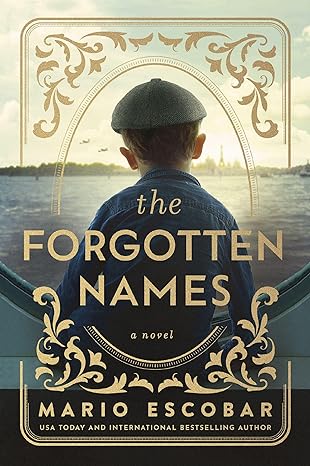
Many historical novels focus on one particular character and develop a story around that character. If it is a dual timeline, then the focus is on one character in each timeline. Escobar’s The Forgotten Names does, in the current timeline, focus on a nonfictional French historian and law student, Valérie Portheret. She spent 25 years identifying at least 90 of the 108 children whose identities were deliberately and necessarily abandoned in the rescue attempt from the Vénissieux internment camp near Lyon. Had their brave parents not signed release forms giving up their parental rights, the children would certainly have been killed by the Nazis who issued mandates for the number of Jews to be “processed.” The Vichy government was theoretically in control of France, but the reality was that they answered to the Nazis who disregarded both the legalities and moralities of the French.
A diverse coalition of Catholics, Protestants, and Jews, including social workers and Resistance organizations, found a loophole in the law. Orphaned minors could obtain an exemption from the roundup that sent the occupants of Vénissieux to their deaths. Escobar tells of the harrowing days and nights spent getting parents to agree, separating the children from their parents, arranging for new homes, transporting them to Lyon, and keeping them until the new parents arrived. All very secretive and all very dangerous for everyone involved in any way.
Escobar is a historian, but he also knows how to tell a story. The chapters are short, encouraging the reader to jump from the end of one into the beginning of the next chapter. The escape story of 1942 is framed by the research story which begins in 1992 when it was still difficult to find a sympathetic advisor. Sadly, the research was hampered by continuing anti-Semitism, rising fascism, and a reluctance to open up wounds of the past. Portheret persisted in locating the children for twenty-five years. The novel is personalized with the backgrounds and experiences of various children and families as imagined by Escobar. In this way, a sad part of history is brought to life with the goal of societies not repeating the horrific tragedies so many suffered through. Portheret originally planned her thesis to examine the life of the infamous Klaus Barbie, known as “the Butcher of Lyon.” As she began her work, however, she found herself drawn to the plan to “exterminate innocent children” and preferred to focus on the victims rather than the barbaric individuals who perpetrated the crimes.
There are so many books about World War II and the Nazis, but this is a new take on the crimes committed in that war. As hard as it is to read about the suffering of innocents whose only crime is to be Jewish, I am glad I read this book. Some of the Christian characters connect various events to Christian theology such as the birth of Jesus who was a Jew, God given Christian/human morality “which imposes duties and recognizes rights,” and the “demands of charity [love] made by Christ to be the distinctive mark of his disciples.” Above all is the emphasis that the human heart rebels against the cruel and painful measures enacted on Jews and certain groups of foreigners.
I received a complimentary copy of this book in exchange for an honest review. Opinions expressed in this review are completely my own.
Rating: 5/5
Category: Historical Fiction, Multicultural
Notes: The book contains references and something I always look for in historical fiction—a discussion of what is real and what is fictional. What follows is a World War II timeline beginning with the invasion of Poland by Germany in 1939 and continuing through the surrender of Nazi Germany to the Allies in 1945. The book concludes with Discussion Questions, information about the author who is Spanish and the translator.
Publication: June 11, 2024—Harper Muse
Memorable Lines:
“Have you noticed how the executioners often end up as celebrities? There are books and books about them. But so few write about their victims. The victims are mere numbers, faceless statistics, figures on the yellowed pages of history.”
The land of Mozart, Goethe, and Immanuel Kant had become a nation of barbarians, of heartless warriors whose driving desire was to control the human race and conquer the world.
“But now everybody—at least in the West—knows that it’s wrong to sacrifice humans. Maybe war will teach us a lesson we can’t learn any other way: the lesson that killing one another for our ideas, beliefs, or flags is absurd, because we all belong to the only human race there is, and we’re all brothers and sister of one another.”
The Golden Gals’ French Adventure–senior ladies having fun
The Golden Gals’ French Adventure
by Judy Leigh

Not as funny as I had thought it would be based on the one other book I had read by Judy Leigh, The Golden Gals’ French Adventure, is nevertheless an interesting story. It is the tale of Fliss and Shirl, two friends from North Clayworthy, England, who travel to Brittany on vacation. Fliss is retired, entitled, and rich. Shirl is down to earth and a good friend to Fliss who hires her as a chauffeur and cleaner. When Fliss decides to visit an old friend at his family home, she recruits Shirl to go with her. They take along Shirl’s granddaughter Macey Roux who is a delightful baby—except when she is teething. She captivates all on the trip, even Fliss who has never had anything to do with babies.
The Golden Gals’ French Adventure is character driven. The reader meets a variety of people, most of whom are likable. A few start out less so, but then there is character development. The adventures include the beach, historic sights, learning French, a cooking competition with a chef, delicious French food, Breton customs, a castle, and of course some romance. The welcoming Barron family is delighted to have guests. A subplot is that Macey Roux’s mother, Gemma, is in Corfu with a boyfriend who doesn’t know of the baby’s existence. How will the characters respond when the Corfu and Brittany holidays end? Will it be hard to give up the vacation fun or will they be ready to return to their lives in North Clayworthy with the thought of “there’s no place like home?”
I received a complimentary copy of this book in exchange for an honest review. Opinions expressed in this review are completely my own.
Rating: 4/5
Category: Fiction, Romance, Women’s Fiction
Notes: Some swearing. No open bedroom doors.
Publication: June 4, 2024—Boldwood Books
Memorable Lines:
It occurred to her that she’d always been too busy. She’d never stopped to notice the beauty in nature; she’d been far too busy chasing things she’d believed were desirable. She realised now that they weren’t.
Maurice’s house was perfect for him. It held memories that made it wonderful, just as it was. And it was a home, unlike her own sterile house, a place where she simply kept her things.
…her feelings for the Barrons were completely fraternal which was much better than a roll between the sheets. It lasted longer; it was worth more. It was honest respectful, and it was a form of love she’d seldom encountered.
The Start of Something Wonderful–Lake District of north west England
The Start of Something Wonderful
by Jessica Redland
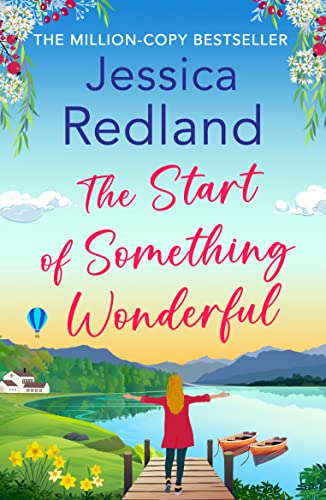
Sometimes people have to go through some hard times before they are ready to make changes in their lives. At some point they also begin to appreciate what they already have. Such is the case for Dane whose divorce is pending and for Autumn who loses her job as a greeting card illustrator while she is grieving for her grandfather and coming to grips with a past failed romance.
The Start of Something Wonderful is about Dane and Autumn as they literally bump into each other. In the process of their meeting, we learn so much about their pasts and their hopes and dreams. They do not start out looking for romance, but in their efforts to begin again with their lives, they discover a friendship and a kinship that draws them close together.
The setting is one the author is quite familiar with—Derwent Water in the Lake District National Park in north west England near Keswick. The beauty of the area and the feel of community in the small towns nearby are inspiring to Autumn as are her visits to Hill Top Farm and the legacy of her personal heroine, Beatrix Potter. She wants to take her inspiration from Potter and the area without copying her.
Rosie is an important character in that she was Autumn’s penpal from age eleven. Neither had a lot of friends in school and family needs kept each close to home. Thus they became confidants through the rest of their lives. When Autumn goes to meet and visit Rosie for a fortnight in the Lake District where Rosie manages a stable and teaches riding skills, a new stage of life begins for both women.
The main characters are quite likable along with several others who contribute to the plot. There are also a few who are despicable, especially Autumn’s ex-boyfriend. The romance is gentle and slow and suited to the story and the needs of the characters. Several events were quite touching, and I enjoyed the whole book. Redland is a good writer. I have enjoyed everything I have read by her, and I am excited for this new series.
I received a complimentary copy of this book in exchange for an honest review. Opinions expressed in this review are completely my own.
Rating: 5/5
Category: Fiction, Romance
Notes: #1 in Escape to the Lakes
Publication: July 17, 2023—Boldwood Books
Memorable Lines:
“You really think certain people are meant to be in your life?” “Of course! I think they appear when you need them and we’re the living proof of that.”
We really were kindred spirits, neither one us willing to travel far from home because we had a loved one to look out for, and neither of us having a friend who we could pour our hearts out to in person. It was no wonder we’d become so close as penpals. There’d been nobody else to turn to.
It was my grandparents’ home and I needed my own space. It was full of memories, but selling it wouldn’t take them away. They were in my heart and my head and would remain with me wherever life took me. I didn’t need to own their house to remember them.
The Swiss Nurse–refugees from war
The Swiss Nurse
by Mario Escobar

I am so glad that I had read other books by Mario Escobar, because this work of historical fiction started off roughly for me. I feel sure the fault was my own. I am shamefully unfamiliar with the Spanish Civil War, and I started the book too late in the evening. I persevered the next day, however, and was quickly immersed in a tale of evil hearts and the strength of some good people who worked to help others in dire circumstances.
When Franco and his troops were successful in this war, they were determined to obliterate the Republicans fighting for their freedom and anyone associated with them. The result was a massive exodus of refugees into southern France which was not prepared for the influx and did not welcome them with open arms. The “camps” they provided were sandy beaches with no structures. There was little food and no potable water; the refugees were not allowed outside the camp.
This book is about the refugees in that war which was followed up by the events of World War II and the further torment of innocents by the French Vichy government which was a puppet government of the Nazis, and then by the Nazis themselves. Much of the story describes the horrible conditions of the refugee camps and the strength and boldness of Elisabeth Eidenbenz, a Swiss woman whose focus was orphans in Spain until she was forced relocate to southern France where she opened a hospital taking in pregnant women and giving them a safe place to deliver their babies. The other main character is Isabel, a Spanish lady who married Peter, an American who fought with the Spanish for their liberation. Their lives intersect when Isabel gives birth to her precious daughter Lisa at the Elne Maternity Hospital. With Peter held in various prisons and concentration camps and conscripted into the army for manual labor, Isabel stays to help in the maternity hospital.
The author pulls the reader into the horrible conditions and the faith and courage of characters who stand up for what is right. As a reader, you want everything to turn out great for the sympathetic characters. This is, however, a work of historical fiction, so not everyone has a happy ending. It is important to read works like this so that we are not duped yet again by politicians who promise good things and deliver nothing, creating untenable situations. History like this must not be allowed to repeat itself.
I received a complimentary copy of this book in exchange for an honest review. Opinions expressed in this review are completely my own.
Rating: 5/5
Category: Historical Fiction, Multicultural, Fiction
Notes: Additional material includes: References, Clarifications from History, Timeline, Discussion Questions, and Information about the Author and the Translator
Publication: April 14, 2023—Harper Muse
Memorable Lines:
Gazing off into the distance, their gaunt faces reflected the weary sadness of their souls. Their cheeks were sunken with hunger, and their skin was pallid from exhaustion and malnourishment.
An entire generation had been killed for naught: anonymous heroes on both sides, idealists attracted by the siren songs of their leaders who stayed safe in the rear guard. The only hope was to erase those painful years from their lives and try to start over from scratch.
Argelès-sur-Mer had been both refuge and jail. It had stamped out of us the hope of recovering our lives one day. We were now flea-infested riffraff with bones aching from damp nights spent on hard sand with thin blankets. The starry sky had been our prison roof.
“Sometimes we have to feel our way in the dark in order to find the path, but beyond the fog the sky is still blue, and the sun is still shining.”
The Rose and the Thistle–laird of the manor
The Rose and the Thistle
by Laura Frantz
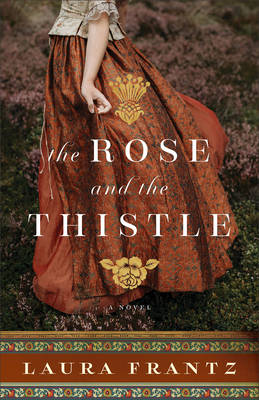
How many times have there been royal overthrows in England and other parts of the British Isles? More than I can keep straight. Therefore, the first part of The Rose and the Thistle was a little confusing to me as I took the author’s brief historical note and tried to integrate the facts into the story she told. The historical backdrop is the Rising or rebellion in 1715 when the Jacobites, supporters of the now exiled Stuart dynasty, tried to reclaim the throne from the German George I. Add in to that strife a generous serving of discord of a religious nature (Catholic Scots vs. Protestant English), and you have quite a mess.
Lady Blythe Hedley of Northumbria has been living in the French courts during some of this conflict. When events turn more dangerous, her father, the Duke of Northumbria, sends her to take refuge at her godfather’s house. He is the laird of Wedderburn Castle and father of many sons. The Hedleys are Jacobites so Lady Blythe’s presence must be kept secret to protect her and them.
Marriage is a critical issue for women to ensure their safety and position in society and to men to safeguard their family wealth, maintaining it and hopefully increasing it. Thus, courting, relationships, and marriage are critical social, political, and financial concerns.
A few chapters into the book, I began really enjoying the characters and plot. My lack of familiarity with the political intrigue worked itself out as the historical context found its place as a backdrop to several romances in the novel. The protagonists are Lady Blythe, a Countess; and Everard, Lord Fast, who inherits all of his father’s assets on becoming the Earl of Wedderburn. There are many reasons for the pair to have conflicts and watching how they are resolved is fascinating. They are both characters of faith who find more commonalities than differences in their faiths.
Orin is a favorite character, an eight year old who is much loved by his family but has grown up motherless. He is very intelligent and yet whimsical. Once Lady Blythe is given the freedom to roam the castle and grounds, she and Orin take to each other immediately. Blythe and Everard’s mutual love for Orin is a factor in their growing admiration for each other.
The plot is full of romance and social jousting. Royal court and military politics play an important role. The book also includes servants in the household, positions taken by women who find themselves unmarried and without any family wealth, and the tenants who work the estate’s coal mines.
Hawking, horseback riding, inns, and traveling in the early 1700’s are part of the story as is imprisonment in the tower, owning family jewels, and having staffed, but little used, residences scattered around the country. I enjoyed The Rose and the Thistle and recommend it for those who like clean historical fiction.
I received a complimentary copy of this book in exchange for an honest review. Opinions expressed in this review are completely my own.
Rating: 4/5
Category: Historical Fiction, Romance, Christian, Religion,
Notes: 1. A clean historical fiction; a romance that is a standalone.
2. Includes a Glossary of Scottish words.
Publication: January 3, 2023—Revell
Memorable Lines:
“What news have you of the king o’er the water?” Everard could not keep his mockery at bay. “That the French court is in a chaos similar to that in Genesis before the creation of the world.”
Nay, when all was said and done, Blythe would never forget the way the new laird tenderly bent down and lifted his little brother, whose tears streaked his pale face, into his strong arms and carried him all the way home.
She waved her fan about again with practiced ease. Women and fans were not unlike men with swords, he decided. Hers seemed a blatant tool for coquetry.
Madame Fourcade’s Secret War: The Daring Young Woman Who Led France’s Largest Spy Network against Hitler
Madame Fourcade’s Secret War
by Lynne Olson

Until I read Madame Fourcade’s Secret War, my idea of the French resistance in WWII was that it was composed of small, scattered groups of French who wanted no part of the German Nazis and fled to the forests to live in secrecy and give the Germans grief. This biography of Madame Fourcade is about her life, but also relates the amazing story of Alliance, an intricate spy network that collaborated with the British in obtaining information about German troop and ship movements that was critical to the eventual success of the Allies.
The work the resistance did was extremely dangerous from the undercover agents and their support crews to couriers and radio operators. Everyone was constantly under threat and generally on the move to avoid capture, imprisonment, torture, and execution. Yet these many brave individuals and the people who helped transport and conceal them performed their tasks voluntarily and with courage. They came from all walks of life knowing they were committing to the ultimate sacrifice in many cases.
It was amazing to read of the various situations they were involved in and the escape attempts. Fourcade, as the leader of this network, changed her identity and transferred her headquarters frequently, leaving her children in the care of others. The book makes clear how unusual and difficult it was in that time period for a woman to have a role of authority over men. She was a natural leader, however, and that quality was soon recognized by those who reported to her.
This work of nonfiction displays author Lynne Olson’s extensive research, but it reads like a novel. The reader wants to keep going to subsequent chapters to discover what happens next to the members of Alliance. There are many surprises, both good and bad.
The roles of the various countries and their agreements were at times quite infuriating. France was divided up into a northern part taken over by Germany and a southern part which became a puppet regime for Germany with their operatives everywhere. Even in exile in Britain there were two competing sides with French leaders—de Gaulle and the Free French vs. Giraud, a general the British were using to win over French forces in North Africa. There were even political pushes for dominance by the various resistance networks. Fourcade did her best to keep Alliance out of all the different political drives.
In each of the many historical fiction books popular right now, readers can learn something interesting and new about various groups in WWII. I recommend reading Madame Fourcade’s Secret War. As nonfiction, it is a slower and more difficult read, but it is well worth the effort to understand the French resistance movement and so much more about the events and major figures of WWII.
Rating: 5/5
Category: Nonfiction, Biography
Notes: 1. This would make a good selection for book clubs who want to read a work of nonfiction.
2. There are pictures of many of the agents.
3. Helpful sections of the book include Selected Cast of Characters, Author’s Note (about Fourcade’s name), Notes, Bibliography, and Index.
Publication: 2019—Random House
Memorable Lines:
Lynen, who had recently agreed to take part in a theatrical tour across France, said he would transport the transmitters and secret documents from one city to another in his costume trunk. He told Fourcade that his celebrity would be an advantage rather than a negative: No one would ever believe that the famous “Carrot Top” was a spy. It would be, he said with a grin, his finest role.
A few days before, she had gone to confession and told the priest about the poison she was taking with her and her concerns about being damned in the eyes of the church if she used it to kill herself. She hoped she would have the courage to resist torture, but she worried that she might not be able to do so and might, in the end, inform on her colleagues. The priest allayed her fears, saying her death would not be a suicide but rather a necessary means of resisting the enemy. He gave her absolution in advance.
Although they were from varied walks of life and political backgrounds, a moral common denominator overrode all their differences; a refusal to be silenced and an iron determination to fight against the destruction of freedom and human dignity. In doing so, they, along with other members of the resistance, saved the soul and honor of France.
A Certain Darkness–could WWI have ended sooner?
A Certain Darkness
by Anna Lee Huber
Lord Ardmore—a good name for an evil person. Although he is not physically present in A Certain Darkness, his influence and machinations pervade the events of this spy novel. Verity Kent and her husband Sidney are a rich and glamorous couple who are both well known in the intelligence circle for undercover work for the British during WWI. Sidney is also a war hero. In this book, they are once more called into service by their country to discover potentially damaging evidence.
In this action packed drama, Verity and Sidney don’t know whom to trust as they try to uncover how a murder occurred on a train and in a jail cell without anyone seeing either crime. Verity is a polyglot, a helpful skill as the couple interacts with French, German, Dutch, and Flemish speakers. One of my favorite scenes involves Verity speaking in their language to someone who is previously unaware that she can understand their conversations with others—rather embarrassing for the speaker.
The plot is complicated because the events that occurred during and after the war are quite complex. Just when I thought I wasn’t enjoying the book because of the intricate historical references, the action and intrigue picked up and I couldn’t wait to read what would happen next.
Both characters suffer from the horrors and stresses of the war, but there are some mental and emotional breakthroughs for both of them in this book. Whereas in the first book I read in the series (#2) I found the couple rather frivolous, I have come to like and respect both of them as I have gotten to know them better. There has also been more character development with each book. If you are interested in history or like spy mysteries, you will enjoy this series including A Certain Darkness. It closes out with a very important hook that will keep me and other readers anxious to read the next book in the series.
I received a complimentary copy of this book in exchange for an honest review. Opinions expressed in this review are completely my own.
Rating: 4/5
Category: Mystery, Historical Fiction
Notes: 1. #6 in the Verity Kent Mystery Series. I do not recommend this book as a standalone. There is just too much necessary background provided in the previous books.
2. Clean.
3. One of the themes of this book concerns the ending of WWI. I did an Internet search on this topic and found this is a concern for some historians. In her introduction, Huber lists a recently published nonfiction book on this subject that she used as a resource for her fiction book.
Publication: August 30, 2022—Kensington
Memorable Lines:
Much of intelligence gathering in general was accepting that there were few total victories, few clear choices of right and wrong. Everything was shaded in gray. One had to make judgment calls, constantly wagering possible sacrifices versus gains. Sometimes you got it right and sometimes you got it wrong. But whatever the outcome, you had to swallow the guilt and disgust such decisions and compromises at times wrought.
I recognized what game he was playing, for he’d learned it from the best. After all, Lord Ardmore didn’t simply aim to outwit his opponents, but to corrupt and demoralize them. To turn them against themselves, against their very morals.
“I’d accepted long ago that the war was utterly senseless.” His voice rasped as if being dragged from the depths of his lungs. “That I was simply stuck. Just a little cog in a great monstrous machine that couldn’t be stopped and would one day consume me as well.”
Suspects–dangerous corruption
Suspects
by Danielle Steel

If you want an entertaining romance mixed with some mystery and spies, Suspects is a good choice. It reads quickly and has sympathetic main characters. Theo is a successful business woman in the fashion industry. She is married to an older, extremely wealthy man. They have a relatively happy marriage with one child. Everything changes instantly as Theo’s husband and son are kidnapped, probably by an angry Russian over a business deal that went sour.
Mike is a career CIA agent, promoted up the ladder but still very hands-on. He is married to his job. His path crosses with Theo’’s as he follows up on Pierre de Vaumont, a slimy character who makes his money by matching rich and shady individuals with corrupt individuals who can fulfill their needs. Mike knows about the kidnapping and is immediately drawn to Theo and wants to keep her safe.
Most of the book deals with efforts to find the kidnappers and keep Theo safe. In the process a mostly long distance romance, New York to Paris, develops between Theo and Mike.
I received a complimentary copy of this book in exchange for an honest review. Opinions expressed in this review are completely my own.
Rating: 4/5
Category: Women’s Fiction
Notes: There is steam in this romance as the couple enjoys a “lovefest of tenderness and passion” whenever they are together. Their sexual encounters are closed door, but that part of the story becomes repetitive and does not move the plot forwards.
Publication: June 28, 2022—Delacorte Press (Penguin Random House)
Memorable Lines:
He could feel his good resolutions sliding away, like Jello-O down the drain.
The windows were all tightly closed so tear gas wouldn’t enter the apartment, and they heard the first cannons go off, shooting tear gas into the crowd. Mike was shocked at what was happening, it looked like a war zone in the most civilized city in the world.
“You’re not a normal person. You’re an exceptional, remarkable one that people are jealous of, which makes you a target. And there are dangerous people in the world.”
Aria’s Travelling Book Shop–trauma of grief
Aria’s Travelling Book Shop
by Rebecca Raisin
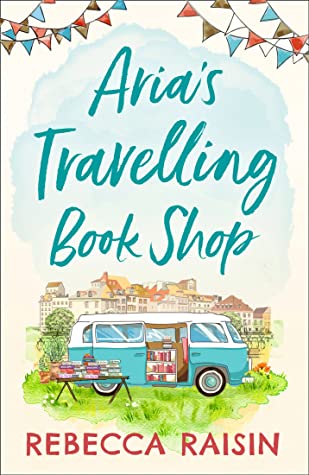
This second adventure of the Van Lifers features Aria, Rosie and Max who are the main characters in Aria’s Travelling Book Shop. We follow them to France for the summer where they meet up with new and old friends as is the way with these nomadic souls who travel from festival to festival earning their way as they go by holding pop-up specialty shops.
This story is told from Aria’s point of view. She lost the love of her life to cancer three years ago and is still struggling with grief, guilt, and an inability to move forward in her life. Her friend Rosie is always there to support her, but Rosie has a life surprise that complicates her ever-meticulous plans. Aria tries to re-establish a relationship with her husband’s family who estranged themselves from her after TJ’s death. She receives a journal written by TJ during his last months that reveal his hopes for her future. Jonathan is a successful writer who wants to be friends with the romance book loving Aria.
An interesting technique the author uses is to have Aria step outside herself, as if she were an onlooker announcing the events. For example, in italics we read “Hopeless romantic Aria vowed never to love again after loving her husband, TJ, but fate seems to have other ideas and keeps throwing mysterious Jonathan in her path. Is this a test of her commitment…” Using this approach, we get an up close view of Aria’s working through her issues in an almost humorous way.
In addition to personal matters, Rosie and Aria are confronted with a negative and unhappy “friend” who invites herself along. She is not a nice person, but Rosie and Aria try to understand and help her. Look for a surprise transformation for that character, and enjoy the very bookish nature of this novel.
I would like to extend my thanks to Edelweiss and to HarperCollins for giving me the opportunity to read this book in exchange for an honest review.
Rating: 5/5
Category: Romance, General Fiction (Adult)
Notes: #2 in The Travelling Shops series, but can be read as a standalone.
Publication: August 10, 2021—Harper Collins
Memorable Lines:
Promises that won’t be kept swirl in the air above like the glittery trail of a sparkler extinguished before the word is written. I smile sadly, wishing things didn’t have to end but knowing that they do.
“According to my translation app you just told him: You’re a wet chicken!” She bites down on her lip before laughter gets the better of her.
I duly sit and wait for Rosie as she hurries to make tea and serves me a slice of cake so large it has its own postcode.
Mrs. ‘Arris Goes to Paris–charming
Mrs. ‘Arris Goes to Paris
by Paul Gallico

A delightful work of fiction set in London and in Paris tells the tale of Ada Harris, a hard working char woman who sets her sights on owning a Christian Dior dress. She doesn’t want to wear it, just to own and look at something so beautiful as one would admire a work of art. How indeed would an honest widow, who is already living with few indulgences, manage to accumulate enough money for a designer dress?
Paul Gallico in Mrs. ‘Arris Goes to Paris takes us on the journey with Mrs. ‘Arris as she struggles with the money issues that crop up all through the book as there are many aspects of a trip to Paris that the poor lady who is clearly not a seasoned traveller could not anticipate. You will quickly come to love Mrs. ‘Arris as everyone does who meets her. She is so genuine and determined and never wishes anyone ill.
Paul Gallico makes his character come to life from her wrinkled face and the twinkle in her eye to her accent (e.g. “lydy” for “lady”), dropping her “h’s,” and her word choices like “lumme” and “blime.” Her interactions with other characters are key to the story. They have aspirations of their own, and Mrs. ‘Arris is not shy about helping others including Natasha, Dior’s top model, and M. Fauvel, a quiet accountant at the fashion house. She breaks down English/French and class barriers with her inviting charm and practical approach to problems.
This little book brought smiles to my face, and I got teary eyed a few times as I found Mrs. ‘Arris had stolen my heart. The author’s writing style is perfect for this book, moving along quickly with descriptions that can put the reader in a messy bachelor’s flat or on the thick gray carpets of Dior’s. It is a charming novel that has held up well across the years, and that I will no doubt reread just for pleasure in the near future.
Rating: 5/5
Category: Fiction
Notes: Blogger friend Christopher recommended this book in a “throw back” post. His review was so convincing that I bought it immediately. It’s over a year later, but I finally read it and am so happy I did. Thanks, Christopher! You can find his review here: https://pluckedfromthestacks.wordpress.com/2019/06/24/mrs-arris-goes-to-paris/.
Publication: 1958—Doubleday & Co.
Memorable Lines:
And yet with some chars there was more to it than just that, and particularly with Mrs. Harris—a kind of perpetual house-proudness. And it was a creative effort as well, something in which a person might take pride and satisfaction. She came to these rooms to find them pigsties, she left them neat, clean, sparkling and sweet-smelling.
She had an exquisite figure and clever tiny feet that never once had tripped upon the corpses she had climbed over on her way up the ladder of success.
Mrs. Harris simply felt that if one owned a dress so beautiful that it cost four hundred fifty pounds there was then nothing left upon earth to be desired.
 education pathways