Home » Posts tagged 'floods'
Tag Archives: floods
Where Lilacs Still Bloom–a talent with plants
Where Lilacs Still Bloom
by Jane Kirkpatrick
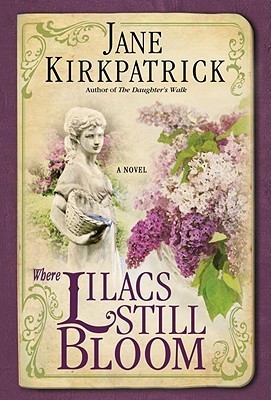
Hulda Klager was a hardworking German immigrant with an eighth grade education and a burning desire to implement changes in plants. She started with wanting a crisper, easier to peel apple for her apple pies. Her father had inspired her to follow her dreams, so while taking care of a large family and garden, she began exploring plant hybridization. She was successful and expanded her efforts to other plants. Her passion was lilacs, and her goal was to develop a creamy white lilac with 12 petals. In the process she developed over 250 varieties of lilacs. Her husband supported her interest in growing hybrids even in the face of those who initially condemned her for wanting to change nature as God had created it or for overstepping bounds as a housewife.
Although Kirkpatrick did a thorough job of researching the life of Hulda Klager, she had to rely on second hand sources. Despite Kirkpatrick being a very talented writer, Hulda Klager did not emerge from the pages as someone the reader could identify with. She was strong, persistent, and resilient but not portrayed as personable. Based on the number of people that committed to helping her with her lilacs throughout her life, however, she must have been an admirable and likable woman. In her almost 97 years, she influenced a lot of people and gave away many of her lilac starts. When the house and gardens were in disrepair and the famous Lilacs Days at the house had gone by the wayside, dedicated volunteers restored it all using contributions of Klager starts donated from gardens all over the country.
Where Lilacs Still Bloom is not a page turner in the traditional sense, but it did hold my interest as I watched Hulda Klager overcome many personal tragedies and fight against the flood waters time and time again that threatened her family, her garden and farm, and her huge collection of lilac plants. Kirkpatrick fills this book with descriptive passages that help the reader visualize the setting and circumstances. There are also many selections that can be read multiple times for the sheer beauty of the writing.
Rating: 4/5
Category: Historical Fiction
Notes: 1. The book includes a Reader’s Guide of discussion questions and notes from the author.
2. Klager kept detailed notes about her work, but most were lost in the various floods.
Publication: 2012—Waterbrook
Memorable Lines:
Melancholy seeped in like water filling footprints on a soggy lawn. It was always there beneath the surface that year but didn’t assert itself until pressure was applied…Maybe the sadness began with thinking of my parents too much. They were everywhere in that house, memories like cobwebs catching me unsuspecting.
“Beauty matters, Bertha; it does. God gave us flowers for a reason. I think so we’d pay attention to the details of creation and remember to trust Him in all things big or little, no matter what the challenge. Flowers remind us to put away fear, to stop our rushing and running and worrying about this and that, and for a moment have a piece of paradise right here on earth. God offers healing through flowers and brings us closer to Him.
“Yes, I pamper my lilacs. They remind me of the woman who kept them blooming and how she dug them up when high water came and floated them on rafts tied to trees so they weren’t ruined by standing river water. She taught me about persevering and trusting that providence would provide.”
The Boys in the Boat: Nine Americans and Their Epic Quest for Gold at the 1936 Berlin Olympics
The Boys in the Boat
by Daniel James Brown
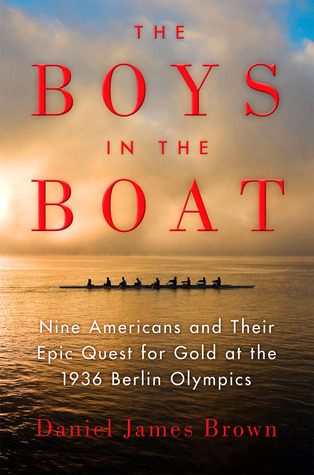
Are you a big sports fan? Do you love rowing competitions? Do you know what makes a good coxswain? If your answers, like mine, are “no,” I guarantee that you will love The Boys in the Boat anyway!
Daniel James Brown is a masterful writer. His research is the backbone of the story, but that is just the beginning. He focuses his story of nine young Americans and their coaches on one amazing young man, Joe Rantz. In the process of rolling out this tale, Brown gives the reader a deep look at Joe, who despite terrible odds survived desperate times and the abandonment of his family. With sacrifices and persistence, he struggled through the Depression to earn his way through college and a place on the University of Washington eight-oar crew.
Holding down several jobs and living in tiny, dank quarters, Joe was bullied by his teammates for always wearing the one ragged sweater he owned and for being perpetually hungry. Despite World Wars, the collapse of Wall Street, the Great Depression, flooding, the Dust Bowl, and record unemployment, there were still students who were of a “privileged” class. Many students in the West were from tougher, more humble circumstances, but few of Joe’s teammates had backgrounds comparable to Joe’s. The rowers in the East generally went to elite schools and reflected British roots in their rowing.
Although the book focuses on Joe, partly because of Joe’s unique story and partly because the author was able to interview Joe himself and Joe’s daughter, Brown also includes the backgrounds and activities of each of the other boys in the boat.
The descriptions of the qualifying race in Poughkeepsie and the Olympic competition in Berlin will immerse you in the races to the point of feeling like you are there. There are so many factors that play important roles in rowing. The coaches are key in bringing the boys along, eliminating those who do not have extreme desire and persistence. They have to motivate them to work as a team, teach them how to row, and strategize which students will work best in each position on the boat.
Each chapter starts with a philosophical rowing quote by boat builder George Yeoman Pocock. He hailed from a line of boat builders and prided himself on the quality of his boats. He also had a talent for both seeing how a rower could improve and effectively sharing that with the young man.
Leading into the Olympic competition is fascinating information about Hitler’s motivations with the Olympics and what he did to achieve world-wide acclaim. His public relations efforts portraying Nazis as accepting and culturally sensitive were quite successful internationally.
The Boys in the Boat is one of those books that will stay with me for a long time. Joe’s strength of character and physical endurance are inspirational. I am thankful that the author included an epilogue that shares what happened to each of the rowers in their adult lives. There are also a few pages that give insight into how Brown learned so much about this “epic quest.” The crew endured practices in cold and rain, in heat and rough waves. The success of the nine was well-deserved and merited recording in this outstanding book.
Rating: 5/5
Category: Nonfiction, History, Sports
Publication: 2013—Penguin
Memorable Lines:
To defeat an adversary who was your equal, maybe even your superior, it wasn’t necessarily enough just to give your all from start to finish. You had to master your opponent mentally. when the critical moment in a close race was upon you, you had to know something he did not—that down in your core you still had something in reserve, something you had not yet shown something that once revealed would make him doubt himself, make him falter just when it counted the most. Like so much in life, crew was partly about confidence, partly about knowing your own heart.
“It takes energy to get angry. It eats you up inside. I can’t waste my energy like that and expect to get ahead. When they left, it took everything I had in me just to survive. Now I have to stay focused. I’ve just gotta take care of it myself.”
The wood, Pocock murmured, taught us about survival, about overcoming difficulty, about prevailing over adversity, but it also taught us something about the underlying reason for surviving in the first place. Something about infinite beauty, about undying grace, about things larger and greater than ourselves, About the reasons we were all here. “Sure, I can make a boat,” he said, and then added quoting poet Joyce Kilmer, “ ‘But only God can make a tree.’ “
As the observation train drew back upriver again for the start of the varsity race, the atmosphere grew electric, the dusky sky crackling with static. The crowd began to buzz. Boat whistles shrilled. Alumni draped arms over one another’s shoulders and sang fight songs. Somebody was about to win big; somebody was about to lose big.
The Nine Tailors–complicated plot
The Nine Tailors
by Dorothy Sayers
The reader of The Nine Tailors is thrown headlong into the world of change-ringing in English churches, the ancient art of ringing huge bells by ropes, not according to melody, but mathematical patterns. Dorothy Sayers’ book also immerses the reader into Anglican church architecture and local sluices, fens, and waterways. I didn’t have the necessary background knowledge to understand or appreciate the extensive backdrop Sayers paints for her mystery, and that deficit on my part hindered my appreciation of the novel.
At the same time, I must applaud the author for one of the most convoluted plot structures I have ever encountered. Dorothy Sayers is considered one of the top writers in the mystery genre, and having read The Nine Tailors, I understand the reason for her reputation even though her style is not quite to my taste. Her main character, Lord Peter Wimsey, is a likable protagonist. The conclusion of the tale is both satisfying and surprising. I must admit on a personal level that I have allowed myself to be spoiled by the easy reading afforded by currently produced cozy mysteries which I very much enjoy. The Nine Tailors has a much more intellectual bent and certainly stretches the reader’s mental reaches. I recommend this book within the constraints of a mystery that requires the reader to put forth at least equal effort to that of the author.
Rating: 4/5
Category: Mystery
Notes: #11 in the Lord Peter Wimsey Mystery Series. As it is not very character dependent, it could be appreciated as a standalone.
Publication: 1934—Harcourt Brace & Co. (Harvest Books)
Memorable Lines:
A powerful ecclesiastical odor, compounded of ancient wood, varnish, dry rot, hassocks, hymn-books, paraffin lamps, flowers and candles, all gently baking in the warmth of slow-combustion stoves, billowed out from the interior.
It came upon him with a shock that Uncle Edward could not be many years older than himself. He felt for him the apprehensive reverence which one feels for a quaint and brittle piece of antiquity.
I think I have been the most unmitigated and unconscionable ass that ever brayed in a sleuth-hound’s skin.
Mardi Gras Murder–lots of Louisiana flavor in this mystery
Mardi Gras Murder
by Ellen Byron
 Mardi Gras Murder takes place in Pelican, Louisiana, as the townsfolk work together to recover from flooding. Maggie Crozat is an artist who works at her family’s B & B as well as a tour guide at Doucet, the plantation that belonged to her mother’s family. The story starts with action as a body no one can identify shows up during the cleanup, but the author, Ellen Byron, also very quickly gives a background introducing many of the characters. It is fortunate that Byron includes a list of characters because I had to refer back to it may times. Families and lineage are very important in determining status in Louisiana, and it seems like everyone is related to or at least knows everyone else in Pelican.
The plot gets complicated as Maggie has to substitute for her grandmother as a judge in the Miss Pelican Mardi Gras Gumbo Queen competition, there is another murder, and Maggie uncovers a lot of local secrets. The storyline is interesting, and I enjoyed the Louisiana setting and a generous sprinkling of Cajun French dialogue. It was also fun to read about the local cuisine, frequently leading me to the Internet for personal searches to learn more. Gopher, a Bassett hound pictured on the cover, attracted me to the book, but he has only a minor presence. All in all, Mardi Gras Murder is an enjoyable read.
I would like to extend my thanks to netgalley.com and to Crooked Lane Books for giving me the opportunity to read this book in exchange for an honest review.
Rating: 5/5
Category: Mystery
Notes: 1. #4 in the Cajun Country Mystery Series. There are a LOT of characters in this book, but the author seems aware of potential issues and manages them well. This was my first foray into the series, but I enjoyed it.
2. A detail that makes a fun side story, but is inaccurate: A cast iron pot used for the gumbo cook-off had been passed down the family line. The seasoning that had accumulated over the years was supposedly ruined when some dogs licked it. Actually “seasoning” does not affect the flavor of foods cooked in the pot. Seasoning makes it nonstick and prevents rusting. The well-seasoned, prized pot need not have been discarded. A simple hand washing, heating to dry, and wiping with lard or oil would have restored the pot quite satisfactorily.
Publication: October 9, 2018— Crooked Lane Books
Memorable Lines:
He made himself sound important, but it came across as someone trying very hard to inflate a small balloon.
“Boy, I had a bad case of SDS back there,” Denise said. She saw the puzzled expression on Maggie’s face. “Southern Door Syndrome, where you take almost as long to say goodbye as you stayed at the party.”
“You know the old cliché, chére. Ninety-nine percent of American families are dysfunctional, and the other one percent is lying about it.”
 education pathways