
Home » Posts tagged 'executions'
Tag Archives: executions
The Watchmaker’s Daughter: the true story of World War II heroine Corrie Ten Boom
The Watchmaker’s Daughter
by Larry Loftis
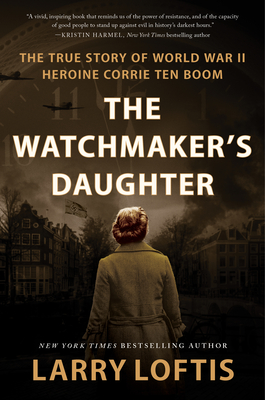
The Hiding Place, the original popular story of Corrie ten Boom, written with John and Elizabeth Sherrill, was released in 1971 and made into a movie in 1975. Corrie, skilled in watch repairs, and the rest of the ten Boom family saved many Dutch—both Jews and non-Jews—from being sent to prison, concentration camps, and labor camps by German Nazis in World War II.
Although The Hiding Place was a landmark book in telling the story of this remarkable Christian lady, Larry Loftis has gone even further in writing The Watchmaker’s Daughter. His research into the background of the World War II setting of the book sets the reader up to better understand the times culturally and politically and the invasion of Holland. His research includes examining photos and original small books by Corrie ten Boom along with memorabilia that are archived in the Billy Graham Center Archives at Wheaton College. Corrie ten Boom did not keep a diary, but Loftis sought out many other primary sources including journals and letters from survivors who had been hidden in the ten Boom home.
Corrie and her older sister Betsie were interned in Ravensbrück Concentration Camp for their crimes of hiding Jews. There these Christian sisters had a ministry within the barracks, holding secret Bible studies and encouraging the other women to hold strong despite the horrible conditions and continuous threat of execution. Upon release, Corrie began a ministry of traveling internationally with a message of forgiveness and established 3 different centers, one in a transformed concentration camp, to meet the physical and emotional needs of survivors. Betsie had a vision of the centers while they were still in the camp at a time when the fulfillment of her vision seemed impossible. Corrie’s story is an amazing one showcasing the love of God and the power of forgiveness.
Rating: 5/5
Category: Biography, Nonfiction, Christian, History
Notes: Even if you think you know the story of Corrie ten Boom, I encourage you to read this book. Corrie’s story is unforgettable, and her courageous life of dependence on God extended way past the events in Ravensbrück. Loftis’ research and writing along with Corrie’s life and faith make this book remarkable.
Publication: 2023—HarperCollins
Memorable Lines:
This was the hardest part—the hatred. Over ensuing days Corrie tried to be nice to the woman, but to no avail. “She seemed to be entirely devoid of human feeling,” Corrie recalled, “and altogether hard, hostile, and wicked…Why should they always snap and snarl at us? I always greeted them with a pleasant ‘Good morning,’ but everything seemed to glance off their impenetrable armor of hate.”
“My sister died here,” she told Tiny. “She suffered so much. I, too, have suffered. But Jesus is always with us. He did a miracle in taking away all my hatred and bitterness for my enemies.”
For more than fifty years the Beje had been her own hiding place, her refuge. But Ravensbrück had taught her that this magnificent home—with all of its memories—was but a shadow; her true hiding place was Christ.
Animal Farm–still relevant
Animal Farm
by George Orwell

In reaction to Stalin’s efforts to gain control in the Spanish Civil War in 1937, George Orwell, a writer who fought in that war and witnessed the purges, created what he called “a fairy tale.” Russell Baker, author of the afterword in the Signet Classics edition of Animal Farm said that Orwell “thought too many decent people in the Western democracies had succumbed to a dangerously romantic view of the Russian revolution that blinded them to Soviet reality.” Clearly, Orwell, a self-proclaimed socialist, abhorred the totalitarian state which could emerge from socialism.
The allegory Animal Farm was first published in 1945 after pro-Soviet sentiment died down. It was immediately popular in England and America. It has a timeless theme which Téa Obreht, originally from Yugoslavia, shares in her introduction: “no society is inherently safe from these horrors.” Sometime in the new century, when engaging in retirement downsizing, I donated my copy of Animal Farm remembering it as an important work, but convinced that it is not relevant in our freedom loving United States of America. Recently, concerned about the direction toward total control being gradually imposed in my country, I bought a new copy of Animal Farm.
This short work of fiction tells the story of the animals on Mr. Jones’ farm. They don’t have it too bad. They have just enough to eat and a place to sleep, but they resent Mr. and Mrs. Jones and their farmhouse. The animals are convinced by Major, a prize boar, to fight for their freedom and transform their home into a socialistic farm where no one would be their master, they wouldn’t have to work as hard, and food would be in abundance. They are successful initially in working toward their dream, but things change very gradually as two competing pigs take over after the death of Major. Some of the problems at Animal Farm are born of natural disasters; others are the result of greedy and power-hungry pigs with their security guard dogs.
The animals continue to work hard and grumble little, but life gets worse for all but the pigs and dogs. Eventually the animals no longer remember what the seven commandments that structure their society are or recognize the changes that occur in them. Most can not read them anyway. They also don’t remember what things were really like in the past. They are easily convinced by the leader’s assistant, who with rapid-fire delivery spouts off “facts and figures,” thus proving that their lives are much better than they used to be.
Most of the characters are animals, of course. My favorite is the donkey, Benjamin, who has seen it all, but rarely talks. He just goes along knowing he will probably outlive whatever the latest notion is. Boxer is a very strong horse who has two personal mottos: “I will work harder.” and “Napoleon [the victorious pig leader] is always right.” The other animals find Boxer very inspiring. The animals are divided into committees. Interestingly, there is a Re-education Committee which the cat, who is rarely around at work time, joins. There is a large contingent of sheep who can be counted on to respond to everything with a loud chanting of “Four legs good, two legs bad.”
If you have not read Animal Farm, I encourage you to do so. It truly is reflective of what is occurring within the U.S. society including the political class and those who serve them. Although this was written with Stalin in mind, I was able to discern similarities to people, groups, and events in 2020-2021 and ponder the twenty or so build-up years leading to the changes we’re currently experiencing. Animal Farm is relevant today, and sadly will remain relevant as long as there is a greedy, power-hungry class and a populace that can be duped by false “facts,” persuasive rhetoric, and romantic notions of a utopian society.
Rating: 5/5
Category: Fiction
Notes: Political Allegory
Publication: Originally published in 1948. I read the Signet Classics edition published in June 2020 by Penguin Random House.
Memorable Lines:
He repeated a number of times, “Tactics, comrades, tactics!” skipping round and whisking his tail with a merry laugh. The animals were not certain what the word meant, but Squealer spoke so persuasively, and the three dogs who happened to be with him growled so threateningly, that they accepted his explanation without further questions.
Truth to tell, Jones and all he stood for had almost faded out of their memories. They knew that life nowadays was harsh and bare, that they were often hungry and often cold, and that they were usually working when they were not asleep. But doubtless it had been worse in the old days. They were glad to believe so.
But once Benjamin consented to break his rule, and he read out to her what was written on the wall. There was nothing there now except a single Commandment. It ran:
ALL ANIMALS ARE EQUAL
BUT SOME ANIMALS ARE MORE EQUAL THAN OTHERS
 education pathways