Home » Posts tagged 'discrimination'
Tag Archives: discrimination
My Several Worlds: A Personal Record
My Several Worlds: A Personal Record
by Pearl S. Buck
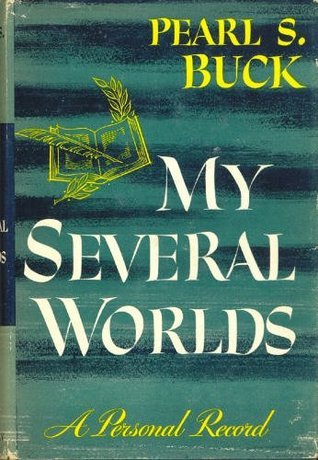
WHAT IS MY SEVERAL WORLDS?
It is a collection of essays integrated into a memoir. Author Pearl S. Buck, as she writes this tome, considers herself midway in her writing career. She presents it as a “record of the age in which I lived” and “as nearly an autobiography as I shall ever write.” It is not a linear book. The place she is located when she writes each section is noted, but not the date because it is such a combination of times. Although a confusing style at first, it makes sense because as she is writing about her current life in the United States, she will suddenly revert to recounting her younger years in China and historical world events or advance her opinions on a variety of subjects from practical to esoteric.
WHO WAS PEARL S. BUCK (1892-1973)?
She was a prolific author, primarily a novelist, and the winner of both the Pulitzer Prize in 1932 and the Nobel Prize in Literature in 1938. The child of Christian missionaries, she spent much of her life in China until politics forced Americans to leave. Completely bilingual, Pearl was an astute translator of Chinese and had great admiration for Chinese social structure and love for the Chinese people. When she returned to the United States, she found that she lived in two separate worlds and never felt quite at home in either. She was well-traveled and had friends from all over the world.
WHERE DID BUCK GET HER INSPIRATION?
Buck’s source material was mainly her observations of people. In her travels, she paid attention to people, listening more than talking. Her focus was more on the common man and woman than the famous people who wanted to entertain her as a celebrity.
WHAT ARE SOME OF BUCK’S “SEVERAL WORLDS”?
Buck watched various political groups attempt takeovers in China. This land she loved and which helped shape her was subject to political strife from inside the country and by forces from the outside. She was witness to Western influences on young Chinese who studied in the United States and tried to bring change to ancient Chinese customs. These endeavors were not always positives for the Chinese people.
As an American adult with Chinese training, Buck experienced disparate worlds in the United States. Looking past geopolitical issues, Buck also had several worlds on a personal level. Although equipped to mingle in high society circles, she preferred a rural lifestyle with a large household of adopted children who learned life and family skills on their farm. She had a long, unhappy marriage to an agricultural missionary in China followed by a long, happy marriage to her publisher in the U.S. Although a teacher and primarily a writer, Buck devoted her talents to social enterprises as well. She opened The Welcome Home for U.S.-born children of Asian descent whose mixed-race status made them “unadoptable” according to adoption agencies. She also advocated for appropriate care for the disabled, a cause close to her heart as her first child was unable to live independently.
WHAT IS YOUR OPINION OF MY SEVERAL WORLDS?
This is not an easy read; there is no fluff to it. In My Several Worlds you will discover a lot of Chinese history since, as Buck points out, the Chinese civilization is very old. She refers to many events in China’s past without details as she feels they have already been discussed thoroughly in books she and others have written. Her thoughts on the various subjects she examines are interesting although I do not always agree with all of them. They are informed by her unique background of living a cosmopolitan life. She was homeschooled by Christians but tutored by a Confucian. She went to college in the United States, but despite altering her clothing never felt like she fit in.
Buck is an excellent writer, but the reader needs to approach this non-fiction work with a desire to learn—to learn more about China, about adults who have grown up in more than one culture, and about the fascinating Pearl S. Buck. Having read this memoir, I think a good follow up would be to read one of her many novels.
Rating: 5/5
Category: Memoir, Nonfiction
Publication: 1954—John Day Co.
Memorable Lines:
But I had never known what hatred was. I had neither been hated nor had I ever hated anyone. I could not understand why we, who were still ourselves and unchanged, should be lumped with unknown white men from unknown countries who had been what we were not, robbers and plunderers. It was now that I felt the first and primary injustice of life. I was innocent but because I had the fair skin, the blue eyes, the blond hair of my race I was hated, and because of fear of me and my kind I walked in danger.
No people can be educated or even cultivated until books are cheap enough for everybody to buy.
I went back to my own resurrected home with a heavy heart indeed, for I knew that from that day on the new government was doomed in the end to fail. Why? Because it had failed already in understanding the people whom it purposed to govern and when a government does not rule for the benefit of those ruled, sooner or later it always fails, and history teaches that lesson to every generation whether or not its rulers can or will understand.
The Oceans Between Us–disgrace for two nations
The Oceans Between Us
by Gill Thompson
 A very good storyteller, Gill Thompson discovered a story that needed to be told and related in such a way that it reached past the bare facts. In The Oceans Between Us, she has done just that.
I was pulled into the story relating to each of the characters as we explored them and their part in making history. Molly and Jack are British mom and son separated when a wartime bomb is detonated destroying their home. They end up oceans apart and although the thread flowing through the book is their longing for each other, their lives continue on with highs and lows. Other themes are institutional abuse and racial discrimination. Those are hard and cold terms that come alive as we watch them played out in this story. The events are a part of history I was unaware of. You’ll want to read this book to see one author’s view of how it may have played out on a personal level and discover if justice was actually ever served.
I would like to extend my thanks to netgalley.com and to Headline for giving me the opportunity to read this book in exchange for an honest review.
Rating: 5/5
Category: Historical Fiction
Publication: March 21, 2019—Headline
Memorable Lines:
Everything seemed out of kilter. Like when she’d tried for hours to do a jigsaw here at Warlingham, only to realize half the pieces came from another set.
Jack was a frozen child, forever trapped in her mind in his five-year-old body. Molly could no more imagine him at eighteen than she could fly.
But the lawyer in him resisted the child. He couldn’t risk his career before it had started. Bindoon had given him brawn but it hadn’t robbed him of a brain. Besides, you didn’t fight violence with violence. You fought it with cunning.
The Book Woman of Troublesome Creek–the blue librarian
The Book Woman of Troublesome Creek
by Kim Michele Richardson
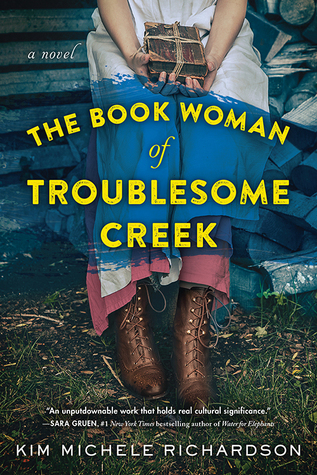 Two tales woven seamlessly into one—that’s The Book Woman of Troublesome Creek, a work of historical fiction carefully researched and crafted by Kim Michele Richardson. Cussy Carter is a blue-skinned young woman, strong, determined, and the subject of suspicion, hatred, and discrimination in the backwoods of the Kentucky Appalachians in the 1930’s. She is also a Book Woman, a librarian who travels by mule to deliver books to the far reaches of the mountains to patrons who otherwise would have no reading options. Cussy, also called Bluet, knows her place in society as does her Black friend Queenie. They are both considered “colored.” Most people are disgusted by looking at Cussy and certainly avoid any kind of touch.
Richardson paints a moving portrait of Cussy and what it must be like to be an object of ridicule and perhaps the last of her kind. You will be hoping for the best for Cussy who, as a coal miner’s daughter, lives in poverty but shares freely with her even more impoverished patrons. Her father, also a Blue, suffers from lung issues and horrible working conditions.
The Book Woman of Troublesome Creek is a work you will read with your heart in your throat, amazed at the struggles and sufferings of Cussy, her pa, her patrons, and those who dare show kindness to her. At the same time, the book is uplifting because there are good people included in the story and Cussy always stands as a model of someone who does what is right because it is right and in spite of those who would hurt her.
I would like to extend my thanks to netgalley.com and to Sourcebooks Landmark for giving me the opportunity to read this book in exchange for an honest review.
Rating: 5/5
Category: Historical Fiction
Notes: There are helpful Author’s Notes at the end of the book discussing the rare condition called methemoglobinemia. Richardson also gives background on the Pack Horse Library Project and courting candles. She explains that she altered one fact regarding dates so that she could include certain medical information.
Publication: May 7, 2019—Sourcebooks Landmark
Memorable Lines:
I lived for the joy of bringing books and reading materials to the hillfolk who were desperate for my visits, the printed word that brought a hopeful world into their dreary lives and dark hollers. It was necessary. And for the first time in my life, I felt necessary.
I couldn’t help notice again how the students waited for me, looked up at me, all quiet and not a single fidget or wiggle, as hungry for the stories in these books as they were for the food that always seemed sparse in this real land.
Nary a townsfolk, not one God-fearing soul, had welcomed me or mine into town, their churches, or homes in all my nineteen years on this earth. Instead, every hard Kentucky second they’d filled us with an emptiness from their hate and scorn. It was as if Blues weren’t allowed to breathe the very same air their loving God had given them…
Shadow Among Sheaves–sacrifices
Shadow Among Sheaves
by Naomi Stephens
 The Biblical story of Naomi and her daughter-in-law Ruth is known and quoted as an example of devotion. Upon the death of her husband and sons, Naomi encourages her daughter-in-laws to return to their home countries, but Ruth says: “Entreat me not to leave thee, or to return from following after thee, for whither thou goest, I will go; and where thou lodgest, I will lodge: thy people shall be my people, and thy God my God.” (Ruth 1:16).
In Shadow Among the Sheaves author Naomi Stephens uses this story in a new setting. Nell (Lady Hawley) and her daughter-in-law Rene move from India back to England in the glory days of the British Empire. Rene, from the highest caste in India, has promised to take care of Nell, but because of discrimination against Indians, they are treated as outcasts and beggars. Stephens’ story follows the same general lines as the Biblical story but is fleshed out with a deeper plot and extensive character development. Using the complexities of the ethnic divide and the social and class norms in Britain at that time, Stephens weaves a riveting tale of love and conflict.
I would like to extend my thanks to netgalley.com and to Barbour Publishing (Shiloh Run Press) for giving me the opportunity to read this book in exchange for an honest review.
Rating: 5/5
Category: Christian, Romance
Notes: You do not have to be familiar with the Bible story of Ruth and Naomi to enjoy this book, but if you would like to read it, the book of Ruth is found in the Old Testament and is only four chapters long.
Publication: April 1, 2019— Barbour Publishing (Shiloh Run Press)
Memorable Lines:
An aching belly, an empty room, skin pulled tight over hungry bones—all of these sacrifices were worth it, she knew, if it meant staying with Nell, if it meant her family would be her family forever.
Thomas had never been a monster, exactly, though he had always been monstrously arrogant.
Music began tumbling across the now barren fields. The notes were thick and plucky, sticking to the window like hands pressed up against the glass.
 education pathways