Home » Posts tagged 'customs'
Tag Archives: customs
Beneath a Turquoise Sky–educating the Navajos
Beneath a Turquoise Sky
By Kiersti Giron
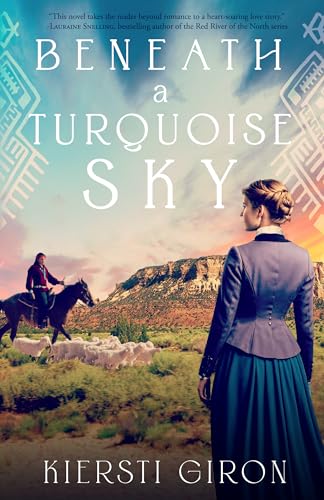
As Beneath a Turquoise Sky begins, the author introduces Caroline Haynes, a young lady in 1910 in Pennsylvania. After five years of playing the role of mother to her two younger brothers, she feels replaced by her father’s new wife Lillian. Her best friend’s brother, whom she had long adored, moved to China to be a missionary, without Caroline, and later married. Recognizing that she really doesn’t have a home or is needed in Pennsylvania, Caroline follows up on an article in the Home Mission Monthly seeking a teacher for the younger students at the Hebron Navajo Mission. She was drawn to “children in need of schooling, of the light of Jesus.”
When she arrives at the Territory of New Mexico after a long, arduous journey, she is shown to her tiny room attached to the girls’ dormitory and meets the handsome, but rigid, Rev. Willis Abernathy and his aunt Miss Spencer. Both have their own strict ways of running a school which are typical of schools set up for Native Americans at that time. The goal is conversion, but not just spiritual conversion. The white men wanted to get rid of Navajo culture and replace it with European customs all while making it clear that the Navajos are second class people. The motto of some was: “Kill the Indian, save the man.” To this end, the Navajo students were often punished if they spoke their own language. Haircuts were forced on them. Their traditional clothes were taken away, and they were supplied with uniforms.They were assigned Anglo names and removed from their families. The parents were told this was “all for their own good.”
Caroline’s interactions with the students and the other staff is a major part of the story, but just as important is Willis’ relationship with Tse, a Navajo two years younger. They grew up together and were friends for many years, but that all changed and we see it play out as Tse needs a job to help support his parents. Willis gives it to him but treats him in a very condescending way. As was typical of that time period, he seems to have no concept of the value of cultural differences. Tse is a Christian, but because he has reverted to Navajo dress and culture, Willis feels that he has turned his back on God.
Caroline “disobeys” Willis in her efforts to teach the children and give them the emotional support they need. Tse is her “accomplice” and both of them are chastised by Willis.
There are a number of well-executed plot twists that culminate in decisions these characters have to make that will affect their future and the future of the mission. Although I had a hard time liking Willis, I could understand him as a product of his time. That does not excuse most of his behavior, however. The story concludes with many loose ends tied up, but there are still systemic problems that are not worked out regarding how the Navajos and the white men interact with each other. Caroline and Tse are both very likable characters portrayed with some depth. They live out the kindness of Jesus in their everyday lives. Willis thinks he is doing the right things, but is missing the mark in his goals and how he treats others. All of the characters experience growth and positive change, and Tse especially comes to understand how he can honor his Navajo heritage and also be a follower of Jesus.
Rating: 5/5
Category: Historical Fiction, Christian, Romance
Notes: 1. The book includes a Glossary of Navajo Words, Historical Notes, and Acknowledgements of people and organizations that have contributed to the author’s understanding of the complicated historical and cultural background of this story.
2. Giron states that she has “shown only the milder side” of the trauma children experienced under this “education” system, but it is certainly sufficient to expose the reader to the damage even well meaning individuals caused in imposing Euro-American culture and customs in the name of religion.
Publication: April 14, 2025—Story Architect
Memorable Lines:
Perhaps being set apart did mean rejecting all that was Navajo and taking on the white man’s ways. But where was that ordained in Scripture? Not like the people of ancient Israel were European, after all.
But no, the bilagáanas were always right—government officials, Indian agents, or missionaries. No matter how many broken treaties, broken promises, broken families. Broken children’s hearts.
He sang as he bridled his horse, praising Jesus in his language, letting the tune follow the natural pattern of the tones, as in the chants. It sounded genuinely Navajo, yet the truth of the words lent a wholeness to his tongue he’d never heard before.
The Importance of Being Earnest : A Trivial Comedy for Serious People
The Importance of Being Earnest
by Oscar Wilde
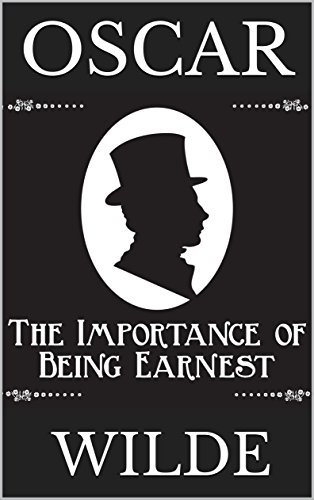
There is probably no better work to evoke book club discussion than Oscar Wilde’s famous satirical play The Importance of Being Earnest. The extreme characters as well as the situation are the source of humor as Wilde mocks the customs and manners of Victorian England. In our discussion we examined parody, satire, and sarcasm, when each is appropriate, and their potential hurtful nature. We also talked about what constitutes humor.
Wilde’s characters border on the absurd. The women are fluff, the men are profligates who nevertheless think highly of themselves, and no one tells the truth. In fact, the lies that both male protagonists have told are the basis of the humorous confusions in the story. Jack lives in the country, but pretends to need to go frequently to the city because of a younger brother named Ernest who gets into scrapes. When he is in the city, Jack goes by the name of Ernest. Jack’s friend Algernon wants to meet Jack’s ward so he goes to Jack’s house as Ernest. It just happens that Cecily, Jack’s ward, and Gwendolen, Jack’s fiancee agree that they could only love someone whose name is Ernest. The two young ladies’ diaries are a source of amusement as the events in the diary are fictional. For example, Cecily records the marriage proposal of Algernon as Ernest, their breakup, and subsequent reunion even though they have never met.
The Importance of Being Earnest was first presented on February 14, 1895. It continues to amuse audiences today in live theater presentations and in a number of video productions.
Rating: 5/5
Category: Drama, Satire
Publication: February 14, 1895—original production
March 1, 1997—Project Gutenberg
Memorable Lines:
The amount of women in London who flirt with their own husbands is perfectly scandalous. It looks so bad. It is simply washing one’s clean linen in public.
I never travel without my diary. One should always have something sensational to read in the train.
Cecily: That certainly seems a satisfactory explanation, does it not? Gwendolen: Yes, dear, if you can believe him. Cecily: I don’t. But that does not affect the wonderful beauty of his answer. Gwendolen: True. In matters of grave importance, style, not sincerity is the vital thing.
The Lost Traveller–a mysterious victim
The Lost Traveller
by Sheila Connolly
 I was delighted to have an opportunity to get my first taste of Sheila Connolly’s mysteries as she has a number of books and series to her credit. I don’t usually start a series this far in (#7), but Connolly does a good job of introducing her characters. She starts The Lost Traveller off with a nervous American family, first time travelers abroad, visiting Sullivan’s Pub, giving the author a natural opportunity to explore the setting with the reader and present Maura, the American owner of the pub. The pace continues briskly as Maura, on lunch break, spots what appears to be a trash bag down a ravine on her property. It isn’t trash caught by a bridge pier, however, but something more ominous. Next we are introduced to the local gardaí (police). The plot pace moderates as Maura struggles with various types of issues—relationship, crime, business, and legal. It picks up again at the end with the resolution of some of those problems.
I enjoyed the Irish brogue and sprinkling of Irish words and names throughout. I learned more about Ireland and the Travellers, a sort of Irish version of gypsies, but they are not Romani. More information about the Travellers would have been welcome along with some character development of Peter, the father of the Traveller family that Maura meets. In fact, character development is a weak link in the book. For example, there are a group of men who frequent the pub and try to help Maura discover the identity of the victim and who murdered him. This group stands as a Greek chorus, with little revealed about any of them. They serve to reflect Maura’s progress involving the murder mystery. Although I am not thoroughly taken by the book, I enjoyed the intricacies of the plot well enough to try another book in the series.
I would like to extend my thanks to netgalley.com and to Crooked Lane Books for giving me the opportunity to read this book in exchange for an honest review.
Rating: 4/5
Category: Mystery
Notes: #7 in the County Cork Mysteries, but works as a standalone.
Publication: January 8, 2019—Crooked Lane Books
Memorable Lines:
Was she getting soft? She’d always been independent, mostly out of necessity. She hated to ask people for help, much less emotional support. Now she had someone in her life who offered both, although cautiously.
This was ridiculous: she was being bossed around by a child. Well, one who could definitely cook, and who knew more about computers than she did.
What had Ireland done to her? She’d gone soft. And, she realized, she kind of liked it.
Hot on the Trail in Ancient Egypt–young time travelers
Hot on the Trail in Ancient Egypt
written by Linda Bailey
illustrations by Bill Slavin
 Hot on the Trail in Ancient Egypt is a juvenile graphic novel that kept this adult interested from beginning to end. In this book, which is part of The Time Travel Guides, the bored Pinkerton twins chase after their little sister Libby who has entered the rather creepy Good Times Travel Agency. Opening the owner’s personal guide book catapults the three children into Ancient Egypt. They learn that their adventure will not end until they finish reading the book.
The layout of the book is very appealing. The fictional story is told in comic book style at the top of the page. At the bottom of the page is a drawing of an aged book (Julian T. Pettigrew’s Personal Guide to Ancient Egypt) containing nonfiction text that explains and elaborates upon what is happening in the story. For example, when an Egyptian woman invites them into her home, the nonfiction text describes the house, food, and clothing of Ancient Egypt.
I can’t stress enough the current importance of books like this to interest children in history for three reasons. First, most people are familiar with the saying attributed to George Santayana that “those who do not learn history are doomed to repeat it.” There are many horrific events in history most can agree should never be repeated. Second, sadly to say, most children are not exposed to history in their younger years in school. The school day and curriculum in public elementary school is so regimented that the focus is reading, taught in a boring and uninspired way, math, and standardized testing. I am not kidding or exaggerating when I say that as a teacher I had to sneak in science and history and hope the principal didn’t catch me. Third, history is interesting and FUN. in an age when teachers do their best to incorporate games and movement activities called “brain breaks” (to replace the recess that was taken away), we need to restore the intrinsic fun that comes through learning interesting things. In that way we create life long learners.
In addition, a book of this type actively demonstrates reasons for reading—to learn more about something you are interested in and to be carried away by a story. I particularly appreciate that Bailey gave a belated shout out to her high school history teacher: “Great work, Mr. Visch—you made it fun!” She dedicated the book to her daughter who “once did a school project on the Sphinx and has been in love with all things Egyptian ever since.” Teachers and projects do make a difference.
I would like to extend my thanks to netgalley.com and to Kids Can Press for giving me the opportunity to read this book in exchange for an honest review.
Rating: 5/5
Category: Children’s Nonfiction
Notes: 1. new edition of an older book
2. Grade Level: 3-7
3. Age Range: 8-12 years
Publication: May 1, 2018—Kids Can Press
Memorable Lines:
For drinks, try the national beverage—beer! It’s made from half-cooked bread and river water, and it’s thick, dark and sometimes a bit lumpy. You’re supposed to strain it well before serving, but not everyone does.
Down at the bottom are the farmers and laborers. Most people in ancient Egypt are at the bottom of the society—where there’s plenty of room!
Sightseeing in the middle of a getaway? This was a very bad idea. Emma and Josh tried to lure their little sister out of the pyramid.
 education pathways