Home » Posts tagged 'creation'
Tag Archives: creation
Frankenstein: The Modern Prometheus
Frankenstein
by Mary Shelley
with A Guide to Reading and Reflecting by Karen Swallow Prior

What do you think of when you hear the word “Frankenstein?” For many, that name conjures up an ugly monster pieced together from the flesh of others. A quick Internet search of images associated with that name bring up iconic pictures that are a part of our popular culture. Many movies have been made of the book Frankenstein as well as versions and spin-offs of the Gothic novel. In truth, Victor Frankenstein is the name of the scientist who created the monster who was never named in the book, but may be referred to as “The Creature.”
Clearly a classic, Frankenstein, was the creation of 18 year old Mary Shelley as a result of a dreary day’s writing contest with a small group of men, that included her husband the poet Percy Bysshe Shelley and Lord Byron. The little group fought to overcome the ennui of the season. Mary Shelley won and her story was first published anonymously.
The structure of the story is initially a little confusing, but it becomes clearer as the tale progresses. Captain Robert Walton’s narrative frames the story with his recounting, as his ship headed to the North Pole, of the sighting of an unknown creature and then the rescue of a man who was pursuing the creature. Much of the book is epistolary as Walton shares the story of Victor Frankenstein’s life with his sister in England.
The reader is also given the Creature’s viewpoint. At eight feet tall and very different looking, he is viewed as a threat. At times the reader might feel some sympathy for him as he wants love and acceptance, but he also reveals a murderous side. When he realizes he will never be integrated into human society, he approaches Victor with the idea of creating a woman to be his wife. This request ignites another ethical dilemma for Victor who has already ignored his moral obligations when he gave life to the Creature and then abandoned him. His bad decisions turn his life and that of his loved ones into tragedies.
The editor of this volume, Karen Swallow Prior, is a Professor of English and Christianity and Culture. She states that the major themes of Frankenstein are “creation, creator, guilt, ambition, reason vs. emotion, nature vs. nurture, friendship, sexuality.” She points out that Shelley does not write from a biblical point of view, but that these themes are timeless. This is obviously a complicated book and important in terms of its effects on our culture. The editor Prior attempts to make it more accessible in her introduction and in the background she presents about the time in which it was written. Not an easy read, Frankenstein offers a lot of food for thought. The reader will probably argue with the characters over their motivations and actions and will be hard pressed to find a likable character among them. Victor Frankenstein, in particular, proves over and over again that he is self-centered. His own happiness and a fulfilled ego are so important to him that his emotions swing wildly and greatly affect his health while he disregards how his actions hurt others.
Rating: 4/5
Category: Fiction, Gothic, Classic, Christian
Notes: 1. The editor ends each section (volume) with Reflection Questions which are a wonderful resource for individuals or groups studying Frankenstein. She also includes Questions for Further Reflection which address the whole book.
2. The appendix adds the introduction to the 1831 edition.
3. Prior has helpful footnotes on the appropriate pages to define words that are unfamiliar to readers in the twenty-first century.
4.Frankenstein is subtitled The Modern Prometheus pointing to the tension between a creation and its creator.
5. Although Frankenstein is not a Christian novel, Prior’s goal is to show readers how to approach it from a Christian viewpoint and to the glory of God
6. Prior has a series of classics that she has edited in a similar way. I have read several of these with my Book Club. Some have been more enjoyable than others, but all have resulted in good discussions.
7. This was written during the transitional period from Enlightenment to Romanticism.
Publication: 1818—Original publication
2021—(as edited by Prior) B&H Publishing
Memorable Lines:
I entered with the greatest diligence into the search of the philosopher’s stone and the elixier of life. But the latter obtained my most undivided attention: wealth was an inferior object; but what glory would attend the discovery. If I could banish disease from the human frame, and render man invulnerable to any but a violent death!
I was benevolent and good: misery made me a fiend. Make me happy and I shall again be virtuous.
“Hateful day when I received life!’’ I exclaimed in agony. ‘’Accursed creator! Why did you form a monster so hideous that even you turned from me in disgust? God, in pity, made man beautiful and alluring, after his own image; but my form is a filthy type of yours, more horrid even from the very resemblance. Satan had his companions, fellow-devils, to admire and encourage him; but I am solitary and abhorred.”
The Magician’s Nephew–another C.S. Lewis masterpiece
The Magician’s Nephew
by C.S. Lewis
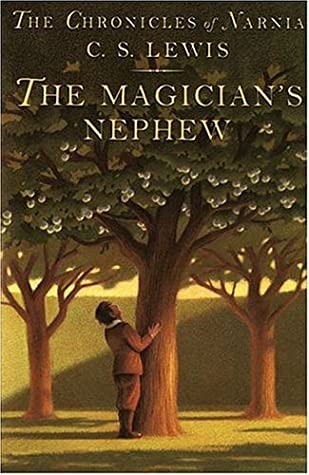
I entered The Magician’s Nephew not really knowing what to expect. It was written by C.S. Lewis the year prior to the publication of the last book in the series, The Last Battle, which I have not read yet. At the suggestion of a member of our book club who was actually rereading the series, we inserted The Magician’s Nephew immediately before The Last Battle—not because it belongs there chronologically, but because it could perhaps be appreciated better at that point in our reading. I don’t think you could go wrong with any sequence of these books! C.S. Lewis intended it to be read first in his Chronicles of Narnia, but by the time it was first published, many of his readers would have already greedily devoured the first five books. It is indeed a prequel to the delightful The Lion, Witch, and the Wardrobe, but for those who have already read that first classic tale, you will enjoy the “ah ha” moments that arise as Lewis gives you a backstory that renders both subtle and obvious connections. It never has the feel of a book written at the instigation of a publisher who just wants to squeeze more out of a popular series. It seems that it is Lewis’ desire to bring the pictures he has painted in his novels together with cohesion and forward looking vision.
In The Magician’s Nephew, a story which begins in London, you will learn of the creation of the world Narnia, meet Aslan the Lion, and witness the awakening of the Witch. There are many connections to the creation of Earth and its population as found in the Bible; but of course it is Narnia and in this fictional realm we learn how the animals came to talk and see the never changing character of Aslan who reigns with power and love, who grieves for the things that grieve us, and gives us hope during times of devastation.
This book has sad and fearful moments as well as happy and triumphant ones. The humor as the animals plant and water Uncle Andrew in hopes that the poor “plant” will revive is more refreshing to the reader than to Uncle Andrew! The pure evil of Jadis the Witch is the stuff of ancient fairy tales as is the conflict of good and evil. The characters are ones you can feel strongly about. The setting, as always with C.S. Lewis, is so vividly and well described that you can visualize both the “real” world of London and fictional worlds to which the children (main characters Digory and Polly) can transport themselves. As to plot, it constantly throws in surprises, but events are always connected. It becomes a quick read, not because it is short or light reading, but because it is so much fun to read. As with all the books in the series, it can be read as a child enjoys fiction or as an adult looking for deeper meaning. I suggest you read it both ways at once. Come to the story for entertainment and leave with the enrichment of a well-told tale imbued with rich symbolism.
Rating: 5/5
Category: Fiction, Christian
Notes: #1 in The Chronicles of Narnia series, but can be read at any time in the reading of the series. Warning: If this book is your first experience with this series, you will probably want to read more!
This series is often listed as Children’s Fiction, but is really appropriate for all ages with adults reading it on a different level from children. It is perfect for a read-aloud.
Publication: 1955—Harper Collins
Memorable Lines:
For what you see and hear depends a good deal on where you are standing; it also depends on what sort of person you are.
She has won her heart’s desire; she has unwearying strength and endless days like a goddess. But length of days with an evil heart is only length of misery and already she begins to know it. All get what they want; they do not always like it.
For the rest of that day, whenever he looked at the things about him, and saw how ordinary and unmagical they were, he hardly dared to hope; but when he remembered the face of Aslan he did hope.
The Road to Paradise–climbing new heights
The Road to Paradise
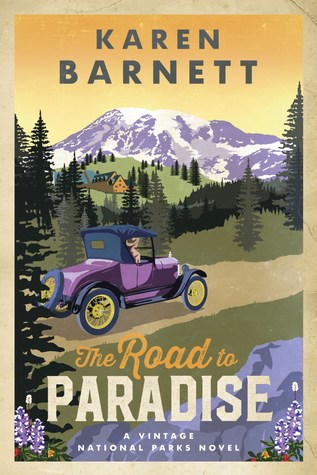
Karen Barnett’s The Road to Paradise is a delightful visit through time to Mount Rainier National Park in Washington. Set in 1927, the story tells of young Margie Lane, the socialite daughter of Senator Thomas Lane. A naturalist at heart, Margie is hired for the summer, as a political favor, into the male dominated environment with the expectation that she will only last a few days. Margie, lacking practical experience, brings with her determination, enthusiasm, a sense of wonder at God’s creation, and an academic background in botany and zoology.
This book has a villain, Phillip Carmichael, who has been manipulating Margie since childhood, and it has a hero, Chief Ranger Ford Brayden, Margie’s new boss. By the end of the story the reader has learned the motivations of each character and how their backgrounds and experiences set the stage for their actions.
Maggie is attracted to Ford, but realizes they have no future together because he does not share her faith in God. Calling God “the greatest Artist ever known,” Margie sees Him all around her in His amazing creation in Mount Rainier National Park and asks God to use her to share His love with others.
As Margie struggles in her new job and relationships with co-workers at the Park, Phillip is always a force as he tries to convert the Park from wilderness to super tourist entertainment center—by any means necessary. Margie’s parents also play a role with their expectations for their daughter’s social and media status.
I would like to extend my thanks to Edelweiss and to Waterbrook (Random House) for giving me the opportunity to read this book in exchange for an honest review.
Rating: 5/5
Category: Fiction, Christian, Historical Fiction
Notes: a Vintage National Parks novel
Publication: June 6, 2017—Waterbrook (Random House)
Memorable Lines:
Ridgeline after ridgeline of deep green rose to meet the jagged edges of the enormous peak, tucked into its rumpled blanket of white.
Her smile added to the graceful beauty of her face. “I love seeing God’s creation laid out in front of us. ‘The earth is full of thy riches.’ How anyone can look at this natural order and not see the Maker’s hand, I’ll never comprehend.”
“God wants me broken and miserable?” She shook her head. “I don’t think I’d go that far, Ford, but when we’re weak He is strong. It’s in His strength that we find victory.”
 education pathways