Home » Posts tagged 'courage'
Tag Archives: courage
Into the Forest–A Holocaust Story of Survival, Triumph, and Love
Into the Forest
by Rebecca Frankel
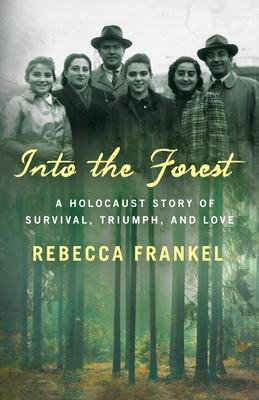
So many books have been written about World War II and, more recently, about the Nazi treatment of Polish Jews. Rebecca Frankel adds Into the Forest to the collection. It is nonfiction that in many parts the reader would wish it to be fiction, that the torture, annihilation, and deprivation should not really have happened. It is the story of the Rabinowitz family, of the many Jews who died, of the love that persisted through two years of living on the move in the cold forests, of digging holes in the ground to hide from Nazis. It is the story of survival, of triumph as the lives of some of the people in the book intersect years and thousands of miles later.
This book was emotionally difficult to read, knowing it is nonfiction, and thus was a slow read for me. The author knew first hand some of the people she wrote about. She spent five years researching and interviewing. There is a huge section of copious notes detailing where her information came from for each chapter.
The Prologue ties the tale together and is worth rereading at the conclusion of the book. There are two chapters that set the stage of what life was like in the little Polish village of Zhetel before the invasion of the Russians, followed by the occupation of the Germans. Then the focus lands on the German-created Jewish Ghetto, the Polish Resistance, and the various “selections” in which laborers and those destined for the mass graves were chosen. The “lucky” escaped to a huge forest, but many died there as hunted animals before the liberation came. The Rabinowitz family had their eyes set on a future in Palestine, but they had many more moves in their future and were caught up in the growing prosperity of the 1950’s. Into the Forest is a challenging book worth reading. It shows Jewish life and customs in the midst of both tribulation and good times. The book thankfully ends on positivity as the author stresses the various types of love woven into the book.
I received a complimentary copy of this book in exchange for an honest review. Opinions expressed in this review are completely my own.
Rating: 5/5
Category: History, Nonfiction, Memoir
Publication: September 7, 2021—St. Martin’s Press
Memorable Lines:
The forest, however, would not be exempt from the war’s brutalities or the bare-knuckled survival required to endure it. Nor would it provide ample shield for the Jews or the partisans—Russian and Jewish alike—who had taken shelter here and set up their outposts in its wilds, no matter how dark or deep. The farther they went and the safer they were, the more determined their killers became to root them out.
In some areas, the advertised reward for information on the partisans or hiding Jews was a single cup of sugar. Which was either a reflection of the paltry value of a Jewish life, or the peasants’ depth of desperation.
But Moscow’s successful onslaught had made the retreating Nazis more dangerous and, however unimaginably, even more murderous. Himmler issued an order to those in the path of the fast-moving Soviet troops: destroy all evidence.
The Princess and the Goblin–multi-layered fairy tale for all ages
The Princess and the Goblin
by George MacDonald

Ready for another, good-for-all-ages fairy tale? My book club read The Princess and the Goblin by George MacDonald, a Scottish minister, poet, and novelist, who inspired and influenced many authors through the ages including C.S. Lewis, Lewis Carroll, J.R.R. Tolkien, G.K. Chesterton, and Madeleine L’Engle. Like The Chronicles of Narnia, The Princess and the Goblin is first and foremost a fun fantasy tale, beautifully written. As it progresses, layers of symbolism are added with themes of courage, honor, belief, trust, virtue, and faith. As any good fairy tale does, The Princess and the Goblin differentiates between good and evil. Children and adults are living in a rather messy world today where ethics often are blurred, but there are still truths that need to be valued. There are morals that hold us to a standard that forms a good society.
With the author’s great descriptive powers, all of the characters are detailed both physically and morally. The goblins are all evil with designs on the full destruction of the human race. The humans in the story are not perfect, but demonstrate character development based on their experiences.
Irene is a little princess who lives in a country castle. Her noble king-papa visits her regularly as he tours his kingdom staying in touch with his people. Irene discovers her great-great-grandmother living in a section of the castle. No one else has seen her or her rooms. She acts as a God figure in the story, guiding Irene to safety and to belief. A very wise woman, she helps Irene understand that not everyone is ready to believe at the same time. This is apparent in Lootie, Irene’s nurse, who has responsibility for the child’s safety and in Curdie, a clever and brave young miner who befriends and helps Princess Irene. The goblins desire the little princess as a mate for their prince.
There is a lot of adventure in this tale as Curdie works underground (literally) to discover the goblin plots and thwart them. The Princess and Curdie are at odds as he does not initially see what Irene sees because the great-great-grandmother does not actually disclose herself to him.
The settings include a castle with lots of hallways, some beautiful mountains, a small miner’s cottage, pitch black caves where miners toil away picking out ore, and goblin caverns and tunnels. These are the backdrops for the dramatic action of the goblins’ convocation, the Princess’ wanderings, and Irene and Curdie’s courageous rescues of each other. The battle scenes are well played out as Curdie defeats them with poetry and foot stomping.
This is a book that I am sorry I missed earlier in my life. I would love to have shared it with my children and grandchildren when they were younger, but I am happy to pass on the word now to new generations looking for well-written books with substance and value. I look forward to reading The Princess and Curdie, which was written eleven years later, as well as some of MacDonald’s other works (numbering over 50) which encompass a variety of genres. I believe that even reading a biography of this author’s life and influence would be quite interesting as his work did not take a straight forward path. He and his family were plagued with health issues, and despite his success and the admiration of his colleagues, he was not always financially solvent.
Rating: 5/5
Category: Fairy Tale, Fantasy
Publication: November 16, 2010—Project Gutenberg (which includes beautiful illustrations by Jessie Willcox Smith from the 1920 version.
First published by Strahan & Co. 1872
Also published by David McKay Co. 1920
Memorable Lines:
Her fear vanished: once more she was certain her grandmother’s thread could not have brought her there just to leave her there…
“But it wasn’t very good of him not to believe me when I was telling him the truth.” “People must believe what they can, and those who believe more must not be hard upon those who believe less. I doubt if you would have believed it all yourself if you hadn’t seen some of it.”
…Lootie had very foolish notions concerning the dignity of a princess, not understanding that the truest princess is just the one who loves all her brothers and sisters best, and who is most able to do them good by being humble toward them.
The Voyage of the Dawn Treader–magical sea voyage
The Voyage of the Dawn Treader
by C.S. Lewis

I absolutely love C.S. Lewis’ The Voyage of the Dawn Treader. It is full of fantastically magical creatures and exciting adventures for Lucy, Edmund, and their cousin Eustace. Although this is not the first book in The Chronicles of Narnia, the reader, whether returning or new to the series, is immediately drawn into the story by the first three paragraphs which describe Eustace, a new and quite unlikable character. As I read, I gradually realized the strong influence of classical literature in this book. The sailing from one unforgettable place to another, sometimes with an escape necessary, is reminiscent of Homer’s The Odyssey, although these interesting characters are clearly Lewis’ own ingenious creations. Royal mermaids and mermen hold a hunt for fish like one might hunt small game in England, but with a trained hawk. The Dawn Treader, belonging to King Caspian and carrying the children and a full crew, is attacked by a sea serpent capable of crushing the ship. There are invisible creatures, the Dufflepuds, who move by jumping wildly from one place to another. With another nod to classical literature, there is a Chief Voice among the Invisibles; his followers echo and affirm him just like a Greek chorus. C.S. Lewis’ literary background and expertise shine brightly in this book.
Woven into the recounting of their escapades, the book has serious themes that are addressed in a distinctly unpreachy way. A major one is greed as Eustace becomes like a dragon hoarding his treasure. Later the group finds pond with water that turns everything it contacts into gold. It also brings out bad character traits, and in the end they all disassociate themselves from the location which they name Deathwater Island. Not surprisingly, greed is also an important theme in The Odyssey.
Although there is not one to one symbolism comparisons between people and ideas found in Christianity and characters and concepts in The Chronicles of Narnia, there are certainly important similar themes. When the travelers need to make important choices, they often find that Aslan has appeared and is staring at them just as Jesus gives his followers wisdom when needed. Chapter 12, “The Dark Island,” is a metaphor for God rescuing us when we are going through dark times. In the last chapter, there is a depiction of going to Aslan’s country (i.e. heaven) and references to the Lion and the Lamb, important symbols in Christianity. These passages are so beautiful; I don’t want to spoil the experience with my own words. You need to read it for yourself as only C.S. Lewis, the inimitable storyteller, can convey the meaning and the feeling with his exquisite word pictures.
Rating: 5/5
Category: Christian, Fantasy
Notes: I read the 50th anniversary edition of the book. The backline illustrations were by Pauline Baynes who was the first illustrator for The Chronicles of Narnia, and the cover art was by Chris Van Allsburg.
Publication: 1952—Harper Trophy (Harper Collins)
Memorable Lines:
Up went the ring, flashing in the sunlight, and caught, and hung, as neatly as a well-thrown quoit, on a little projection on the rock. No one could climb up to get it from below and no one could climb down to get it from above. And there, for all I know, it is hanging still and may hang till that world ends.
“Use, Captain? If by use you mean filling our bellies or our purses, I confess it will be no use at all. So far as I know we did not set sail to look for things useful but to seek honor and adventure. And here is as great an adventure as ever I heard of, and here, if we turn back, no little impeachment of all our honors.”
“I might as well have behaved decently for all the good I did with my temper and swagger.”
 education pathways