Home » Posts tagged 'Civil War'
Tag Archives: Civil War
Under the Tulip Tree–must-read book about slavery
Under the Tulip Tree
by Michelle Shocklee
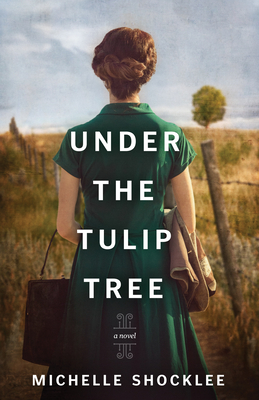
We have all heard it: it is important for us to know history so we don’t repeat the mistakes of the past. Michelle Shocklee does that in her novel Under the Tulip Tree. We get a view of slavery through the eyes of Lorena (Rena), an aspiring writer, who struggles to pursue her career in a male dominated society. She is sixteen when the stock market crashes and her privileged life changes forever. Seven years later she accepts a job with the Federal Writer’s Project (FWP) and meets Frankie who at 101 years old has a horrendous story to tell about what life was like for her and for others who were slaves.
The impact of someone being owned by another person is a concept that is hard for Rena to get her head around. The atrocities that Frankie shares are heartbreaking—even more so when you realize these things are drawn from actual events as told to FWP workers who were employed by the government to interview former slaves and record their stories for posterity.
What makes this story especially impactful is that Rena is telling this story from the viewpoint of a young White woman during the Great Depression. Although slaves had been freed, Blacks still did not enjoy equal rights. From sitting at the back of the bus, to lower pay, to being treated as dirty and ignorant, Blacks suffered from discrimination. Some Whites treated Blacks that way just because they could—acts of control and power. Some Whites treated Blacks that way because they were raised with that mindset, a deep cultural fear and hatred of someone who was different or because their own families had been mistreated by the Feds during and after the Civil War.
Rena’s father was a banker who fell apart after the crash. With her grandmother’s help, her family stayed afloat with both Rena and her mother getting jobs. Employment outside the home was something that was not acceptable for “their kind.” Rena’s mother was especially class conscious and worried about what her gossiping neighbors and former friends would say about Rena consorting with Blacks in Hell’s Half Acre where Frankie lived in a well-kept, small home boasting a beautiful floral garden and an outhouse.
As Frankie tells her story to Rena, the reader is quickly tied into the cruelty of the drama taking place in the book, and it becomes a page turner. It is harder to connect with Rena, but she grows as a person and becomes someone with the potential to do good. You can’t tell a story like this without pondering how a good God can allow bad things to happen. Frankie understandably harbors a lot of hate in her heart, but God works gently on her by bringing Illa, a Quaker woman, and Sam, a former slave, into her life, each encouraging, challenging and helping her.
Shocklee is a masterful storyteller, evoking empathy for 7 year old Frankie and embedding her into the heart of the reader. She shares the difficulties Frankie endured throughout her life without bearing down on graphic details. The author also dives into the “contraband” camp where Frankie lived for three years, still nominally a slave but under the protection of the Federal soldiers. Then she paints a picture of the horrors of war and its aftermath. As we learn about this part of history, we also see how citizens, both Black and White, were faring during the Great Depression. There are several surprising events at the end of this tale that help to bring closure for the characters and the reader.
There is a strong spiritual theme in Under the Tulip Tree. Frankie’s mother, Mammy, is a Christian believer, and although separated from each other early in Frankie’s life, Frankie never forgets her mother’s faith. Another important theme is literacy. Slaves were not allowed to learn to read. It was clear to the masters that slaves who could read could not be controlled as easily. Therefore books were forbidden. Frankie initially wanted very much to read, but the consequences were too great, robbing her of that desire. Standing up for what is right, for the downtrodden, for yourself against the power of the group in control is also a recurrent theme. All of these and many others remain ideas we wrestle with in our current society. On the positive side, we see the strength to be found in literacy, in trusting in God despite the circumstances, in the power in the Word of God, and in love for others—even our enemies.
Rating: 5/5
Category: Historical Fiction, Christian
Notes: 1. My personal thoughts in response to Under the Tulip Tree:
—The problem is not addressed in this book; but, sadly, slavery/human trafficking is widespread all over the world today. It is a major problem in the U.S.
—We make quick assumptions every day about other people based on where they come from, how they look and talk, and so many other factors. People, Black and White, did that in the book, and we still do it today.
- Original stories collected by WPA are available online from several sources. One is sponsored by Rice University: https://libguides.rice.edu/c.php?g=1231494&p=9012494
- Discussion questions are included in the back of the book.
Publication: 2020—Tyndale
Memorable Lines:
[Rena]: “People like me, like my family, we don’t know much about what slaves experienced. I’ve never heard of children being beaten with no one held accountable, or being forced into labor at the age of seven. Even though slavery isn’t legal anymore, I believe it’s important to remember the past as it truly was, not as we wish it to be.”
[Frankie]: “Helplessness washed over me, and I hated myself for it. Ever since the day I was sold away from Mammy, I’d despised helplessness. When overseers beat me and chased me down like an animal, I’d been helpless. When men used my body for their own pleasure and babies died, I’d been helpless to prevent it from happening. But the one thing I’d fought to maintain control over was my emotions. No one could force me to love or hate. They were mine to decide. I wasn’t about to allow this white woman to steal that away from me, no matter her attentive ministrations.”
[Sam]: “Don’t you see, Frankie? The day I landed on Miz Annabelle’s doorstep changed my life. I thought I found freedom when I ran away from my master, but it weren’t mine. Not yet. Freedom comes in knowing the truth of God. He loves each of us the same. He loves you, Frankie.”
The Hour of Peril–The Secret Plot to Murder Lincoln before the Civil War
The Hour of Peril
by Daniel Stashower
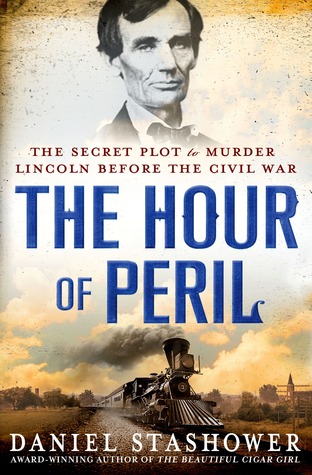
This nonfiction account of an assassination plot against President-elect Abraham Lincoln required extensive research as much was written about the plot at the time, but many of the primary source documents present conflicting perspectives. I don’t think the author of The Hour of Peril, Daniel Stashower, had any intention of creating a tome that parallels current events, but it is hard not to make comparisons as we watch history repeat itself.
The politics of the elite to gain money and power is certainly a theme as well as inciting ordinary people to take extra-legal actions. Good and bad, ethical and immoral, slave vs. free, states’ rights or federal control—they all play a role in the politics of that time.
The rights of men to live freely and the rights of states to determine their own laws clash as the Union begins to disintegrate. Lincoln’s position is that new territories being added must be free, but that he would not advocate changing the slavery laws as they currently existed in the various states in the Union. This position incited those who felt Lincoln went too far and those who decided he had not gone far enough. There were just too many people unwilling to compromise.
As Lincoln headed to Washington, he wanted to greet as many people as possible and was not concerned about his safety. When Allan Pinkerton, a detective with a reputation for being “fierce and incorruptible,” was hired to secure the rail lines the president would be traveling on through Maryland, he discovered that there was a plot to assassinate Lincoln. At that time the focus of his investigation changed. He used the same techniques he had used for years to infiltrate groups planning railway robberies, but his operatives had to intensify their efforts because the time frame for discovery was very short. Pinkerton devised an extremely complicated plot that was successful but did require some last minute changes.
A lot of The Hour of Peril was about Pinkerton and included some discussion of Kate Warne, the first female detective in the United States. Pinkerton requested absolute secrecy of the very few people who were informed of the plot and countermeasures. He was dismayed when he discovered that Lincoln and several people close to the president-elect had, in fact, disclosed information about the travel plans, possibly endangering Lincoln’s life.
The Hour of Peril is not a quick or easy read, but well-worth the time invested. There is much information about and insight into the Civil War era and politics in general to be gained.
Rating: 5/5
Category: History, Nonfiction
Publication: 2013—Minotaur Books
Memorable Lines:
Among those attempting to defuse the crisis was the recently defeated candidate, Stephen Douglas, who selflessly carried a message of unity to hostile audiences in the South, attempting to calm the secessionist fervor and broker a compromise.
He would have been wary of revealing too much in a letter, especially one sent to a politician. As Pinkerton had told Samuel Felton at the start of the operation, “on no conditions would I consider it safe for myself or my operatives were the fact of my operating known to any Politician—no matter of what school, or what position.”
As far as Pinkerton was concerned, there would be no future disclosures. He had sworn the main participants to secrecy, and arranged matters so that the minor players had no sense of the larger plan. In many cases, even those directly involved in carrying out crucial elements of the detective’s design were ignorant of the roles they had played. Once again, secrecy had been the lever of his success.
The Engineer’s Wife–P.T. Barnum’s inclusion disappoints
The Engineer’s Wife
by Tracey Enerson Wood

Historical fiction is a difficult genre for both writer and reviewer. The writer has to juggle how much history should be included with the amount of fictitious information needed to establish the setting and especially to flesh out the characters. The reviewer then must judge the book based less on plot, which is to some degree predetermined, than on the author’s ability to combine history and fiction into a package that is both believable and pleasing.
In many ways I appreciated Tracey Enerson Wood’s The Engineer’s Wife. The subject is interesting. Emily Warren Roebling, a woman restricted by the social conventions governing the women of the mid to late nineteenth century, marries a Union officer. After he resigns his commission, he dedicates his life to his father’s project, the construction of the Brooklyn Bridge. This is a controversial project that proves dangerous to many, including her husband Wash who is an engineer. Rather than choosing to devote herself to the project after Wash is injured, Emily is subtly and progressively sucked into supervising the construction to completion.
The author has a wonderful way with words, and her research into the engineering aspects of the bridge is thorough. My only complaint of this work of historical fiction is the inclusion of Emily’s extended friendship and romance with the famous P.T. Barnum. Given that they lived and worked in the same city, their paths probably did cross, but in her notes at the end of the book the author freely admits that she had no basis for the creation of their relationship. It is such a major part of the story that I felt cheated as a reader. This is a work of fiction with a real setting rather than fictionalized history. Perhaps this work simply lies at the opposite end of a continuum from my preferred reading tastes in this genre.
I would like to extend my thanks to Netgalley and to Sourcebooks Landmark for giving me the opportunity to read this book in exchange for an honest review.
Rating: 3/5
Category: Historical Fiction
Notes: Contains two added sections: Reading Group Guide and A Conversation with the Author
Publication: April 7, 2020—Sourcebooks Landmark
Memorable Lines:
Autumn had painted the trees with brilliant oranges, reds, and yellows. Soon, cold, clear nights would rob the forest, leaving the trees to face the winter stark and barren.
Her lips were drawn tight enough to sling the arrows her eyes aimed at us.
The panic I had successfully tamped down returned like a lion for the kill.
A Long Walk to Water–impactful
A Long Walk to Water
by Linda Sue Park
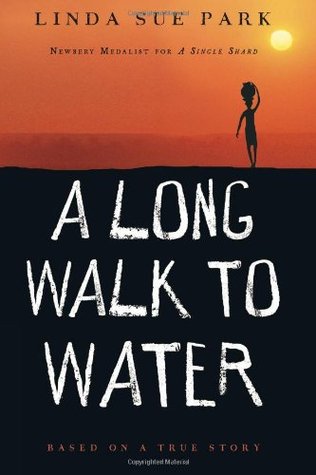
You have probably heard of the Lost Boys of Sudan. In A Long Walk to Water, Linda Sue Park tells the story of one of those lost boys, Salva Dut, who even as a refugee himself, took on a leadership role for 1500 boys in their very long, dangerous, and seemingly hopeless journey for survival. Salva, as a young adult, was chosen out of a refugee camp to emigrate to the United States. This book tells how he transformed his desperate situation into a life giving project for the people of Sudan based on hope, faith, and most especially perseverance.
Told in two timelines with apparently disparate plots, this book moves back and forth with both stories progressing forward in each chapter. It begins slowly, but soon picks up the pace and the reader’s interest. The book starts with the tale of Nya, an eleven year old girl in southern Sudan in 2008 who spends her day traveling from her village to a pond to collect dirty water in a jug which she then carries home on her head. She does this twice a day in extreme heat, traversing with bare feet a thorny path to bring home enough water for her family to survive.
Salva’s story also begins in southern Sudan, but much earlier, in 1985, when his village and school are attacked by armed men during an ongoing confrontation between the Muslim government in the north and the rebels of the south. Thus begins Salva’s separation from his family and his struggle for survival.
Although this book is aimed at a younger audience, as an adult I am so glad I read this story which is based on the lives of real people, Salva and Nya and their families. It reads quickly and lays out the need for clean, accessible water for South Sudan, pointing out the many rippling effects of pure water on a community. It also shows how diverse tribes can work together for a common good. The website noted at the end of the book provides more information and gives a practical way for those of us blessed with plenty to help those without the basic necessities.
Rating: 5/5
Category: Children’s Historical Fiction
Notes: 1. The suggested ages and grade levels vary according to printed reports, but in general: Grades 5-9 and Ages 10-14. The book does a good job of recording hardships and violence without graphic details. Because of the subject matter, I would not recommend it for younger children.
2. The reader will find links to lots of videos about Salva and his project at www.waterforsouthsudan.org.
Publication: October 4, 2011—HMH Books for Young Readers
Memorable Lines:
No one in the group had eaten anything for two days. Their water was nearly gone. Only the vision of leaving the desert kept them moving through the heat and the dust.
It did not seem as if the camp could possibly hold any more, but still they kept coming: long lines of people, some emaciated, some hurt or sick, all exhausted.
He felt as though he were standing on the edge of a giant hole—a hole filled with the black despair of nothingness. I am alone now.
It was hard to keep hope alive when there was so little to feed it.
Into the Frying Pan–medical mayhem
Into the Frying Pan
by Sarah Osborne
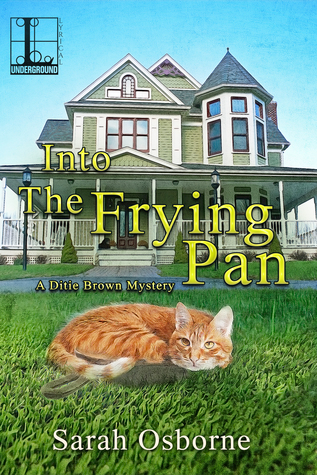 If my opinion of this book were based on the likability of the characters the plot centers around in Into the Frying Pan, it would get a low rating. Fortunately the main characters, pediatrician Ditie Brown and her detective boyfriend Mason, along with Ditie’s adopted daughter Lucie and Ditie’s close friends Lurleen and Danny, do not like these people either. Sadly they were an odd group of former friends from Ditie’s medical school days.
The tale is full of suspicions and secrets when one of the group is killed during a Civil War reenactment. Ugly motives and complicated relationships emerge. Will Ditie be able to protect herself and her children while interviewing former friends to discover the murderer?
I would like to extend my thanks to netgalley.com and to Lyrical Underground (Kensington Press) for giving me the opportunity to read this book in exchange for an honest review.
Rating: 5/5
Category: Mystery
Notes: #2 in the Ditie Brown Mystery Series but great as a standalone.
Publication: May 28, 2019— Lyrical Underground (Kensington Press)
Memorable Lines:
I hung up not sure what I was feeling. I’d put Phil in a category of lousy human being and now he was trying to ease his way out of that box.
Agatha Christie would have loved this gathering. A small clutch of people with one murderer in the mix.
“You see, I learned the hard way that some people get broken by their past and don’t recover from it—that was Carl. I did everything I could not to be like my mother, but Carl became his father. He ran around, had schemes to get money, and always wanted more than he had. I thought I could love him into being a better man, but you can’t do that for another person. They have to do it for themselves.”
We Hope for Better Times–discrimination across the years
We Hope for Better Things
by Erin Bartels
 This work of fiction begins in the present day where the story centers on Elizabeth Balsam, an investigative journalist in Detroit, Michigan, always looking for a good story. She thinks she has found it when a stranger asks her to return a camera and some photos of the ’67 Detroit race riots to a relative of hers that she doesn’t actually know. This is interesting timing as she has just lost her job when outed during undercover work. Is it possible that what seems like a devastating blow to her career will be the best thing that could have happened to her?
Suddenly the author drops us into Detroit in 1963, and we are introduced to an interracial couple. This is a thread that ties right into Elizabeth’s story as she meets Nora. This elderly relative probably has a story to tell if she can just be coaxed into telling it. This new plot thread segues into the story of yet another family member, Mary Balsam. Mary’s home is in Lapeer County in 1861, but it is now Nora’s home.
All three generations involve interracial couples, and author Erin Bartels tries to present the problems each generation encounters. We witness the horrors and sadness of racial issues that run the gamut from slavery to discriminating glances and everything in between.
Each plot thread is strong and as each chapter ended, I couldn’t wait to get to that part of the story again as the chapters cycled through each woman’s tale. As the book draws to a conclusion, the threads become tightly knitted together forming the family’s story.
Although We Hope for Better Things is fiction, it has the feeling of “it could have happened.” The Christian aspects are not prominently featured, but there is an important theme throughout of God’s plan for a person’s life. A sub-theme is the Christian community’s response to runaway slaves in the 1860’s in Mary’s small community during the Civil War.
This is an important work of historical fiction especially for those interested in the Civil War, the riots of the 60’s, or the current progress or lack of it on racial issues. The author presents events in the context of the culture during the specific time period. This novel focuses on the women in each generation and gives a more complete portrayal of them than of the men in the story, and that is probably how this tale needs to be told.
I would like to extend my thanks to netgalley.com and to Revell for giving me the opportunity to read this book in exchange for an honest review.
Rating: 5/5
Category: Christian Fiction, Historical Fiction
Publication: January 1, 2019—Revell
Memorable Lines:
I was getting less twitchy about not having internet access. I didn’t exactly miss hearing the constant beeps notifying me of texts and tweets and status updates. Out here it was just the ambling, quiet life of the country. A comfortable obscurity.
“That’s good money.”
“What do we need it for? We’re making ends meet.”
“Barely. We’re not getting ahead.”
“Ahead of what? If you have enough to live, what do you need more for?”
“There’s no one right path that if you make the wrong choice you’re sunk. Whatever you choose to do, God can use that. Life is always a winding path. It’s only in retrospect that it appears to be a straight and inevitable one.”
Road Trip to the South!
This summer I took a road trip from New Mexico to the South to visit friends and family. My route took me through the Texas Panhandle, Oklahoma, Missouri (going East), Kentucky, Tennessee, North Carolina, and Arkansas (going West). I was driving my appropriately designated “Desert Sky Blue” Ford Thunderbird, but going through my head was “See the U.S.A. in your Chevrolet.” I hope the people who came up with that ad campaign, tune, and lyrics were well compensated–now that was branding!


Most of my time was well spent reminiscing and catching up. I was treated to some sightseeing along the way.


Paducah, Kentucky, is restoring its downtown area. So much interesting history there! We had a delicious lunch at a bakery that survived a major flood and currently includes a café, walked the brick paved streets admiring period storefronts, viewed fantastic murals along the riverbank, and lingered in a local museum with fascinating memorabilia.


In Asheville, North Carolina, I enjoyed the Blue Ridge Parkway.

In Chattanooga, Tennessee, I went to the National Cemetery. It may seem like a strange place to visit, but I have memories of going there as a little girl with my father like you would go to a park. I had a fuzzy recollection of a “train statue” and was eager to make a better connection. There is a memorial there to Andrews’ Raiders and the Great Locomotive Chase, a military raid in 1862 during the American Civil War. The locomotive pictured below is a model of The General. The memorial is surrounded by tombstones of some of those involved and indicates which ones were executed, escaped, or exchanged.


A bit of history has been brought to life in the James County Courthouse which has been remodeled with a wedding chapel upstairs and a tearoom, which I highly recommend, beneath–wonderfully decorated, delicious food, and a friendly staff.

Always good to travel and always good to return to a place you call home. The New Mexico desert is a welcome sight as I head towards my mountain retreat.

 education pathways