
Home » Posts tagged 'church'
Tag Archives: church
Even if He Doesn’t–suffering and trust
Even if He Doesn’t: What We Believe about God When Life Doesn’t Make Sense
By Kristen LaValley
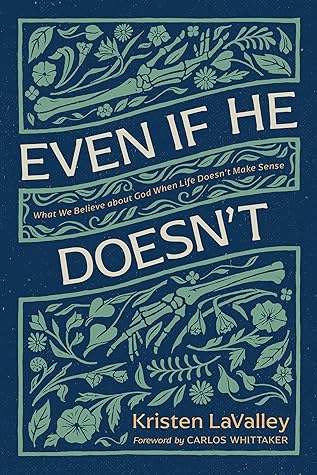
Life is not easy and it certainly can be messy. Just ask Kristen LaValley who with her husband suffered a miscarriage, loss of position in their church, income, and home through what certainly felt like betrayal by friends who turned their backs on the couple. They were faced with the necessity of deciding who should live—twin 1, twin 2, and/or mom. Along with traumatic events over the years, add in the changes that accompany situations like this—finding new friends and trusting them, moving, knowing what to say to well-meaning friends and family, anxiety attacks, health issues, and reconciling their life complications with what they know about a good God.
LaValley does not compare her sufferings with anyone else’s—suffering is suffering. She shares what it meant in her life and describes God’s faithfulness as she made her way through her life journey. Her story is not a comfortable one, but it is valuable to see how she relied on God through the high and low points. It is important to see how God is with us even when He doesn’t answer prayers the way we think He should. He is good because that is His character.
I received a complimentary copy of this book in exchange for an honest review. Opinions expressed in this review are completely my own.
Rating: 4/5
Category: Christian, Nonfiction, Religion, Spiritual Growth
Notes: 1. For some reason, my digital copy of this book disappeared so I checked out an audio version from my library. I’m glad I did. The author did a great job of reading her own book. We all suffer in different ways, and we all know others who are suffering. We need to know how to react to those in pain. Even if you don’t agree with every detail in the book, you can benefit from it. Life is a journey, and we are all involved in discerning the best way to trust in God and move forward with Him as our guide. You are not necessarily at the same place in your trip as LaValley is, but we share a common struggle.
2. Even if He Doesn’t includes a lot of Scripture references that LaValley uses to support her thoughts on suffering.
Publication: February 20, 2024—Tyndale Momentum
Memorable Lines:
The comfort of “even if he doesn’t” isn’t just that one day he will, which I fully believe. It’s that he’s good anyway. He’s faithful anyway. He’s loving anyway. Even when he doesn’t.
When our image of God is dependent on things going the way we believe they should, our image of him is centered on us, not on him. But true faith isn’t believing God is good just because we have proof of it. Faith is believing that he’s good even when we don’t have proof.
The idea that God wants us to suffer (for any reason) stands in direct contradiction to the life, testimony, and work of Christ. Jesus came to take our suffering on himself, not to have us prove something by our own suffering.
Rediscovering Christmas–finding joy after tragedy
Rediscovering Christmas
by Mindy Obenhaus
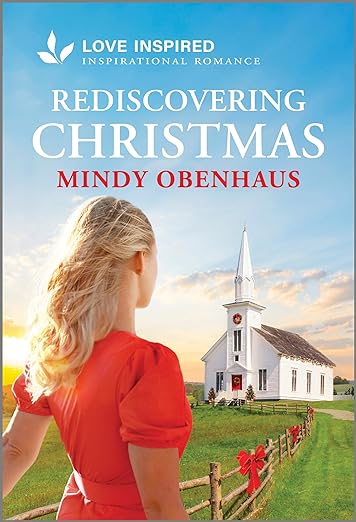
What does it take to weaken a Christian’s faith in God? In the case of Tori Stallings it was the death of her husband and her mother and the complete destruction of her home by fire. These sequential catastrophes in just a few years time left Tori devastated despite the support she had from friends, family and co-workers.
Tori had learned to be independent over the years as her confident and dashing husband Joel devoted more time to his country than to his family. His quiet brother Micah quit the military when his brother died to try to pick up the pieces for Tori and her son Aiden. His secret is that his friendship with Tori was more than that when they hit their teenage years, but he kept his crush hidden when she was obviously attracted to Joel.
Tori and Micah are thrown together when she loses her home and she and Aiden move into the family home Micah shares with his mom. Aiden, an adorable six year old, never really knew much of his dad, and Uncle Micah became the father substitute in his life, a relationship Micah and Aiden both enjoyed.
Although there is a growing attraction, Tori and Micah need to get over the feeling they are doing something wrong since Tori is his brother’s widow. Also, Tori is angry with God, and Micah knows that he can’t pursue a relationship with her until she works through her anger and realizes she needs to put her trust for the future in God’s hands.
There are multiple obstacles to be overcome and lots of good people to help them as they face the issues that come when disasters strike and faith is tested.
I received a complimentary copy of this book in exchange for an honest review. Opinions expressed in this review are completely my own.
Rating: 5/5
Category: Romance
Notes: 1. It was only when I reached the notes at the end of the book that I realized that this book (#6) is the last of the Hope Crossing series, so it certainly could be read as a stand alone.
2. This was my last Christmasy book for 2024 and it made a fitting ending. Faith and having the heart of a servant were threads all through the book. In the process of righting her relationship with God, Tori also rediscovered the joy of the Christmas season with help from Micah. Christmas decorations and traditions reestablished for their first Christmas after the fire helped Tori rediscover Christmas as well.
Publication: November 26, 2024—Harlequin
Memorable Lines:
None of them spoke because there’d been nothing to say. There was no room for platitudes at a time like this. He was certain Tori would hear her fair share of those over the coming days, weeks and months. But he and his mom cared about her too much for that. Sometimes the best thing you could do was to let someone cry.
“…you’ve faced more than your fair share of loss in recent years. It stands to reason that you’d be hurting and angry. But be aware, my friend, while you might try to run from God, you can’t outrun Him. And I know this for a fact because He loved me enough to pursue me even when I chose not to trust Him.”
“We’re not called to understand everything that happens in our lives. We’re called to trust Him with our lives, come what may.”
Epiphany: The Season of Glory
Epiphany: The Season of Glory
by Fleming Rutledge
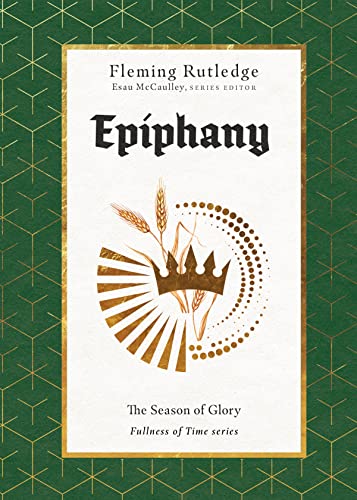
If you didn’t know anything about Fleming Rutledge before you began her tome on Epiphany, you would certainly quickly ascertain for yourself that she is a theological scholar. One of the first women to be ordained by the Episcopal church, she has spent her life studying the Bible and serving as a priest. As an author she has written many books and is known as an expert on the works of Tolkien. There is no fluff to be found in Epiphany: The Season of Glory.
Epiphany is celebrated on January 6 as the day the Magi brought their gifts to the Christ child, manifesting the glory of God and acknowledging the inclusion of Gentiles in the worship of Jesus. The day in many churches is extended into a season which celebrates other events in which the glory of God is preeminent: the baptism of Jesus by John the Baptist, the miracle of wine at Cana, and the transfiguration on the mountain top.
This book explains why we celebrate the day and season of Epiphany. It is a deep study which answers many questions for the reader and may well initiate many new questions. It is a work that requires time, careful reading, and thought. As other theological books, there are footnotes at the end. Many are reference sources for ideas and quotes in the book. Rutledge’s footnotes, however, include expansions on the various topics within and enlarge the experience for the reader. They are as interesting and thought provoking as the main body of the book.
Epiphany: The Season of Glory is part of the Fullness of Time Series which seeks to explain the liturgical calendar of many churches such as Anglican, Episcopal, and Lutheran. Many other churches are also finding renewal through experiencing the traditional seasons. As the editor of the series states “We want readers to understand how the church is forming them in the likeness of Christ through the church calendar.” The six books in the series are by different authors and can be read as standalones. This book is more intellectually challenging than the other books in the series, but they are all worthy reads.
Rating: 5/5
Category: Nonfiction, Christian, Religion
Notes: standalone, but part of the Fullness of Time Series
Publication: 2023—InterVarsity Press
Memorable Lines:
There will always be those who do not recognize him, but they will nevertheless be in his sight and have a part in his eternal plan (see Romans 11). The church, however, in its observance of Epiphany, is to take care of its calling, to point to Christ’s glory, and let his glory take care of itself.
Telling stories about Jesus, what he said and what he did, is an essential part of spreading the gospel. But without the doxa, the glory of the only Son from the Father, it is an incomplete gospel.
The season teaches us to value the entire fellowship of believers, because Jesus calls persons to himself without regard to their station, reputation, accreditation, or accomplishments—and we see how we can begin to be transformed by the action of his Hoy Spirit working through the unearned and undeserved gifts that he bestows.
A Christmas Gift–sacrificing during hard times
A Christmas Gift
by Glendon Swarthout
illustrated by Myles Sprinzen
The story of this novella is told from the viewpoint of James Chubb, a thirteen year old boy who is sent from his home in Pennsylvania to his grandparents’ farm in Michigan. In the Great Depression, James’ father can not find work, any kind of work, to support his family. Like many other children in that generation, James was shipped off to live with relatives he had only visited twice. His grandparents were nice, however, and James worked hard for them.
A Christmas Gift covers several generations with a special focus on James’ great-grandfather who died in the Civil War. The reader sees the effect of war on multiple generations and the impact of the Great Depression on hard-working men who feel the shame of not being able to put food on the table. Many of those people would not accept government handouts, which even if accepted were still not enough for survival.
It was certainly not a good year for Christmas gifts. Some children received one practical gift like galoshes or a handmade gift such as a scarf. Many, of course, did not get anything for Christmas. In this story we see an abundance of love in a sacrificial gift.
Swarthout describes in detail the melodeon and the OilPull tractor that play key roles in the plot. He writes about the events of this story in such a way that you feel like you are there witnessing the difficult birth of an out of season lamb and the exhaustion of his grandfather during an evening like no other. He inserts some amusement in the participation of a family of daughters and some wonder in a magical Christmas Eve rescue.
Swarthout is an award winning writer, and his expertise shows in A Christmas Gift as he takes the reader on a journey back in time and into a rural farm setting. There are terms that the modern reader will find unfamiliar as James uses slang from the day. One funny touch is the inclusion of the use of a “party line” on their telephone service.
The trip skillfully manipulates emotions so that the reader feels close to this thirteen year old. Although it is not light-hearted,there is joy and also melancholy to be found in the tale. It is a story that in many ways defies typical genre classification. It is a good read, but each reader needs to decide if it achieves the classic status some feel it deserves.
Rating: 4/5
Category: Historical Fiction, Novella
Notes: 1. This book has also been published under the name The Melodeon (Doubleday, 1977) and has been made into a movie with the title A Christmas To Remember (1978).
2. YouTube has some great videos that will help the author’s wonderful descriptions of the melodeon and the Rumely Oil Pull tractor come alive.
Publication: 1992—St. Martin’s Press
Memorable Lines:
Ella kept two hundred chickens. “Good layers,” she called them — a characteristically rural understatement. Those Leghorns of hers were cornucopias, mother-lodes, veritable volcanoes of eggs.
Our ring was three long and one short, and after five minutes I decided some of the garrulous wives in the neighborhood must be on the line, so I lifted the receiver and listened in. Universal sin absolves individuals, and since everyone did it in those days, listening in on a party line was not considered sinful.
“You have to take the vinegar with the honey. That’s marriage for you.”
Surprised by Oxford–an intellectual’s search for meaning
Surprised by Oxford
by Carolyn Weber

Carolyn Weber had quite a culture shock when, as a scholarship student, she transported herself from Western Ontario into the revered halls of Oxford University. In that first year of working on her Master of Philosophy degree, she was introduced to a different system of learning and classes. She was expected to learn for the sake of learning and to pursue academic interests through tutorials—meetings of small groups of students with a professor. Along with tea or sherry, the groups dove into intellectual pursuits that exhilarated this future professor of literature.
Along the way, Weber discovered a diverse group of friends from a variety of backgrounds who challenged each other in the friendly way comrades can have in the pub over a pint at the end of a long day of studying. She discovered a diversity of spiritual beliefs from atheist to Eastern religions, but none kindled in her the desire to investigate like the Christian faith did. The Christian students and professors were not what she expected. No one was standing on street corners thumping a Bible. Instead, when they found she was interested, they encouraged her to actually read the Bible and to attend groups where the writings of C.S. Lewis were discussed.
Through Surprised by Oxford, I learned a lot about the University of Oxford that contradicted the stereotypes that are generally shared in media. It was interesting to watch her personal and intellectual growth, to see her search within herself for spiritual meaning and communication with God. Obviously a lover of literature, Weber begins each chapter with poetry and sprinkles other lines of poetry throughout the book, especially as she and her friends quote poetry to each other in the context of their discussions.
Rating: 5/5
Category: Memoir, Christian
Publication: 2011—Thomas Nelson
Memorable Lines:
I had no real need of believing in men, God incarnate or otherwise. Fathers especially were not to be trusted. They did not even seem relevant really. That much I had learned. That much I brought with me.
“Despair is the greatest sin,” Dr. Nuttham finally responded slowly. “It involves forgetting that God is there. Forgetting that He is good and that all He is and does extends from and works toward this perfect goodness. That doesn’t mean that He allows evil, or creates it, or perpetuates it. That’s our entwinement. Rather, He uses even our evil toward His good. We all need forms of remembering this first great love…writing, reading, creating, being.”
“Jesus brings the most radical message there is into any society at any time: you are beloved; you are worth a price that only the God of the universe could pay.”
Tess of the d’Urbervilles–new look at a classic
Tess of the d’Urbervilles
by Thomas Hardy (and Karen Swallow Prior)
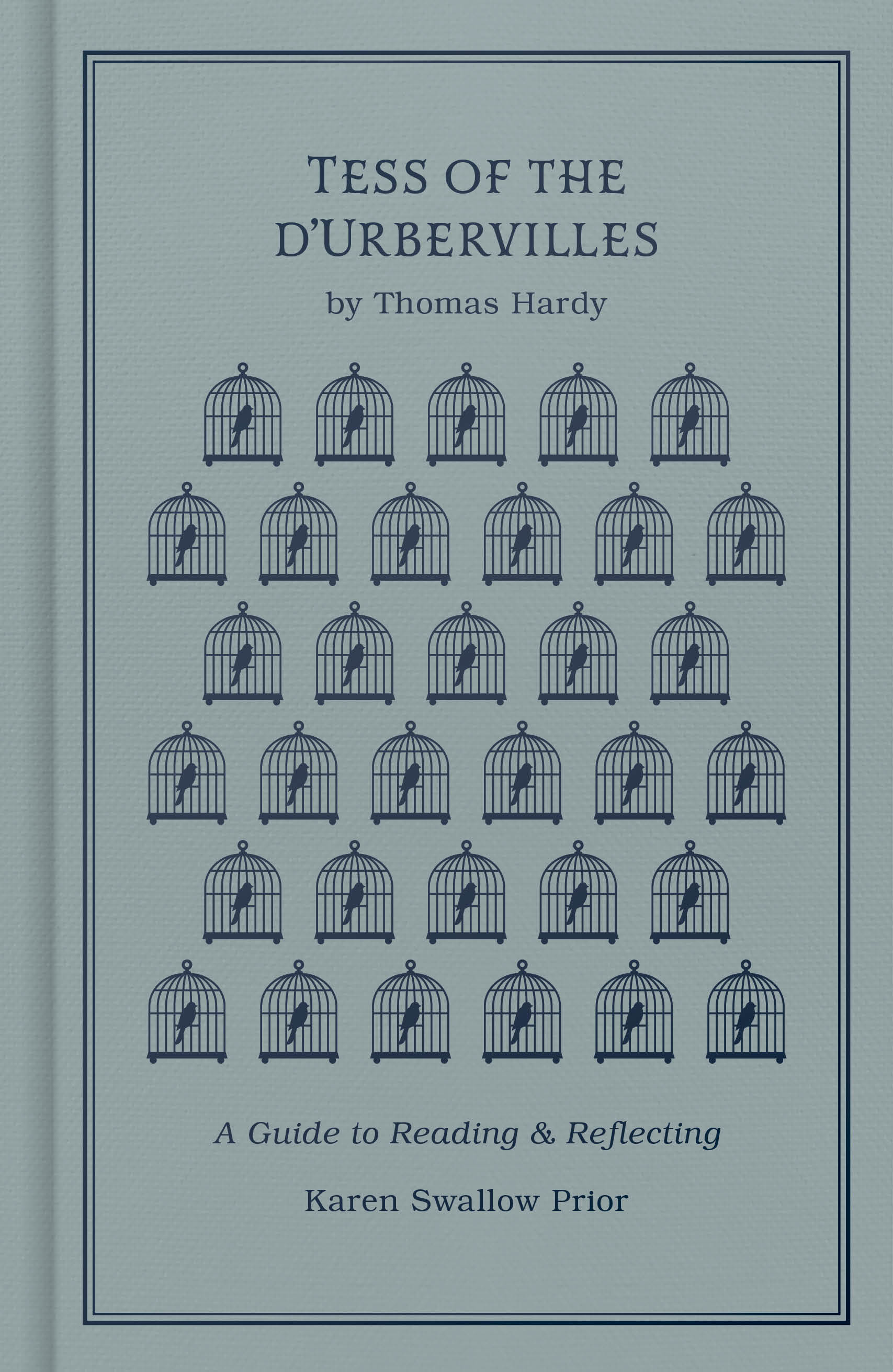
First published in serialized form in 1892, this classic has been read and studied over the years. Summaries are available everywhere on the Internet, so I want to share with you the particular edition I read this summer with my book club. It includes “A Guide to Reading and Reflecting” by Karen Swallow Prior who is a literature professor and author herself. We have read other books that include her notes, but I think this is the best one of the series that we have read.
Prior gives a lot of background on Thomas Hardy and the times in which he lived that are essential for understanding Tess of the d’Urbervilles. Born to a working class family, he longed for a scholarly life which at times seemed out of his reach. For example, he desired ordination but was unable to afford the university costs and so became a draftsman for a church architect. He studied on his own, and this book is full of classical and Biblical references. He also read books that are contradictory to traditional Christianity. He became an agnostic who attended church all his life. These are a few of the conflicts that show up thematically in Tess of the d’Urbervilles along with sexual purity being essential to women, but not to men. The plight of agricultural workers can not be missed as well as the difficulties of overcoming class rules and status. Nature itself and self-determination are also central themes.
In this edition, Prior helps the reader delve into the deeper meanings of the book. Hardy creates interesting characters and a solid plot, but also a certain line to destruction and despair for Tess. Prior points out Hardy’s use of literary techniques but also how to read this novel from a Christian worldview. I think her comments would also be interesting to those with a secular point of view.
Prior does not change anything in the original text. She does include brief, helpful footnotes that explain words that might be unfamiliar to a modern reader as well as classical allusions. Hardy divided the book into seven sections called “Phases.” Prior ends each phase with reflection questions which are valuable in pointing out aspects the reader might miss and in demanding deeper introspection. Prior concludes the book with questions “For Further Reflection” which apply to the text as a whole.
Rating: 5/5
Category: Classic, Fiction
Notes: There are currently 6 classics in this series.
Publication: 2022—B&H Publishing Group
Memorable Lines:
From Prior: Tess of the d’Urbervilles is not merely dark and pessimistic but is tragic—tragic in the true literary sense.
From Hardy: The clock struck the solemn hour of one, that hour when fancy stalks outside reason, and malignant possibilities stand rock-firm as facts.
From Hardy: It is Tess Durbeyfield, otherwise d’Urberville, somewhat changed—the same, but not the same; at the present stage of her existence living as a stranger and an alien here, though it was no strange land that she was in. After a long seclusion she had come to a resolve to undertake outdoor work in her native village…
The Ministry of Ordinary Places: Waking Up to God’s Goodness Around You
The Ministry of Ordinary Places: Waking Up to God’s Goodness Around You
by Shannan Martin
 Where is a Christian’s mission field? You know, the ordinary person who has not been called to go to another country? Shannan Martin in The Ministry of Ordinary Places says it is wherever God has placed you. She doesn’t advocate passing out pamphlets, cornering people, or pushing invitations to come to church. Instead, we are to love people, listen to them, invite them into our homes, be available to them and to the opportunities to help them as God presents them to us.
As a rural introvert, Martin has had to change a lot in opening her heart, time, and home to her neighbors in a multicultural setting. She had to “choose the comfort of the past or the struggle of moving forward.” She learned that hospitality is not perfection in entertainment; it is extending invitations willy nilly, throwing together some tacos, and letting God take it from there. She has learned to receive kindness from others, understanding the cost of that kindness from someone who is down and out.
Martin’s story is engaging, and her writing style is excellent from the humorous “Go with God, good middle school bus driver. You are a rose among loud, hormonal, Hot-Cheetos-for-breakfast-eating, lanyard-flipping thorns” to sharp edged descriptions such as “She has known the desolate landscape of struggle. Hunger and wanting blow through her life like gale-force winds through a thin cotton jacket.” There is magic for the reader in words like these.
Martin does not believe in pushing Jesus down anyone’s throat; she makes her own heart accessible and invites others into her life where they not only see, but feel, the impact of Jesus on individual lives.
I would like to extend my thanks to netgalley.com and to Thomas Nelson for giving me the opportunity to read this book in exchange for an honest review.
Rating: 5/5
Category: Christian
Publication: October 9, 2018—Thomas Nelson
Memorable Lines:
Only as we engage in the hidden practice of listening do we learn about the struggles of others, gaining empathy where we one cast judgement.
It’s so easy to tip into judgment when we view the world through an us-them dichotomy. Sitting face-to-face, the problems loom larger and we have to contend with the sticky fact that there is simply always more to the story.
…we are all longing to be part of something bigger than ourselves. Sometimes we get so hung up on doing something great, we forget the best thing is often the smallest.
Death and Daisies–magic and murder in Scotland
Death and Daisies
by Amanda Flower
 Fiona, who has inherited a home in Scotland, a magic garden, and most importantly the position of Keeper of the Garden from her godfather, Ian, is joined in the book by her much younger, at-loose-ends sister Isla. Fiona is opening her flower shop named the Climbing Rose Flower Shop after the 300 year old rose growing in her magic garden in Duncreigan. Some townspeople are welcoming and friendly like Raj and Pasha, twins in their sixties with calming and wise ways. Others view the sisters with suspicion for their strange Tennessee accents and ways and their association with the magic garden. The local minister is so opposed to Fiona that he publicly bans her from the church.
Death and Daisies by Amanda Flower centers around a murder, threatening notes, an abusive spouse, and drugs. Fiona is compulsive about investigating despite a scary vision that might potentially foretell her death and the warnings of Chief Inspector Neil Craig who is afraid she will be hurt.
Death and Daisies is a fun and fascinating cozy mystery you will not want to put down. Filled with interesting characters and lots of twists and turns in the plot, this tale has room for character development and an interesting setting. The murderer and the reason for the murder surprised me. The author has another surprise for Fiona and the reader toward the end of the book on a very personal level. There is closure to this book, but also several issues that deserve further attention. I can’t wait for the next book in the series.
I would like to extend my thanks to netgalley.com and to Crooked Lane Books for giving me the opportunity to read this book in exchange for an honest review.
Rating: 5/5
Category: Mystery
Notes: #2 in the Magic Garden Mystery Series but works well as a standalone
Publication: November 23, 2018—Crooked Lane Books
Memorable Lines:
“St. Thomas Church, as it stands today, is much younger. It was built in the seventeenth century.” She said this like the seventeenth century was last week. If anything was over one hundred years old back in Nashville, they turned it into a museum and built a fence around it. In Scotland, “old” had quite a different definition than I was accustomed to.
I didn’t want to break it to her, but no one had their life figured out at twenty-two. I didn’t have it figured out at thirty, and I wasn’t expecting fifty to be much better.
“But no one should make an apology expecting one in return. That ruins it for both parties. It is better to say you are sorry and be at peace.”
 education pathways