
Home » Posts tagged 'Christians'
Tag Archives: Christians
The Watchmaker’s Daughter: the true story of World War II heroine Corrie Ten Boom
The Watchmaker’s Daughter
by Larry Loftis

The Hiding Place, the original popular story of Corrie ten Boom, written with John and Elizabeth Sherrill, was released in 1971 and made into a movie in 1975. Corrie, skilled in watch repairs, and the rest of the ten Boom family saved many Dutch—both Jews and non-Jews—from being sent to prison, concentration camps, and labor camps by German Nazis in World War II.
Although The Hiding Place was a landmark book in telling the story of this remarkable Christian lady, Larry Loftis has gone even further in writing The Watchmaker’s Daughter. His research into the background of the World War II setting of the book sets the reader up to better understand the times culturally and politically and the invasion of Holland. His research includes examining photos and original small books by Corrie ten Boom along with memorabilia that are archived in the Billy Graham Center Archives at Wheaton College. Corrie ten Boom did not keep a diary, but Loftis sought out many other primary sources including journals and letters from survivors who had been hidden in the ten Boom home.
Corrie and her older sister Betsie were interned in Ravensbrück Concentration Camp for their crimes of hiding Jews. There these Christian sisters had a ministry within the barracks, holding secret Bible studies and encouraging the other women to hold strong despite the horrible conditions and continuous threat of execution. Upon release, Corrie began a ministry of traveling internationally with a message of forgiveness and established 3 different centers, one in a transformed concentration camp, to meet the physical and emotional needs of survivors. Betsie had a vision of the centers while they were still in the camp at a time when the fulfillment of her vision seemed impossible. Corrie’s story is an amazing one showcasing the love of God and the power of forgiveness.
Rating: 5/5
Category: Biography, Nonfiction, Christian, History
Notes: Even if you think you know the story of Corrie ten Boom, I encourage you to read this book. Corrie’s story is unforgettable, and her courageous life of dependence on God extended way past the events in Ravensbrück. Loftis’ research and writing along with Corrie’s life and faith make this book remarkable.
Publication: 2023—HarperCollins
Memorable Lines:
This was the hardest part—the hatred. Over ensuing days Corrie tried to be nice to the woman, but to no avail. “She seemed to be entirely devoid of human feeling,” Corrie recalled, “and altogether hard, hostile, and wicked…Why should they always snap and snarl at us? I always greeted them with a pleasant ‘Good morning,’ but everything seemed to glance off their impenetrable armor of hate.”
“My sister died here,” she told Tiny. “She suffered so much. I, too, have suffered. But Jesus is always with us. He did a miracle in taking away all my hatred and bitterness for my enemies.”
For more than fifty years the Beje had been her own hiding place, her refuge. But Ravensbrück had taught her that this magnificent home—with all of its memories—was but a shadow; her true hiding place was Christ.
Pentecost: A Day of Power for All People
Pentecost
by Emilio Alvarez
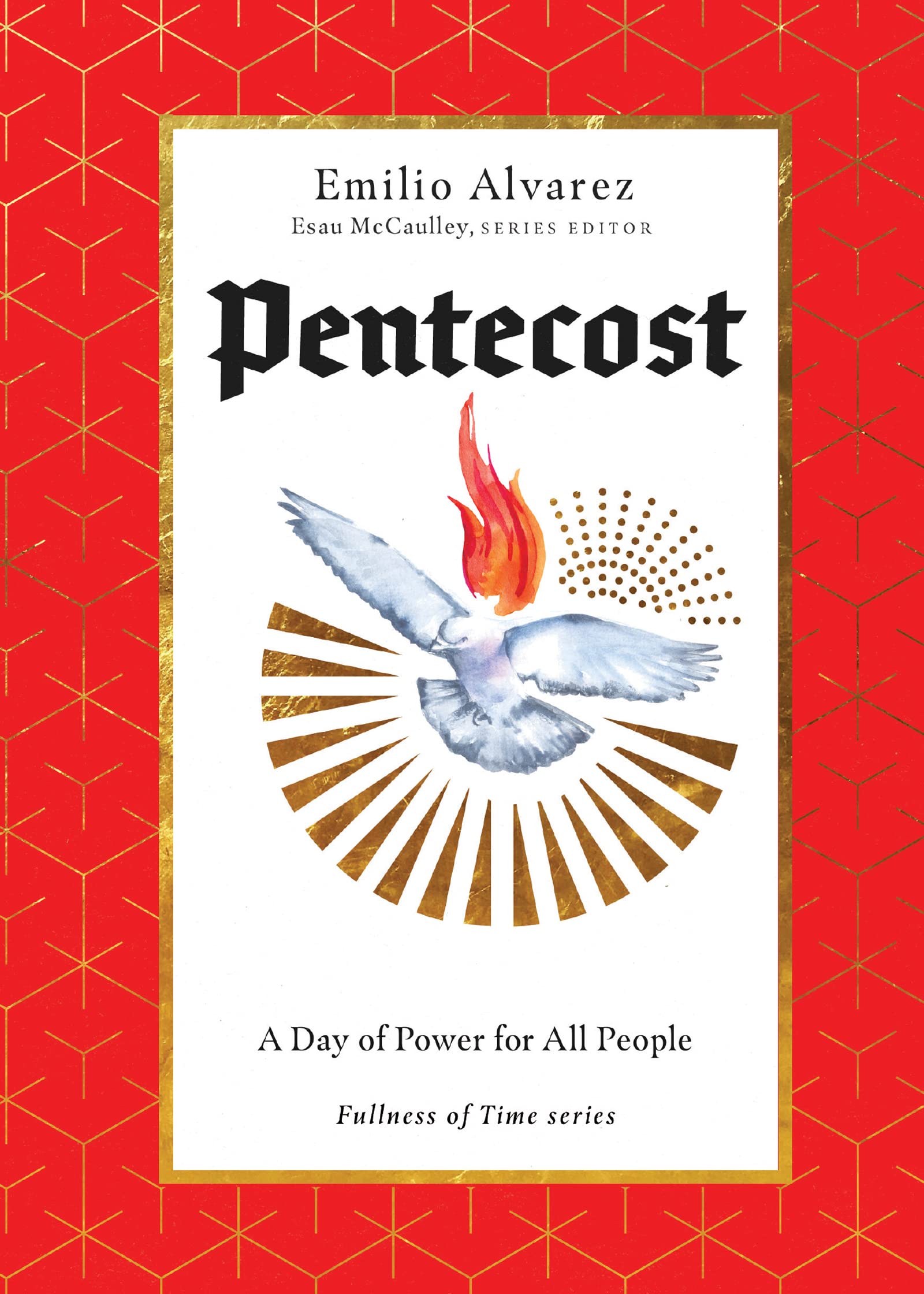
Pentecost is celebrated by Christians as the day when the Holy Spirit came to the early Christian church empowering Jesus’ followers to evangelize the world with the good news of salvation to all who believe that Jesus Christ died for their sins and was resurrected on the third day as He foretold. The writer Luke in Acts 2:1 sets the stage for the narrative with “when the day of Pentecost was fully come.” Jesus’ followers had been waiting for the prophecy to be fulfilled but were not told exactly when that would be. Pentecost is celebrated 50 days after the Jewish Passover. The author of Pentecost, Emilio Alvarez, writes that this season of waiting is a time to prepare our hearts. Fittingly, this book is part of the Fullness of Time series.
This little book begins with a discussion of the concepts of power and of pilgrimage. Next Alvarez devotes a chapter to various Jewish feasts that are the roots of the Pentecost celebration. Then a chapter is devoted to the speaking in other tongues as the Holy Spirit on that day of Pentecost enabled the Jews gathered from many nations to speak in each others’ languages. He relates this phenomenon to a reunion of peoples and a reversal of what happened at the Tower of Babel.
A large part of the book Pentecost is devoted to the rituals and liturgy related to the celebration of Pentecost ranging from the dates of remembrance to the custom of specific colors used for decorations and clothing and on to practices of kneeling or standing. Within the unity of Christian worshipers, there is a diversity of groups who celebrate in many different ways. Alvarez chooses to discuss the Christian tradition found in these five churches: Eastern Orthodox, Roman Catholic, Syrian Orthodox, Anglican, and Pentecostal. From this discussion you can extrapolate that there are a number of ways to celebrate Pentecost. They vary by culture, tradition, and understanding of Scriptures. The hymns, prayers, and Scriptures of these five traditions are just samples of the many available to Christians, and this theological scholar invites Christians to draw from other groups’ practices to enrich, not dilute their own. He ends this section with an interesting testimony of his own spiritual background as a Pentecostal Christian which differs greatly from the liturgies in the other church groups examined in this book. It is a personal spiritual journey which neither discredits nor confirms the formal liturgies found in the other churches mentioned. There are truths and blessings to be found in all of these traditions.
Upon a first reading of the Conclusion, I found it to be beautifully written, helping the reader to imagine the first Pentecost. Upon a second reading I realized I was in disagreement with the author. While I, also, want all people to overcome the “differences in race, culture, and religion,” I do not connect that as a necessity upon which the coming of the Holy Spirit depends. In Acts 1:4-8, Jesus told his followers that they should wait in Jerusalem until they received baptism of the Holy Spirit which would empower them as witnesses. Jesus had said that he would send the Holy Spirit. Just like salvation, this empowerment is a gift of God, not something we can earn.
Overall, I profited from reading this book. It gave me much to think about, and I had my view of the practices within many Christian churches widened.
Rating: 4/5
Category: Religion, Christianity, Theology, Nonfiction
Notes: 1. This is probably not an appropriate book for someone new to Christianity, but might be helpful to someone looking to understand formal liturgical church services.
2. I have read three other books in the Fullness of Time series, and this is my least favorite. I personally battle between it being highly edifying and overly pedantic.
3. I read this for my book club, and it was full of topics for discussion. My understanding of the book profited from hearing other viewpoints.
Publication: 2023—InterVarsity Press
Memorable Lines:
…no matter where we are in the world, and no matter what Christian tradition we belong to, at Pentecost all those who believe in the coming of the Holy Spirit sing and glorify the Most Holy Spirit, and God hears it as if it was coming from one voice.
At Pentecost we are awakened from the delusion that only our race, ethnicity, culture, political party, or language matters, is important, or is even truly Christian. This is one of the great errors of postmodernity, this division through delusion. In remembering Pentecost, however, we once again call on the Spirit to illuminate the dark areas of our lives and confront our delusion with godly wisdom and truth.
There is nothing we can successfully rationalize or theologize about Pentecost that would cause all Christian parties to nod with complete approval, yet there is nothing we can do or say against it that discredits its success in evangelizing the nations.
Everything Sad is Untrue–memories are culture carriers
Everything Sad is Untrue
by Daniel Nayeri

Daniel Nayeri’s Everything Sad is Untrue is part memoir and part storytelling where he fills in the things he doesn’t remember exactly from his childhood. The first part of the book is a mixture of three kinds of stories—myth, legend, and history—that attempt to place the reader in Daniel’s past and his ancestry as it happened and as he imagined it might have happened. He relates “story” in this way to help the reader understand the very different Persian culture he started his life in and which formed his beliefs and attitudes.
Although there are no chapters in this book, the reader can clearly tell when the story pivots from providing background to relating the events from the time his mother became a Christian on a visit to the West. She embraced Jesus and her faith in Him wholeheartedly. Christianity in Iran is a capital offense, so she had to take her children and flee. She traded a comfortable life as a respected physician married to a successful dentist for the life of an impoverished refugee, looked down on because of her language, menial job, and poverty. But she had Jesus, and no one could take that away from her.
Some of the book tells about the year they spent in a refugee camp in Italy. It was not actually a camp with tents, but a concrete building with small rooms and a bathroom. The residents were refugees from many countries, all waiting for the U.N. to find a place that would accept them. They had nothing and there was no access to books, media or recreation. It was made even harder by the refugees’ inability to converse with each other and by impatient workers who processed each refugee’s mound of paperwork.
A lot of Daniel’s story tells what life was like for him as a child in Edmond, Oklahoma, where they eventually settled. He experienced bullying, but came up with tricks for avoiding the worst of it. There was culture shock around every corner as he tried to fit into a very different mindset. Fortunately, he had an outstanding teacher in Mrs. Miller who encouraged him without babying him. The librarian in Edmond was kind too, and so Daniel spent many Saturdays there devouring books. His mom ended up in the emergency room several times thanks to his stepfather Ray, a black belt. Despite lots of difficult times, Daniel never seems to plead for sympathy from the reader and always points to his mother as the strongest person he knows.
Everything Sad is Untrue is a book I recommend. It is a challenging read as the author’s life is presented through the eyes of a child, but with some of the understanding of an adult. Memories are an important theme of this book as Daniel says, “Memories are always partly untrue.” and “A patchwork story is the shame of a refugee.” This is a book ripe with principles and beliefs worth pondering and a story and characters who will remain in the reader’s thoughts long after the last page is turned.
Rating: 5/5
Category: Autobiographical novel/fictionalized memoir
Notes: 1. This is a hard book to categorize which may, in part, be a critical factor in making it a very good book.
2. It has been rated for children 12+ on Amazon. Some readers refer to it as a Young Adult book. To me, it is probably more appropriate for adults. Some of the fascination with “poop,” however, in Daniel’s childhood classroom would attract the attention of middle school boys.
3. This book has won many awards.
4. I thought not having chapters would be a negative for me, but it does fit the style of Everything Sad is Untrue.
Publication: 2020—Levine Querido
Memorable Lines:
Memories are tricky things. They can fade or fester. You have to seal them up tight like pickles and keep out impurities like how hurt you feel when you open them. Or they’ll ferment and poison your brain.
And here is the part that gets hard to believe: Sima, my mom, read about him and became a Christian too. Not just a regular one, who keeps it in their pocket. She fell in love. She wanted everybody to have what she had, to be free, to realize that in other religions you have rules and codes and obligations to follow to earn good things, but all you had to do with Jesus was believe he was the one who died for you. And she believed.
Imagine you’re in a refugee camp and you know it’ll be a tough year. But for the person who thinks, “At the end of this year, I’m going somewhere to be free, a place without secret police, free to believe whatever I want and teach my children.” And you believe it’ll be hard, but eventually, you’ll build a whole new life….But if you’re thinking every place is the same, and there will always be people who abuse you, and about how poor you’ll be at first, the sadness overtakes you….But what you believe about the future will change how you live in the present.
 education pathways