
Home » Posts tagged 'Brooklyn'
Tag Archives: Brooklyn
A Tree Grows in Brooklyn–a no-nonsense coming of age story
A Tree Grows in Brooklyn
by Betty Smith
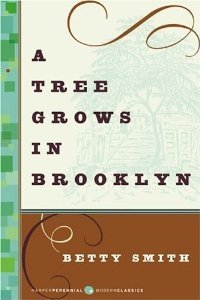
Sometimes publishers and reviewers have the audacity to promote a newly published book as a “classic.” In my opinion a classic is a book of excellence that has stood the test of time and is judged to be worthy of reading and rereading by future generations. First published in 1943, A Tree Grows in Brooklyn is such a book. Written by Betty Smith, it is fiction but it has its basis in Betty Smith’s own coming of age in Brooklyn.
The protagonist is Francie, a girl who grows up in difficult circumstances of poverty with an alcoholic father who is nonetheless likable. Her mother favors her younger brother over Francie knowing she will be able to succeed in spite of her background. Francie, like Betty Smith herself, from a young age is a reader and a writer. Francie’s mother, Katie, works cleaning houses and believes with all of her being that education is the route to success for her children. She insists that her children read a page from Shakespeare and the Bible each night. She evens barters piano lessons for herself and Francie, with little brother Neeley, who inherited his father’s musical aptitude, watching. Their father Johnny worked as a singing waiter when he could get employment.
There is not a plot per se in A Tree Grows in Brooklyn; it is a recounting of a family’s struggle to survive. The reader is immersed in the setting, the culture, and the characters. Despite the lack of twists, cliff hangers, climax, and denouement, this novel is a page turner of a gentle sort. Ripe with symbolism, this book is perfect for discussion and introspection. It opens the door to an era gone by and good hearted, imperfect people who want to keep their dysfunctional families intact and give their children a better life than they had. It is the fight for the American Dream set down on paper.
Rating: 5/5
Category: Classic, Literary Fiction
Publication: 1943—Harper Collins
Memorable Lines:
Mama explained: “Francie is entitled to one cup each meal like the rest. If it makes her feel better to throw it away rather than to drink it, all right. I think it’s good that people like us can waste something once in a while and get the feeling of how it would be to have lots of money and not have to worry about scrounging.”
“Who wants to die? Everything struggles to live. Look at that tree growing up there out of that grating. It gets no sun, and water only when it rains. It’s growing out of sour earth. And it’s strong because its hard struggle to live is making it strong. My children will be strong that way.”
Oh, the last time how clearly you see everything; as though a magnifying light had been turned on it. And you grieve because you hadn’t held it tighter when you had it every day.
The Engineer’s Wife–P.T. Barnum’s inclusion disappoints
The Engineer’s Wife
by Tracey Enerson Wood

Historical fiction is a difficult genre for both writer and reviewer. The writer has to juggle how much history should be included with the amount of fictitious information needed to establish the setting and especially to flesh out the characters. The reviewer then must judge the book based less on plot, which is to some degree predetermined, than on the author’s ability to combine history and fiction into a package that is both believable and pleasing.
In many ways I appreciated Tracey Enerson Wood’s The Engineer’s Wife. The subject is interesting. Emily Warren Roebling, a woman restricted by the social conventions governing the women of the mid to late nineteenth century, marries a Union officer. After he resigns his commission, he dedicates his life to his father’s project, the construction of the Brooklyn Bridge. This is a controversial project that proves dangerous to many, including her husband Wash who is an engineer. Rather than choosing to devote herself to the project after Wash is injured, Emily is subtly and progressively sucked into supervising the construction to completion.
The author has a wonderful way with words, and her research into the engineering aspects of the bridge is thorough. My only complaint of this work of historical fiction is the inclusion of Emily’s extended friendship and romance with the famous P.T. Barnum. Given that they lived and worked in the same city, their paths probably did cross, but in her notes at the end of the book the author freely admits that she had no basis for the creation of their relationship. It is such a major part of the story that I felt cheated as a reader. This is a work of fiction with a real setting rather than fictionalized history. Perhaps this work simply lies at the opposite end of a continuum from my preferred reading tastes in this genre.
I would like to extend my thanks to Netgalley and to Sourcebooks Landmark for giving me the opportunity to read this book in exchange for an honest review.
Rating: 3/5
Category: Historical Fiction
Notes: Contains two added sections: Reading Group Guide and A Conversation with the Author
Publication: April 7, 2020—Sourcebooks Landmark
Memorable Lines:
Autumn had painted the trees with brilliant oranges, reds, and yellows. Soon, cold, clear nights would rob the forest, leaving the trees to face the winter stark and barren.
Her lips were drawn tight enough to sling the arrows her eyes aimed at us.
The panic I had successfully tamped down returned like a lion for the kill.
 education pathways