
Home » Posts tagged 'Anglican'
Tag Archives: Anglican
Pentecost: A Day of Power for All People
Pentecost
by Emilio Alvarez
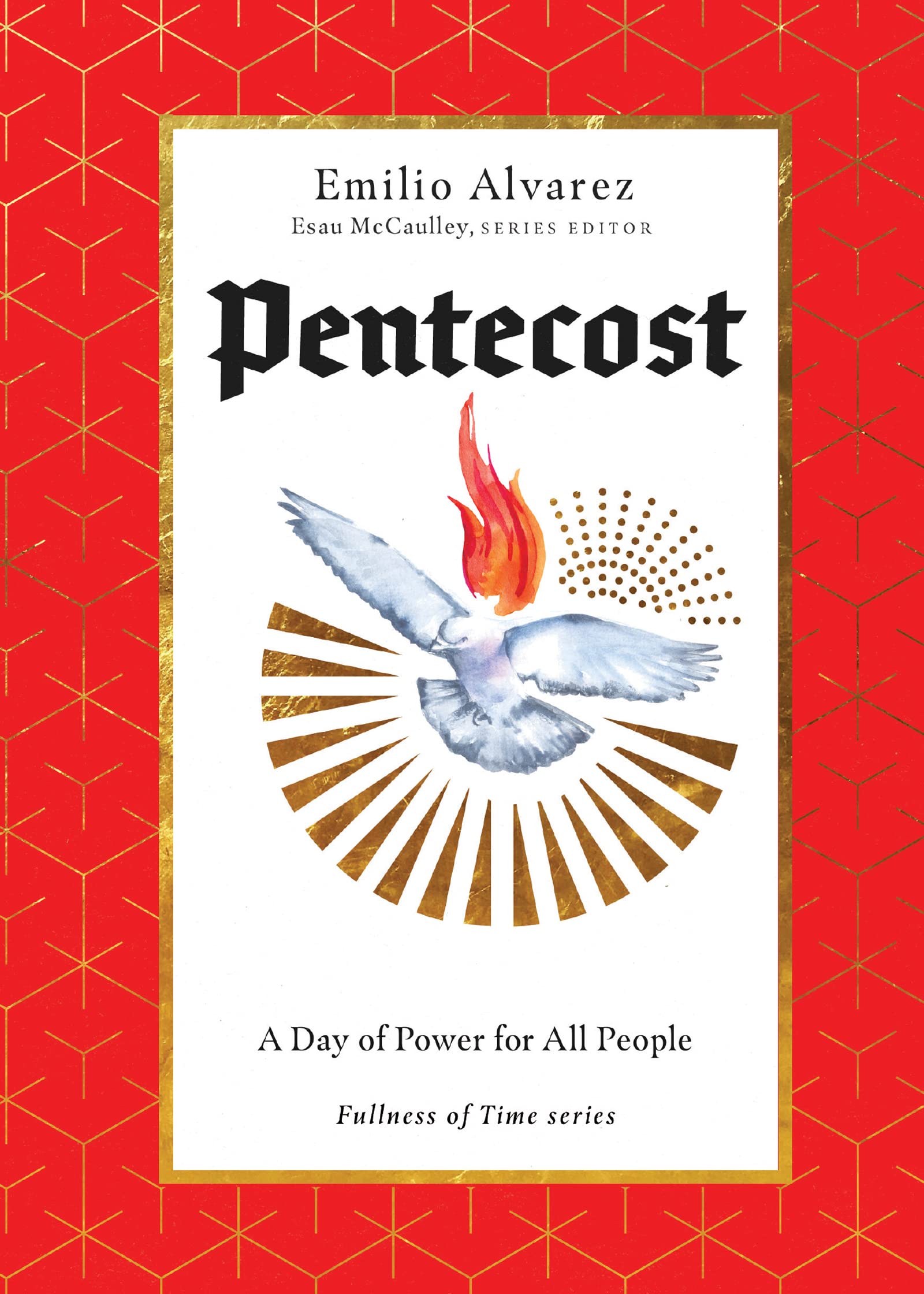
Pentecost is celebrated by Christians as the day when the Holy Spirit came to the early Christian church empowering Jesus’ followers to evangelize the world with the good news of salvation to all who believe that Jesus Christ died for their sins and was resurrected on the third day as He foretold. The writer Luke in Acts 2:1 sets the stage for the narrative with “when the day of Pentecost was fully come.” Jesus’ followers had been waiting for the prophecy to be fulfilled but were not told exactly when that would be. Pentecost is celebrated 50 days after the Jewish Passover. The author of Pentecost, Emilio Alvarez, writes that this season of waiting is a time to prepare our hearts. Fittingly, this book is part of the Fullness of Time series.
This little book begins with a discussion of the concepts of power and of pilgrimage. Next Alvarez devotes a chapter to various Jewish feasts that are the roots of the Pentecost celebration. Then a chapter is devoted to the speaking in other tongues as the Holy Spirit on that day of Pentecost enabled the Jews gathered from many nations to speak in each others’ languages. He relates this phenomenon to a reunion of peoples and a reversal of what happened at the Tower of Babel.
A large part of the book Pentecost is devoted to the rituals and liturgy related to the celebration of Pentecost ranging from the dates of remembrance to the custom of specific colors used for decorations and clothing and on to practices of kneeling or standing. Within the unity of Christian worshipers, there is a diversity of groups who celebrate in many different ways. Alvarez chooses to discuss the Christian tradition found in these five churches: Eastern Orthodox, Roman Catholic, Syrian Orthodox, Anglican, and Pentecostal. From this discussion you can extrapolate that there are a number of ways to celebrate Pentecost. They vary by culture, tradition, and understanding of Scriptures. The hymns, prayers, and Scriptures of these five traditions are just samples of the many available to Christians, and this theological scholar invites Christians to draw from other groups’ practices to enrich, not dilute their own. He ends this section with an interesting testimony of his own spiritual background as a Pentecostal Christian which differs greatly from the liturgies in the other church groups examined in this book. It is a personal spiritual journey which neither discredits nor confirms the formal liturgies found in the other churches mentioned. There are truths and blessings to be found in all of these traditions.
Upon a first reading of the Conclusion, I found it to be beautifully written, helping the reader to imagine the first Pentecost. Upon a second reading I realized I was in disagreement with the author. While I, also, want all people to overcome the “differences in race, culture, and religion,” I do not connect that as a necessity upon which the coming of the Holy Spirit depends. In Acts 1:4-8, Jesus told his followers that they should wait in Jerusalem until they received baptism of the Holy Spirit which would empower them as witnesses. Jesus had said that he would send the Holy Spirit. Just like salvation, this empowerment is a gift of God, not something we can earn.
Overall, I profited from reading this book. It gave me much to think about, and I had my view of the practices within many Christian churches widened.
Rating: 4/5
Category: Religion, Christianity, Theology, Nonfiction
Notes: 1. This is probably not an appropriate book for someone new to Christianity, but might be helpful to someone looking to understand formal liturgical church services.
2. I have read three other books in the Fullness of Time series, and this is my least favorite. I personally battle between it being highly edifying and overly pedantic.
3. I read this for my book club, and it was full of topics for discussion. My understanding of the book profited from hearing other viewpoints.
Publication: 2023—InterVarsity Press
Memorable Lines:
…no matter where we are in the world, and no matter what Christian tradition we belong to, at Pentecost all those who believe in the coming of the Holy Spirit sing and glorify the Most Holy Spirit, and God hears it as if it was coming from one voice.
At Pentecost we are awakened from the delusion that only our race, ethnicity, culture, political party, or language matters, is important, or is even truly Christian. This is one of the great errors of postmodernity, this division through delusion. In remembering Pentecost, however, we once again call on the Spirit to illuminate the dark areas of our lives and confront our delusion with godly wisdom and truth.
There is nothing we can successfully rationalize or theologize about Pentecost that would cause all Christian parties to nod with complete approval, yet there is nothing we can do or say against it that discredits its success in evangelizing the nations.
Year of Wonders: A Novel of the Plague
Year of Wonders: A Novel of the Plague
by Geraldine Brooks
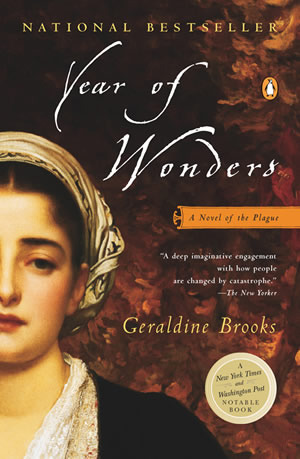 Our book club undertook Year of Wonders by Pulitzer Prize winner Geraldine Brooks. There are many things to recommend it, especially the depth of character development. Also prominent is the ability of the author to immerse the reader in the year 1665 in a small town in England where women of all classes were subject to the whims and humiliation of men.
We divided the reading and the discussion into two parts. The first half of the book was well received even though graphic descriptions of the Plague were tough to read. Several of us had to put the book aside for a time because of the horrors of the Plague and the difficult lives of the characters.
The ending of the book was met with a consensus of disappointment. After detailed and extensive exploration of the characters, author Brooks turns everything upside down leaving a shambles of motivations and actions that are disjointed based on expectations drawn from previous descriptions of their personalities. There is a baseness and meanness rising to the surface of characters who have been portrayed as admirable. The theology exposed by the ministers is not Biblically sound, but if one were to read the notes at the end of the book, it would not be surprising as the author refers to herself as having a “secular mind.” This is a dark book and not one that I would recommend mainly because the ending tries to provide closure much too quickly and, in the process, rather bizarrely changes the essential characters of all the major actors in the story.
I would like to extend my thanks to NetGalley and to Penguin Books for giving me the opportunity to read this book in exchange for an honest review.
Rating: 2/5
Category: Historical Fiction
Notes: This book includes an afterword, interview with the author, and discussion questions.
Publication: April 30, 2002—Penguin Books
Memorable Lines:
I liked her, too, because it takes a kind of courage to care so little for what people whisper, especially in a place as small as this…She was a rare creature, Anys Gowdie, and I had to own that I admired her for listening to her own heart rather than having her life filled by others’ conventions.
And so, as generally happens, those who have most give least, and those with less somehow make shrift to share.
“…we must take stock of these herbs and such remedies as the Gowdies may have left here. The key to defeating this Plague, I am convinced, must lie here, in the virtue of such plants as can be used to nourish those who remain in health. We must strengthen our bodies that we may continue to resist contagion.”
 education pathways