
Badges
Three Day Quote Challenge–Day 2
I love Robert Frost’s poetry, but I never knew he had a sense of humor until I encountered this quote:

Three Day Quote Challenge–Day 1

My new blogger friend, Wendy from Ramblings and Musings, invited me to participate in this three day quote challenge.
The rules for the challenge are:
- Thank the person nominating you for the challenge.
- Post a quote on your blog for 3 consecutive days.
- Invite 3 of your favorite bloggers to join the challenge.
My nominees for the challenge are:
- David from David Snape and Friends, whom I originally started following because of an interesting post he wrote on autism. It is also through his blog that I discovered the fantastic Kindness Blog.
- Shellie from Shellie Woods who writes about marketing and life, from a Christian perspective.
- Kim from Learn to Love Food. Through her blog Kim has taught me about the need some children have for food therapy and her fun approach to helping those with food issues.
No obligation–just fun, inspiration and exposure to bloggers you may not have encountered before.
My first quote has been my favorite for years. It was my signature quote on my work email. I wanted it always there as a reminder to the “Standardistas” that accumulating facts is not what education is all about. Many education policy makers and enforcers (in my former school district and around the country) have forgotten that education is inspiring children to be lifelong learners.
Peter Greene: The Correct Number of Standardized Tests
Does the Department of Education really want us to go from bad to worse?

The U.S. Department of Education says that the correct number of standardized tests is 2% of instructional time.
In most districts, that would be about 20-24 hours of taking tests. Not prepping for them, just taking them.
That would be an increase in the amount of time now allocated in most places to standardized tests. Should children in grades 3-8 really sit for 20 hours of tests? Sounds nutty.
Peter Greene has a different idea. He says the correct number of standardized test is zero.
He writes:
Students need standardized tests like a fish needs a bicycle. Standardized tests are as essential to education as a mugging is essential to better financial health.
Is there a benefit to the child to be compared and ranked against the rest of the children in the country, to be part of the Great Sorting of children into winners and losers? No. Having such…
View original post 117 more words
I Am That Teacher Too (Letter 5)–Reading is a Passion, Not a Learning Objective
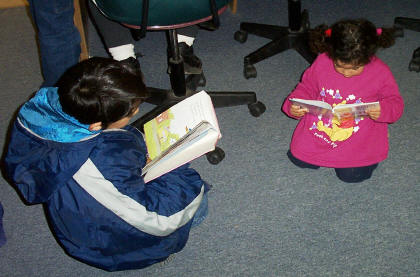
Dear Former Students,
What do I hope you remember about me?
Reading, of course! Together we fell in love with the books we read. If you were in my recent classes, you will remember the magical repetitions of Pete the Cat books. For a more sophisticated enchantment, we devoured several books in the Magic Tree House series, sneaking social studies and science into our day. Who could forget the adventures of Jamie and Tom at Dinosaur Cove or Dorothy and her friends in the Wizard of Oz? Some students may be reminiscing about the aliens in The Sand Witch and the mystery and history found in Help! I’m a Prisoner in the Library. Bunnicula, a great children’s mystery, was a favorite with some classes.
As a young teacher, I had experts tell me that first graders are not ready to sit and listen to chapter books. Not true! Storytellers have been recounting their tales without benefit of visuals since before the written word. Perhaps you were in the class that listened at story time to several picture books, at least one chapter in a longer book, and then BEGGED for more. I usually introduced classes to chapter books with Judy Blume’s short chapter book Freckle Juice followed by Chocolate Touch and Chocolate Fever.
We had many special literacy activities related to stories we read. For example, we discussed the meaning of Bill Martin Jr.’s Knots on a Counting Rope and made our own counting rope. In the 1st/2nd grade multiage class, we read the original version of 101 Dalmatians learning the meaning and use of many British words and enjoying playing with the unfamiliar words. We made a huge mural containing 101 Dalmatians just in time for the 100th day of school. Drama, dancing, art, music, and writing were all pulled into the process of learning to read and learning through reading. Activities did not begin and end because of the clock on the wall or the threat of an administrator’s possible walk-through. We had reading buddies once a week from the upper grades, working on social skills as well as reading skills and giving you the opportunity to read your favorite books as many times as you liked and have a positive emotional connection to reading. Our buddies benefited in similar ways with the addition of an opportunity to practice leadership and demonstrate maturity.
You amazed your parents with your beautiful poetry recitations—poems that move the soul like “Stopping by Woods on a Snowy Evening” and poems that giggle the spirit like “The Purple Cow.” You recited the poems by yourself before the whole class exploring the sounds of language and gaining self-confidence. You learned to appreciate language by playing with rhymes, patterns, meter, and figures of speech. Often whole families memorized the poems, and some can still recite their favorites. Reader’s Theatre and musical Reader’s Theatre provided fun opportunities to practice reading with fluency and expression.
My philosophy was “I teach reading all day long.” It worked. I had parents tell me that their child loved reading because of me. I hope you were one of them.
I Am That Teacher Too (Letter 4) Technology—14 years of growth
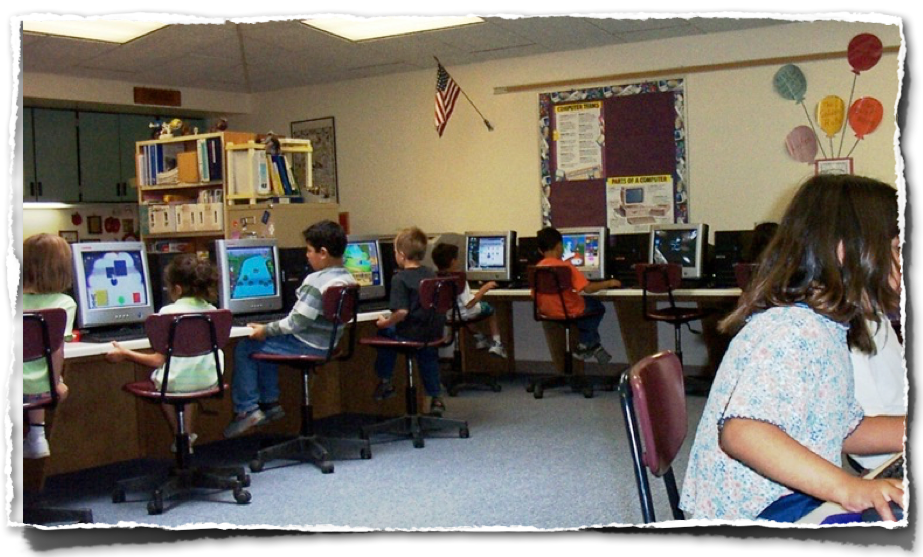 Dear Former Students,
What do I hope you remember about me as your computer lab teacher?
My enthusiasm! I was so fortunate. In the middle of a job I loved, teaching first graders in a school that valued developmentally appropriate, early childhood instruction, I was given the opportunity to create a computer lab and the curriculum to go with it. I loved teaching kids and I loved technology. What could be better?
Our beginnings were quite humble. We pulled together a lab using one Mac computer from each classroom, but also leaving computers for classroom use. Children had to share computers in the lab, and computers had to share printers. We’re talking primitive sharing, not networking; I unplugged the printer and plugged it into the neighboring computer so you could print your stories using tractor pin feed paper. And I did it very carefully. If one of the pins in the Imagewriter cord got bent, it could be a minor crisis. No printing from two computers and no spare cords. Over time, the lab was continually updated, expanded and kept state of the art.
We were a school where few students had computers at home, but you had a reputation for being able to use computers better than other students in the district. Your teacher joined me in the computer lab, and we worked together, learning and teaching. It was exciting for me and for you. It was learning at its best. I used my knowledge of good teaching to integrate what you were learning in the classroom with our technology projects. As the standardistas took over education, that became more difficult to do. Learning became focused on skills instead of knowledge. The computer lab became “child care” for teachers so they could attend Professional Learning Committees. It was a welcome release of pressure for you as a student. I tried to give you what you needed: mouse skills for K while you learned about jellyfish and celebrated holidays and paint programs for first grade to work on math and writing. In second grade you wrote and indulged in clip art in PowerPoint. Third graders, do you remember the excitement of beginning keyboarding and using Publisher to create visitor brochures about the state of New Mexico? Some of you even got to proudly present them to legislators when you visited the state capitol. Older students, we worked on projects too, but we also dipped our toes into the emerging world of blogging, emails, and Internet safety (which I see many of you practicing today). Our district was trying to enter the digital world in a safe and thoughtful way. To look back now, it appears to have been baby steps, but that was the beginning and it was an exciting and important time. We also struggled with learning about the confusing world of copyright laws and fair use. I hope all of that helped you as you moved on to middle school.
Testing—the Beginning of the End
For many years in the computer lab we always had a word of the week, a technology term that we learned to expand our vocabulary. At the end, even that got put aside. Three times a year, the schedule was thrown out the window as we had to take the required Measures of Academic Progress (MAP) tests. It was quite high pressure. When you were younger, most of you didn’t understand and were thrilled with the seemingly high score. As you grew older, the “cut score” reality set in. Regardless of how well you scored, it was rarely high enough and you could have always scored higher. There were rewards given by individual teachers and by the school. Even more pressure. Some of you must have felt like failures. You weren’t. The system failed you. What you probably didn’t know was that people above your teacher were telling your wonderful, hardworking, caring teachers that they were failures as well.
At some point I became too expensive as a certified teacher. The only written qualification for my replacement was that he or she should be able to use Microsoft Word. Seriously, that was what was viewed as necessary to do my job? This “assistant” (who she was assisting?) was charged with the care of you, two computer labs, scheduling, ordering equipment, preparing reports, training staff members, and a lot of technology maintenance. I worked with my replacement on the transition, and she is very capable and wants the best for you. The hardest part of this transition was moving my focus from all of the students at the school to only a classroom. I felt so responsible for all of you. I was also a little disappointed that the administration did not announce this change to students. Many of you felt I had abandoned you. This was definitely not the case, and nothing made me happier than to see you on campus and get one of your great smiles and maybe a hug.
What do I hope you remember about me in the computer lab?
A teacher who cared about you as a person and not a number on a test.
A teacher who cared about where you came from and what you went home to. A teacher who helped you learn about writing, language, art, math, science and developing technologies as well as about computers.
A teacher who tried to share with you things that would help you in your classroom and in your life.
A teacher who loved school and tried to provide opportunities for you to love learning as well.
A teacher who respected you because YOU are a person worthy of respect.
John Thompson Explains Why Reformers Hated John Oliver’s Brilliant Critique of Standardized Testing
If you haven’t seen John Oliver’s video, celebrate the end of the school year by doing so. Get those endorphins flowing. Then read this post. The last paragraph is perfect!
As historian-teacher John Thompson explains, reform spokesmen were really outraged by John Oliver’s brilliant send-up and put down of our nation’s obsession with standardized testing and its primary beneficiary: Pearson.
Some used the typical manipulation of test data to claim big gains in 1999 allegedly caused by NCLB, signed into law in 2002.
Others must have been embarrassed by scenes of children chanting pro-testing propaganda, like happy robots.
The fear and trembling by reformers showed that Oliver hit exactly the right spots.
Thompson writes:
“Its hard to say which is more awful – the way that stressed out children vomit on their test booklets or schools trying to root inner-directedness out of children. On the other hand, even reformers should celebrate the way that students and families are fighting back, demanding schools that respect children as individuals. Even opponents of the Opt Out movement should respect the way it embodies…
View original post 147 more words
The Big Business of Charter Schools
Charter schools are big business. There are, of course, exceptions where charter schools are a grass roots effort to provide an alternative. If you ever doubted the motives behind most charter schools, give this a read; it is disgusting.
This is one of Valerie Strauss’s best columns, where she reviews a television interview with Dennis Brain, the CEO of Entertainment Properties Trust. Brain is a big investor in charter schools, and he is bullish about the future.
Here is a small snippet of the interview:
DB: Well I think it’s a very stable business, very recession-resistant. It’s a very high-demand product. There’s 400,000 kids on waiting lists for charter schools … the industry’s growing about 12-14% a year. So it’s a high-growth, very stable, recession-resistant business. It’s a public payer, the state is the payer on this, uh, category, and uh, if you do business with states with solid treasuries. then it’s a very solid business.
Anchor: Well let me ask you about potential risks, here, to your charter school portfolio, because I understand that three of your nine “Imagine” schools are scheduled to actually lose their charters for…
View original post 299 more words
Arthur Goldstein: Outrage! NY Cuts English Instruction
We need to support English Language Learners as their playground English turns into academic English–not pull the rug out from under them.
Arthur Goldstein teaches English as a second language to high school students in the borough of Queens in Néw York City. He is outraged because the Néw York State Education Department has decided to cut ESL instruction by integrating it into subject matter instruction.
He writes:
“Beginners, since I started in the eighties, have gotten three periods a day of instruction. Intermediate students got two, as did advanced. Proficient students, those who tested out, usually got one period but sometimes got another to help them along. Because placement tests are usually total crap, because they gave the same one for decades, and because some kids guess well for no reason, I’ve often seen kids at high levels come back for help.
“NYSED knows everything, though, and has determined we have to stop coddling these kids. So now, for one period a day previously devoted to English, all ESL students in…
View original post 367 more words
Detective Gordon, The First Case
Move over Holmes and Watson! Move over Poirot and Hastings! Another Detective duo is in town: Detective Gordon, the aging police chief toad, and his sidekick Buffy, a very young, energetic mouse. Use Ulf Nilsson’s book, Detective Gordon, The First Case, with readers who are ready for chapter books or to introduce mysteries as a read aloud. The story is a kinder, gentler type of mystery with easily understood messages. It also contains some word fun that students will enjoy exploring and repeating. For those who love drama, the characters are unique and lend themselves to creative expression. The illustrations are sweet, appealing, and as soft as the snow covered landscape of the book’s origins in Sweden.
Will Great Scores on a High Stakes Test Land You a Job at Goodreads?
Goodreads is a website that has created a huge community of readers, and their goal is to hook up readers with books they will love. In browsing today, I came across their Jobs page. I’m not looking to come out of retirement, but I was interested in their values:
- Ownership

- Create Fun
- Be Humble
- Think Big
- Customer Obsession
- Be Passionate
- Help Each Other
- Always Be Learning, Always Be Teaching.

Goodreads says they want people that are creative and care about the customer. Reread their list of values. Are any of those items on a standardized test? Are any of those values part of the Common Core State Standards? Would they be integral to a private school education where neither the CCSS nor standardized testing is required? Then WHY are we not including them in a public school education? All of our kids deserve a first class education.
If you want to see the source, go to:

