
Badges
Ghost of Africa– don’t miss this medical action suspense
The Ghost of Africa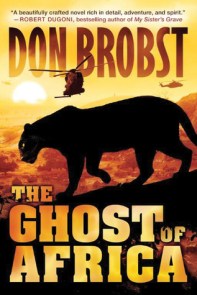
by Don Brobst
Don Brobst has created a fast paced adventure set in Africa. Although The Ghost of Africa is fiction, Don Brobst’s background lends a definite authenticity to the story. Like his protagonist, Dr. Paul Branson, the author is a medical doctor who travels to Africa frequently to provide medical assistance. The reader can assume the comparison ends there as the fictional doctor becomes entangled in a deadly struggle over oil between local forces in North Sudan and South Sudan.
Although Waterfall Press publishes Christian fiction, this novel does not fall anywhere near the category of historical romantic fiction that can be so typical of fictional works from a Christian publishing house. The author has obviously thoroughly researched special forces and military equipment. The result is a very detailed and physical fight for survival with a ruthless antagonist. There is a Christian theme as Dr. Branson is viewed by the natives as The Chosen One, a label he struggles with and tries to put into perspective for the native population.
I strongly recommend The Ghost of Africa. It does have a strong element of violence, but it is not gratuitous. This book stands up well with other action adventures. It also provides a realistic look at life in Africa for the innocents who are caught up in others’ struggles for wealth and power.
I want to extend thanks to netgalley.com and Waterfall Press for the opportunity to read this book in exchange for an unbiased review.
Cliff Notes for American History???
 Everything You Need to Ace American History in One Big Fat Notebook is geared to Middle School Students, but makes an excellent reference for adults as well. The text is marked up with various colors of highlighter to emphasize the most important points. Periods are outlined so students can visualize a timeline of events, but are fleshed out enough that cause and effect are included making history more understandable and thus more memorable. Out of approximately 500 pages, I chose to read about the Civil War and Reconstruction periods because of a discussion with a colleague. I was not disappointed: I came away with answers to some questions and a better overall understanding of the events in a fairly brief amount of time. Obviously, since it was written for middle school students, it was not an exhaustive treatise on the Civil War, but it was a great summary and beginning place for more in-depth research. One of the difficulties of studying American History at any grade level is that is nearly impossible to cover the full history of America in one school year. With this supporting text, one could independently study periods that are not studied in class.
As an independent reviewer, I usually read a book one time and then move on to the next book. In this case I was looking forward to having Everything You Need to Ace American History in One Big Fat Notebook on my iPad as a reference and work through the various periods as a side hobby. As a tribute to the book’s usefulness, I must say I was disappointed to discover that this book has an expiration date and is no longer available to open. Who knew a book could be like a carton of milk? I guess I will purchase a copy!
Everything You Need to Ace American History in One Big Fat Notebook has a proposed publication date of August 9, 2016. I would like to extend my thanks to netgalley.com and to Workman Publishing for allowing me to read and review this book in exchange for an unbiased review.
Riveting Memoir of a Romanian Lawyer– Could be Used in Christian High School?
 Saving My Assassin
by Virginia Prodan
Virginia Prodan has written a riveting memoir Saving My Assassin. It was difficult to read many parts of this book because of its troubling, torturous content, but the triumphant spirit of this tiny powerhouse of a woman kept me returning to discover how God could possibly use the evil that surrounded her for His greater purpose.
Virginia Prodan was formerly a lawyer during the cruel Communist dictatorship of Romanian leader Nicolae Ceausescu. Currently she is an international lawyer residing in the U.S. where she continues her work representing Christians who find themselves in legal difficulties because of their stand for Christ.
Saving My Assassin begins with a brief glimpse at a pivotal moment in Prodan’s life. That part of the story ends abruptly, but is repeated and continued later in the appropriate time sequence. This is a technique which could be annoying, but is used here to skillfully draw the reader into the critical nature of the happenings in Prodan’s life. Next we learn of mysteries and events in her younger years which help us understand how she became such a determined adult. She endured a cruel childhood which left her determined to discover the truth on all levels. Why was she so mistreated by her own family? Why did she look so different from them? Why were people in Romania not allowed to worship God when their laws said they could? What motivated the cold violence of the Securitate, the Communist government agents who stalked her, interrogated her, and threatened the lives of her and her children? Why were they so willing to torture and kill their own citizens, innocent of crimes, many of whom apparently disappeared into the night?
Although this book is written for adults, I think mature high school students would appreciate it as well. I taught high school English in a Christian school before I became an elementary public school teacher. This is the kind of book I would have used with my seniors. It would be particularly appropriate for reading in conjunction with a history or civics class as it deals with a Communist dictatorship during the Reagan era and shows the power and influence the U.S. can choose to wield in supporting Christians around the world. Because Saving My Assassin has a strong Biblical message, I assume it could not be assigned for reading in a public school setting, but I would be interested in feedback from teachers with more recent public high school experience than I have.
Saving My Assassin has a proposed publication date of June 7, 2016. I would like to extend my thanks to netgalley.com and to the publisher Tyndale House for allowing me to read and review this book in exchange for an unbiased review.
Perfect Chapter Book for Beginning Readers
 As a teacher of early learners, K-2 in particular, I was always on the lookout for useful books for the classroom. I have found one that is great for students to read at home and at school. I am not a fan of the “guided reading” programs currently pushed in many school districts. A large number of the book selections are frankly boring. Reading should be fun! Pedro, First Grade Hero is a book young readers will enjoy. Its anticipated release date by Capstone Press is September 1, 2016, and I highly recommend it! I personally would use it in reading groups and then send it home for kids to enjoy there as well.
Pedro, First Grade Hero
by Fran Manuskin
Pedro, First Grade Hero, is a delightful “chapter book” for early readers. Children usually want to read chapter books like their teacher models for them. Unfortunately most chapter books are just too difficult for them to read independently. Pedro, First Grade Hero, however, comes to the rescue for the beginning reader. It is actually a collection of four stories, all about Pedro. The readability level, length of the stories, and interest level is perfect for first graders as is the focus of each story.
Pedro is a very likable little boy. In the first story, “Pedro Goes Buggy,” Pedro has to find a bug to write about in school. Discussions about the best bug ensue in the classroom and at home. Even his little brother Paco gets involved in the fun. The story has a nice resolution and ends on a humorous note. For the teacher who likes to integrate learning strands, language arts, math and science provide easy tie-ins.
“Pedro’s Big Goal” draws in boys and girls who love soccer. This chapter has “bigger is not always better” as well as “keep trying” as its themes. Children will enjoy the ending and teachers can help them appreciate the play on words.
Most people love a good mystery as do Pedro and his friends who form a mystery club in the third story, trying to find a missing locket and cell phone. Good vocabulary words include sparkle, locket, and chirping.
The final story, “Pedro for President,” teaches Pedro and his friend Katie Woo what is involved in being class president. As they ponder what they have to offer the class, little brother Paco “helps” with the election poster and Pedro creatively turns that effort into a positive. Pedro, who always encourages his classmates and promotes fairness in the election, is the obvious favorite for president.
The illustrations by Tammie Lyon are colorful, appealing, and depict well the characters’ emotions and reactions. Teachers interested in promoting multi-cultural cohesiveness in their classrooms will appreciate the inclusion of children of various backgrounds. At the end of this book are four pages of jokes in the riddle format that will delight first graders.
I would like to thank netgalley.com and the publisher, Capstone Press, for the opportunity to read this book in exchange for an unbiased review.
Book Review of Simple Pleasures
I recently read and reviewed a book that I enjoyed as an adult, but I think would also be appropriate for middle or high school students, particularly those interested in learning about those who choose a different type of life from theirs. The book has no inappropriate words or violence and is suitable for all readers.
Simple Pleasures: Stories from My Life as an Amish Mother
by Marianne Jantzi
When I reflect upon Simple Pleasures: Stories from My Life as an Amish Mother by Marianne Jantzi, the first word that comes to mind is “sweet” and the second is “comfortable.” Usually a reader of mysteries and action novels, I was pleasantly surprised by this work. It lacks the frenetic pace of fiction, but it pulls the reader along, not by suspense, but by the desire to view more of the daily life of a rural Amish family.
This book is a collection of the author’s journal writings and contributions as a monthly columnist to the Amish periodical “The Connection.” Jantzi is a Canadian, an Amish wife and mother, and a former school teacher. Her book is part of a series called “Plainspoken: Real Life Stories of Amish,” which provides opportunities for outsiders to read about Amish life from the viewpoint of Amish writers.
In an “Author’s Note” at the beginning of the book, Jantzi offers some structure for her non-chronological tales by briefly profiling her family and providing a few explanations of terms specific to her family. Although she provides this essential introduction, it would also have been helpful to provide at least a brief summary of Amish beliefs and customs or to explain them in context. These details could help clarify misconceptions about the Amish way of life. For example, they eschew motorized vehicles. As a non-Amish Christian, I wonder why it is acceptable to go to work via a car with a driver. Perhaps if the writer is Amish, these “irregularities” do not stand out as such.
What this book excels at is allowing the reader a peek at the daily life of an Amish mother of four in a very cold climate. In addition to the normal childcare activities, Jantzi raises fruits and vegetables during the short growing season and preserves them for the long winter. She cooks without electricity, operates a shoe store on their property, and tries to find time to fulfill her passion for writing. She has many social roles and duties in the close-knit Amish community as a woman of God, a wife and mother, daughter and sister by birth and by her membership in the Amish community. She obviously has a good relationship with her in-laws: they share a connected house and even move from one side to the other as their families change in size.
Although Jantzi’s life is different in many ways from that of the typical non-Amish mother, most will be able to identify with certain familiar themes. She finds there is rarely enough time or energy for the things that need to be done. Despite good planning, the unexpected always arises with young children. If you look for the good and the humorous, you will usually find it. Jantzi is an introspective woman of faith, always trying to achieve a closer walk with God through obedience and humility.
I extend my thanks to NetGalley and the publisher Herald Press. They have afforded me the opportunity to read this book in exchange for an honest review.
Amy Frogge: My 9-Year-Old Will Take Tests That Are Longer than My LSAT Exam
Why teachers should not be evaluated based on standardized test scores and why children should not take the tests in the first place.

Amy Frogge is a member of the Metro Nashville school board. She was elected despite being outspent 5-1 by the corporate reformers who are trying to take over local and state school boards. Amy didn’t know anything about corporate reform when she decided to run for school board. She is a mom of children in Nashville public schools, and she is a lawyer. She went door to door and won her race.
Once she became a school board member, she realized that much was wrong. The charter industry was targeting Nashville, threatening to skim off the students they wanted and to reduce the funding for public schools. State-mandated testing, she discovered, was completely out of hand, a time-wasting burden to children and an unnecessary financial drain on the district’s schools.
This post has been widely shared on Facebook. Here, she explains why parents must get involved and act to defend…
View original post 586 more words
Enchant your everyday: Connection
As true now as it was then. This is what we should be doing in our schools.
Here Are All the Links on ESSA Series: Ask Your Own Questions
Good reference for what the changes may mean to education. So much still depends on how the the states move forward, but it seems to me that the states have fewer restrictions in general and fewer monetary incentives to pursue excessive high stakes testing.
The series about the new Every Student Succeeds Act is concluded. I want to thank Senator Lamar Alexander and his staff, especially David P. Cleary, chief of staff, for responding to my questions. I know that readers have additional questions or want clarifications of some of the statements. The new law is the result of negotiations between the two parties. Questions will inevitably arise as the new law is implemented. Meanwhile, feel free to submit your questions and you can be sure that Senator Alexander’s staff will answer them as best they can. Let me add that there are things in this law I like, and things I don’t like. I will spell those out in a separate post.
Here are the links to each of the posts written by Senator Lamar Alexander’s staff.
View original post 32 more words
Great Model for Opting Out

TN State Representative Mike Stuart and his wife Ruth opt their own children out of testing. It will be interesting to see what the response of his school district is. The letter is very respectfully written with options for what their children might do during the testing time and the parents’ willingness to participate in preparing materials for those days. As Mr. Stuart is a lawyer, it also addresses the legal aspects of opting out. This great letter could be a model for parents everywhere and can be found on the blog Momma Bears which addresses overtesting in Tennessee: Stuarts’ Letter on Momma Bears.

Is It Bullying? – A Visual Guide
Great resource as a way to think about bullying.

Wikipedia describes Bullying as;
“the use of force, threat, or coercion to abuse, intimidate, or aggressively dominate others. The behavior is often repeated and habitual.”
If your child (or yourself) are unsure of how best to categorize any difficult interactions you are having with others, the simple guide below, that was found posted to a fence, will be of help.

Please sharethis with your friends and family. Let’s do everything WE can to…


