Badges
Holding Up the Universe–Teenage/YA Review
Holding Up the Universe
by Jennifer Niven
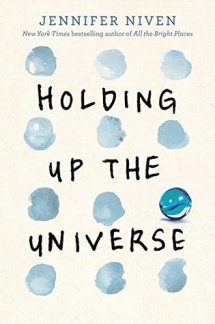 I read a review of the Teenage/Young Adult novel Holding Up the Universe on another blog, BongBongBooks. I was intrigued and decided to read it myself. It is the story of Jack Masselin, a teenager who has prosopagnosia, the inability to recognize faces–even those of family members. The other main character, Libby Strout, is a girl who gains so much weight in the process of grieving after her mother’s death that she has to be removed from her home by a crane. Lest these two young people seem like examples of extreme difficulties beyond the realm of possibility, readers should know that prosopagnosia is an actual disorder and that there is a reality TV show entitled My 600 Pound Life. The author did her homework and this novel has authenticity as we see how these two and their families struggle with the many issues that result from their conditions.
A major theme of this book comes from Harper Lee’s To Kill a Mockingbird: “Atticus, he was real nice…” “Most people are, Scout, when you finally see them.” There are two ways of not seeing people that this book explores: prosopagnosia (face blindness) and being unwilling to look past a person’s obvious exterior features such as weight, skin color, or disabilities to see who the person really is, what they are like on the inside.
I really liked this book for the plot development and the characters. I empathized with both characters as they tried to deal not only with their personal problems but also with relationship issues in their own families, with each other, and with peers. As you might expect, bullying and discrimination are major issues for the overweight Libby. It is not an uncommon theme in YA literature as, unfortunately, bullying others for individual physical differences occurs often in our society. I had to really step outside my framework to think what it must be like to walk into a room and not be able to recognize anyone. NOT ANYONE! Not my family, not my friends, not the people I saw two minutes ago. The author does a good job of helping the reader understand what face blindness must be like as it is lived out.
There is a lot of what I consider to be inappropriate language on the milder end of the continuum in this book. It was frequent enough that I did a little research on what kind of language is generally acceptable in Teenage/YA literature. I found many blog posts dealing with this question, ranging from none to anything goes and everything in between. I understand that many teenagers today use different word choices than when I was a teenager. I also know that in current films that kind of language and worse is commonplace. I include this paragraph as a warning to those who might be offended by some of the words used casually by the characters in Holding Up the Universe. The language did not enhance the story for me, nor did it ruin it. I do recommend this book with this one qualification.
I would like to extend my thanks to netgalley.com and to Penguin Books for giving me the opportunity to read this book in exchange for an honest review.
Send in the Clowns–outstanding cozy mystery
Send in the Clowns
by Julie Mulhern
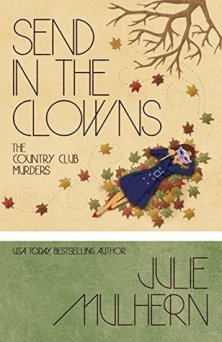 The Country Club Murders is a series of cozy mysteries set in in the early 1970’s. Send in the Clowns is the fourth in the series and the second one I have read. While there is a lot of serious crime in this tale, Julie Mulhern knows how to write with humor and keep the reader coming back. I honestly had trouble putting the book aside at bedtime. Then I devoured the last half the next morning.
There is no waiting for the book to get interesting. In the first chapter, Ellison, who seems to attract handsome men and dead bodies, has to go to a haunted house to retrieve her teenage daughter. While there she has an encounter with two clowns, one of whom calls her by name and then dies in her arms. There are many more twists and turns in the plot which keep interest at a high level all the way through.
The likable Ellison Russell may have been born with a silver spoon in her mouth, but she is no stranger to personal tragedies and horrors. The story is told from her perspective. The dialogue intermixes what Ellison says (in quotes) with what she thinks so well that her character takes on a reality not possible with third person narration. The way she is presented makes it very easy to identify with her and her struggles to get the men in her life to see her as capable and independent. Remember, this is the early seventies, an era when women are still expected to emerge from college with an “MRS.” degree.
One of my favorite aspects of the book is the setting of the seventies. The little details are right on target, but not forced. There is shag carpeting and the only telephones are those that are attached to the wall. The diet soft drink of choice is Tab, and a plaid coat in shades of plum and hunter green echoes one I wore in that time frame. Probably one of the best and most subtle references to an earlier time is Ellison’s admonition to the teenagers as they exit the car: “Lock your door.” Each door needed to be locked manually by the passenger.
I have absolutely no negative criticisms for this book. In fact, I am going to return to the series to read the two out of four that I have not read yet. Additionally it is important to note that reading them out of sequence did not detract from my pleasure in reading these mysteries. Send in the Clowns has everything you want in a cozy–a fast pace, intricate turns in the plot, interesting characters and setting, a little romance with the requisite tension, and a good resolution.
This book is scheduled for publication on October 25, 2016.
I would like to extend my thanks to netgalley.com and to Henery Press for giving me the opportunity to read this book in exchange for an honest review.
Abstract Aliases–part of a cozy mystery series with an art world focus
Abstract Aliases
by Ritter Ames
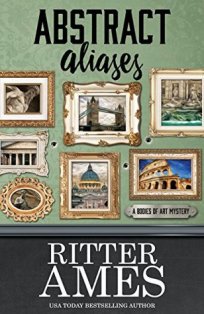 Abstract Aliases is the third book in the cozy mystery series Bodies of Art written by Ritter Ames. A typical cozy mystery series continues from book to book with the same main characters. Each novel has a unique plot, and the author only has to fill in some background information about the characters and their relationships for the reader to be ready to enjoy the story. Abstract Aliases is different because the plot continues into the next book. This format is not a bad thing, but the reader should be aware of it.
Laurel Beacham is an art recovery expert with high end tastes (Fendi purse) and great survival skills (telescoping baton). She rarely knows who to trust as the complicated plot keeps tossing surprises her way. The person she most wants to trust is the handsome and resourceful Jack Hawkes, but he has mysterious connections and reveals little about himself. Together they try to unravel the murders of forgers, an office break in, and the identity of the enigmatic Ermo Colle.
I read Abstract Aliases as a stand-alone and I enjoyed it. It had an engrossing plot, well-developed main characters, and multiple interesting settings as the characters travel the world seeking to unravel a multi-faceted mystery. There are abundant surprise twists to the story. Although not an art historian myself, I took pleasure in reading about famous works of art and museums and learning about the world of forgery.
I recommend Abstract Aliases to cozy mystery lovers, but I suggest reading this series in sequence. It will make much more sense, and you will have a better understanding of the minor characters.
I would like to extend my thanks to netgalley.com and to Henery Press for giving me the opportunity to read this book in exchange for an honest review.
This book is scheduled for publication on October 11, 2016.
Another Way to Help Teachers
Here’s a thoughtful way for book lovers to help teachers and their students.

We know teachers are the lifeblood of our education system. However, each year they must spend more out of their own pockets for classroom supplies they cannot get from schools’ depleting budgets. In the past, I’ve given teachers gift cards to office supply stores to help, but last week I found another way I’d never thought of before. Our small town has a wonderful and thoughtful used bookstore. I turned in a bunch of books and received an $80 credit for my efforts–but I’m not going to buy any books. Instead, I’ve turned over my credit to any of the county’s teachers who’ve signed up to receive children’s fiction books for their classrooms.
So, rather than refilling my bookshelves, my credit will help fill classroom libraries for students instead. I can’t think of a better way to promote reading for young people. Yes, I could have bought books and donated…
View original post 102 more words
Nice Girls Endure–being different
Nice Girls Endure
by Chris Struyk-Bonn
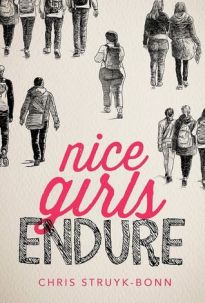 Chelsea’s memories of being whispered about, teased, taunted, and treated as “different” go back to third grade and the torment never let up. We meet Chelsea in high school. Her weight problems have not changed and the negative ways people, especially other teenagers, treat her have only intensified. She has no friends and has developed a fake exterior to help her survive. After all, “nice girls endure.”
Chris Struyk-Bonn chose a first person narration of Chelsea’s story, Nice Girls Endure. It seems only appropriate that Chelsea should get to tell her own story, and the effect is very personal. We get to hear of the nightmare of being bullied because of being overweight and how it affects every aspect of her life. This is a Young Adult book, but is so well-written that even as an adult I strongly empathize with Chelsea and was anxious to see her work through her problems.
The chapters are short and the pace is fast. The characters are well-developed and provide Chelsea with opportunities to see various ways others deal with weight issues and bullying. In the end she makes her own decisions about her life and future. Meanwhile the reader feels almost a part of the story. I was ready to take out a few unkind souls myself. My favorite character is one of Chelsea’s classmates, Melody. She knows how to be herself and knows how to be a friend.
This book is not just about being overweight. It is about being different. It is not just about being bullied, it is also about bullying. I hope that anyone who reads Nice Girls Endure will come away with a greater awareness of and sensitivity to those who are different. Everyone has positive attributes and deserves an opportunity to let their talents shine. There are many negative ways to deal with peers who are labeled “different,” from outright physical and emotional attacks to more subtle teasing, smirking, and exclusion, to totally ignoring the person. In this story, even teachers were guilty of the less overt responses, but their actions or ignoring the actions of others hurt just as much.
This was a quick book to read, but I recommend it for Young Adult and Adult readers. You will probably come away with more thoughtful and understanding attitudes towards those who don’t easily fit into society’s boxes.
Note: The book contains a sprinkling of mild swearing and an occurrence of sexual aggression and is therefore inappropriate for younger readers.
I would like to extend my thanks to netgalley.com and to Capstone Press for giving me the opportunity to read this book in exchange for an honest review.
Little Chickies/Los Pollitos–a great bilingual book for preschoolers
Little Chickies/Los Pollitos
by Susie Jaramillo
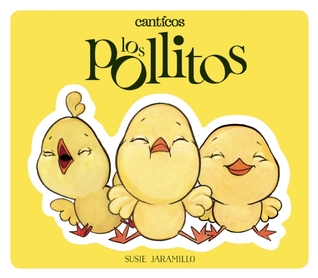 Susie Jaramillo is a bilingual mother and artist who grew up in Venezuela and in the United States. In working with her own young children, she found a need for bilingual books to share traditional Latin American nursery rhymes in Spanish with a translation into English which maintains the original meaning without sacrificing the beauty of language. To this end she founded Canticos and has published the first book, Little Chickies/Los Pollitos. She has written and illustrated two more bilingual books which are available for preorder.
The art work in Little Chickies/Los Pollitos is very appealing. The simple storyline is that of a mother hen taking care of her babies. It is the kind of book children would love to read and sing over and over again.
One thing that makes Little Chickies/Los Pollitos valuable in working with preschoolers, in presenting an alternate language, is the accordion fold format. You read the story all the way through in one language and then from the back you can go forward again reading in the other language with no disruption of the story or words that don’t match up with the voice. Jaramillo added other features that make it special as well. The rhymes are put to music so children can sing the book. They are interactive with spinning wheels and flaps that lift. An app can be purchased as an extension of the book. There are free videos of it on Vimeo and more information is available at canticosworld.com.
I would like to extend my thanks to netgalley.com and to the publisher Encantos for giving me the opportunity to read this book in exchange for an honest review.
The Other Einstein–Did Albert Have Help with his Theory of Relativity?
The Other Einstein
by Marie Benedict
 Fascinating! I found the story of The Other Einstein to be a very different and fascinating reading experience: this historical novel is like none other I have read. The author, Marie Benedict, examines the facts that exist about Albert Einstein’s first wife, Maleva Marić, an outstanding physicist and mathematician in a time when women were rarely admitted to universities. Some speculate that her contributions to Einstein’s Nobel Prize winning theory of relativity may have been significant.
The book traces Maleva’s journey from Serbia to the Polytechnic campus in Zürich where, as a woman, she must struggle to be recognized as a serious and capable student. To that end she tries to maintain a collegial relationship with fellow student Albert Einstein who has more romantic inclinations. The author is able to weave a convincing tale of how this dedicated female student deviated from her professional goals as a result of various circumstances, including the death of their daughter born out of wedlock, Maleva’s physical health, her lack of acceptance (because of a physical disability, her intelligence, and her ethnicity) by many in society including Albert’s family, and the self-centered behaviors of Albert Einstein himself. Maleva struggles to be everything Einstein wants–totally devoted to his needs, the perfect housewife and mother, and a scientific collaborator. She finds the task impossible, especially in the face of Einstein’s professional and personal betrayals of her.
The Other Einstein ends with an epilogue which gives Maleva a chance to reflect upon her life and gives the reader a few details about her life after she and Einstein are divorced. The author adds an interesting and helpful section on her own motivations in writing the book, her research, and the extent of fictionalization. She includes sources for readers who want to pursue the story further, including original correspondence discovered in the 1980’s. She follows with a Reading Group Guide of questions that could be the catalyst for excellent discussions. The book ends with an author interview which provides more background information on the writing of The Other Einstein.
Although there are a lot of references to various specific theories of physics, a physics background is definitely not necessary for full enjoyment of this book. As a personal opinion, I think women would tend to relate better to Maleva’s difficulties and struggles than men. This book enthusiastically receives my highest recommendation.
This book is scheduled for publication on October 18, 2016.
I would like to extend my thanks to netgalley.com and to Sourcebooks for giving me the opportunity to read this book in exchange for an honest review.

The Top 12 Global Teacher Blogger Discussion: September 2016
Why should the arts still be important in education?

 How can we maximize the value of art and music in education and how can it be blended with more traditional subjects (math, science, history, etc.)?
I teach at a community college, and a professor there created an art therapy club for professors, adjunct, and staff. Nine people attended the first session where they colored with pens and painted with watercolors. Future sessions will consist of making jewelry, drawing, and using mixed media—all as therapy to help adults relieve a stressful week. This is brilliant; however, our primary and secondary children are going to school during a time when the arts are slowly being eliminated from their curriculum. I find this dichotomy painfully ridiculous.
Instead of answering the question this month, I’m going to ask a few of my own:
If schools embraced this idea of art therapy, would we have as many children and teens suffering from stress and…
View original post 199 more words
Teenage Kindness–what a great idea
This may not be a typical education post, but ask any teacher how anxiety and isolation affect student learning.
SHERMAN OAKS, Calif. (CNN) – A California teen is sharing her high-tech way to handle lunch-room anxiety. Natalie Hampton, 16, struggled to make friends back in middle school. The hardest part of the day? Lunch time. “I ate along pretty much every day for the two years that I was there. And I have personally…
via California teen launches app to help others make friends at lunch — KRQE News 13
Escaping the Nazis on the Kindertransport–introduction to the Holocaust for younger students
Escaping the Nazis on the Kindertransport
by Emma Carlson Berne
 Many books have been written for middle school students about the Jews in Nazi Germany. In Escaping the Nazis on the Kindertransport, Emma Carlson Berne shares a piece of their story with children aged 8-12. As a teacher I could certainly see this book also being used as a resource for older students who are reading below grade level as it has an interest level appropriate to them as well.
The physical book is designed with the look and feel of an aging family picture album. There are seven chapters that focus on individual children who were part of the 10,000 children rescued from Nazi controlled areas and relocated to the United Kingdom prior to the beginning of World War II. Their story is told in the third person but from the child’s perspective.
The first chapter begins with a poem “The Leather Suitcase” written by Tom Berman who was saved as a 5 year old child by a Kindertransport. Some background is given as it describes what it must have been like for such a young boy to be separated from his parents for a long trip to an unfamiliar country with a different language, not knowing if he would ever see them again. This chapter captures the reader’s interest immediately.
The next chapter, “From Kristallnacht to Kindertransport,” gives more historical details about the increasing persecution of the Jews and their limited options for survival. Then the book returns to the stories of individual children, ending with a chapter that briefly recounts what happened to each child after the Kindertransport. It might be specifics of their time living with another family, further emigration, or an ultimate career, depending on their circumstances and the source documents available. There is also general statistical information about the 10,000 children of the Kindertransport.
There are study resources at the end of the book. The “Timeline” integrates important historical dates of the war with major events related to the Kindertransport and the seven children whose rescues are detailed in the book. The “Glossary,” of course, defines unfamiliar terms such as “haftarah” and “pogrom” which are used in the book. Next is a page which explains The Kindertransport Association (KTA), whose president was a consultant for the book. The KTA is comprised of the rescued Kinders, as they call themselves, and their descendants. “Read More” lists three more books on the topic for young readers. There is a page of discussion questions to evoke higher level thinking and several pages devoted to bibliography, source notes, and an index.
Escaping the Nazis on the Kindertransport is a valuable teaching resource, drawing from original sources. The length of the chapters is appropriate for this age level as well as for typical time periods in the school day. It could be used for independent reading or group study, but because of the difficult nature of the subject matter and the age of the intended reader, I definitely suggest adult support. The author handles the ugly reality of Nazi Germany with restraint without hiding the brutal truths of beatings, interments, and death. Being drawn into their stories will be troubling for some youngsters, especially those for whom this is their introduction to Holocaust studies.
I highly recommend Escaping the Nazis on the Kindertransport as an integrative teaching tool combining reading with social studies, especially history and geography. It abounds with possibilities for discussions to stretch young thinkers to make make new connections and offers opportunities for deep enrichment of vocabulary. Even as an adult, I found the book well written, interesting, and a source of new learning.
This book is scheduled for publication on February 1, 2017.
I would like to extend my thanks to netgalley.com and to Capstone Press for giving me the opportunity to read this book in exchange for an honest review.

