Home » reading
Category Archives: reading
Booktrovert?
Are you an extrovert? An introvert? Maybe a booktrovert?
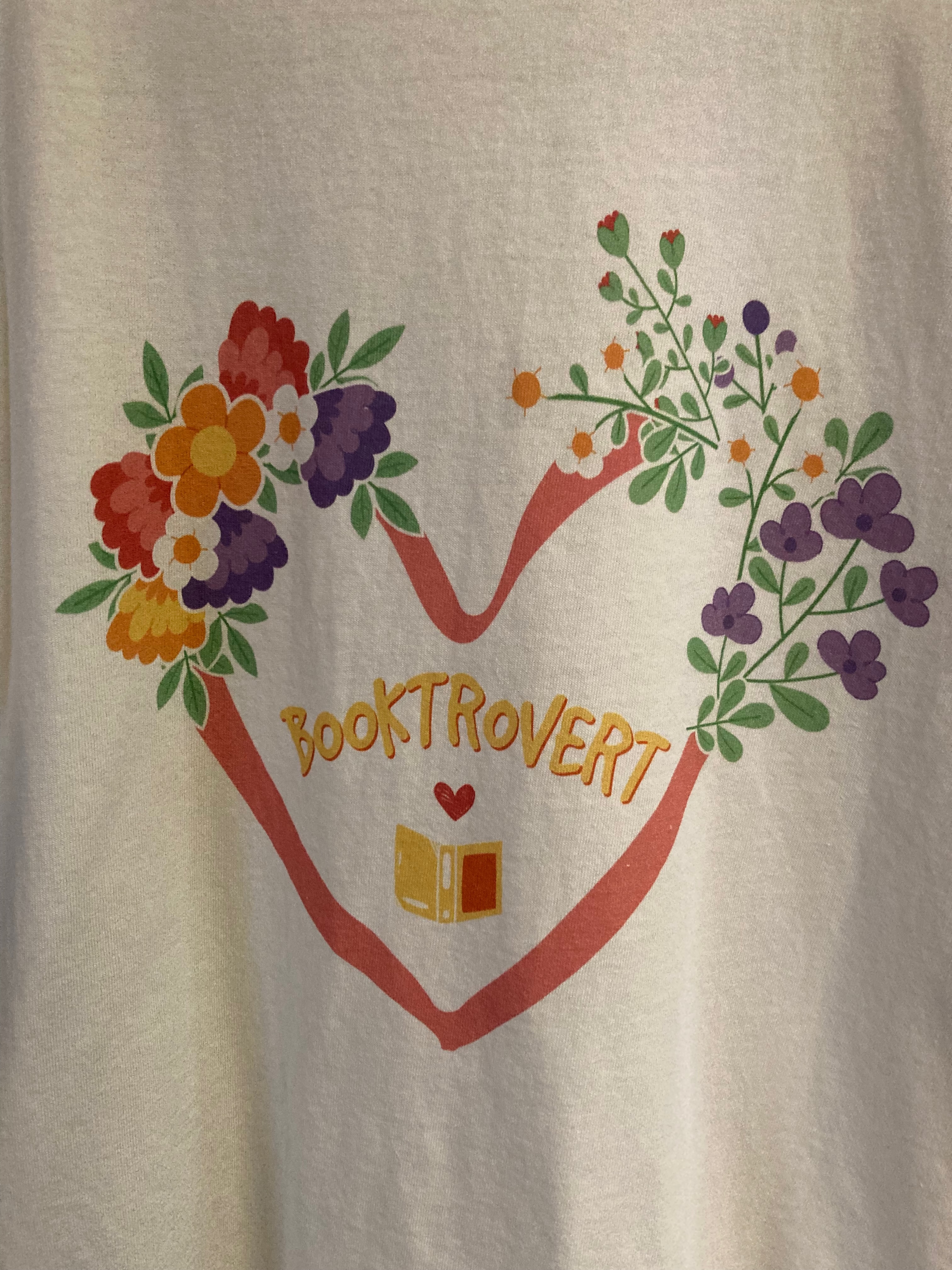
I fell in love with this t-shirt on author Melinda Curtis’ website. I rarely buy clothes for myself, but this shirt is me!
When I started looking around, I found lots of other t-shirts on the Internet with the word “booktrovert.” What??? This is a thing??? Where had I been in the last few years? (OK, that one is easy–I had my nose in a book!) I looked up the word “booktrovert.” According to the Urban Dictionary and other sources, a booktrovert is “a person who prefers the company of fictional characters to real people.” Now, I just find that weird. That is NOT who I am. Since this word is “made up” or can be considered part of our evolving English language, I am going to offer up MY definition: a booktrovert is someone who may or may not enjoy the company of real people, but enjoys spending time reading a good book. A booktrovert also enjoys all things bookish–memes, libraries, bookstores, mugs, bookmarks, book clubs, t-shirts, etc.
So, to all of you who love books, I salute you and the books you are reading. I also wish you a wonderful season of reading, whether you are sunning on the beach or snuggled up by a cozy fire!

The Keeper of Hidden Books–importance of books
The Keeper of Hidden Books
by Madeline Martin

This book is perfect for:
—lovers of books, reading, and libraries
—those who think reading is important for continuity of culture
—people who value ideas
—readers who like the notion of discussion in book clubs
—history buffs
—those interested in Poland—culture, history, role in WWII, underground resistance
—Girl Guides and Boy Scouts
—people who want to know more about the horrific treatment by the Nazis of Jews and Poles.
The Keeper of Hidden Books starts gently with Girl Guides preparing their skills for a war they assumed would never happen. Poland had lost its freedom before, and the Poles were determined it would not happen again. We gradually learn about the lives and values of several of the girls and their families. We witness the responses of the Polish citizens—both heroic and traitorous. As the story progresses we watch the destruction by the Nazis of libraries and books and the valiant efforts of librarians and volunteers who resist this extinction of knowledge. We also observe the desire of people of all ages to maintain access to books that provide escapism during times of hunger, persecution and despair.
This is a good book for me because I treasure books as many of the characters in the novel do. It is a warning to all of us to guard our freedoms, especially the freedom of speech which includes the written word. Hitler worked hard to maintain his power through censorship; we must not let history repeat itself.
I received a complimentary copy of this book in exchange for an honest review. Opinions expressed in this review are completely my own.
Rating: 4/5
Category: Historical Fiction
Notes: The author concludes with notes about her research into the history behind her story, a tale which is based on real events and people in Warsaw. Buried in her discussion of the destruction of books by the Hitler Youth is the statement “But the power of books still endured.” That is a distillation of the theme of this book.
Publication: August 1, 2023—Hanover Square Press (Harlequin)
Memorable Lines:
Now the world crumbled in on itself, burning away the beauty of Warsaw, and there was no more time for reading than there was food to eat.
More and more children were appearing at the library as time went on. Many of them were desperate for distraction, to read about faraway places they could not go, or to transport themselves to mythical lands that could still tease at their dulled imaginations. They wanted stories where villains were vanquished. But books were more than a means of escape for these children; they offered another life to live. They offered hope.
…why Hitler so feared the books he banned. There was power in literature. Brilliant and undeniable. Books inspired free thought and empathy, an overall understanding and acceptance of everyone.
Reflections on Reading
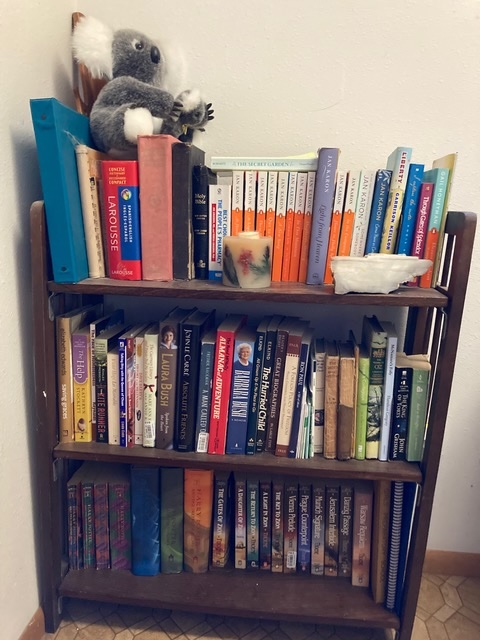
Like singer Jimmy Buffett who “took off for a weekend last month, just to try and recall the whole year,” I spent some time this week reflecting on books and reading. I had decided this year not to get so wrapped up in Advanced Reader Copies (ARCs) that I felt limited in my reading choices. To start this process I began requesting fewer ARCs thus limiting the self-imposed pressure of commitments to authors and publishers. Initially difficult to do, I can now visually see in my book lists that I have requested about half of the number of books I normally applied for in the past from ARC sources. The result is that I am enjoying my book club reads more, occasionally reading library books and books that have been waiting patiently on my physical bookshelves, and reprioritizing my non-reading time.
“To everything there is a season.” I enjoy reading as much as ever, but I am happy with the gradual rebalancing of my time as I make these subtle changes.
HAPPY READING TO ALL! 📚💜📚
The Little Books of the Little Brontës–creativity in childhood
The Little Books of the Little Brontës
by Sara O’Leary
illustrated by Briony May Smith

This little book of historical fiction introduces children to the famous Brontë family. The girls, Charlotte, Emily, and Anne, and their brother Branwell are raised by their father who is a vicar, their aunt, and a housekeeper. They grow up in relative poverty, but have a fun life with much time to exercise their creativity as they are homeschooled and spend a lot of time exploring the moors. Almost anywhere they go would be by foot.
The Little Books of the Little Brontës tells how they loved to read and as children they made tiny books for each other and for their toy soldiers. As they grew older, their reading passion was turned to writing. The sisters died young, but their books are still eagerly read today.
I enjoyed this fictional view of the Brontës’ childhood. It is easy for children to follow. I particularly liked the illustrations; they are delicate, detailed, and whimsical. After explaining that the sisters had short lives, the author takes the reader back to their happy early years which is a sweet ending and very appropriate to a children’s book.
I received a complimentary copy of this book in exchange for an honest review. Opinions expressed in this review are completely my own.
Rating: 5/5
Category: Children’s Fiction, Historical Fiction
Notes: 1. Includes directions on how to make a little book.
2. There are Author’s Notes containing information about the family for adults.
3. The book ends with an extensive Bibliography.
4. Ages 5-9, Grades K-4
5. Print length: 40 pages.
Publication: October 17, 2023—Tundra (Penguin, Random House Canada)
Memorable Lines: (which is also the first sentence)
Many years before you were born,
sometime in the long ago,
a child named Charlotte Brontë
made a little book for her little sister Anne.
The Trouble with Reading (Part II)—Reading to Learn
I recently had some eye-opening experiences regarding reading that I want to share. I love to read, have a reading specialist credential, and am a retired educator of 34 years. I also love to learn, and I did just that this week in reading two different books. I gained a new appreciation of the struggles some readers have with reading. If you want to read Part I of The Trouble with Reading which deals with dyslexia, click here.
The other book I read that was a learning experience was a printed copy of a nonfiction book I purchased to read with my book club. It is a well-researched book that focuses on a part of my country’s history. Reading it was a great reminder of the differences in reading a fiction and a nonfiction work. “Work” is an appropriate word here, because of the extensive research effort of the author and the extra time and focus the reader needs to devote to reading the book. There are so many historical figures that play into the book along with settings of note. It is hard, but important, to keep track of them all. It is a very good and well written book and appropriate for book club discussion. I had to schedule reading it into my day so that I finished it by the time of our meeting. In other words, reading it was a chore; to do it justice, I took extensive notes and found the process tiring. Also, it did not focus on a subject that is my primary strength which makes the book intrinsically less interesting and more difficult to read. I brought less background knowledge to the table.
The book was not entertaining, but I am glad I read it. Although nonfiction varies widely, in general it is not my favorite genre. As all teachers should know, I was reminded that nonfiction, which is the foundation of most subject area texts, requires a different set of reading skills and those should be explicitly taught after students master the general reading process. Early elementary focuses on “learning to read” and grades above that should focus on “reading to learn.” Some middle and high school teachers believe that students leave elementary school with the skills they need for content area reading. This knowledge, however, is developmental; what is needed to process a middle grade text is not sufficient for comprehension of a high school text. Unfortunately, many students do not leave elementary school reading on grade level, making the gap even larger. To some degree, all teachers must be reading teachers.
The Trouble with Reading (Part I)–Learning to Read
I recently had some eye-opening experiences regarding reading that I want to share. I love to read, have a reading specialist credential, and am a retired educator of 34 years. I also love to learn, and I did just that this week in reading two different books. I gained a new appreciation of the struggles some readers have with reading.
Although we often think of dyslexia as letter reversals, it is actually a problem that is much wider than that one symptom. Dyslexia is an impaired ability to read and is not correlated with IQ. It can manifest itself in many ways. I don’t have dyslexia, but an Advance Reader Copy I read this week made me feel like I do. Anytime certain pairs of letters should have been present on the page, they were omitted. Here are some examples of the defective text along with what should have appeared on the page.
stu ed-full (stuffed full)
e fat one (The fat one)
on re (on fire)
e notes owed (The notes flowed)
“at’s a rst.” (“That’s a first.”)
BUT MY FAVORITE was a character named “Cli.” It seemed like an unusual name; about half way through the book, I started laughing at myself. I applied the missing letter pattern and discovered that the character is probably named “Cliff.”
The missing letters were: th, ff, fl, fi. Spacing was not always consistent with missing letters. Without context and my understanding of the importance of context, I would have been totally lost. Being able to pick up the pattern was also important. As it was, I had to make myself finish reading the book for the purpose of reviewing, but the experience was less than enjoyable and quite tiring. I put myself in the place of readers who have reading difficulties—letter reversals, words moving across the page, etc. I have renewed sympathy for their struggle. Professionally there are still arguments over causes and remedies, but being given more time to process text and learning coping strategies are helpful to many readers. Those who find reading “natural” and easy can remind themselves that we all have strengths and be thankful that reading is so accessible for them while being supportive and understanding of those for whom reading is a fight for meaning.
Let me assure you that Advance Reader Copies rarely have that many problems and that reviewers are warned that these ebooks have not always undergone the final editing process when they are presented to reviewers. The published book should be and usually is free from errors.
Check back in tomorrow for my reflections on a different type of difficulty I experienced with the other book.
Top Ten Tuesday, May 26, 2020
Blogging friend, retired teacher/librarian, and book reviewer Carla has chosen out some of her favorite quotes from children’s books to share. I love them all. There is such wisdom in children’s literature. I challenge all education administrators to apply the quote from The Phantom Tollbooth in all of their dealings teachers and students. We do, in fact, learn from our mistakes!

Top Ten Tuesday was created by The Broke and the Bookish and is now hosted by That Artsy Reader Girl. Each week a new theme is suggested for bloggers to participate in. This week’s prompt is Top Ten Opening Lines. I do not have any idea or memory of opening lines except for Tale of Two Cities by Charles Dickens. Instead, after reading Carol’s list at The Reading Ladies, I went with Favourite Book Quotes, specifically Favourite Children’s Book Quotes. I had a real hard time limiting this to ten, but here is what I ended up with.
View original post 396 more words
State of the Stacks: Too Soon Edition
I’m reblogging this essay to share with my readers because it contains a great discussion on developmental reading and book choices. I hope you find it as interesting as I do.


As a child, reading is a constant period of transitions. A kid usually starts with someone reading picture or board books to them. From there, they might try to tackle wordier texts like easy readers and chapter books. Before long, there’s a pull for longer stories with more complex plots, and that’s when middle grade novels kick in. And as they grow and develop as readers, young adult works wait for them before they drift into the wild and untamed world of adult books.
Of course, every reader is different and, just because a kid moves toward a different style of book, it doesn’t mean they can’t return to an old, trusted format. So while each type of book represents a door for readers, it’s an open one— one they can pass back and forth to suit their moods. It’s how adults can still find joy in picture books.
However…
View original post 646 more words
Madeline Finn and the Shelter Dog–introduction to the animal shelter
Madeline Finn and the Shelter Dog
written and illustrated by Lisa Papp
 If you like kids and reading and you have a heart for shelter dogs, then you will enjoy sharing Madeline Finn and the Shelter Dog by Lisa Papp with a child in your life. The storyline is simple. A little girl, Madeline, begs her mother for a puppy. Mrs. Dimple, who volunteers at a shelter, has a rescue dog, Bonnie, with some pups. Madeline is allowed to choose one, and in the process she learns about shelters where animals wait for their forever homes as well as how to care for her new puppy. Madeline is a girl of action. She not only helps at the shelter, she also rallies her community to bring blankets and books to read to the shelter animals. Madeline Finn and the Shelter Dog is a sweet read with gentle and engaging illustrations.
I would like to extend my thanks to netgalley.com and to Peachtree Publishers (Myrick Marketing) for giving me the opportunity to read this book in exchange for an honest review.
Rating: 4/5
Category: Children’s Fiction
Publication: March 1, 2019—Peachtree Publishers (Myrick Marketing)
The Writer Who Couldn’t Answer Standardized Test Questions About Her Own Work

Photo by Pixabay on Pexels.com
This article hits me hard on two levels. One is OVERTESTING! What are we doing when we contrive in standardized tests to create “gotcha” questions that the author of a work can not even answer? The other is a reader’s understanding of a piece. To comment on a work of literature is to bring your own background knowledge to the work. It should affect each reader in a different way. This is not to say that we cannot discuss the possible intended meaning by the author, but to claim authoritatively from a reading what another person thinks is hubris. My view of standardized tests is that you are right, KayCKay; just listen for the cha-ching echoing in the hallowed halls of learning.

Yesterday I posted a review of one of Edgar Allan Poe’s short stories called The Cask of Amontillado. At the end of my review I commented that the story has been analyzed to death regarding the “meaning” of the story and what the story may signify or represent. My final comment was to wonder what Poe would say if we were able to ask him directly. My thought is that he would say it was just a story!
Today I saw an article about a poet that couldn’t answer standardized test questions about her own poems!
View original post 319 more words
 education pathways