
Home » Nonfiction (Page 5)
Category Archives: Nonfiction
How the West Brought War to Ukraine–understanding how U.S. and NATO policies led to crisis, war, and the risk of nuclear catastrophe
How the West Brought War to Ukraine
by Benjamin Abelow

A short book, How the West Brought War to Ukraine, presents an important but controversial view of which countries are behind the current conflict between Russia and Ukraine. To understand Benjamin Abelow’s thesis, you have to revisit history going back almost 200 years to the Monroe Doctrine. In 1823, the United States made it clear that foreign forces placed near U.S. territory are in violation of that policy and provide a reason for war. If you follow that to its logical conclusion, countries massing troops on Russia’s border, especially with weapons whose capability allows reaching within Russia’s borders, is clearly an offensive act.
For years, the U.S. and NATO have been setting up countries that border Russia with military aid to be able to fight a proxy war. Abelow explains “How the Narrative Drives the War” in his introduction in which he lists the Western provocations. The rest of the book is an amplification and explanation of each one of these. One of his most compelling arguments is asking his reader to put the U.S. in Russia’s position. What would the U.S. do? How would it react if foreign forces massed on the Mexican or Canadian border with the ability to send destructive weapon fire into the U.S.?
The author is not a Putin lover, but he does try to present the other side, the side the Western media is not showing. The author is sympathetic to both Russian and Ukrainian soldiers. Among the many leaders he quotes, he includes Chas Freeman, former Assistant Secretary of Defense for International Security Affairs. He speaks of the U.S.’s two contradictory aims which will result in many deaths. Dripping with irony, Freeman says “We will fight to the last Ukrainian for Ukrainian independence.” The author also spreads the blame around to many Western leaders (including George W. Bush, Trump, and Biden) who have reneged on promises to secure borders and have propped up regimes whose goals were to break down those borders. You may or may not agree with the author, but if you read the book, you will be able to have an informed opinion about this conflict which could potentially evolve into a nuclear war.
I received a complimentary copy of this book in exchange for an honest review. Opinions expressed in this review are completely my own.
Rating: 5/5
Category: History, Nonfiction, Politics
Notes: 1. I always try to learn from history, and there are very few politicians I trust. I have to ask why we are involved in this conflict. It is hard to convince me that it is out of concern for the common man and woman in Ukraine when there are conflicts and genocides all over the world that we ignore. It seems something more than altruism is at play.
2. I have bumped this review ahead in my queue because the book’s message is time sensitive. Recently, pipelines that are important to our world were blown up, and this morning I read that an important bridge suffered an explosion in the Crimea and apparently several people lost their lives. There has been war and conflict in that part of the world for centuries, but it seems there currently is evil afoot with a very destructive path.
3. For memorable lines for this complex topic, I am just noting one paragraph rather than 3 shorter passages. I think it presents the theme and the persuasive writing style of this book quite well.
Publication: August 31, 2022—Siland Press
Memorable Lines:
Had the United States not pushed NATO to the border of Russia; not deployed nuclear-capable missile launch systems in Romania and planned them for Poland and perhaps elsewhere as well; not contributed to the overthrow of the democratically elected Ukrainian government in 2014; not abrogated the ABM treaty and then the intermediate-range nuclear missile treaty, and then disregarded Russian attempts to negotiate a bilateral moratorium on deployments; not conducted live-fire exercises with rockets in Estonia to practice striking targets inside Russia; not coordinated a massive 32-nation military training exercise near Russian territory; not intertwined the U.S. military with that of Ukraine; etc. etc. etc.—had the United States and its NATO allies not done these things, the war in Ukraine probably would not have taken place. I think that is a reasonable assertion.
Through Gates of Splendor–a call from God
Through Gates of Splendor
by Elizabeth Elliot

Five young men felt God’s call to share the good news of Jesus with an Ecuadoran Indian tribe that had never had positive encounters with outsiders. Their bad experiences date back to the ruthless rubber traders of the 1870’s—“civilized savages against unbaptized savages.” They had Stone Age technology, were feared by other Indians for their unprovoked ambushes, and had a language known only to themselves. The missionaries and their wives had a daunting task. They started by evangelizing more friendly local tribes and establishing bases, many refurbished from areas abandoned by Shell Oil Co. From these bases they did flyovers of the Auca land, first to find where in the jungle the Aucas were living and later to communicate with them by dropping gifts to demonstrate their friendly intentions.
When they felt the time was right, they finalized plans to land and meet with the Aucas in person. The book becomes very intense at that point. After an initial positive meeting, there is literally radio silence instead of the expected call back to the wives. A search and rescue team went in consisting of Ecuadorian military, volunteer missionaries and Indians, and U.S military. It was a dangerous mission.
Although the preparation and action are the basis of the story, the core of the book is faith in God. Elizabeth Elliot, the author of Through Gates of Splendor, was the wife of Jim Elliot, the first missionary of the group to respond to God’s call to contact this people group who had never heard of Him. Jim Elliot was willing to die if need be to share the good news of salvation to the Aucas. He said, “He is no fool who gives what he cannot keep to gain what he cannot lose.” The story of the lives of these young men and their dedication to God is inspiring and many of their notes and thoughts are recorded in this book. In its pages you will see a vivd picture of what God’s call can look like as well as how these missionaries and their wives responded.
Rating: 5/5
Category: History, Christian, Memoir
Notes: The 40th anniversary edition which I read included:
1. Maps
2. Photographs, many taken at great peril by a Life magazine reporter who chose to stay with the search party when he could have returned to the base and safety.
3. Two Epilogues. One was written in 1958 explaining the immediate aftermath of the first contact and one written in 1996 relating the lives of the families as they evolved over the next 40 years.
Publication: Originally 1956
40th anniversary edition in 1996—Living Books (Tyndale)
Memorable Lines:
“If that old engine had quit up there, God alone could have saved me. I might just as well admit it frankly right here; I don’t like to fly over stuff like that and I have to have a pretty good reason to be over it without a good position-check and a good river to identify my position by. But these are people for whom Christ died, and you have to find them before you can take the Gospel to them, so I was happy to have stumbled on them.”
Pete Fleming was one of those who could not be content while the Aucas remained in darkness. In his diary he wrote: “It is a grave and solemn problem; an unreachable people who murder and kill with extreme hatred. It comes to me strongly that God is leading me to do something about it, and a strong idea and impression comes into my mind that I ought to devote the majority of my time to collecting linguistic data on the tribe and making some intensive air surveys to look for Auca houses….I know that this may be the most important decision of my life, but I have a quiet peace about it.
September, 1955, was the month in which Operation Auca really started, the month in which the Lord began to weave five separate threads into a single glowing fabric for His own Glory. Five men with widely differing personalities had come to Ecuador from the eastern United States, the West Coast, and the Midwestern States. Representing three different “faith-missions,” these men and their wives were one in their common belief in the Bible as the literal and supernatural and perfect word from God to man. Christ said “Go ye”; their answer was “Lord, send me.”
Food Triggers–a Godly approach to healthy eating
Food Triggers
by Amber Lia

Amber Lia writes Food Triggers from the perspective of a certified health coach and a Christian. She began her journey to develop healthy eating habits when she was sixty pounds overweight. She views the journey to health as both a physical and a spiritual battle. She began her personal changes with a “medically designed plan” in consultation with a health coach for accountability. She combined that with examining her food triggers one at a time. This book does not tell you what to eat although she clearly avoids sugars and excessive carbs. She intends her book to be read one chapter per day for 31 days. Each chapter addresses a specific motivation or food trigger, some external and some internal.
Lia backs up the information with research and with Scriptures. She encourages the reader to “exchange unhealthy patterns for God-honoring habits.” Some of her chapters resonated with me and others did not apply. She addresses how others can try to sabotage your healthy eating plan and the temptations that may arise when you are in community settings that involve food. There are many difficult areas she addresses including travel, portion control, and boredom. Food Triggers is not a diet plan, but is another tool with insights and practical tips that those struggling with weight loss and/or healthy eating can add to their toolbox.
I received a complimentary copy of this book in exchange for an honest review. Opinions expressed in this review are completely my own.
Rating: 4/5
Category: Nonfiction, Christian
Notes: Although I am in support of portion control, I did not agree with the author’s emphasis on following the serving sizes indicated on packaging. I have always viewed those as the food industry’s efforts to simplify the nutritional labeling. The FDA, however, says that the goal for their newly revised labels is to “bring serving sizes closer to what people actually eat so that when they look at calories and nutrients on the label, these numbers more closely match what they are consuming.” In other words, the serving size is not what people should eat, but what the “average” person consumes. These revised figures have gone up for ice cream, but decreased for yogurt. The government in this case is not leading consumers to healthier eating. You know the old saying, “just because he jumps off a cliff, doesn’t mean you should too.” A good example of that is the marketing of soda in huge cups. Along with that we have a huge increase in obesity and diabetes.
Publication: January 4, 2022—Bethany House (Baker Publishing)
Memorable Lines:
In many ways, our culture has brainwashed us with massive portions and helpings that are, well, NOT helping.
Your health journey will present you with hard choices, and it won’t just be saying no to onion rings—but saying no to people or jobs or places that are not moving you toward God’s best for us.
[part of a prayer from the chapter on holidays] Transform my thinking so that I learn to focus on the people and meaningfulness behind times of celebration, instead of all the things to put in my mouth.
Prayer in the Night–for those who work or watch or weep
Prayer in the Night
by Tish Harrison Warren

“Compline” or “Night Prayer” dates back to the fourth century and is intended to be a simple, private service to end the day. It includes Psalms and other Scriptures. One of the prayers, the subject of Prayer in the Night, is:
Keep watch, dear Lord, with those who work, or watch or weep this night, and give your angels charge over those who sleep. Tend the sick, Lord Christ; give rest to the weary, bless the dying, soothe the suffering, pity the afflicted, shield the joyous; and all for your love’s sake. Amen.
Tish Harrison Warren, an Anglican priest, analyzes this prayer describing anecdotally and theologically how and why the prayer has come to mean so much to her.
Life has not been particularly easy for Warren or for many of the parishioners under her care. She is honest and real about her struggles. Most of the book is written in layman terms, but there are some theological concepts that she labels somewhat abstractly. For example, “theodicy” was not a part of my vocabulary although I am aware of the inner conflict many have wondering “why bad things happen to good people.” She used it enough times in context that I was able to adopt it.
Warren doesn’t shy away from pain, vulnerability, weariness, and grieving. She points out the differences between the suffering and the afflicted and how God brings comfort to both. While much of the book addresses the darker side of life, she also brings light on that darkness with the joy, love, and trustworthiness of God.
Rating: 5/5
Category: Christianity, Religion, Theology
Notes: Includes Discussion Questions and Suggested Practices for groups or individuals to encourage deep thinking and application.
Publication: January 26, 2021—IVP
Memorable Lines:
When we’re drowning we need a lifeline, and our lifeline in grief cannot be mere optimism that maybe our circumstances will improve because we know that may not be true. We need practices that don’t simply palliate our fears or pain, but that teach us to walk with God in the crucible of our own fragility.
The hope God offers us is this: he will keep close to us, even in darkness, in doubt, in fear and vulnerability. He does not promise to keep bad things from happening. He does not promise that night will not come, or that it will not be terrifying, or that we will immediately be tugged to shore. He promises that we will not be left alone. He will keep watch with us in the night.
In a culture that’s increasingly committed to nursing every grievance, there’s deep wisdom in being able to name what is right and whole about life, to keep moving forward despite obstacles, to have a wider perspective, to look hardship in the eye and laugh.
Made to Crave–not a diet plan
Made to Crave: Satisfying Your Deepest Desire with God, Not Food
by Lysa TerKeurst
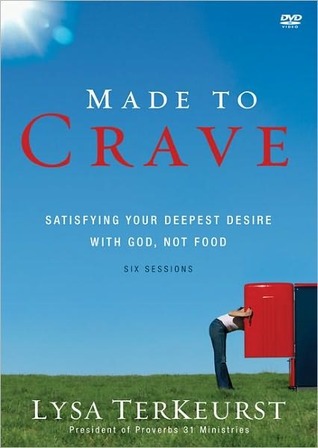
When Lysa TerKeurst decided to get serious about losing weight and keeping it off, she consulted a nutritionist, was given a food plan, had weekly weigh-ins for accountability, and learned a lot about food choices and portions, but all of that is not what her book, Made to Crave, is really about. TerKeurst uses the weight loss challenge as an opportunity to reexamine her relationship with God; what she learned can be applied to other addictions as well. In her introduction she says, “God made us capable of craving so we’d have an unquenchable desire for more of Him, and Him alone. Nothing changes until we make the choice to redirect our misguided cravings to the only one capable of satisfying them. Getting healthy isn’t just about losing weight. It’s not limited to adjusting our diet and hoping for good physical results. It’s about recalibrating our souls so that we want to change—spiritually, physically, and mentally.”
This book is not going to be right for everyone as it tells of TerKeurst’s personal journey. She addresses the problems she confronts like stress eating, being comfortable with your body regardless of your size, and overindulgence. She ties her thoughts into appropriate Scripture references and includes sections at the end that collate the verses into one area according to subject. She also has “Healthy Eating Go-To Scripts” that are self-talk and Scriptures you can use to encourage yourself to stay the course. Each chapter ends with Personal Reflections that reiterate TerKeurst’s theme in that chapter and has questions for thought.
Is this the right book for you? That is a question only you can answer for yourself. As anyone who has ever tried to break the pattern of yo-yo dieting knows, it is not an easy or simple task. I would suggest that it would be one more tool in a Christian’s toolbox when trying to address the complex problem of losing weight. It is not an eating plan or a book that will “fix” your problem. To really work through this process requires soul-searching and hard work.
Rating: 4/5
Category: Christian, Nonfiction, Health
Notes: There is some humor sprinkled through the book. My favorite is her reference to removing her ponytail holder in a desperate attempt to make those scales go down. I can identify in my attempt to attain “data collection consistency,” right?
Publication: 2010—Zondervan
Memorable Lines:
We need a power beyond our frail attempts and fragile resolve. A power greater than our taste buds, hormones, temptations, and our inborn female demand for chocolate. Yes, the truth of who we are and the power to live out that truth—that’s what we need.
But I’ve realized when the desire for treats is triggered by difficult emotions, it’s not really a desire for treats—it’s a thinly veiled attempt at self-medication.
But pity parties are a cruel way to entertain, for they leave behind a deeper emptiness than we started with in the first place.
Seabiscuit–racehorse with a heart
Seabiscuit: An American Legend
by Laura Hillenbrand
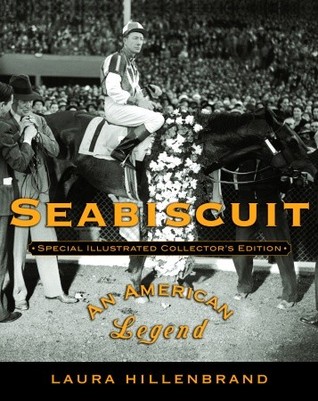
Seabiscuit is the story of an incredible racehorse who took the nation by storm at a time when people needed something positive. He lacked perfect conformation. It seemed like he never got a lucky break when it came to weather or rulings about the amount of extra weight added to his saddle for the races. What he had, however, was strength, speed, competitiveness, and the ability to give all that was asked of him. He also had a supportive team that never gave up on him.
Laura Hillenbrand had been writing about horses and racing in periodicals for years. In Seabiscuit she took that writing to a whole new level, researching, interviewing, delving into archives and corroborating the facts. Then she worked her magic as an outstanding writer to organize the information and make it come alive in word pictures that capture the reader’s heart and imagination.
Hillenbrand doesn’t just help the reader understand and come to love Seabiscuit as his fans did. She takes us into the life of Red Pollard, the jockey who knew Seabiscuit and his ways best. She introduces us to owner Charles Howard and trainer Tom Smith who were as unlikely to be part of his success story as Seabiscuit himself. We are treated to mini-biographies of those around Seabiscuit and the general nature of racing and betting in the 1930’s.
As a complete novice in the world of horse racing, I had to labor a little initially to follow the details, but I soon caught on and began chasing the powerful horse across the pages of this well written book. Hillenbrand’s words are chosen with care and create images in the mind and stir emotions in the heart making this a truly unforgettable piece of nonfiction.
Rating: 5/5
Category: Nonfiction, History
Notes: I purchased the Special Illustrated Collector’s Edition which contains more photographs than the original publication. I highly recommend this edition.
Publication: 2003—Random House
Memorable Lines:
Red Pollard and George Woolf had signed on to a life that used men up. But for all its miseries, there was an unmistakable allure to the jockey’s craft, one that both found irresistible….When a horse and a jockey flew over the track together, there were moments in which the man’s mind wedded itself to the animal’s body to form something greater than the sum of both parts….At the bottom of the Depression, when wrenching need narrowed the parameters of experience as never before, the liberation offered by the racehorse was, to young men like Pollard and Woolf, a siren song.
Seabiscuit seemed a cumbersome giant in comparison. At 1,040 pounds, he outweighed War Admiral by 80 pounds, with six feet of girth and a markedly wider chest. But the big body was perched on legs a full two inches shorter. His neck was thick, his head heavy, his tail stubby, his boxing-glove knees crouched….the mane plaits didn’t lie right and stuck out like quills. the horse stood straddle-legged, as if perpetually bracing himself against a strong wind.
A mournful hush fell over the barn, broken only by the long, low moans of a saddle pony who missed his absent stable companion. All evening long, the deep sad sound drifted out from the shed rows.
The Nine–despair and courage
The Nine
by Gwen Strauss

Five years of research and writing went into the creation of The Nine, a nonfiction work that focuses on a group of nine women, most in their twenties, who joined the Resistance movement in World War II at various times and places. Six were French, two Dutch, and one Spanish. They were individually captured and sent to worse than horrible Nazi internment camps.
The author was able to interview her great aunt Helène who spoke five languages and was the leader of this band who joined together to survive and escape. Strauss followed quite a maze of information and was aided by many including families of “The Nine.” The book begins with Helène’s story which for me was emotionally difficult as she provides some details of her capture and torture. There were some types of torture, however, that Helène would not discuss or even name. The rest of the account moved more quickly as we learn more about each of the young ladies in the first nine chapters along with descriptions of life in a labor camp. Each chapter moves them closer to either death or escape. Most of the rest of the book lays out their last days together and concludes with what happens after the war is over.
The ladies did not share their stories with very many people for a variety of reasons which the author relates. Several wrote about their experiences in unpublished formats to be discovered after their deaths. Many former prisoners of World War II suffered again after their presumed return to safety—homes and loved ones were gone, their bodies were physically ruined, and society turned against them. Statistically they were lucky to survive, but they bore visible and invisible scars. Most returnees were reluctant to discuss their imprisonment with even those closest to them and found that, in general, people did not want to hear about their experiences.
I highly recommend this book for the author’s insightful and thorough reporting about the brave women of the Resistance and the cruel and evil system that treated them as vermin. One of the policies that I sadly see repeated currently is those in power inciting division to weaken and control those under them. In the camps, the Poles received the best treatment from the Nazis, followed by the Reds. Every group looked down on another in the camps with the Roma (Gypsies), criminals, and homosexuals regarded as the bottom of humanity.
I received a complimentary copy of this book in exchange for an honest review. Opinions expressed in this review are completely my own.
Rating: 5/5
Category: History, Nonfiction (Adult)
Notes: 1. Subtitled: The True Story of a Band of Women Who Survived the Worst of Nazi Germany
2. At the first of the book there is a list of the women with their nicknames and a brief description
3. At the end of the book are notes about the author’s journey into the past, a bibliography, notes on each chapter, and a list of the illustrations (which sound interesting, but were not included in my Advance Reader Copy).
Publication: May 4, 2021—St. Martin’s Press
Memorable Lines:
The Jewish prisoners were given the worst rations, worst living conditions, and the hardest jobs. They were already the most traumatized group, having suffered pogroms, witnessed mass murders, and narrowly escaped the gas chambers. All of them had probably seen their loved ones die, and they may or may not have counted themselves lucky to be alive.
They were proud of how they served each other, divided food equally, and maintained their civility in such an uncivil place. It had kept them strong when others become more and more like animals, lost their sense of themselves, and fell into dark despair.
In the sea of people who seemed to have been tossed up like pebbles on a beach, the prospect of finding their loved ones felt nearly impossible.
Mission Possible–living a life that counts
Mission Possible
by Tim Tebow
with A. J. Gregory
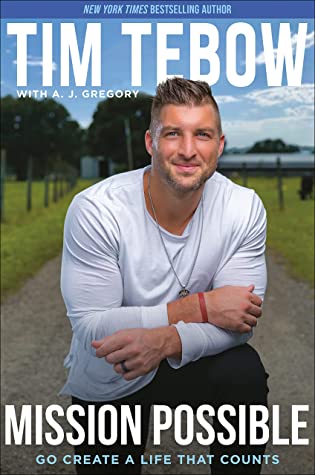
Have you ever thought about the purpose of your life? Tim Tebow, athlete, speaker, and TV sports analyst, shares his ideas on the subject in his latest book Mission Possible. He says that our “big-picture purpose is to bring glory to God wherever you are” and that “Living a mission-possible life means executing the good works that God has already prepared for you to do.”
Tebow lays out in plain language and through Scriptures and anecdotes how each one of us can live out a mission possible life, a life of significance. As head of the Tim Tebow Foundation, Tebow tries to transparently live out his beliefs as he spearheads projects to honor the disabled where they are each crowned king or queen of the prom at Night to Shine events all over the world. He does this to show them how much God loves them and how special they are in God’s eyes. His foundation is also involved in orphanages and health care clinics as well as fighting sexual trafficking. While we can’t all do the things he does or have the influence he has, Tebow says that we can all live out our purpose and make a difference in the lives of others.
In this powerful and inspirational book, Tebow addresses some of the hard problems we face as we try to discover our purpose and make our lives count. Sometimes we encounter obstacles that could keep us from completing our mission, but God can do the impossible if we are willing to be used by Him. God can use us wherever we are, even if we think what we are doing is insignificant. As Tebow notes about Jesus: “He lived fully with purpose in every moment.” That is hard to do but Jesus is the ultimate example for living a life full of purpose.
Our mission possible life will aim for excellence with integrity and gratitude. Tebow also encourages you to pursue your mission with passion. He shares how to find your edge and use it well. He gives guidance for dealing with uncertainties, imperfections, and even failure. He encourages you to take that first step, however small it may be: you don’t have to map out the whole journey before you begin in faith.
There is so much Godly, practical wisdom in Mission Possible. The style is easy to read and well organized, the content is important, and the message is clear. The book concludes with a prayer for those who don’t yet have a personal relationship with Jesus and want to pray to accept Him into their lives. There is another prayer for those ready to make their lives count. This book will make an impact on your life. Read it. Share it. Act on it. You will be glad you did.
I would like to extend my thanks to NetGalley and to WaterBrook for giving me the opportunity to read this book in exchange for an honest review.
Rating: 5/5
Category: Christian, Nonfiction
Notes: Tebow has created 3 companion products that support this book as well as a children’s picture book on the same topic.
Publication: March 8, 2022—WaterBrook
Memorable Lines:
See, my mission was never to put on Night to Shine. Now, I love it and it’s absolutely my favorite night of the year, but my mission was, and continues to be, loving and celebrating and caring for those whom God loves and celebrates and cares for.
God has given us His best, His Son, and has proved that He can be trusted. I may not understand why certain roads have started or ended but I can count on His faithfulness.
We may not be blessed with Tom Cruise’s stunt skills. I can’t sing, and maybe you can’t play football. But there’s one thing we can all do: because of the work Jesus did for us on the cross and through the Resurrection, we can each make our lives count.
Drop Acid–how to lower uric acid values
Drop Acid
by David Perlmutter
with Kristin Loberg
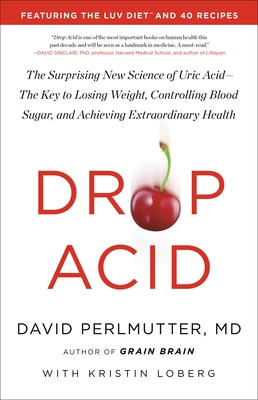
Be prepared when you read Drop Acid for a book that concentrates on a medical theory that attributes many of our medical woes including obesity, diabetes, nonalcoholic fatty liver disease, premature death, stroke, coronary artery disease, Alzheimer’s and hypertension to high levels of uric acid. In his efforts to convince the reader of his theory, Dr. Perlmutter, a neurologist, spends about half of his book expounding in detail the scientific basis of the principles of his LUV (Lower Uric Values) Diet, a trademarked designator. He spends a further 16% of the book at the end on notes for further reading.
The second part of Drop Acid lays out a plan of action for the reader to follow in lowering uric acid levels in three main areas: food; sleep, exercise, exposure to nature, and timing of meals; followed by fine tuning the process. He concludes with recipes that he developed with Tricia Williams, a food therapist.
I was really excited to read this potentially life-changing book. Unfortunately, my eyes glazed over during the details of the first half, and I failed to be convinced that this is a program I personally want to commit to. Even the recipes are challenging. Although Perlmutter claims substitutes can be made in ingredients, I have to ask why one would suggest recipes that specifically include Castelvetrano olives, za’atar seasoning, Tuscan kale, or dulse flakes.
I apply a healthy dose of skepticism when members of the medical community make a business out of healthcare. Perlmutter, in an effort at full disclosure, shares that he is on the board of directors of a company marketing a device, a continuous glucose monitor (CGM) to measure and monitor blood glucose, a device he maintains is not necessary for his program but would be very useful. He frequently in the text refers the reader both to that device and to his self-promoting website. He also introduces the website of Tricia Williams where his business is again promoted and ready-to-eat meals following this diet are available for purchase.
I am not a scientist or a medical professional, and I have not tried his program myself. I am reviewing the book for readability and appeal, not evaluating the efficacy of the LUV diet.
I would like to extend my thanks to NetGalley and to Little, Brown & Co. for giving me the opportunity to read this book in exchange for an honest review.
Rating: 2/5
Category: Health, Mind, and Body
Notes: 1. Perlmutter is the author of a family of five books focused on gluten-free diets. His flagship book for that effort is Grain Brain.
2. Perlmutter ties his Covid wagon to a uric acid star, seemingly willing to accept most of the pandemic deaths as the inevitable result of comorbidities associated with high uric acid rather than admit most could have been avoided with the right therapeutics.
Publication: February 15, 2022—Little, Brown, & Co.
Memorable Lines:
As you will soon learn, long before any symptoms develop, asymptomatic hyperuricemia may well be fomenting an unending, irreversible storm and subtly stoking biological processes that ultimately result in elevated blood sugar and blood pressure, bad cholesterol, excess body fat, and systemic inflammation, which opens the door for any number of chronic degenerative conditions.
Contrary to what Big Corn will tell you, fructose and glucose are not siblings with equal biological effects. Fructose is more like glucose’s evil twin: when you eat glucose, your body uses it to produce energy; but when you eat fructose, it triggers changes in the body that favor the storage of energy in the form of fat.
If elevated uric acid precedes and predicts biological mayhem and future risk for most chronic diseases, then we must start paying attention to this important metabolite.
Seeing Beautiful Again–encouragement
Seeing Beautiful Again
by Lysa TerKeurst

Are you going through a hard time, something that is devastating and you have no control over? Do you wonder if you’ll ever “see beautiful” again? Lysa TerKeurst experienced three of those, two physical and one relational, in a short period of time. She has written several books that describe her journey. In Seeing Beautiful Again, she has drawn from her experiences and writings to compose a devotional book to guide readers through fifty days of their struggle. The goal is to give hope and demonstrate that by clinging to God’s promises, readers can stay the course and trust God.
Seeing Beautiful Again is divided into sections and each section begins with a letter to the reader from author Lysa TerKeurst. Each devotional begins with Scripture and ends with a prayer. In between Lysa shares her thoughts on the topic. These passages sometimes include parts of her personal story and always draw the reader to God’s truth which can be applied to a personal situation.
TerKeurst’s other books like Forgiving What You Can’t Forget examine in depth our response to hurts. This devotional is a daily dose of encouragement to fight the good fight and to remember God’s love and His promises in the middle of the trauma.
I would like to extend my thanks to Edelweiss and to HarperCollins Christian Publishers for giving me the opportunity to read this book in exchange for an honest review.
Rating: 4/5
Category: Religion, Christian Life, Women’s Issues
Notes: Devotional
Publication: March 30, 2021—Harper Collins Christian Publishers
Memorable Lines:
Their victory never hinged on their ability or any of their well-thought-out plans. It was solely dependent on their unwavering obedience offered to a loving and mighty God.
My job is to be obedient to God. God’s job is everything else.
Father God, thank You for reminding me I can trust You in the waiting. I know I can entrust every season of my life into Your hands. Thank You for being present in every moment, strengthening me in the places that I feel inadequate to keep going. When I feel uncertain about what’s ahead, remind me of who You are. I know it will get me through. In Jesus’ name, amen.
 education pathways