Home » Nonfiction (Page 4)
Category Archives: Nonfiction
For Everything a Season: Simple Musings on Living Well
For Everything a Season
by Philip Gulley
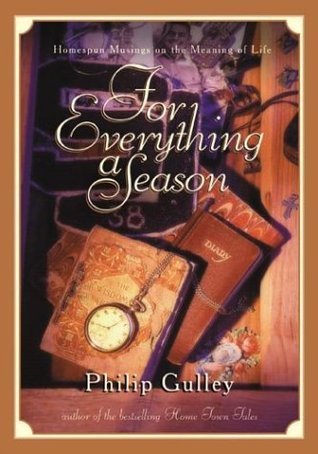
Although For Everything a Season is written by a Quaker pastor, this book is not a devotional or a Bible study. It is relatively short and could be devoured in one sitting or, as I preferred, by reading a chapter or two every few evenings or so. It is calming, soothing, and yet humorous. The kind of humor that makes you nod and smile and occasionally let a laugh bubble over. It is filled with anecdotes about people he knows, about the way things used to be, and his own responses to life. Gulley is the kind of person you would like to converse with as he sits in the porch rocker and you gently sway on the swing and reminisce.
Rating: 5/5
Category: Nonfiction, Essays, Short Stories, Inspirational, Christian
Publication: 1999—Multnomah Publishers
Memorable Lines:
We embrace our children, but there comes the time to step aside and let others love them, too…They do not love our children as much as we do, but they love them in ways we cannot. It is not possible for us to give our children all the love they need. We can only give them so much, then must send them forth so that others might embrace them too.
As a Quaker, I am compelled to embrace certain virtues I would not otherwise find attractive. Since Quakers are pacifists, I can’t fight with anyone. By and large, this has not been a problem, except once when I had a mean boss and wanted to punch him in the nose but couldn’t because I was a Quaker. Instead I quit and found a new job. But there for a while, I wished I were a Baptist.
Regarding simplicity…We also believe if you have to cram your sweaters in the dresser drawer, you have too many sweaters and should give some away. Episcopalians believe you should buy a bigger dresser.
All Creatures Great and Small–more than an animal story
All Creatures Great and Small
by James Herriot
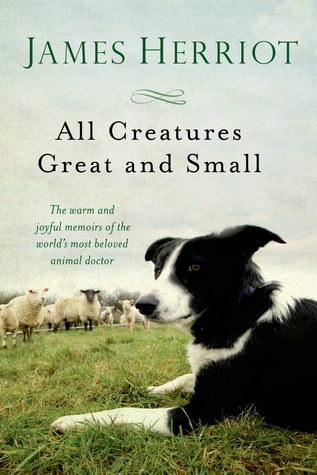
Veterinarian James Herriot set the bar high for veterinarian memoirs when he penned All Creatures Great and Small. Humorous, touching, joyful, personal, this book had me smiling and laughing through the tales of this newly qualified vet who begins his career in the Yorkshire Dales where he falls in love with the land, his patients, and their hard-working owners.
Much of the book’s humor is self-deprecating as Herriot describes unfortunate circumstances in which he is enmeshed. Some come from his visits to various farms, often for middle of the night emergencies. A great deal of amusement arises from Siegfried Farnon, Herriot’s likable, dashingly charming, energetic, and volatile boss and from Siegfried’s younger brother Tristan. Although the brothers love each other, they are frequently at odds due to Tristan’s carefree attitudes.
Although I read this book over thirty years ago, my recent reread was a pure delight. The characters are down to earth and detailed so well the reader can easily picture them. There are customs and manners in the Dales that are foreign to twenty-first century denizens. Herriot is quick to contrast the tools, techniques and medicines available to him as a young vet in 1937 with those used later in his career. All of this is quite interesting, but Herriot’s storytelling abilities are what draw the reader in and keep him returning chapter after chapter. I was so sad when I came to the last page. The fun was over! I read this book with my book club, but I think I may “need” to do a reread of the other books in the series as well.
Rating: 5/5
Category: Memoir
Notes: 1. The series is based on Herriot’s experiences and those of other vets. The characters’ names have been created for the series. Some of the nonfiction may be embellished.
2. It is hard to pull out a passage and say “See how funny this is” because so much of the humor relies on the context and the characters, but it is very funny.
3. There are at least two television series and a movie based on these characters.
4. I would be remiss if I did not note that the word d__n is sprinkled throughout the book. I did not remember this from my earlier reading. In this case I felt the usage fit the story and the characters. It is not used in a mean spirited way and did not detract from the book for me.
Publication: 1972—St. Martin’s Press
Memorable Lines:
“Animals are unpredictable things so our whole life is unpredictable. It’s a long tale of little triumphs and disasters and you’ve got to really like it to stick it…One thing, you never get bored.”
I had learned enough of Dales ways to keep quiet at meals; when I first came to the district I had thought it incumbent on me to provide light conversation in return for their hospitality but the questioning glances they exchanged with each other silenced me effectively.
…now that I was away from the noise and stuffiness of the buildings, the silence and the emptiness enveloped me like a soothing blanket. I leaned my head against the back of the seat and looked out at the checkered greens of the little fields along the flanks of the hills; thrusting upwards between their walls till they gave way to the jutting rocks and the harsh brown of the heather which flooded the wild country above.
People who think farming is a pleasant, easy life should have been there to see the hunched figure disappear into the blackness and the driving rain. No car, no telephone, a night with the heifer, eight miles biking in the rain and a back-breaking day ahead of him. Whenever I thought of the existence of the small farmer it made my own occasional bursts of activity seem small stuff indeed.
Sit, Stay, Heal: What Dogs Can Teach Us About Living Well
Sit, Stay, Heal
by Dr. Renee Alsarraf
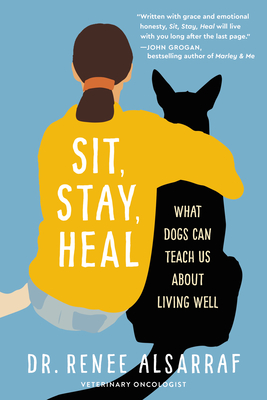
Dr. Alsarraf is a veterinary oncologist. Her training and profession put her in the odd position of knowing way more than most people about cancer in both animals and people. Even as she works with cancer patients and their pet parents every day, she is shocked when she is diagnosed with what she calls “the C word.”
Dr. Alsarraf’s story is quite properly told in the first person. She shares the struggles of some of her patients and compares them with her own battles. Because animals live in a present mindset, they don’t have a fear of the tomorrows of cancer. They have fewer side effects from treatments. For example, they don’t lose their fur. There are many similarities, however, in the unknown outcomes of treatments and the unpredictability of cancer.
I thought this might be a very dark book, but it isn’t. It is inspiring to watch Dr. Alsarraf and her team of assistants work diligently and with care and respect as they treat their patients. Dr. Alsarraf takes time to explain everything to the pet’s human parents and to answer their questions. She never hurries them or makes them feel guilty about their decisions assuring them that there are no right or wrong answers in treatment choice.
There is another situation in this dedicated vet’s life that doubles the emotional impact, but to share it would be a spoiler. I found tears streaming down my face and had to wait a day to finish the book. Sit, Stay, Heal is very well written. The Introduction sets up the reader to journey with the author through her personal battle and shares her philosophies about cancer, pets, and fighting back. Each of the ten chapters that follow focuses on the story of a pet patient, the pet’s family, and her interaction with them all the while enduring her own health struggles. Sit, Stay, Heal is a heart felt book with more smiles than tears for a dog owner.
I received a complimentary copy of this book in exchange for an honest review. Opinions expressed in this review are completely my own.
Rating: 5/5
Category: Memoir, Nonfiction
Publication: October 18, 2022—Harper One
Memorable Lines:
All cats and dogs live in the moment, carefree. They do not waste the present, worried about what might happen in the future. Or how much longer they have to live.
Before the C word, I’d always thought that life was so under my control, and yet the disease has helped me realize that I was never in control of the really big things, or even the medium things.
It’s never easy to say goodbye to a loved one. Through good days and bad, our pets provide such unconditional love, support, and companionship. They’re with us for fun times, and also are there to snuggle with when the outside world seems too harsh.
Liturgy of the Ordinary: sacred practices in everyday life
Liturgy of the Ordinary
by Tish Harrison Warren

Liturgy is the form or pattern that a church service follows. It may be a general and loose sequence or it may be highly structured as followed by Anglicans and other denominations that use The Book of Common Prayer. In Liturgy of the Ordinary, Tish Harrison Warren connects our daily routines to the rituals and patterns of the Christian life from our waking in the morning to our rest at the end of the day. Along the way she examines our search for lost objects and ties it into confession and repentance. She discusses quarrels within the family and how as Christians we are called to extend peace or shalom. Warren dissects how we look at time and at community. She suggests savoring the good gifts of God in our everyday life, but discourages overindulgence in pleasure lest it become an addiction, trapping us in the cycle of wanting more.
Liturgy of the Ordinary is a wonderful book for individual enjoyment and study or for sharing with a group. It is a book that takes simple concepts and invites a deeper dive. Warren is an excellent writer. The book is full of wisdom from both Warren and those she has studied. She invites the reader to look at everyday routines in a new way. The book is replete with anecdotes and quotes. Above all, Warren is open and honest; readers will see themselves in her struggles and her revelations. She makes the mystery of living out the Christian life in this broken world both real and accessible.
Rating: 5/5
Category: Christian, Nonfiction
Notes: Includes Discussion Questions, Practices, and a Bibliography
Publication: 2016—InterVarsity Press
Memorable Lines:
Waiting, therefore, is an act of faith in that it is oriented toward the future. Yet our assurance of hope is rooted in the past, in the person of Jesus of Nazareth and in his promises and resurrection. In this way, waiting, like time itself, centers on Christ—the fulcrum of time.
Christian friendships are call-and-response friendships. We tell each other over and over, back and forth, the truth of who we are and who God is…My best friendships are with people who are willing to get in the muck with me, who see me as I am, and who speak to me of our hope in Christ in the midst of it. These friends’ lives become a sermon to me.
The words of the liturgy felt like a mother rocking me, singing over me, speaking words of blessing again and again. I was relaxing into the church like an overtired child collapsing on her mom. When my husband and I would get into the car after church each week and talk about the service, I would say to him, “It feels like chamomile tea.”
The Wind in My Hair–compulsory hijab
The Wind in My Hair
by Masih Alinejad with Kambiz Foroohar

In her memoir The Wind in My Hair, Masih Alinejad, in exile first in Great Britain and later in America, tells the struggles she had and all Iranian women still endure with laws in Iran that make wearing the hijab compulsory from age seven. The “morality police” in that country take this law over what women wear to the extreme. Women can be beaten, flogged, and jailed if even a strand of hair escapes the hijab. Women who have resisted this compulsory law have had acid splashed in their faces and have been incarcerated, tortured, and sometimes raped.
Masih tells her personal story of an impoverished, but mostly happy, rural childhood with conservative parents. Always a bit of a rebel, Masih was expelled from high school in her final semester and jailed for belonging to a small anti-government secret society. Later as a parliament reporter, she was banned from the parliament building for asking the wrong questions.
In exile Masih worked tirelessly and sometimes under threats of violence for the rights of women in Iran. There are more issues involved than compulsory hijab, but that is a visible sign of the control men have over women in Iran. Masih used the tools of social media, especially Facebook and Twitter, to broadcast her positions in Iran where the government controls television and newspapers. The movements she started were given exposure internationally via the Internet.
Masih is highly critical of female politicians and government employees who visit Iran but are unwilling to bring up women’s rights in official discussions and wear some version of head covering during their visit. Masih made recordings of Iranian families’ stories about their dead or missing loved ones called The Victims of 88. Brave women flooded her social media accounts with pictures of themselves without the hijab in the interest of freedom. The Wind in My Hair is well-written by a journalist-storyteller who has lived the story she tells. It will grip you and not release you as you ponder the freedoms you currently enjoy in your own country.
Rating: 5/5
Category: History, Memoir
Notes: Perhaps because she was not raised American, perhaps because she is a journalist, Masih’s perception of current politics and reporting in the U.S. seem somewhat skewed. She clearly understands that you can’t trust reports in Iran, but does not seem to realize that there is censorship in the U.S. by big business, politicians, and the media working in concert. That viewpoint does not change the importance of her analysis of the Iranian government’s control over its people following the deposition of the Shah.
Publication: May 29, 2018—Little, Brown, & Co.
Memorable Lines:
“The Americans are coming to steal Iran away. They’ll kill us all.” I really thought we’d face another war immediately. It was not rational, but, like millions of Iranians, I had been brainwashed by the daily propaganda on the national television and radio stations. I thought it was only Khomeini who was strong enough to stand up to the greedy U.S. capitalists. Many years later, I discovered that Khomeini was a coldhearted dictator who ordered the execution of thousands of Iranians.
I didn’t even know what charges I faced. No one had read the complaint against me. I had no lawyer to defend me. I was forced into giving a confession, and now all that remained was for this judge to pass a sentence. It didn’t sound very just. Later in life, I discovered that there is not much justice in the Islamic Republic.
There is a predictable cycle in Iranian politics, as predictable as the weather. Every year, for a few months, the government relaxes its grip and some actions are tolerated—women can show a few inches of hair under their head scarves, or men and women can actually walk together without being married, or the newspapers can publish mildly critical articles. Then, just like the dark clouds that gather in late autumn, the freedoms are taken away and transgressors are punished.
The Remarkable Ordinary: How to Stop, Look, and Listen to Life
The Remarkable Ordinary
by Frederick Buechner

Art and music as gateways to God—an interesting thought Frederick Buechner uses as the basis of his first chapter in The Remarkable Ordinary. That beginning was a little slow to take hold on me, and it didn’t really continue on as a predominant theme in the book. In fact, the book continues forward in three parts with a total of eight chapters. As I read, I felt like I was examining Buechner’s mind, his thought processes, his memories, and most importantly his search for God in the ordinary things of life. When he began a relationship with Christ, he was “all in.” Not content to read the Bible through as a first step, he wanted to jump right into seminary. He eventually decided that his training in the ministry and his skills would be best used as a writer rather than as a pastor. He never used the term philosopher, but that is what I see him as. The Remarkable Ordinary is part philosophical treatise and part memoir. He delves into therapy sessions, dreams, and family history that helped form his character and beliefs.
Buechner is honest and introspective, and the book is a product of his soul searching. Each chapter is a collection of his thoughts on various themes. He reflects on holiness, our personal journeys, our efforts at controlling others, and the wars we wage with ourselves and those around us. He shows facets of God to us as he examines the arts, other people, the ordinary things around us, and our stories, dreams and memories. He ties all of these parts of the “remarkable ordinary” into our need to “stop, look, and listen to life.”
I actually read much of the book twice in an effort to understand Buechner’s views. It is different from other books I have read by religious leaders. Buechner is very open about his beliefs and his past and yet, probably rightly, he did not reveal all as he continued to clarify his thoughts. Some things are too personal to share with the world. Frederick Buechner passed away on August 15. 2022, leaving behind a legacy of 39 works of fiction and nonfiction in several genres written over a span of 60 years.
Rating: 4/5
Category: Nonfiction, Christian
Publication: October 3, 2017—Zondervan
Memorable Lines:
It seems to me almost before the Bible says anything else, it is saying that—how important it is to be alive and to pay attention to being alive, pay attention to each other, pay attention to God as he moves and as he speaks. Pay attention to where life or God has tried to take you.
We’ve all had saints in our lives, by which I mean not plaster saints, not moral exemplars, not people setting for us a sort of suffocating good example, but I mean saints in the sense of life-givers, people through knowing whom we become more alive.
I was so motivated because I was at that point so on fire with, I can only say, Christ. I was to the point where when I would see his name on a page, it was like seeing the face of somebody you loved, and my heart would beat faster. I had to find out more about him.
I certainly am always at war one way or another with myself, and some of them are wars I must fight to try to slay the demons, to kill the dragon, to lay the ghost to rest. But there are other wars you fight with yourself that are really not worth fighting at all. The war to make yourself be more, do more than you have it in you really to do or to be.
Help is Here: Finding Fresh Strength and Purpose in the Power of the Holy Spirit
Help is Here
by Max Lucado

In the way Max Lucado presents information in all of his writings, he tells us in Help is Here about the Holy Spirit—with lots of Scripture as the basis to which he adds humor and anecdotes to make his point clear and personalize it for the reader. I never realized how many verses of the Bible, especially the New Testament, talk about the Holy Spirit: who He is, His job description, and how we can access His power and help. As always, Max points the reader to God: the Father, the Son, and the Holy Spirit.
When you are in such despair that you don’t know how to pray, the Holy Spirit will intercede and pray for you. When you have a task that is too big for you, you can have the Holy Spirit walking beside you, empowering you. Nothing is too big or too hard for Him. When you need direction, the Holy Spirit is there. When you feel totally undone, the Holy Spirit can breathe new life into you. If you have never investigated the role of the Holy Spirit, I urge you to read Help is Here. Max explains His role in the world and urges you to welcome the Holy Spirit into every part of your day. Practical and inspirational, Help is Here is a treasure for Christians whether you have been walking with Jesus for a lifetime or you have just met Him. If you are a seeker wanting to know more about God, this is a good book for you too.
Rating: 5/5
Category: Christian, Nonfiction, Inspiration
Notes: Help is Here ends with “Questions for Reflection” prepared by Max’s daughter Andrea Lucado. There is a set of questions for each chapter. The book concludes with a few pages of footnotes.
Publication: September 13, 2022—Thomas Nelson
Memorable Lines:
…your Father is more than willing to release blessings in abundance. You have the Spirit as your advocate and your Father as your provider. You may feel weak, but you’ve never been stronger.
We have a helper, a divine instructor. He will save us from the cul-de-sac of confusion and the dead end of doubt. He does this by enrolling us in the primary course of his university: Jesus Christ.
The chief aim of the Spirit is to escort you into the Sistine Chapel of Jesus and watch you grow wide-eyed and slack-jawed. He will enchant you with the manger, empower you with the cross, embolden you with the empty tomb. He will infect you with his love for the Savior.
The help you need is here. Ask the Spirit to infuse you with his power. Throw open the door! Swing wide the gate! Stand on the threshold and say “Come in!”
Into the Forest–A Holocaust Story of Survival, Triumph, and Love
Into the Forest
by Rebecca Frankel
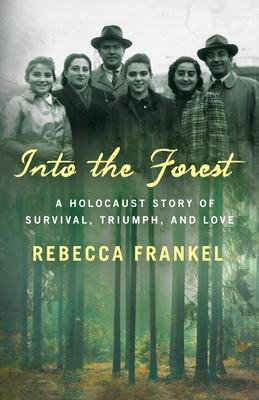
So many books have been written about World War II and, more recently, about the Nazi treatment of Polish Jews. Rebecca Frankel adds Into the Forest to the collection. It is nonfiction that in many parts the reader would wish it to be fiction, that the torture, annihilation, and deprivation should not really have happened. It is the story of the Rabinowitz family, of the many Jews who died, of the love that persisted through two years of living on the move in the cold forests, of digging holes in the ground to hide from Nazis. It is the story of survival, of triumph as the lives of some of the people in the book intersect years and thousands of miles later.
This book was emotionally difficult to read, knowing it is nonfiction, and thus was a slow read for me. The author knew first hand some of the people she wrote about. She spent five years researching and interviewing. There is a huge section of copious notes detailing where her information came from for each chapter.
The Prologue ties the tale together and is worth rereading at the conclusion of the book. There are two chapters that set the stage of what life was like in the little Polish village of Zhetel before the invasion of the Russians, followed by the occupation of the Germans. Then the focus lands on the German-created Jewish Ghetto, the Polish Resistance, and the various “selections” in which laborers and those destined for the mass graves were chosen. The “lucky” escaped to a huge forest, but many died there as hunted animals before the liberation came. The Rabinowitz family had their eyes set on a future in Palestine, but they had many more moves in their future and were caught up in the growing prosperity of the 1950’s. Into the Forest is a challenging book worth reading. It shows Jewish life and customs in the midst of both tribulation and good times. The book thankfully ends on positivity as the author stresses the various types of love woven into the book.
I received a complimentary copy of this book in exchange for an honest review. Opinions expressed in this review are completely my own.
Rating: 5/5
Category: History, Nonfiction, Memoir
Publication: September 7, 2021—St. Martin’s Press
Memorable Lines:
The forest, however, would not be exempt from the war’s brutalities or the bare-knuckled survival required to endure it. Nor would it provide ample shield for the Jews or the partisans—Russian and Jewish alike—who had taken shelter here and set up their outposts in its wilds, no matter how dark or deep. The farther they went and the safer they were, the more determined their killers became to root them out.
In some areas, the advertised reward for information on the partisans or hiding Jews was a single cup of sugar. Which was either a reflection of the paltry value of a Jewish life, or the peasants’ depth of desperation.
But Moscow’s successful onslaught had made the retreating Nazis more dangerous and, however unimaginably, even more murderous. Himmler issued an order to those in the path of the fast-moving Soviet troops: destroy all evidence.
Battle Cry of the Siamese Kitten: even more tales from the Accidental Veterinarian
Battle Cry of the Siamese Kitten
by Philipp Schott, DVM

I had a delightful journey through a series of tales, compared by the author to snacks, in Philipp Schott’s latest book Battle Cry of the Siamese Kitten. It is his third book of this type. It includes animal stories, vet stories, and client stories along with memories dredged up from his unusual childhood as a German immigrant. We gain insight into how he thinks and how he relates to others. There is a lot of humor in the book, and Schott doesn’t shy away from laughing at himself. He has a great way with words that lets the reader experience the animal encounters whether they be disgusting and smelly, bloodletting, or laugh out loud funny. The second tale about a two pound “gorgeous fluffy kitten who channels Satan” will ensure that you are fully engaged as this tiny, very loud, little guy “starfished himself across the entrance” to the kennel looking for a “decisive victory.”
Philipp Schott draws on over 30 years of experience with animals. He is the kind of vet you would want for your own pets—caring, hardworking, kind, intelligent, and honest. Unless you live in Winnipeg, Manitoba, you are unlikely to meet him. He lives there with his family and four animals who admittedly receive people food from time to time as treats. Although she did not contribute to this book, his wife is also a veterinarian and probably a very patient person.
I received a complimentary copy of this book in exchange for an honest review. Opinions expressed in this review are completely my own.
Rating: 5/5
Category: Memoir, Nonfiction
Notes: The more I read, the more I liked what I was reading and even went back to read a few tales again for pure pleasure.
Publication: October 11, 2022—ECW Press
Memorable Lines:
Supercat put his ears back flat and stared at me with an intensity that signaled a level of hatred two steps beyond loathing.
I am not easily bored, but this was an exception. Flies fell asleep in that class.
Have you ever noticed this? The happiest dogs are the ones carrying sticks. And if the sight of a happy dog carrying a stick doesn’t gladden your heart, then what are you doing with this book in your hands?
Some Golden Daybreak–the Second Coming of Christ
Some Golden Daybreak
by Lee Roberson, D.D.
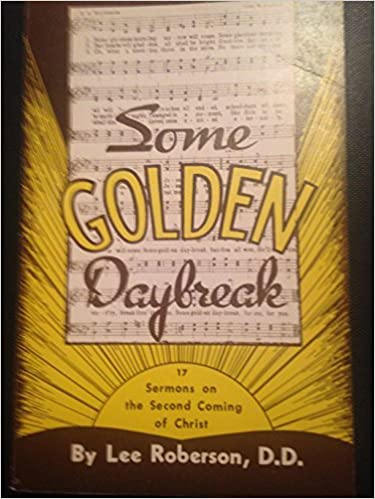
Having worked through two different current Bible studies on the book of Revelation, I came away with more questions than answers. I learned that there are three major perspectives that scholars adopt to address this New Testament book of prophecy. I remember clear teachings when I was a child at Highland Park Baptist Church in Chattanooga, Tennessee, so I searched online for a book by the pastor at that time. On a used book site, I found Some Golden Daybreak, a collection of 17 sermons on the Second Coming of Christ written by Dr. Roberson. Since then, I discovered that Amazon has both paperback and a Kindle version so this book has clearly passed the test of time.
I highly recommend Some Golden Daybreak. Its teachings are based on Scriptures found in both the New and Old Testaments and address such topics as the mark of the beast, Armageddon, and the much debated Great Tribulation. It answered many questions for me satisfactorily. If you have wondered about eternal life and salvation, this book will provide hope, inspiration, and answers.
Rating: 5/5
Category: Christian, Religion
Publication: 1957—Sword of the Lord Publishers
Memorable Lines:
He invites all sinners to come and to drink of the water of life. No one is excluded. All are invited. What is the water of life? It is salvation through faith in Christ. How do we take it? Freely, without money and without price. It is for everyone.
He is coming again. He is coming in power and great glory. The Christ who was prophesied to come as Saviour hundreds of years before He was born; the Christ who walked upon the earth and died upon a cross; the Christ who arose triumphant from the grave; the Christ who ascended back into Glory; the Christ who gave His promise before leaving this earth that He would come again—this Christ is coming.
The more we study the truth of His coming and the more we observe the trends of the times, the more we feel like fervently praying, “Even so, come Lord Jesus.”
 education pathways