Home » Memoir
Category Archives: Memoir
Sergeant Rex: The Unbreakable Bond Between a Marine and His Military Working Dog
Sergeant Rex
by Mike Dowling
with Damien Lewis
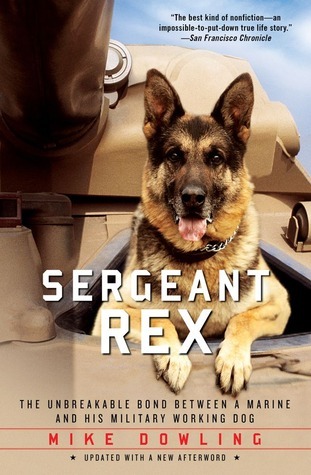
Meet Rex, a very smart, well-trained German Shepherd. He has a highly sensitive sense of smell and can communicate what he finds to his handler who has trained him so well that that he can trust the dog to lead the way. The result saves a lot of lives, both Iraqi and American. Rex and his handler Mike, a young Marine, are among the first K9 teams to go to Iraq, and they have never been tested in actual battle conditions. They learn a lot which they can then share to help other teams in training. When a Marine team is not scheduled to go out, Mike and Rex rotate through guard duty at the gate. Rex can also bring down a “bad guy.” Neither of these activities meet their goals in Iraq, however, and Mike had to initially persuade commanders to allow them to go into the field on missions. After the soldiers saw what they could do, their bravery, courage, and skills, they begged to have them accompany them.
It’s extremely hot in Iraq and Rex, of course, is wearing a coat. When working he has to be watched carefully for dehydration. The pair go out with regular Marines on missions. Typically, marines clear a building of possible terrorists. Then Mike and Rex enter to search for armaments and materials that can be used to build IED’s. Rex can also do the very dangerous job of sweeping for mines. There are so many points in the process where explosions or enemy attacks could occur. Both Mike and Rex have bullet proof vests, but Mike reserves their use for the times they are most needed because they hold the heat in and increase the possibility of dehydration. Mike always puts Rex’s needs first—from choosing “housing” appropriate for Rex to covering Rex with his own body when they are suddenly under fire. They are truly a dynamic duo and have a special relationship.
Despite the fact that I don’t know much about the various kinds of weapons, I found Sergeant Rex to be both interesting and informative. I learned a lot about the use of dogs in the military and the training involved in preparing a handler/dog team to be successful in the field.
Rating: 5/5
Category: Memoir, Nonfiction
Notes: Contains lots of salty language coming from the mouths of tough marines living on the edge, constantly in danger, and frequently in the midst of explosions and gunfire. Given the circumstances, it wasn’t a problem for me. I just considered the context and moved on.
Publication: 2011—Atria
Memorable Lines:
One thing is crystal clear. K9 handlers and their dogs are at the top of the insurgents’ hit list, along with the EOD guys. We always presumed it would be the enemy’s priority to kill Rex and me, because we’re always at the front of patrols sniffing out the bombs. The more effective we get at finding their arms and explosives, the more they’ll want to hit us.
At times like these Rex becomes a therapy and a morale dog. Seeing Rex and talking about their dogs remind the guys of life back home. It reminds them that there is a world outside the madness of Fallujah and Mahmoudiyah, and in part we’re all here fighting for the right to survive this hell and get back to the world that we know so well and love.
The life-and-death existence that we’ve been living here has put it all into perspective and shown me what truly matters in this world.
My Family and Other Animals–adventures of a young naturalist
My Family and Other Animals
by Gerald Durrell
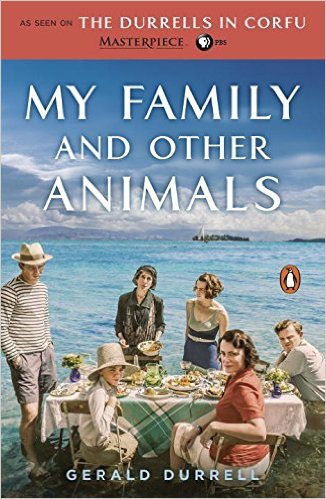
Ready for a boring book about animals? You won’t find it in My Family and Other Animals. Since the author Gerald Durrell (Gerry) was a naturalist from the age of two, there are plenty of animals in this book. He observes them and collects them when his family (Mother, brothers Larry and Leslie, and sister Margo) move from England to the Greek island of Corfu. Both the family and Gerry’s collection of animals are a continual source of humor for the reader with responses ranging from smiles to raucous laughter. Each of the family members is a unique character, but they argue and discuss issues until they arrive at a group “family” decision and act on it.
The story is told by Gerald as an adult looking back on Gerry’s adventures of which there were many. Ten year old Gerry was allowed to roam the island with his dog Roger exploring flora and fauna at his leisure. Occasionally, to Gerry’s dismay, the family would decide to rein him in by providing a tutor. They procured several knowledgeable men at various times, but it was apparent that Gerry’s passion for animals would dominate any efforts at education. When they arrive, Spiro, a local taxi driver and fixer, adopts them and helps them during their stay with any needs they might have. Gerry meets a lot of the locals during his roamings and they always welcome him and offer him refreshment as they chat.
Durrell is a wonderful author whether he is describing natural beauty, the mating of turtles, the parties hosted by the Durrells, the quirks of his siblings, or his observations of small, black scorpions living in the crumbling garden wall. As they are want to do, there were often animal escapes resulting in family meetings to decide what they were going to do about that particular animal’s housing. Occasionally animals were banned from the house, but at no time did the family try to stop Gerry’s proclivity for cultivating interactions with nature. They seemed to understand that it was as much a part of his nature as writing was to Larry, shooting to Leslie, romance to Margo, or cooking to Mother. Their adventures and interactions will keep you turning pages to see what they will do next.
Rating: 5/5
Category: Memoir, Humor
Notes: #1 in the Corfu Trilogy.A 4 season TV series, The Durrells in Corfu, was made by Masterpiece Theatre.
Publication: 1956—Penguin Books
Memorable Lines:
The cypress trees were whipped like dark pendulums against the sky, and the olives (so fossilized all summer, so still and witchlike) were infected with the madness of the wind and swayed creaking on their misshapen, sinewy trunks, their leaves hissing as they turned, like mother of pearl, from green to silver. This is what the dead leaves had whispered about, this is what they had practiced for; exultantly they rose in the air and danced, whirligiging about, dipping, swooping, falling exhausted when the wind tired of them and passed on.
By the time a certain amount of order had been restored, all the baby scorpions had hidden themselves under various plates and bits of cutlery. Eventually, after impassioned pleas on my part, backed up by Mother, Leslie’s suggestion that the whole lot be slaughtered was quashed…Roger and I went and spent the afternoon on the hillside, for I felt it would be prudent to allow the family to have a siesta before seeing them again.
The hill-top seemed to have its own breeze, albeit a baby one, for no matter how hot it was below in the valley, up in the three olive groves the tiny wind played constantly, the leaves whispered, and the drooping cyclamen flowers bowed to each other in endless greeting. It was an ideal spot in which to rest after a hectic lizard hunt, when your head was pounding with the heat, your clothes limp and discolored with perspiration, and the three dogs hung out their pink tongues and panted like ancient miniature railway engines.
Surprised by Oxford–an intellectual’s search for meaning
Surprised by Oxford
by Carolyn Weber

Carolyn Weber had quite a culture shock when, as a scholarship student, she transported herself from Western Ontario into the revered halls of Oxford University. In that first year of working on her Master of Philosophy degree, she was introduced to a different system of learning and classes. She was expected to learn for the sake of learning and to pursue academic interests through tutorials—meetings of small groups of students with a professor. Along with tea or sherry, the groups dove into intellectual pursuits that exhilarated this future professor of literature.
Along the way, Weber discovered a diverse group of friends from a variety of backgrounds who challenged each other in the friendly way comrades can have in the pub over a pint at the end of a long day of studying. She discovered a diversity of spiritual beliefs from atheist to Eastern religions, but none kindled in her the desire to investigate like the Christian faith did. The Christian students and professors were not what she expected. No one was standing on street corners thumping a Bible. Instead, when they found she was interested, they encouraged her to actually read the Bible and to attend groups where the writings of C.S. Lewis were discussed.
Through Surprised by Oxford, I learned a lot about the University of Oxford that contradicted the stereotypes that are generally shared in media. It was interesting to watch her personal and intellectual growth, to see her search within herself for spiritual meaning and communication with God. Obviously a lover of literature, Weber begins each chapter with poetry and sprinkles other lines of poetry throughout the book, especially as she and her friends quote poetry to each other in the context of their discussions.
Rating: 5/5
Category: Memoir, Christian
Publication: 2011—Thomas Nelson
Memorable Lines:
I had no real need of believing in men, God incarnate or otherwise. Fathers especially were not to be trusted. They did not even seem relevant really. That much I had learned. That much I brought with me.
“Despair is the greatest sin,” Dr. Nuttham finally responded slowly. “It involves forgetting that God is there. Forgetting that He is good and that all He is and does extends from and works toward this perfect goodness. That doesn’t mean that He allows evil, or creates it, or perpetuates it. That’s our entwinement. Rather, He uses even our evil toward His good. We all need forms of remembering this first great love…writing, reading, creating, being.”
“Jesus brings the most radical message there is into any society at any time: you are beloved; you are worth a price that only the God of the universe could pay.”
Everything Sad is Untrue–memories are culture carriers
Everything Sad is Untrue
by Daniel Nayeri
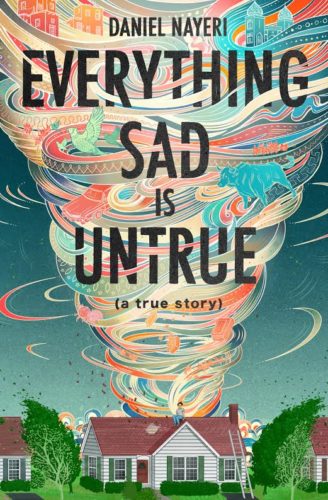
Daniel Nayeri’s Everything Sad is Untrue is part memoir and part storytelling where he fills in the things he doesn’t remember exactly from his childhood. The first part of the book is a mixture of three kinds of stories—myth, legend, and history—that attempt to place the reader in Daniel’s past and his ancestry as it happened and as he imagined it might have happened. He relates “story” in this way to help the reader understand the very different Persian culture he started his life in and which formed his beliefs and attitudes.
Although there are no chapters in this book, the reader can clearly tell when the story pivots from providing background to relating the events from the time his mother became a Christian on a visit to the West. She embraced Jesus and her faith in Him wholeheartedly. Christianity in Iran is a capital offense, so she had to take her children and flee. She traded a comfortable life as a respected physician married to a successful dentist for the life of an impoverished refugee, looked down on because of her language, menial job, and poverty. But she had Jesus, and no one could take that away from her.
Some of the book tells about the year they spent in a refugee camp in Italy. It was not actually a camp with tents, but a concrete building with small rooms and a bathroom. The residents were refugees from many countries, all waiting for the U.N. to find a place that would accept them. They had nothing and there was no access to books, media or recreation. It was made even harder by the refugees’ inability to converse with each other and by impatient workers who processed each refugee’s mound of paperwork.
A lot of Daniel’s story tells what life was like for him as a child in Edmond, Oklahoma, where they eventually settled. He experienced bullying, but came up with tricks for avoiding the worst of it. There was culture shock around every corner as he tried to fit into a very different mindset. Fortunately, he had an outstanding teacher in Mrs. Miller who encouraged him without babying him. The librarian in Edmond was kind too, and so Daniel spent many Saturdays there devouring books. His mom ended up in the emergency room several times thanks to his stepfather Ray, a black belt. Despite lots of difficult times, Daniel never seems to plead for sympathy from the reader and always points to his mother as the strongest person he knows.
Everything Sad is Untrue is a book I recommend. It is a challenging read as the author’s life is presented through the eyes of a child, but with some of the understanding of an adult. Memories are an important theme of this book as Daniel says, “Memories are always partly untrue.” and “A patchwork story is the shame of a refugee.” This is a book ripe with principles and beliefs worth pondering and a story and characters who will remain in the reader’s thoughts long after the last page is turned.
Rating: 5/5
Category: Autobiographical novel/fictionalized memoir
Notes: 1. This is a hard book to categorize which may, in part, be a critical factor in making it a very good book.
2. It has been rated for children 12+ on Amazon. Some readers refer to it as a Young Adult book. To me, it is probably more appropriate for adults. Some of the fascination with “poop,” however, in Daniel’s childhood classroom would attract the attention of middle school boys.
3. This book has won many awards.
4. I thought not having chapters would be a negative for me, but it does fit the style of Everything Sad is Untrue.
Publication: 2020—Levine Querido
Memorable Lines:
Memories are tricky things. They can fade or fester. You have to seal them up tight like pickles and keep out impurities like how hurt you feel when you open them. Or they’ll ferment and poison your brain.
And here is the part that gets hard to believe: Sima, my mom, read about him and became a Christian too. Not just a regular one, who keeps it in their pocket. She fell in love. She wanted everybody to have what she had, to be free, to realize that in other religions you have rules and codes and obligations to follow to earn good things, but all you had to do with Jesus was believe he was the one who died for you. And she believed.
Imagine you’re in a refugee camp and you know it’ll be a tough year. But for the person who thinks, “At the end of this year, I’m going somewhere to be free, a place without secret police, free to believe whatever I want and teach my children.” And you believe it’ll be hard, but eventually, you’ll build a whole new life….But if you’re thinking every place is the same, and there will always be people who abuse you, and about how poor you’ll be at first, the sadness overtakes you….But what you believe about the future will change how you live in the present.
Seeking Allah, Finding Jesus: A Devout Muslim Encounters Christianity
Seeking Allah, Finding Jesus
by Nabeel Qureshi
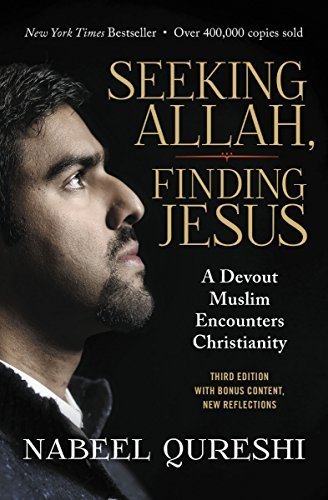
Nabeel Qureshi was an intellectual raised in a Muslim home who devoted years of study and fellowship with his best friend David, a Christian intellectual. They argued, researched, prayed, and maintained their friendship as Nabeel sought the Truth. Was he to find it in Jesus or in the teachings of Islam? This book is perfect for anyone who wants to:
—approach the Bible analytically
—prove or disprove the claims about Jesus Christ
—learn more about the beliefs of Muslims, their culture and how the two are related
—learn about the history of Islam
—understand the difference in approaches to Islam in the East and in the West
—learn some basic Islamic terminology
—witness a true Christian/Muslim friendship
—see how a Christian can share Jesus with others by example as he lives out his beliefs in Jesus through his actions
—learn how to disagree respectfully
—understand the Trinity
—gain an understanding of what a Muslim gives up when he converts to Christianity and the consequences of a conversion
—comprehend the claims and arguments against and for the crucifixion and resurrection of Jesus
—read truths about Muhammad and the Quran that imams don’t share with their followers.
The Foreword of Seeking Allah, Finding Jesus summarizes the book quite well: “This is the riveting story of one man’s quest to set aside his preconceptions and pursue answers to the most pressing issues of life and faith, despite enormous pressure to maintain the status quo.”
Rating: 5/5
Category: Memoir, Christian, Religion and Spiritual
Notes: The author describes the book as a “narrative biography,” and one of the contributors to the lengthy appendix which expands on the topics in the book calls it Qureshi’s “spiritual autobiography.”
Publication: August 21, 2018—Zondervan
Memorable Lines:
The culture clash of immigrant parents with their Western-born children is especially common during the emotionally stormy teenage years, and it serves to illustrate a vital fact: Muslim immigrants from the East are starkly different from their Muslim children born in the West.
Effective evangelism requires relationships. There are very few exceptions.
Because of hadith and tradition, Muslim religion, culture, heritage, and identity all find their core in the person of Muhammad. This is why Muslims see an attack on his character as equivalent to a personal attack on them and everything they stand for.
These are the costs Muslims must calculate when considering the gospel: losing the relationships they have built in this life, potentially losing this life itself, and if they are wrong, losing their afterlife in paradise. It is no understatement to say that Muslims often risk everything to embrace the cross.
My Several Worlds: A Personal Record
My Several Worlds: A Personal Record
by Pearl S. Buck
WHAT IS MY SEVERAL WORLDS?
It is a collection of essays integrated into a memoir. Author Pearl S. Buck, as she writes this tome, considers herself midway in her writing career. She presents it as a “record of the age in which I lived” and “as nearly an autobiography as I shall ever write.” It is not a linear book. The place she is located when she writes each section is noted, but not the date because it is such a combination of times. Although a confusing style at first, it makes sense because as she is writing about her current life in the United States, she will suddenly revert to recounting her younger years in China and historical world events or advance her opinions on a variety of subjects from practical to esoteric.
WHO WAS PEARL S. BUCK (1892-1973)?
She was a prolific author, primarily a novelist, and the winner of both the Pulitzer Prize in 1932 and the Nobel Prize in Literature in 1938. The child of Christian missionaries, she spent much of her life in China until politics forced Americans to leave. Completely bilingual, Pearl was an astute translator of Chinese and had great admiration for Chinese social structure and love for the Chinese people. When she returned to the United States, she found that she lived in two separate worlds and never felt quite at home in either. She was well-traveled and had friends from all over the world.
WHERE DID BUCK GET HER INSPIRATION?
Buck’s source material was mainly her observations of people. In her travels, she paid attention to people, listening more than talking. Her focus was more on the common man and woman than the famous people who wanted to entertain her as a celebrity.
WHAT ARE SOME OF BUCK’S “SEVERAL WORLDS”?
Buck watched various political groups attempt takeovers in China. This land she loved and which helped shape her was subject to political strife from inside the country and by forces from the outside. She was witness to Western influences on young Chinese who studied in the United States and tried to bring change to ancient Chinese customs. These endeavors were not always positives for the Chinese people.
As an American adult with Chinese training, Buck experienced disparate worlds in the United States. Looking past geopolitical issues, Buck also had several worlds on a personal level. Although equipped to mingle in high society circles, she preferred a rural lifestyle with a large household of adopted children who learned life and family skills on their farm. She had a long, unhappy marriage to an agricultural missionary in China followed by a long, happy marriage to her publisher in the U.S. Although a teacher and primarily a writer, Buck devoted her talents to social enterprises as well. She opened The Welcome Home for U.S.-born children of Asian descent whose mixed-race status made them “unadoptable” according to adoption agencies. She also advocated for appropriate care for the disabled, a cause close to her heart as her first child was unable to live independently.
WHAT IS YOUR OPINION OF MY SEVERAL WORLDS?
This is not an easy read; there is no fluff to it. In My Several Worlds you will discover a lot of Chinese history since, as Buck points out, the Chinese civilization is very old. She refers to many events in China’s past without details as she feels they have already been discussed thoroughly in books she and others have written. Her thoughts on the various subjects she examines are interesting although I do not always agree with all of them. They are informed by her unique background of living a cosmopolitan life. She was homeschooled by Christians but tutored by a Confucian. She went to college in the United States, but despite altering her clothing never felt like she fit in.
Buck is an excellent writer, but the reader needs to approach this non-fiction work with a desire to learn—to learn more about China, about adults who have grown up in more than one culture, and about the fascinating Pearl S. Buck. Having read this memoir, I think a good follow up would be to read one of her many novels.
Rating: 5/5
Category: Memoir, Nonfiction
Publication: 1954—John Day Co.
Memorable Lines:
But I had never known what hatred was. I had neither been hated nor had I ever hated anyone. I could not understand why we, who were still ourselves and unchanged, should be lumped with unknown white men from unknown countries who had been what we were not, robbers and plunderers. It was now that I felt the first and primary injustice of life. I was innocent but because I had the fair skin, the blue eyes, the blond hair of my race I was hated, and because of fear of me and my kind I walked in danger.
No people can be educated or even cultivated until books are cheap enough for everybody to buy.
I went back to my own resurrected home with a heavy heart indeed, for I knew that from that day on the new government was doomed in the end to fail. Why? Because it had failed already in understanding the people whom it purposed to govern and when a government does not rule for the benefit of those ruled, sooner or later it always fails, and history teaches that lesson to every generation whether or not its rulers can or will understand.
All Creatures Great and Small–more than an animal story
All Creatures Great and Small
by James Herriot
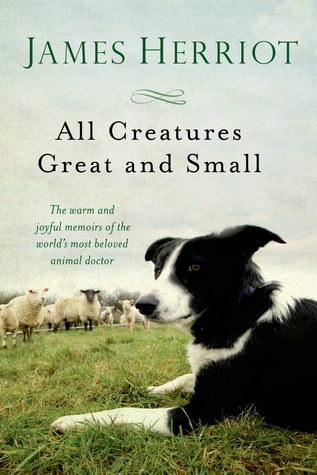
Veterinarian James Herriot set the bar high for veterinarian memoirs when he penned All Creatures Great and Small. Humorous, touching, joyful, personal, this book had me smiling and laughing through the tales of this newly qualified vet who begins his career in the Yorkshire Dales where he falls in love with the land, his patients, and their hard-working owners.
Much of the book’s humor is self-deprecating as Herriot describes unfortunate circumstances in which he is enmeshed. Some come from his visits to various farms, often for middle of the night emergencies. A great deal of amusement arises from Siegfried Farnon, Herriot’s likable, dashingly charming, energetic, and volatile boss and from Siegfried’s younger brother Tristan. Although the brothers love each other, they are frequently at odds due to Tristan’s carefree attitudes.
Although I read this book over thirty years ago, my recent reread was a pure delight. The characters are down to earth and detailed so well the reader can easily picture them. There are customs and manners in the Dales that are foreign to twenty-first century denizens. Herriot is quick to contrast the tools, techniques and medicines available to him as a young vet in 1937 with those used later in his career. All of this is quite interesting, but Herriot’s storytelling abilities are what draw the reader in and keep him returning chapter after chapter. I was so sad when I came to the last page. The fun was over! I read this book with my book club, but I think I may “need” to do a reread of the other books in the series as well.
Rating: 5/5
Category: Memoir
Notes: 1. The series is based on Herriot’s experiences and those of other vets. The characters’ names have been created for the series. Some of the nonfiction may be embellished.
2. It is hard to pull out a passage and say “See how funny this is” because so much of the humor relies on the context and the characters, but it is very funny.
3. There are at least two television series and a movie based on these characters.
4. I would be remiss if I did not note that the word d__n is sprinkled throughout the book. I did not remember this from my earlier reading. In this case I felt the usage fit the story and the characters. It is not used in a mean spirited way and did not detract from the book for me.
Publication: 1972—St. Martin’s Press
Memorable Lines:
“Animals are unpredictable things so our whole life is unpredictable. It’s a long tale of little triumphs and disasters and you’ve got to really like it to stick it…One thing, you never get bored.”
I had learned enough of Dales ways to keep quiet at meals; when I first came to the district I had thought it incumbent on me to provide light conversation in return for their hospitality but the questioning glances they exchanged with each other silenced me effectively.
…now that I was away from the noise and stuffiness of the buildings, the silence and the emptiness enveloped me like a soothing blanket. I leaned my head against the back of the seat and looked out at the checkered greens of the little fields along the flanks of the hills; thrusting upwards between their walls till they gave way to the jutting rocks and the harsh brown of the heather which flooded the wild country above.
People who think farming is a pleasant, easy life should have been there to see the hunched figure disappear into the blackness and the driving rain. No car, no telephone, a night with the heifer, eight miles biking in the rain and a back-breaking day ahead of him. Whenever I thought of the existence of the small farmer it made my own occasional bursts of activity seem small stuff indeed.
Sit, Stay, Heal: What Dogs Can Teach Us About Living Well
Sit, Stay, Heal
by Dr. Renee Alsarraf

Dr. Alsarraf is a veterinary oncologist. Her training and profession put her in the odd position of knowing way more than most people about cancer in both animals and people. Even as she works with cancer patients and their pet parents every day, she is shocked when she is diagnosed with what she calls “the C word.”
Dr. Alsarraf’s story is quite properly told in the first person. She shares the struggles of some of her patients and compares them with her own battles. Because animals live in a present mindset, they don’t have a fear of the tomorrows of cancer. They have fewer side effects from treatments. For example, they don’t lose their fur. There are many similarities, however, in the unknown outcomes of treatments and the unpredictability of cancer.
I thought this might be a very dark book, but it isn’t. It is inspiring to watch Dr. Alsarraf and her team of assistants work diligently and with care and respect as they treat their patients. Dr. Alsarraf takes time to explain everything to the pet’s human parents and to answer their questions. She never hurries them or makes them feel guilty about their decisions assuring them that there are no right or wrong answers in treatment choice.
There is another situation in this dedicated vet’s life that doubles the emotional impact, but to share it would be a spoiler. I found tears streaming down my face and had to wait a day to finish the book. Sit, Stay, Heal is very well written. The Introduction sets up the reader to journey with the author through her personal battle and shares her philosophies about cancer, pets, and fighting back. Each of the ten chapters that follow focuses on the story of a pet patient, the pet’s family, and her interaction with them all the while enduring her own health struggles. Sit, Stay, Heal is a heart felt book with more smiles than tears for a dog owner.
I received a complimentary copy of this book in exchange for an honest review. Opinions expressed in this review are completely my own.
Rating: 5/5
Category: Memoir, Nonfiction
Publication: October 18, 2022—Harper One
Memorable Lines:
All cats and dogs live in the moment, carefree. They do not waste the present, worried about what might happen in the future. Or how much longer they have to live.
Before the C word, I’d always thought that life was so under my control, and yet the disease has helped me realize that I was never in control of the really big things, or even the medium things.
It’s never easy to say goodbye to a loved one. Through good days and bad, our pets provide such unconditional love, support, and companionship. They’re with us for fun times, and also are there to snuggle with when the outside world seems too harsh.
The Wind in My Hair–compulsory hijab
The Wind in My Hair
by Masih Alinejad with Kambiz Foroohar

In her memoir The Wind in My Hair, Masih Alinejad, in exile first in Great Britain and later in America, tells the struggles she had and all Iranian women still endure with laws in Iran that make wearing the hijab compulsory from age seven. The “morality police” in that country take this law over what women wear to the extreme. Women can be beaten, flogged, and jailed if even a strand of hair escapes the hijab. Women who have resisted this compulsory law have had acid splashed in their faces and have been incarcerated, tortured, and sometimes raped.
Masih tells her personal story of an impoverished, but mostly happy, rural childhood with conservative parents. Always a bit of a rebel, Masih was expelled from high school in her final semester and jailed for belonging to a small anti-government secret society. Later as a parliament reporter, she was banned from the parliament building for asking the wrong questions.
In exile Masih worked tirelessly and sometimes under threats of violence for the rights of women in Iran. There are more issues involved than compulsory hijab, but that is a visible sign of the control men have over women in Iran. Masih used the tools of social media, especially Facebook and Twitter, to broadcast her positions in Iran where the government controls television and newspapers. The movements she started were given exposure internationally via the Internet.
Masih is highly critical of female politicians and government employees who visit Iran but are unwilling to bring up women’s rights in official discussions and wear some version of head covering during their visit. Masih made recordings of Iranian families’ stories about their dead or missing loved ones called The Victims of 88. Brave women flooded her social media accounts with pictures of themselves without the hijab in the interest of freedom. The Wind in My Hair is well-written by a journalist-storyteller who has lived the story she tells. It will grip you and not release you as you ponder the freedoms you currently enjoy in your own country.
Rating: 5/5
Category: History, Memoir
Notes: Perhaps because she was not raised American, perhaps because she is a journalist, Masih’s perception of current politics and reporting in the U.S. seem somewhat skewed. She clearly understands that you can’t trust reports in Iran, but does not seem to realize that there is censorship in the U.S. by big business, politicians, and the media working in concert. That viewpoint does not change the importance of her analysis of the Iranian government’s control over its people following the deposition of the Shah.
Publication: May 29, 2018—Little, Brown, & Co.
Memorable Lines:
“The Americans are coming to steal Iran away. They’ll kill us all.” I really thought we’d face another war immediately. It was not rational, but, like millions of Iranians, I had been brainwashed by the daily propaganda on the national television and radio stations. I thought it was only Khomeini who was strong enough to stand up to the greedy U.S. capitalists. Many years later, I discovered that Khomeini was a coldhearted dictator who ordered the execution of thousands of Iranians.
I didn’t even know what charges I faced. No one had read the complaint against me. I had no lawyer to defend me. I was forced into giving a confession, and now all that remained was for this judge to pass a sentence. It didn’t sound very just. Later in life, I discovered that there is not much justice in the Islamic Republic.
There is a predictable cycle in Iranian politics, as predictable as the weather. Every year, for a few months, the government relaxes its grip and some actions are tolerated—women can show a few inches of hair under their head scarves, or men and women can actually walk together without being married, or the newspapers can publish mildly critical articles. Then, just like the dark clouds that gather in late autumn, the freedoms are taken away and transgressors are punished.
The Remarkable Ordinary: How to Stop, Look, and Listen to Life
The Remarkable Ordinary
by Frederick Buechner

Art and music as gateways to God—an interesting thought Frederick Buechner uses as the basis of his first chapter in The Remarkable Ordinary. That beginning was a little slow to take hold on me, and it didn’t really continue on as a predominant theme in the book. In fact, the book continues forward in three parts with a total of eight chapters. As I read, I felt like I was examining Buechner’s mind, his thought processes, his memories, and most importantly his search for God in the ordinary things of life. When he began a relationship with Christ, he was “all in.” Not content to read the Bible through as a first step, he wanted to jump right into seminary. He eventually decided that his training in the ministry and his skills would be best used as a writer rather than as a pastor. He never used the term philosopher, but that is what I see him as. The Remarkable Ordinary is part philosophical treatise and part memoir. He delves into therapy sessions, dreams, and family history that helped form his character and beliefs.
Buechner is honest and introspective, and the book is a product of his soul searching. Each chapter is a collection of his thoughts on various themes. He reflects on holiness, our personal journeys, our efforts at controlling others, and the wars we wage with ourselves and those around us. He shows facets of God to us as he examines the arts, other people, the ordinary things around us, and our stories, dreams and memories. He ties all of these parts of the “remarkable ordinary” into our need to “stop, look, and listen to life.”
I actually read much of the book twice in an effort to understand Buechner’s views. It is different from other books I have read by religious leaders. Buechner is very open about his beliefs and his past and yet, probably rightly, he did not reveal all as he continued to clarify his thoughts. Some things are too personal to share with the world. Frederick Buechner passed away on August 15. 2022, leaving behind a legacy of 39 works of fiction and nonfiction in several genres written over a span of 60 years.
Rating: 4/5
Category: Nonfiction, Christian
Publication: October 3, 2017—Zondervan
Memorable Lines:
It seems to me almost before the Bible says anything else, it is saying that—how important it is to be alive and to pay attention to being alive, pay attention to each other, pay attention to God as he moves and as he speaks. Pay attention to where life or God has tried to take you.
We’ve all had saints in our lives, by which I mean not plaster saints, not moral exemplars, not people setting for us a sort of suffocating good example, but I mean saints in the sense of life-givers, people through knowing whom we become more alive.
I was so motivated because I was at that point so on fire with, I can only say, Christ. I was to the point where when I would see his name on a page, it was like seeing the face of somebody you loved, and my heart would beat faster. I had to find out more about him.
I certainly am always at war one way or another with myself, and some of them are wars I must fight to try to slay the demons, to kill the dragon, to lay the ghost to rest. But there are other wars you fight with yourself that are really not worth fighting at all. The war to make yourself be more, do more than you have it in you really to do or to be.
 education pathways