
Home » Historical Fiction (Page 7)
Category Archives: Historical Fiction
The Enchanted April–looking for happiness
The Enchanted April
by Elizabeth Von Arnim

In an exceptionally rainy and dreary March in England, four strangers decide to get away by sharing the rent on a medieval castle in sunny Italy for the month of April. Lotty Wilkins, who can “see” or visualize people at their best and happiest initiates the effort, recruiting Rose Arbuthnot. Both in their early thirties, they do not have happy marriages. Lady Caroline is a little younger and extremely attractive, but is tired of the superficial cloying of people bewitched by her good looks. The very authoritative Mrs. Fisher in her sixties is still wearing mourning blacks years after her husband’s death and focuses her thoughts and conversations on childhood memories of encounters with famous people, particularly authors. This fictional account relies strongly on character development as these ladies’ situations are examined and they react to each other and to their temporary environment for the month. As I reread the many lines I had highlighted, I found that the writing is indeed exquisite.
The Enchanted April is the kind of book that holds beauty and introspection and gently insists that readers immerse themselves in the deliciousness of a sunny month of flowering plants and enticing foods. There are humorous situations thrown in as Lotty and Rose speak no Italian and the other two ladies don’t want to undertake the bother of dealing with the servants or managing the finances. There are also some surprising plot twists at the end of the tale. If you join the ladies in their Italian castle, your only regret will be saying “Arrivederci” at the end of the stay.
Rating: 5/5
Category: Fiction
Notes: Originally published in 1922.
Publication: July 19, 2005—Project Gutenberg
Memorable Lines:
She wanted to be alone, but not lonely. That was very different; that was something that ached and hurt dreadfully right inside one. It was what one dreaded most…Was it possible that loneliness had nothing to do with circumstances, but only with the way one met them?
“Oh, but in a bitter wind to have nothing on and know there never will be anything on and you going to get colder and colder till at last you die of it—that’s what it was like, living with somebody who didn’t love one.”
In heaven nobody minded any of those done-with things, one didn’t even trouble to forgive and forget, one was much too happy.
Sense and Sensibility–guided reading of a classic
Sense and Sensibility
by Jane Austen
with A Guide to Reading and Reflecting by Karen Swallow Prior

Sense and Sensibility was first published anonymously in 1811; it was Austen’s first book. She was thirty-five. She published three more in her lifetime and two more were published after her death in 1817. Although the focus of this novel is love and marriage, it is not a romance in the modern sense. It is a satire finding humor in the manners and customs at the turn of the century.
The main characters are the pragmatic, self-controlled Elinor Dashwood and her sister Marianne who feels everything deeply and openly. Their financial situation is based on the inheritance system in place at that time in which the eldest son receives the lion’s share of the patriarch’s property and wealth. Thus the young ladies and their mother and younger sister are left with little to live on and are somewhat dependent on an ungenerous half-brother. As the older girls are at marrying ages (19 and 17), the main part of the novel tells of the ins and outs of various suitors and relationships. We watch the characters change and grow as their circumstances alter. The events work to balance out the extremes of character found in Elinor and Marianne.
Karen Swallow Prior takes this classic and becomes a guide for the modern reader. As an English professor, she begins with a thorough introduction befitting her profession. She provides information about the time period, Austen’s background, and the form of the satirical novel. She explains situational and verbal irony as well as free indirect discourse. She also discusses Austen’s Christian background and how a Christian today might view this work. Prior includes footnotes for words, terms, and concepts that harken from the last part of the eighteenth century and might cause confusion or difficulty for a reader in the twenty-first century. As Sense and Sensibility is divided into three “volumes,” Prior follows each section with discussion questions and then ends the book with more general “Questions for Further Reflection.” All of these features improve the reading experience and yield opportunities for a deeper understanding.
Rating: 5/5
Category: General Fiction (Adult), Historical Fiction, Classic
Notes: I found the introduction useful before I began reading Sense and Sensibility, but when I referred back to it in preparation for writing this review, I found it helpful to reread the information as I was able to apply some of it better having completed the novel.
Publication: The novel was originally published in 1811. This edition was published in 2020 by B&H Publishing Group.
Memorable Lines:
From Prior’s Introduction:
Some of its satire is directed at significant human flaws and social structures such as romanticism, greed, falsity, and the prevailing view of marriage as a business transaction. Other objects of satire in the novel are less serious but incur no less delight in being skewered incisively by Austen’s sharp eye and even sharper wit: silly women, idle men, and gossiping tongues.
From the novel:
This specimen of the Miss Steeles was enough. The vulgar freedom and folly of the eldest left her no recommendation, as Elinor was not blinded by the beauty, or the shrewd look of the youngest, to her want of real elegance and artlessness, she left the house without any wish of knowing them better.
Marianne, with excellent abilities and an excellent disposition, was neither reasonable nor candid. She expected from other people the same opinions and feelings as her own, and she judged of their motives by the immediate effect of their actions on herself.
A Tourist’s Guide to Murder–Sam and “the girls” invade Britain
A Tourist’s Guide to Murder
by V.M. Burns

Samantha Washington (Sam) is the owner of a mystery bookshop in North Harbor and has just landed a three book deal with a publishing house. She will spend the next week in England doing research for the British historic cozy mystery she is writing. She is slated for a mystery tour accompanied by her Nana Jo and Nana’s three best friends from the Shady Acres Retirement Village. Of the four senior citizens, not a one meets the stereotype of frail, little old ladies. They have a reputation for helping Sam solve mysteries that come her way through interviews, eavesdropping, feminine wiles, deduction, and the occasional use of martial arts as two of them have blackbelts. They keep the plot moving and the reader laughing.
There are complications just in reaching London with jet lag and no luggage, but that’s only the beginning of their troubles. The owner of the tour company is murdered, but the police, oddly, are not investigating. Unfortunately, there is another murder, and one of the assigned detectives is “as bright as a burned-out light bulb” and “a few sandwiches short of a picnic.” It’s time for Sam, Nana Jo, and “the girls” to join forces to discover the truth.
In order to free up her conscious mind when stymied in her investigations, Sam spends time when she can’t sleep or between tour stops writing her own mystery. Although the book she is writing takes place in 1939, Sam is able to use elements in the murders she is currently investigating and apply the principles to her own mystery with great success. When the flow of the contemporary mystery was first interrupted with this secondary story, I was a little miffed because I wanted the action to continue in the primary story. By the time I reached the next transition to 1939, however, I was anxious to read about the progress made in Sam’s own whodunit. The character Sam’s writing seems a little stilted at first, compared to the rest of the book, but that is perhaps due to the titles of “Lord” and “Lady” still being used along with formalities involved with a household of servants and adherence to etiquette rules. It is quite a contrast to our contemporary society.
I enjoyed Sam’s eagerness in visiting The Grand Hotel in Torquay where Agatha Christie honeymooned in 1914 and the Torquay Museum that displays the famous author’s memorabilia and items from movies based on her books. Next they went to Greenway, Christie’s home in Devon where she wrote many of her books. Sam “fangirled” on the tour of the house taking many pictures and drooling over first editions. Because of the two murders, the itinerary for the trip had to be revised several times, but most of the highlights are still included, and the group is able to visit several places that were alleged to be the settings or inspiration of mysteries by authors like Dorothy L. Sayers and Sir Arthur Conan Doyle.
If you like cozy mysteries, you can’t get any more “bookish” than V.M. Burns’ A Tourist’s Guide to Murder. It has two plots within the same book, a tour of significant literary locations, a writer-sleuth, and a mystery bookstore. It’s not heaven, but it’s pretty close. The tour intentionally lays on some misdirection, and there are red herrings in both plots to keep you guessing. The retirement home group is anything but retiring: they bring to minds phrases like “more fun than a barrel of monkeys” and “herding cats.” I want to read more from this series.
I would like to extend my thanks to NetGalley and to Kensington Books for giving me the opportunity to read this book in exchange for an honest review.
Rating: 5/5
Category: Mystery
Notes: 1. #6 in the Mystery Bookshop Mystery series. This was my first book in this series and I had no problem reading it as a standalone.
2. There are many reasons to read this book, but one of them should not be the two cute toy poodles on the cover. They belong to Sam, but she doesn’t take them with her to England, so they are only briefly mentioned in the book.
Publication: January 26, 2021—Kensington
Memorable Lines:
Lady Clara’s cheeks flamed and her eyes flashed. After a split second, she gave the captain a smile and then stomped down hard on his foot. “Oooph.” Captain Jessup bent over in pain. “Dear me, was that your foot?” Lady Clara said in a voice that oozed sweetness.
Nana Jo glanced at Hannah. “I don’t know about your national health care system, but in the United States, the pharmaceutical companies are running the whole country, and they’ve got a pill for everything.”
“Let’s face it, Stinky Pitt couldn’t find a killer who was standing naked in the middle of the street with a neon sign over his head.” Nana Jo and the girls nodded. Hannah looked confused. “Stinky Pitt?” Ruby Mae looks up from her knitting. “He’s the local detective in North Harbor, Michigan.” “Not the sharpest knife in the drawer?” “I’ve got sharper spoons.”
A Pretty Deceit–the pursuit of Ardmore continues
A Pretty Deceit
by Anna Lee Huber
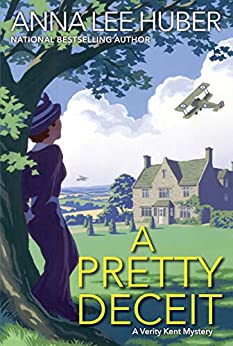
In the aftermath of The Great War, there are many “walking wounded.” This category refers to soldiers with physical wounds, of course. Also included are those psychologically affected, unable to relate to others, even those they love most. Waking or sleeping, the horrors of the war remain with them. Their families have suffered as well. Many have lost sons, fathers, brothers, and husbands either through death or trauma. Women are living in limbo or trying to raise children on their own. All of these injured are touched on as we witness the struggles of the characters in A Pretty Deceit. The protagonist, Verity Kent, is a high society woman married to a war hero. You would think the couple would be happily “living the life” after the war. They harbor secrets, however, as each individually worked for intelligence services, and their past efforts continue to disrupt their current lives.
Verity has a penchant for solving mysteries, and in this historical novel by Anna Lee Huber, Verity is called on by her family to investigate her aunt’s missing possessions as well as the disappearance of a maid. Her husband’s influence is solicited to encourage the government to provide reparations to Verity’s aunt for damages that occurred when Air Force officers were billeted in her home. As the couple tries to help, a murder is discovered on the estate, and Verity is called on to clear the murder victim’s wife. In the middle of these investigations, the couple is asked, unofficially, to investigate a wealthy businessman with connections that rise high in the government. He rarely dirties his own hands but has many minions willing to do his bidding.
I have read two more books in this series, and A Pretty Deceit is my favorite so far. Well written, as all of the books in this series are, this novel is outstanding in background, pace, and character development. We meet Reg, Verity’s cousin who was blinded in the war. We also see her current interactions with two men who had a romantic interest in Verity during the war. Verity is well aware of her attractiveness and is not afraid to subtly use it to achieve her ends. The position and influence of a woman in this time period is well demonstrated by the reactions of characters to women in accordance with class status and race. This historical fiction is a piece worth reading.
I would like to extend my thanks to NetGalley and to Kensington Books for giving me the opportunity to read this book in exchange for an honest review.
Rating: 5/5
Category: Historical Fiction, Mystery
Notes: #4 in the Verity Kent Series, but works well as a standalone
Publication: September 29, 2020—Kensington Books
Memorable Lines:
For all that Aunt Ernestine would be horrified at such conduct in others, she was remarkably oblivious to the fault in herself.
Compassion need not be a restricted commodity, especially not during a time when everyone was still struggling to right themselves after the topsy-turvy years of the war.
He was a cunning manipulator, making people question even those things they knew beyond a shadow of a doubt to be true, and exploiting people’s best and worst natures to convince them to do things they would never have dreamed themselves capable of.
When We Were Young and Brave–kindness in the midst of despair
When We Were Young and Brave
by Hazel Gaynor
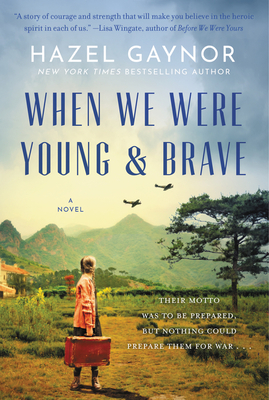
During our current tumultuous times, When We Were Young and Brave was somewhat of a difficult read for me, but I’m glad it is now a part of my personal reading journey. Hazel Gaynor’s latest book relates a fictional version of the events following Japan’s bombing of Pearl Harbor as they play out for the students and teachers at the China Inland Mission School in Chefoo, China. With Japan’s invasion of China, the Japanese seize and occupy the school, later interning the residents in the much larger prison camp known as the Weihsien Civilian Assembly Center where sanitation facilities are disgusting and meals are meager, nutritionally inadequate for growing children, and almost inedible. Despite the harsh conditions, the teachers protect the children as best they can while rallying them with insistence on routines, cleanliness, and a hearty “chin up” attitude. Of particular note is the role of their Girl Guide troop and standards that help the students in maintaining a positive outlook.
The last sections of the book, “Liberation” and “Remembrance,” are remarkable in the beauty of the skillful writing that describes the impact of the American liberation on the camp residents. They gain relief from the fears that haunted them daily, but endure the substitution of new anxieties and questions for the future. Where will they go and what will they do? Is anyone waiting for them at home?
The story is told by alternating narrators. Elspeth is a competent, well-organized, and kind teacher who has a special motherly feeling for Nancy, the daughter of missionaries in China. Their relationship is always teacher and student, but as months of internment become years, Elspeth takes on increasingly more of the commitment for safe care that she made to Nancy’s mother as they departed by boat to sail to the school, both as first-timers. We view their ordeals from both Elspeth’s and Nancy’s points of view.
There are a lot of themes in the book including resilience, relationships, releasing the past, and looking to the future. Symbolism is also important in the kingfisher that becomes the emblem of the new Girl Guide patrol and the sunflower which holds a special meaning for teacher and students.
The characters emerge as three dimensional figures as they are well developed. Realism comes into play with descriptions of the harsh conditions; no one’s story is fairytale like or even positive. The setting is well-executed with vivid word pictures. As the Chinese workers slosh through the camp, the odor of the filth of “honey-pot” buckets they pull from the latrines makes an unforgettable olfactory experience. There are also more pleasant descriptions of the beauty outside the camp, but glimpses are rare for those interned. The last two sections make the book a winner for me, but the first sections are also well written and essential to the success of this historical novel.
Rating: 5/5
Category: Historical Fiction
Notes: There is a very informative section at the end of the book that describes the author’s research and thought processes and some historical background. The author has also included a brief history of the Girl Guides as that organization plays an important role in the girls’ lives. Other additions are a list of books and websites for further reading, including original source documents found at weihsien-paintings.org, and some questions for discussion.
Publication: October 6, 2020—Harper Collins
Memorable Lines:
When she was cross, Miss Kent spoke in a way that reminded me of brittle twigs snapping underfoot on autumn walks. I felt my cheeks go red. Without giving me a ticking-off, she’d done exactly that.
I knew the smile she gave us that morning was the sort of “we must be brave” smile adults use when they’re trying to pretend something awful isn’t happening.
But, as I’d come to realize about life during a war, nothing stayed the same for long. Just when you thought you’d adjusted and adapted and found a way to cope, the situation changed.
Death Comes for the Archbishop–New Mexico frontier
Death Comes for the Archbishop
by Willa Cather

Every well-read person should have read at least one book by Willa Cather, an American Pulitzer Prize winning author famous for her novels set in the frontier. When my book club decided recently to read Death Comes for the Archbishop, I had not read any of Cather’s books. I was delighted that the choice was one that focused on the history of the Catholic church in New Mexico where I currently live. The novel provides as a backdrop a tour of cities, towns, pueblos, and open deserts inhabited by foreign priests, Mexicans, and Indians. Cather paints beautiful word pictures of the landscapes while depicting the difficulties of life, and especially travel, as two French priests attempt to revive the Catholic religion in the region. Churches had been planted over three hundred years earlier but did not receive much attention from Rome. With the annexation of new territories by the U.S., things begin to change in a land viewed as “wild” for many reasons. It is ruled over by the Bishop of Durango located in Mexico, fifteen hundred miles away from Santa Fe where the missionaries headquartered.
Jean Marie Latour, a parish priest based in the Lake Ontario region is elevated to bishop arriving in New Mexico in 1851 after a difficult and dangerous year long journey. He is accompanied by his childhood friend Father Joseph Valliant. Despite its title, Death Comes for the Archbishop is not a murder mystery nor does it focus on the death of the Archbishop. Instead, it is a triumphant tale of strong, wise, and intelligent men who against all odds form friendships with peoples of various tribes, cultures, and languages in a harsh but beautiful land. The descriptive language is exquisite and serves to enhance and further the plot. This book celebrates the usually successful struggles for survival and the somewhat successful attempts to share the Catholic religion. In the Archbishop’s passing, it becomes evident that he was much loved and respected by the peoples of the many cultures in his diocese.
Death Comes for the Archbishop is a tale I would enjoy rereading for the breadth of its descriptions and the depth of its topics. The two Fathers were men I would enjoy meeting. Quite unalike physically and in disposition, they were fast and loyal friends with different means of evangelism, but suitable to their characters. Although this book has a specific setting in terms of time period and location and has characters with a religious profession, its themes of devotion, strength, and friendship transcend the New Mexico frontier of the 1850’s and the Catholic priesthood. Although the specifics were interesting and an effective vessel for the themes, the novel proves Cather to be, above all, an able storyteller. I had no regrets in reading this work of historical fiction based on the lives of two missionaries, and I highly recommend it.
Rating: 5/5
Category: Historical Fiction
Publication: June 15, 1927—Reading Essentials
Memorable Lines:
Everything showed him to be a man of gentle birth—brave, sensitive, courteous. His manners, even when he was alone in the desert, were distinguished. He had a kind of courtesy toward himself, toward his beasts, toward the juniper tree, before which he knelt, and the God whom he was addressing.
There was a reassuring solidity and depth about those walls, rounded at doorsills and windowsills, rounded in wide wings about the corner fireplace. The interior had been newly whitewashed in the Bishop’s absence, and the flicker of the fire threw a rosy glow over the wavy surfaces, never quite evenly flat, never a dead white, for the ruddy colour of the clay underneath gave a warm tone to the lime-wash.
This mesa plain had an appearance of great antiquity, of incompleteness; as if, with all the materials for world-making assembled, the Creator had desisted, gone away and left everything on the point of being brought together, on the eve of being arranged into mountain, plain, plateau.
The Engineer’s Wife–P.T. Barnum’s inclusion disappoints
The Engineer’s Wife
by Tracey Enerson Wood

Historical fiction is a difficult genre for both writer and reviewer. The writer has to juggle how much history should be included with the amount of fictitious information needed to establish the setting and especially to flesh out the characters. The reviewer then must judge the book based less on plot, which is to some degree predetermined, than on the author’s ability to combine history and fiction into a package that is both believable and pleasing.
In many ways I appreciated Tracey Enerson Wood’s The Engineer’s Wife. The subject is interesting. Emily Warren Roebling, a woman restricted by the social conventions governing the women of the mid to late nineteenth century, marries a Union officer. After he resigns his commission, he dedicates his life to his father’s project, the construction of the Brooklyn Bridge. This is a controversial project that proves dangerous to many, including her husband Wash who is an engineer. Rather than choosing to devote herself to the project after Wash is injured, Emily is subtly and progressively sucked into supervising the construction to completion.
The author has a wonderful way with words, and her research into the engineering aspects of the bridge is thorough. My only complaint of this work of historical fiction is the inclusion of Emily’s extended friendship and romance with the famous P.T. Barnum. Given that they lived and worked in the same city, their paths probably did cross, but in her notes at the end of the book the author freely admits that she had no basis for the creation of their relationship. It is such a major part of the story that I felt cheated as a reader. This is a work of fiction with a real setting rather than fictionalized history. Perhaps this work simply lies at the opposite end of a continuum from my preferred reading tastes in this genre.
I would like to extend my thanks to Netgalley and to Sourcebooks Landmark for giving me the opportunity to read this book in exchange for an honest review.
Rating: 3/5
Category: Historical Fiction
Notes: Contains two added sections: Reading Group Guide and A Conversation with the Author
Publication: April 7, 2020—Sourcebooks Landmark
Memorable Lines:
Autumn had painted the trees with brilliant oranges, reds, and yellows. Soon, cold, clear nights would rob the forest, leaving the trees to face the winter stark and barren.
Her lips were drawn tight enough to sling the arrows her eyes aimed at us.
The panic I had successfully tamped down returned like a lion for the kill.
A Long Walk to Water–impactful
A Long Walk to Water
by Linda Sue Park
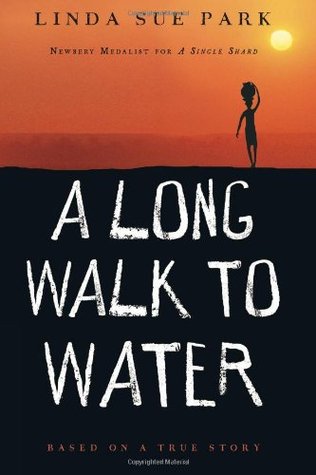
You have probably heard of the Lost Boys of Sudan. In A Long Walk to Water, Linda Sue Park tells the story of one of those lost boys, Salva Dut, who even as a refugee himself, took on a leadership role for 1500 boys in their very long, dangerous, and seemingly hopeless journey for survival. Salva, as a young adult, was chosen out of a refugee camp to emigrate to the United States. This book tells how he transformed his desperate situation into a life giving project for the people of Sudan based on hope, faith, and most especially perseverance.
Told in two timelines with apparently disparate plots, this book moves back and forth with both stories progressing forward in each chapter. It begins slowly, but soon picks up the pace and the reader’s interest. The book starts with the tale of Nya, an eleven year old girl in southern Sudan in 2008 who spends her day traveling from her village to a pond to collect dirty water in a jug which she then carries home on her head. She does this twice a day in extreme heat, traversing with bare feet a thorny path to bring home enough water for her family to survive.
Salva’s story also begins in southern Sudan, but much earlier, in 1985, when his village and school are attacked by armed men during an ongoing confrontation between the Muslim government in the north and the rebels of the south. Thus begins Salva’s separation from his family and his struggle for survival.
Although this book is aimed at a younger audience, as an adult I am so glad I read this story which is based on the lives of real people, Salva and Nya and their families. It reads quickly and lays out the need for clean, accessible water for South Sudan, pointing out the many rippling effects of pure water on a community. It also shows how diverse tribes can work together for a common good. The website noted at the end of the book provides more information and gives a practical way for those of us blessed with plenty to help those without the basic necessities.
Rating: 5/5
Category: Children’s Historical Fiction
Notes: 1. The suggested ages and grade levels vary according to printed reports, but in general: Grades 5-9 and Ages 10-14. The book does a good job of recording hardships and violence without graphic details. Because of the subject matter, I would not recommend it for younger children.
2. The reader will find links to lots of videos about Salva and his project at www.waterforsouthsudan.org.
Publication: October 4, 2011—HMH Books for Young Readers
Memorable Lines:
No one in the group had eaten anything for two days. Their water was nearly gone. Only the vision of leaving the desert kept them moving through the heat and the dust.
It did not seem as if the camp could possibly hold any more, but still they kept coming: long lines of people, some emaciated, some hurt or sick, all exhausted.
He felt as though he were standing on the edge of a giant hole—a hole filled with the black despair of nothingness. I am alone now.
It was hard to keep hope alive when there was so little to feed it.
Year of Wonders: A Novel of the Plague
Year of Wonders: A Novel of the Plague
by Geraldine Brooks
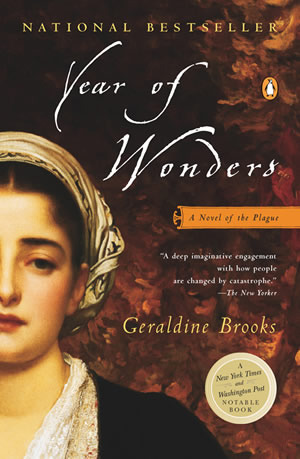 Our book club undertook Year of Wonders by Pulitzer Prize winner Geraldine Brooks. There are many things to recommend it, especially the depth of character development. Also prominent is the ability of the author to immerse the reader in the year 1665 in a small town in England where women of all classes were subject to the whims and humiliation of men.
We divided the reading and the discussion into two parts. The first half of the book was well received even though graphic descriptions of the Plague were tough to read. Several of us had to put the book aside for a time because of the horrors of the Plague and the difficult lives of the characters.
The ending of the book was met with a consensus of disappointment. After detailed and extensive exploration of the characters, author Brooks turns everything upside down leaving a shambles of motivations and actions that are disjointed based on expectations drawn from previous descriptions of their personalities. There is a baseness and meanness rising to the surface of characters who have been portrayed as admirable. The theology exposed by the ministers is not Biblically sound, but if one were to read the notes at the end of the book, it would not be surprising as the author refers to herself as having a “secular mind.” This is a dark book and not one that I would recommend mainly because the ending tries to provide closure much too quickly and, in the process, rather bizarrely changes the essential characters of all the major actors in the story.
I would like to extend my thanks to NetGalley and to Penguin Books for giving me the opportunity to read this book in exchange for an honest review.
Rating: 2/5
Category: Historical Fiction
Notes: This book includes an afterword, interview with the author, and discussion questions.
Publication: April 30, 2002—Penguin Books
Memorable Lines:
I liked her, too, because it takes a kind of courage to care so little for what people whisper, especially in a place as small as this…She was a rare creature, Anys Gowdie, and I had to own that I admired her for listening to her own heart rather than having her life filled by others’ conventions.
And so, as generally happens, those who have most give least, and those with less somehow make shrift to share.
“…we must take stock of these herbs and such remedies as the Gowdies may have left here. The key to defeating this Plague, I am convinced, must lie here, in the virtue of such plants as can be used to nourish those who remain in health. We must strengthen our bodies that we may continue to resist contagion.”
Gilead–coherent ramblings
Gilead
by Marilynne Robinson
 I do most of my reading and reviewing as a solitary occupation until I publish my thoughts on a book. I was glad to have read Gilead by Marilynne Robinson as a part of a book club where we could all bounce our reflections on the book off the mirrors of the impressions of others. The member of our group who suggested this book had read it several times. When I first began the book, I could not imagine enduring more than one reading. I have never liked stream-of-consciousness as a style of writing, and this book is a good example. John Ames, a Congregationalist minister, puts pen to paper to share his final thoughts with his young son, the things he would have told him as he grew, were their age difference not so pronounced. Having finished the book, I reread the first page to gather my thoughts and was amazed at what a perfect beginning it holds, carefully crafted and full of promise.
Although I still don’t favor the stream-of-consciousness style, I appreciate how appropriate it is to this epistolary novel with its many themes. The setting is the Midwestern town of Gilead that was once part of the underground railroad. Racial issues keep popping up at the most unexpected times in this book. Much of the story deals with relationships across generations. Without strict attention, it can be difficult to sort out which generation is being referenced. There are many ministers in the family line, but father and son bonds can be troublesome as the characters struggle to answer for themselves what is required to have a good life. Another level of complication is added in the thread of John’s namesake, Jack, the son of his best friend Robert who is also a pastor. There are undertones of the Biblical story of the “Prodigal Son” in some of those difficult associations. John, who never says anything bad about anyone, will leave behind a loving wife with a mysterious past, a much loved son, and boxes and boxes of sermons. How will he be remembered?
Gilead is not an easy or quick read. Be prepared to reread passages, especially those with theological depth. Some I just had to walk away from; others benefited from group discussion. I plodded through the first half of disparate pieces; I was fascinated with the second half as those pieces came together to form a beautiful design. At some point I probably will reread Gilead after I stand apart a bit and allow the characters of Gilead to become a comfortable part of my vision of “the good life.”
Rating: 4/5
Category: Historical Fiction, Christian
Notes: 1. 2005 Pulitzer Prize for Fiction
2. There are three other books that involve many of the same characters, but Gilead was written first.
Publication: November 15, 2004—Picador
Memorable Lines:
A little too much anger, too often or at the wrong time, can destroy more than you would ever image.
When you encounter another person, when you have dealings with anyone at all, it is as if a question is being put to you. So you must think, What is the Lord asking of me in this moment, in this situation?
I have decided the two choices open to me are (1) to torment myself or (2) to trust the Lord. There is no earthly solution to the problems that confront me. But I can add to my problems, as I believe I have done, by dwelling on them.
 education pathways