
Home » Historical Fiction (Page 4)
Category Archives: Historical Fiction
Christy–Appalachian teacher
Christy
by Catherine Marshall

Christy, who lived a protected childhood in Asheville, NC., was nineteen years old when she answered God’s call through the head of a missionary society to move to Cutter Gap, Tennessee, in the Great Smoky Mountains in 1912. Her job was to teach 67 mountain children who had not had steady opportunities for “book learning.” In fact, the one room school house held only a few much used texts for the students. Christy had to take on the additional duty of procuring books and other needed supplies as donations for her students.
In entering Cutter Gap by foot on a cold, snowy day that had finally thawed out enough for the postman to get through, Christy was crossing into another world with its own customs and unique phrases passed down from Scottish heritage. She was startled by the poverty, unsanitary living conditions, and firm adherence to superstitions. Christy was a witness to feuding and its deadly consequences, but she also discovered in the people kindness, grace, and a heart-felt joy in music.
Christy is the story of author Catherine Marshall’s mother as a teenage teacher. As historical fiction, it is more factual than imaginative. Marshall weaves the many tales she heard from her mother into a story that pulls the reader into a culture struggling for survival in the Appalachian mountains. The descriptions in the book paint a picture of the beauty and the harshness of nature in the mountains.
The characters in the book are well developed. One of my favorites is Miss Alice, a Quaker lady admired by all. She travels among three communities on horseback doing everything from administrative work to nursing the sick. She has deep spiritual insights born of experience. The author also reveals traumatic events in Miss Alice’s past that help her understand the tragedies the mountain folk have to cope with on a daily basis. If there ever was a nonjudgmental character, it would be Miss Alice.
This classic deserves a read or reread; a visit to Cutter Gap is one you will enjoy!
Rating: 5/5
Category: Historical Fiction, Christian, Classic
Publication: 1967—McGraw-Hill
Memorable Lines:
Surely one of the chief differences between the veteran teacher and the recruit must be that the experienced can never find enough time, whereas the ingénue struggles to fill the hours, looks forward to dismissal time as a reprieve.
“…if we will let God, He can use even our disappointments, even our annoyances to bring us a blessing. There’s a practical way to start the process too: by thanking Him for whatever happens, no matter how disagreeable it seems.”
I realized something else…there was more to this gracious offer than met the eye. Fairlight Spencer was not just volunteering to do some washing and ironing for me; she was also holding out to me the gift of her friendship. Among the mountain people, this was the most cherished gift of all. It was a breakthrough of those walls of reserve that had so far seemed impenetrable.
“And as for religion being vague—well, it isn’t. It’s been the delight of my life to find God far more commonsense and practical than any human I know. The only time I ever find my dealing with God less than clear-cut is when I’m not being honest with Him. The fuzziness is always on my side not His.”
Ladies of the Lake–bonds of friendship
Ladies of the Lake
by Cathy Gohlke

Viewing the same characters in a split timeline is a good way to tell the story of four girls who formed life long friendships at Lakeside Ladies Academy in Connecticut. They dubbed themselves “Ladies of the Lake.” They were not similar in background, but over their years at the school, they developed a close bond which they sealed with blood signatures at a gazebo on the school grounds, promising to keep in touch and support each other. The split timeline varies between showing the ladies as young people and as adults with a mystery gradually unraveling as the backgrounds and events that shaped them as adults are revealed.
Unfortunately, mistakes were made and things were said that broke some of the bonds. Dot and Addie are the most prominent characters, but they harbor secrets that keep them apart. Loving the same man, the Great War, and the Halifax Explosion all play a tumultuous role in their futures. Can a teenager bring them together?
Ladies of the Lake has a strong Christian theme as the women struggle through seemingly impossible situations. Portia, Addie’s housekeeper, is a woman of faith who gently guides Addie through some difficulties. The author holds up for examination the perspectives of the times on German Americans and Blacks. She invites the reader to see more than one side of an issue For example, people of German descent, former friends and neighbors, might be viewed as the enemy. Blacks were often held in contempt by some as “less than” even though they were put in a position of nurturing white children.
Forgiveness is a strong theme in this book as there are several characters who need to ask and receive forgiveness. Family is another important theme as the girls form a family for each other regardless of their home situations.
Reading this book is an escape into another world, but not one without pain. The characters are described well, and readers can immerse themselves in their lives as the story is full of twists and turns. The author cleverly hides the identity of Dorothy’s husband, but as the book progresses the reader will take pleasure in deciphering who he probably is.
I received a complimentary copy of this book in exchange for an honest review. Opinions expressed in this review are completely my own.
Rating: 5/5
Category: Historical Fiction, Christian, Women’s Fiction
Notes: There are lots of Scripture references and some particularly lovely and meaningful prayers at appropriate places in the story.
Publication: July 11, 2023—Tyndale House Publishers
Memorable Lines:
If I’d had a grandmother or a guardian angel, I would’ve wanted her to be just like Mrs. Simmons…I would have wanted her to be Mrs. Simmons.
She watched as he rejoined his brother, two halves of a whole, one with a slight limp and the other with a sleeve empty since the Great War, neither of which stole appeal from either man. That war had stolen much from the Meyer family, far more than the damage or loss of limbs.
Tears know no quota; mine couldn’t seem to stop.
A Shadow in Moscow–Cold War spies
A Shadow in Moscow
by Katherine Reay
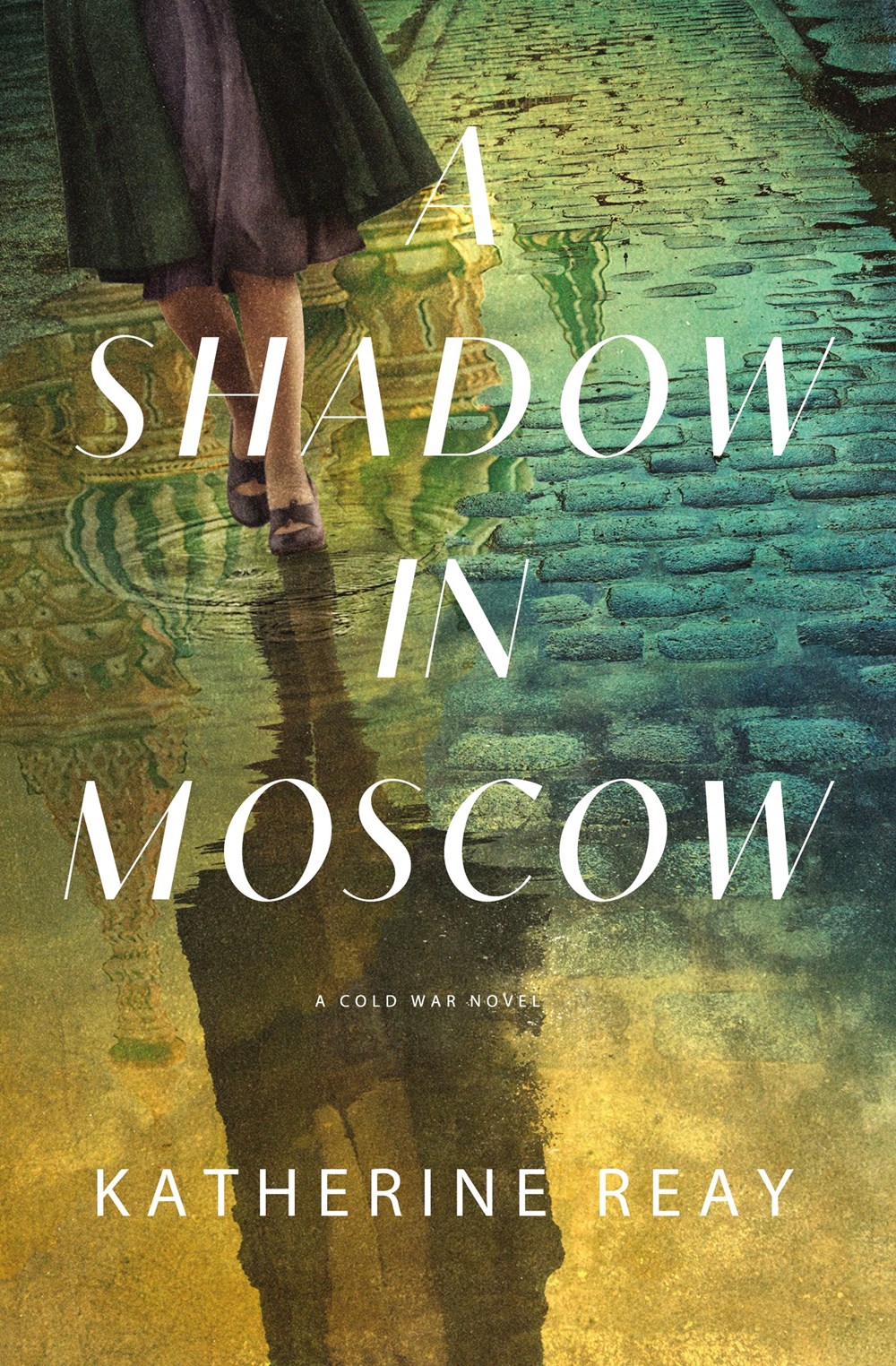
As you can guess from the title A Shadow in Moscow, this book is about spies—two women in particular—and is told in two timelines with a third included in an epilogue. I didn’t like the two timelines for a lot of the book, but by the end I understood why the author chose that style. She purposely does not reveal the connections between the two women operatives until late in the book. She, in fact, keeps a lot of clues from the reader. The whole book is interesting, but a little unsatisfying until the author reveals the relationships to the reader and to the characters themselves. At that point I was shaking my head at the courage, intelligence, and loyalty of these women.
Almost any summary of this work of historical fiction would include spoilers, so I will instead relate some of my impressions. I have read other books by Reay and appreciate her as a writer. She has researched her topic well and has shared information about the Cold War in a way that makes it understandable to the reader. It is hard to comprehend from our position in North America the length and depth of the spy organizations and culture that permeated the world during that era, especially as it involved the Soviet Union, the United States, and Great Britain. This is a story of intelligence agencies (CIA, MI6, and KGB) and counterintelligence agencies. We learn of the extent the KGB went to in their efforts to control the actions and even the thoughts of their people. We see this on an organizational level, but also a personal level as individuals and families are unable to express themselves or know who to trust. As Reay states in her notes to readers, “only in truly understanding our pasts will we be able to navigate—with empathy, humanity, and wisdom—our presents well.”
At two-thirds of the way through this book, I would have given it a moderate stamp of approval. At the end I was overwhelmed with the writer’s talent, with the way the various threads were drawn together, and with the motivations and resolutions for various characters. It will transport you to a difficult time in history when choices, whether based on ethics or on greed, led to life and death decisions.
I received a complimentary copy of this book in exchange for an honest review. Opinions expressed in this review are completely my own.
Rating: 4/5
Category: Historical Fiction
Notes: Discussion questions are included in the back of the book and Reay references other resources on her web page. If this is chosen as a book club selection, I would advise that the members read the whole book before discussing it.
Publication: June 13, 2023—Harper Muse
Memorable Lines:
Jamison’s cramped and stuffy book-lined office is my favorite spot on campus. Something about its dusty, ink-and-paper smell takes me right back to my bedroom and my all-night read-a-thons—because at home you get the best books in secret and only for one night.
Our conformity gives an illusion of power and peace as we are raised to believe our way of life is superior and virtuous. Illusions are powerful things. If you believe them hard enough, they can become one’s reality.
“They’re Americans, Sasha. They have constitutional rights agains that kind of stuff.” The memory is bright and convicting, blinding me with truth. That’s the difference, I think. Forget the bedazzled clothes, the neon colors, the malls, the plentiful vegetables. Forget it all. It’s window dressing hiding the truth. None of that matters because only one thing counts. Rights.
Jayber Crow–Life Story
Jayber Crow
by Wendell Berry

Some books are hard to encapsulate in a book review. Jayber Crow is one of those books. I am grateful to have book club members willing to share their insights and perspectives and give me opportunities to reflect on my own.
Author Wendell Berry is a Kentuckian through and through as is demonstrated in his Port Williams series of 11 novels and additional short story collections with a Kentucky setting. A novelist, poet, agrarian, activist, essayist, and farmer, Berry tells the story of Port William through the lives of his characters. Not a lot “happens” in Port William, but individuals like Jayber Crow are on display for the reader to understand how their experiences determine their strength of character. Jayber Crow has a series of rough circumstances as a child and as a young man; but never viewing himself as a victim, he develops the mental, emotional, and even physical fortitude to become a strong and introspective person. As is often the way in small towns, he is still considered an outsider even after many years of residing in Port William. With the goal of never being under the control of “the man across the desk,” Jayber, who considers himself the town’s most “ineligible bachelor,” has his own business as the town’s barber with side jobs as grave digger and church sexton.
Jayber was born in 1914, so he and all of Port William were affected by both World Wars and the Depression. He was witness to the technological changes that some called progress and others perceived as movements away from self-sufficiency and a difficult, but very satisfying way of life. In the process, they replaced a slower existence powered by manual labor with a more stressful one with a never-ending cycle of debt.
Jayber’s spiritual life is explored in the novel as he was placed in an unloving church orphanage where he thought he was called by God into the ministry. He was given a college scholarship to that end, but had a change of heart as he progressed through his studies. Jayber’s story shows the hand of God working behind the scenes as events from his early days help him as an adult. He is quiet, doing a lot of listening as a barber. As you read this book, you will watch Jayber navigate literal and metaphysical floods. There is a lot of symbolism in the book as related to water and course of direction. His relationships with women are interesting as he finally comes out of his shell by visiting a neighboring town where he will be subject to less town gossip. His marriage covenant is a most unusual one and may leave the reader with more questions than answers.
There is so much to think about in Jayber Crow that it is not a quick or easy to read book. I did enjoy it and recommend it. It takes the reader on a journey across Jayber’s lifetime, but never far from Port William.
Rating: 5/5
Category: Historical Fiction
Notes: 1. #6 in the Port William Series, but works well as a standalone
2. Contains a map and a genealogy of the families of Port William featured in the series.
Publication: 2000—Counterpoint (Berkeley)
Memorable Lines:
Back there at the beginning, as I see now, my life was all time and almost no memory. Though I knew early of death, it still seemed to be something that happened only to other people, and I stood in an unending river of time that would go on making the same changes and the same returns forever. And now, nearing the end, I see that my life is almost entirely memory and very little time.
The talk went the way I love it, so quiet and unhurried I could hear the dampened fire fluttering in the stove.
Her hearing was as sharp as Miss Sigurnia’s was dull. Aunt Beulah could hear the dust motes collide in a sunbeam; she could hear spiders chewing on flies.
The Branches seemed uninterested in getting somewhere and making something of themselves. What they liked was making something of nearly nothing.
Why is hate so easy and love so difficult?
Two Stories for Children
The Quilt Story—love across generations
by Tony Johnston
illustrated by Tomie dePaola
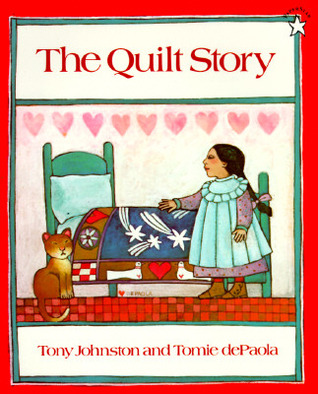
Over the years I have enjoyed sharing legends as presented by Tomie dePaola with my Kindergarten and First Grade classes. Today I reread The Quilt Story written by children’s author Tony Johnston. Tomie dePaola illustrated this book as beautifully and as appropriately as he does his own texts.
The Quilt Story begins in the days of covered wagons as Abigail’s mother makes her a quilt that Abigail uses and enjoys in many ways. It becomes a special comfort to Abigail when her family leaves their old life behind to begin a new one in the woods where her father builds a log cabin. Many years later a descendent of Abigail discovers the quilt, having suffered varmint attacks and natural aging, in the attic. She takes it to her mother and asks her to fix it.
The story is sweet and touching. Ms. Johnston and Mr. dePaola share so much contextually. Abigail’s sadness is apparent and understandable when the rest of the family is happy. The passage of time is indicated by the types of transportation, the clothing, and the homes, but both mothers are kind and comforting. The Quilt Story is reassuring to children in our minimalist and disposable age indicating that some objects do hold emotional memories of times and people of the past.
Rating: 5/5
Category: Children’s Literature, Historical Fiction
Publication: 1985—Putnam Publishing Group
October 1990—Scholastic
Memorable Lines:
So her mother rocked her
as mothers do.
Then tucked her in.
And Abigail felt at home again
under the quilt.
The Cowboy and the Black-Eyed Pea
by Tony Johnston
illustrated by Warren Ludwig
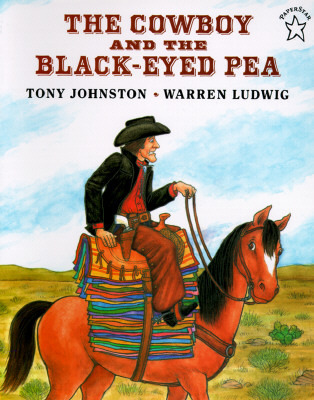
What a delightful reimagining of “The Princess and the Pea!” Set on the “biggest spread in the great state of Texas,” there is humor all the way through. The main character, who is also the heroine of this tale, is Farethee Well, “a young woman of bodacious beauty.” She is also clever and devises a plan to execute her father’s final wishes to “Find a real cowboy who’ll love you for yourself, not just for your longhorn herd.”
Her plan involves hiding a black-eyed pea under a saddle blanket because only a real cowboy would be “sorely troubled” by it. Watching the various suitors as they ride out to unknowingly perform the test is very funny—both in text and in the illustrations. Harkening back to the original fairy tale, a young cowboy arrives in the rain without knowing about the contest for the young cowgirl’s hand. One stampede and a pile of saddle blankets later, the real cowboy is discovered.
Rating: 5/5
Category: Children’s Fiction, Humor
Notes: 1.Don’t look for realism in the cowgirl’s test. If she put a black-eyed pea under the saddle blanket, it would be the horse that felt it, not the cowboy. Just remember it is a remake of a fairy tale and have yourself a Texas-sized good time!
2. Contains humor on both an adult and children’s level so all readers will enjoy this!
Publication: 1992—Putnam & Grosset
Memorable Lines:
Sure enough, quick as you can say “set another place at table,” cowboys from hither and yon came seeking Farethee Well’s hand.
Where Lilacs Still Bloom–a talent with plants
Where Lilacs Still Bloom
by Jane Kirkpatrick
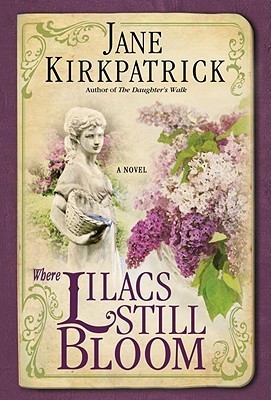
Hulda Klager was a hardworking German immigrant with an eighth grade education and a burning desire to implement changes in plants. She started with wanting a crisper, easier to peel apple for her apple pies. Her father had inspired her to follow her dreams, so while taking care of a large family and garden, she began exploring plant hybridization. She was successful and expanded her efforts to other plants. Her passion was lilacs, and her goal was to develop a creamy white lilac with 12 petals. In the process she developed over 250 varieties of lilacs. Her husband supported her interest in growing hybrids even in the face of those who initially condemned her for wanting to change nature as God had created it or for overstepping bounds as a housewife.
Although Kirkpatrick did a thorough job of researching the life of Hulda Klager, she had to rely on second hand sources. Despite Kirkpatrick being a very talented writer, Hulda Klager did not emerge from the pages as someone the reader could identify with. She was strong, persistent, and resilient but not portrayed as personable. Based on the number of people that committed to helping her with her lilacs throughout her life, however, she must have been an admirable and likable woman. In her almost 97 years, she influenced a lot of people and gave away many of her lilac starts. When the house and gardens were in disrepair and the famous Lilacs Days at the house had gone by the wayside, dedicated volunteers restored it all using contributions of Klager starts donated from gardens all over the country.
Where Lilacs Still Bloom is not a page turner in the traditional sense, but it did hold my interest as I watched Hulda Klager overcome many personal tragedies and fight against the flood waters time and time again that threatened her family, her garden and farm, and her huge collection of lilac plants. Kirkpatrick fills this book with descriptive passages that help the reader visualize the setting and circumstances. There are also many selections that can be read multiple times for the sheer beauty of the writing.
Rating: 4/5
Category: Historical Fiction
Notes: 1. The book includes a Reader’s Guide of discussion questions and notes from the author.
2. Klager kept detailed notes about her work, but most were lost in the various floods.
Publication: 2012—Waterbrook
Memorable Lines:
Melancholy seeped in like water filling footprints on a soggy lawn. It was always there beneath the surface that year but didn’t assert itself until pressure was applied…Maybe the sadness began with thinking of my parents too much. They were everywhere in that house, memories like cobwebs catching me unsuspecting.
“Beauty matters, Bertha; it does. God gave us flowers for a reason. I think so we’d pay attention to the details of creation and remember to trust Him in all things big or little, no matter what the challenge. Flowers remind us to put away fear, to stop our rushing and running and worrying about this and that, and for a moment have a piece of paradise right here on earth. God offers healing through flowers and brings us closer to Him.
“Yes, I pamper my lilacs. They remind me of the woman who kept them blooming and how she dug them up when high water came and floated them on rafts tied to trees so they weren’t ruined by standing river water. She taught me about persevering and trusting that providence would provide.”
The Paris Daughter–a story of art, women, and children in WWII
The Paris Daughter
by Kristin Harmel

World War II brings death, horror, and destruction to the civilians of Paris in this tension filled story of three women who have to make difficult decisions. They are never relieved of the agony of questioning their own judgements and actions: what would a good mother do?
Elise is the belittled wife of a famous painter whose actions put his family in danger. Juliette has the perfect charmed family life until the bombs begin to fall. Ruth Levy is a widowed mother whose Jewish religion and heritage endangers her children. As you read this novel, you will get to know these women and see how each reacts to hardships and trials. You can decide for yourself what it takes to be a good mother and whether any of these ladies are good mothers.
Alongside the main plot in The Paris Daughter, there is another that emerges; it interweaves and is essential to the first. It deals with artists at the time, how they interacted and how they were affected by the war. Elise was a wood sculptor and a painter. Art helped her through the emotional trauma of the war. Art also helped Juliette’s daughter deal with her mother’s increasing mental distress. Alongside these therapeutic benefits, we also witness the personal devastation that occurs when Elise returns home to discover her apartment has been looted of the valuable artwork she and her husband had created.
There are hints along the way as to what may have occurred personally during the war to these families. Eventually the characters and the reader learn the truth, and with the truth there is a way forward. Some of the characters are despicable, while others are noble and honorable. Some crumble morally under the stresses.
This book was a page turner for me, but was also a novel I found upsetting. The depiction of the characters is realistic so watching bad things happen to them was hard. As this book is set in World War II, not everyone is going to have a happily ever after. It is a book I recommend if you enjoy historical fiction, particularly about WWII.
I received a complimentary copy of this book in exchange for an honest review. Opinions expressed in this review are completely my own.
Rating: 5/5
Category: Historical Fiction
Notes: In the author’s notes she responds to questions about why she is drawn to history as her subject matter: “My reasons are numerous, but perhaps the most important one is that if we don’t learn from history, we run the risk of repeating it. Too often in recent years, those of us who read frequently about World War II have seen shadows of that long-ago war in current events and it’s difficult seeing versions of past horrors happening again.”
Publication: June 6, 2023—Gallery Books
Memorable Lines:
Later, Olivier snored peacefully beside Elise while she wiped tears of despair away. He only seemed to see her these days when he wanted the closeness of her; at all other times, his indifference cut her to the core. She owed Olivier everything, and perhaps that was what made it so difficult when it felt to her, sometimes, that he was trying to erase her.
“This isn’t a decision I make lightly, but being a parent is not about dong what is right for ourselves, is it? It’s about sacrificing all we can, big and small, to give our children their best chance at life.”
“There must be something we can do.” “There is,” Madame Levy said. “You can pray for my children. And you can talk to yours about never turning their back on their fellow man. Maybe one day, we’ll all live in a batter world.”
Cold Sassy Tree–Southern novel
Cold Sassy Tree
by Olive Ann Burns
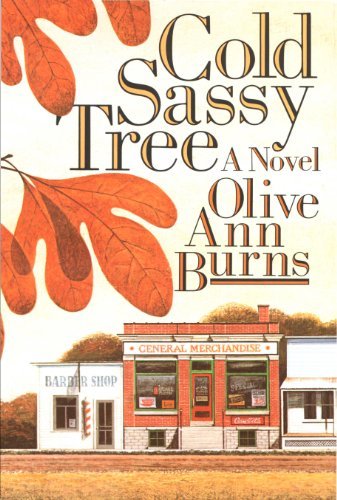
Cold Sassy, Georgia, is the setting for Cold Sassy Tree, a novel very successfully written by a woman with the point of view of a fourteen year old boy, Will Tweedy. The year is 1906. The town is small and populated with unforgettable characters. Many of the anecdotes are drawn from tales Burns heard as a child. The dialect rings through loud and clear. There is no doubt you are in turn of the century South where the Confederacy is still honored and people are starting to turn to indoor bathrooms, electricity, and telephones.
The patriarch of the central family, Grandpa Blakeslee, is the dominant force in the town. What he says, goes. He owns the store where everyone does business and finds out the latest news. His two son-in-laws work for him in what has become a family business. Will Tweedy has a close relationship with his grandpa and thus is often privy to his decisions before others. When his beloved wife of many years, Granny Blakeslee, passes away, Grandpa surprises everyone by remarrying in three weeks at a time when one year is considered the appropriate mourning period. One of his daughters is worried about what others will think and say, and both daughters are concerned about their inheritance. His new bride and the resulting family conflicts play a major role in the story.
Another theme is the coming of age of Will Tweedy, a young man who is given a lot of responsibility, but still struggles through his early teens getting into a lot of mischief. He engages in some dangerous escapades, has his first kiss, and does a lot of eavesdropping.
A serious thread throughout the book is religion. The town has Presbyterians, Baptists, and Methodists. Each church has strict rules, and a lot of hypocrisy comes to light as the members can be very judgmental. Grandpa doesn’t fit well into any of these groups, and he has his own ideas about God. Grandpa and Will Tweedy sort through the big theology questions together.
I like Cold Sassy Tree and recommend it. Although it takes place in a former time period, its themes resonate through the ages. They include greed, racial and social divides, jealousy, family, faith, and trust. All of the characters have traits and actions that make them admirable though flawed. The last quarter of the book is darker than the rest, but it ends on notes of hope.
Rating: 5/5
Category: Fiction, Historical Fiction
Notes: Sassy Tree refers to a Sassafras Tree.
Publication: 1984—Ticknor & Fields
Memorable Lines:
“Don’t she care at all if folks talk? Hadn’t she done enough already, without acceptin’ an expensive gift like that from a man with a reputation so bad it rides ahead of him?”
“Now, Lightfoot, with yore pa dead ’n’ all, I cain’t keep you no more less’n you go in the mill full time an’ pay yore part. Fast as you learn things, you’ll be a-workin’ both sides of the aisle in no time.” “Will, I begged her and begged her, ‘Please’m, let me git one more year a-schoolin’.’ But she said her chi’ren got two year apiece in school, and it ain’t holped them a bit in the mill. Said if they’d a-been borned with books for brains, they’d be makin’ bottom wages just the same.”
“Two elephants tied out yonder wouldn’t draw customers to the store as good as them artermobiles.” That was the Lord’s truth. Cold Sassy never had been a whirlpool of excitement. If the preacher’s wife’s petticoat showed, the ladies could make that last a week as something to talk about. …It’s easy to see why not even the scarlet of the Cold Sassy tree in autumn could equal our big shiny automobiles as something to rave about, especially with the open invite to come sit in them and take a ride.
The Swiss Nurse–refugees from war
The Swiss Nurse
by Mario Escobar

I am so glad that I had read other books by Mario Escobar, because this work of historical fiction started off roughly for me. I feel sure the fault was my own. I am shamefully unfamiliar with the Spanish Civil War, and I started the book too late in the evening. I persevered the next day, however, and was quickly immersed in a tale of evil hearts and the strength of some good people who worked to help others in dire circumstances.
When Franco and his troops were successful in this war, they were determined to obliterate the Republicans fighting for their freedom and anyone associated with them. The result was a massive exodus of refugees into southern France which was not prepared for the influx and did not welcome them with open arms. The “camps” they provided were sandy beaches with no structures. There was little food and no potable water; the refugees were not allowed outside the camp.
This book is about the refugees in that war which was followed up by the events of World War II and the further torment of innocents by the French Vichy government which was a puppet government of the Nazis, and then by the Nazis themselves. Much of the story describes the horrible conditions of the refugee camps and the strength and boldness of Elisabeth Eidenbenz, a Swiss woman whose focus was orphans in Spain until she was forced relocate to southern France where she opened a hospital taking in pregnant women and giving them a safe place to deliver their babies. The other main character is Isabel, a Spanish lady who married Peter, an American who fought with the Spanish for their liberation. Their lives intersect when Isabel gives birth to her precious daughter Lisa at the Elne Maternity Hospital. With Peter held in various prisons and concentration camps and conscripted into the army for manual labor, Isabel stays to help in the maternity hospital.
The author pulls the reader into the horrible conditions and the faith and courage of characters who stand up for what is right. As a reader, you want everything to turn out great for the sympathetic characters. This is, however, a work of historical fiction, so not everyone has a happy ending. It is important to read works like this so that we are not duped yet again by politicians who promise good things and deliver nothing, creating untenable situations. History like this must not be allowed to repeat itself.
I received a complimentary copy of this book in exchange for an honest review. Opinions expressed in this review are completely my own.
Rating: 5/5
Category: Historical Fiction, Multicultural, Fiction
Notes: Additional material includes: References, Clarifications from History, Timeline, Discussion Questions, and Information about the Author and the Translator
Publication: April 14, 2023—Harper Muse
Memorable Lines:
Gazing off into the distance, their gaunt faces reflected the weary sadness of their souls. Their cheeks were sunken with hunger, and their skin was pallid from exhaustion and malnourishment.
An entire generation had been killed for naught: anonymous heroes on both sides, idealists attracted by the siren songs of their leaders who stayed safe in the rear guard. The only hope was to erase those painful years from their lives and try to start over from scratch.
Argelès-sur-Mer had been both refuge and jail. It had stamped out of us the hope of recovering our lives one day. We were now flea-infested riffraff with bones aching from damp nights spent on hard sand with thin blankets. The starry sky had been our prison roof.
“Sometimes we have to feel our way in the dark in order to find the path, but beyond the fog the sky is still blue, and the sun is still shining.”
Under the Tulip Tree–must-read book about slavery
Under the Tulip Tree
by Michelle Shocklee
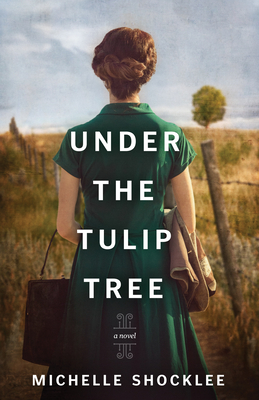
We have all heard it: it is important for us to know history so we don’t repeat the mistakes of the past. Michelle Shocklee does that in her novel Under the Tulip Tree. We get a view of slavery through the eyes of Lorena (Rena), an aspiring writer, who struggles to pursue her career in a male dominated society. She is sixteen when the stock market crashes and her privileged life changes forever. Seven years later she accepts a job with the Federal Writer’s Project (FWP) and meets Frankie who at 101 years old has a horrendous story to tell about what life was like for her and for others who were slaves.
The impact of someone being owned by another person is a concept that is hard for Rena to get her head around. The atrocities that Frankie shares are heartbreaking—even more so when you realize these things are drawn from actual events as told to FWP workers who were employed by the government to interview former slaves and record their stories for posterity.
What makes this story especially impactful is that Rena is telling this story from the viewpoint of a young White woman during the Great Depression. Although slaves had been freed, Blacks still did not enjoy equal rights. From sitting at the back of the bus, to lower pay, to being treated as dirty and ignorant, Blacks suffered from discrimination. Some Whites treated Blacks that way just because they could—acts of control and power. Some Whites treated Blacks that way because they were raised with that mindset, a deep cultural fear and hatred of someone who was different or because their own families had been mistreated by the Feds during and after the Civil War.
Rena’s father was a banker who fell apart after the crash. With her grandmother’s help, her family stayed afloat with both Rena and her mother getting jobs. Employment outside the home was something that was not acceptable for “their kind.” Rena’s mother was especially class conscious and worried about what her gossiping neighbors and former friends would say about Rena consorting with Blacks in Hell’s Half Acre where Frankie lived in a well-kept, small home boasting a beautiful floral garden and an outhouse.
As Frankie tells her story to Rena, the reader is quickly tied into the cruelty of the drama taking place in the book, and it becomes a page turner. It is harder to connect with Rena, but she grows as a person and becomes someone with the potential to do good. You can’t tell a story like this without pondering how a good God can allow bad things to happen. Frankie understandably harbors a lot of hate in her heart, but God works gently on her by bringing Illa, a Quaker woman, and Sam, a former slave, into her life, each encouraging, challenging and helping her.
Shocklee is a masterful storyteller, evoking empathy for 7 year old Frankie and embedding her into the heart of the reader. She shares the difficulties Frankie endured throughout her life without bearing down on graphic details. The author also dives into the “contraband” camp where Frankie lived for three years, still nominally a slave but under the protection of the Federal soldiers. Then she paints a picture of the horrors of war and its aftermath. As we learn about this part of history, we also see how citizens, both Black and White, were faring during the Great Depression. There are several surprising events at the end of this tale that help to bring closure for the characters and the reader.
There is a strong spiritual theme in Under the Tulip Tree. Frankie’s mother, Mammy, is a Christian believer, and although separated from each other early in Frankie’s life, Frankie never forgets her mother’s faith. Another important theme is literacy. Slaves were not allowed to learn to read. It was clear to the masters that slaves who could read could not be controlled as easily. Therefore books were forbidden. Frankie initially wanted very much to read, but the consequences were too great, robbing her of that desire. Standing up for what is right, for the downtrodden, for yourself against the power of the group in control is also a recurrent theme. All of these and many others remain ideas we wrestle with in our current society. On the positive side, we see the strength to be found in literacy, in trusting in God despite the circumstances, in the power in the Word of God, and in love for others—even our enemies.
Rating: 5/5
Category: Historical Fiction, Christian
Notes: 1. My personal thoughts in response to Under the Tulip Tree:
—The problem is not addressed in this book; but, sadly, slavery/human trafficking is widespread all over the world today. It is a major problem in the U.S.
—We make quick assumptions every day about other people based on where they come from, how they look and talk, and so many other factors. People, Black and White, did that in the book, and we still do it today.
- Original stories collected by WPA are available online from several sources. One is sponsored by Rice University: https://libguides.rice.edu/c.php?g=1231494&p=9012494
- Discussion questions are included in the back of the book.
Publication: 2020—Tyndale
Memorable Lines:
[Rena]: “People like me, like my family, we don’t know much about what slaves experienced. I’ve never heard of children being beaten with no one held accountable, or being forced into labor at the age of seven. Even though slavery isn’t legal anymore, I believe it’s important to remember the past as it truly was, not as we wish it to be.”
[Frankie]: “Helplessness washed over me, and I hated myself for it. Ever since the day I was sold away from Mammy, I’d despised helplessness. When overseers beat me and chased me down like an animal, I’d been helpless. When men used my body for their own pleasure and babies died, I’d been helpless to prevent it from happening. But the one thing I’d fought to maintain control over was my emotions. No one could force me to love or hate. They were mine to decide. I wasn’t about to allow this white woman to steal that away from me, no matter her attentive ministrations.”
[Sam]: “Don’t you see, Frankie? The day I landed on Miz Annabelle’s doorstep changed my life. I thought I found freedom when I ran away from my master, but it weren’t mine. Not yet. Freedom comes in knowing the truth of God. He loves each of us the same. He loves you, Frankie.”
 education pathways