
Home » Gothic Novel
Category Archives: Gothic Novel
The Fisherman’s Lady–Scottish classic
The Fisherman’s Lady
by George MacDonald
edited by Michael Phillips
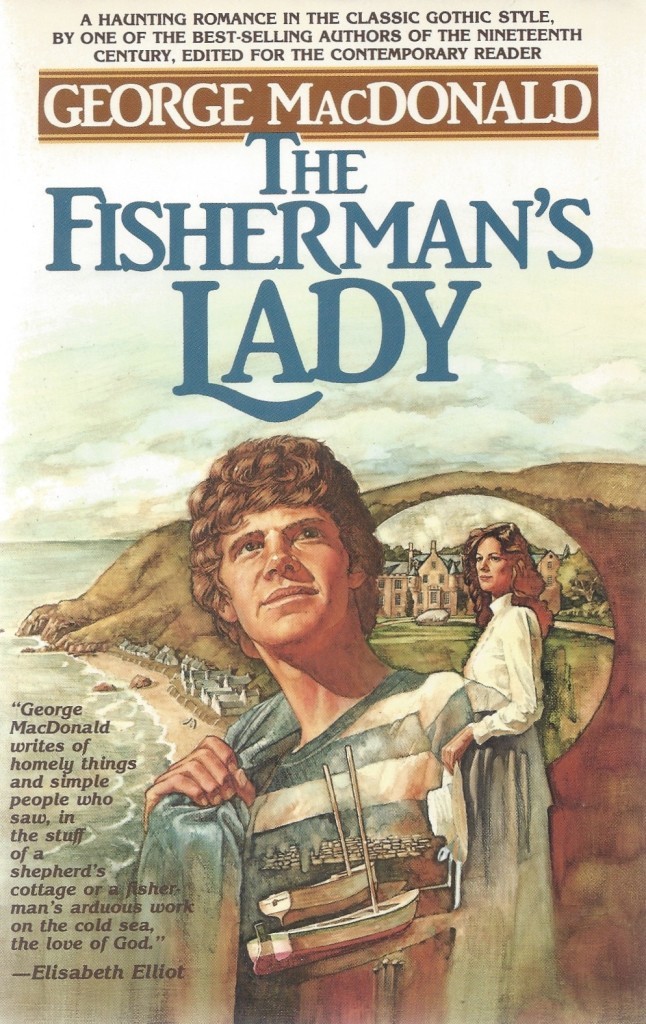
First published in 1875, entitled Malcolm, with a sequel arriving in 1877, The Fisherman’s Lady is a challenging read and a classical romance by a prolific writer of many genres. C.S. Lewis claimed MacDonald as his favorite writer saying, “I never wrote a book in which I did not quote George MacDonald.” The language is, of course, of an older age and reflects MacDonald’s background: Scottish minister, and author of fiction and nonfiction, including poetry. Contemporaries include Lewis Carroll, G.K. Chesterton, Charles Dickens, and Mark Twain.
Much of the dialogue in The Fisherman’s Lady is written with a Scottish brogue adding to the difficulty for the modern reader. Initially, I purchased a Kindle version that included both Malcolm and The Marquis of Lossie. Next, I located a printed version of The Fisherman’s Lady edited by Michael Phillips. He simplified the original by omitting some of the passages, but he also left some of the Scottish dialect for an authentic flavor.
Some readers categorize this novel as having a “gothic style.” It does contain some gothic elements from that Victorian period—a castle; dark, locked rooms; potential hauntings; crumbling stairways; the past affecting the present; twisted family ties; missing people; unusual sounds; and dreams.
The plot starts with sudden impact as it focuses on a corpse. Then, it proceeds slowly as characters are introduced. There are a lot of important figures in the book, and the editor lists them and a note about most of them, along with an area map. The story gains momentum and interest for the reader with lots of hooks leading into the following chapters. The protagonist is Malcolm, a fisherman who lives with his adopted father Duncan, an elderly, blind piper. Malcolm is a happy young man, honest, and a hard worker. He is devoted to the man who raised him whose only fault appears to be a quick temper over an old feud with another family. On the other side of the social strata is the Marquis of Lossie and his daughter, the beautiful Lady Florimel (Flory). Questions hang throughout the book concerning Malcolm’s parentage and that of the “Mad Lair,” a hunchbacked dwarf who has been badly mistreated by his mother.
Malcolm and Flory become friends, but they do not develop a romantic relationship because they both realize that social boundaries make any such bond between them unrealistic. Malcolm, however, would do anything for Flory, desiring to serve her long-term.
There are a few really evil women in this book. The way the upper class treats servants, laborers, the poor, and the disabled is upsetting, but a reflection of the times.
I enjoyed most of the book as far as it went, but I was disappointed in the sudden cut-off of the tale with no satisfactory conclusion for the characters. Most modern tales with sequels tie up the main threads in the first book but provide a motivation to encourage the reader to continue on to find out what happens to the characters in the next stage of their lives. This book contains a major event and then just ends with little attention to the aftershocks. The editor does include a brief paragraph to assure the reader on certain key points, but that statement was not part of the original text.
Rating: 4/5
Category: Historical Romance, Classic
Notes: 1. The first part of a two part set of books about Malcolm.
2. Includes Christian themes and shows characters trying to come to grips with their faith.
3. Clean
4. Includes preface by the editor and three appendices providing historical notes.
5. I have not yet decided if I will read the sequel, The Marquis of Lossie, or not.
Publication: Original in 1875—Henry S. King Publishers in Great Britain, and George Routledge & Sons in New York, and J.B. Lippincott in Philadelphia
This version edited by Michael Phillips in 1982—Bethany House Publishers
Memorable Lines:
Whatever may have been the projected attitude of the marquis, the moment he stood on the piper’s floor, the gentleman in him got the upper hand and his behavior to the old man was not only polite but respectful. At no period in the last twenty years had he been so nigh the kingdom of heaven as he was now when making his peace with the blind piper.
But Lady Florine had never studied anything yet, had never even perceived that anything wanted studying—that is, demanded to be understood. What appeared to her most odd, most inconsistent, was his delight in what she regarded only as the menial and dirty occupation of cleaning lamps and candlesticks; the poetic side of it, rendered tenfold poetic by his blindness, she never saw.
“No, no; never run from a lie. And never say, neither that you didn’t do the things except it be laid straight to your face. Let a lie lay in the dirt. If you pick it up, the dirt’ll stick to you, even if you fling the lie over the dike at the end of the world. No, no! Let a lie lay as you would the devil’s tail!”

