Home » Fiction (Page 61)
Category Archives: Fiction
Blood Brothers–a Satisfying Read
Blood Brothers
by Rick Acker
Satisfying. Blood Brothers by Rick Acker is satisfying. That may not sound like much of a compliment, but it really is–the same way that an excellent meal is satisfying. When I finished the book, I found the ending had come at the right time and in the right way without being predictable. Through Acker’s writing I had experienced just the right amount of excitement and intrigue within a framework of our legal and investigative systems and a background of scientific research. There was even a touch of history and the romance of a foreign country.
When I reviewed Acker’s book Dead Man’s Rule, I mentioned that the main character’s wife, Noelle, had only a minor role and was not well-developed. That deficit was rectified in this novel as Noelle is presented as a three-dimensional character adding realism to the novel.
Blood Brothers deals to a great degree with relationships–mainly focusing on two rich brothers, Karl and Gunner, at odds over control of their pharmaceutical company and also on lawyer Ben Corbin and his spouse Noelle. Private investigator Sergei Spassky, who is a new Christian, has to confront his feelings for FBI agent Elena Kamenev, a nonbeliever who shares his Russian heritage. Together they have to face the ramifications of very different religious beliefs.
The intricacies of the lawsuit and countersuit were handled well including the reactions of a fairly new judge and the chosen jury. Insights into the science trials were also interesting and included one loose end (a mistake made by a summer intern) that surprisingly was not included in the book’s resolution. I appreciated the brief afterword containing nonfiction information related to some of the technical aspects of the book. I definitely advise reading it after you finish the book, however, as reading it in advance would spoil the story for you.
Rick Acker has written three legal thrillers for adults and two detective mysteries intended for a younger audience, but as is often the case with a well-written book for youth, several reviewers also recommend them for a fun read for adults. I definitely was not disappointed by Blood Brothers, the second of Acker’s engaging tales for me and certainly not the last.
I would like to extend my thanks to netgalley.com and to Waterfall Press for the opportunity to read this book in exchange for an unbiased review.
Reflections on What Comes Around–with Content Warning!
What Comes Around
by Adair Sanders
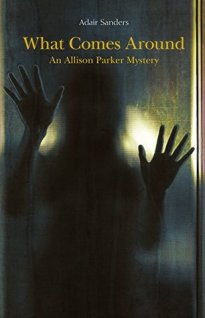 In the interest of full disclosure, I need to say that I went to school with the author and I really wanted to like this book as much as I did her two previous books: As Sick as Our Secrets, the first in the Allison Parker Mystery Series and Biologically Bankrupt…Sins of the Father, a sad, autobiographical work. What Comes Around is the second in her mystery series. I think Sanders is a good writer: in terms of plot, characters, etc, I can easily award this book four stars (out of five). The first chapter is particularly well written and drew me into the rest of the tale.
My reticence in wholeheartedly recommending What Comes Around centers on its graphic descriptions of sexual violence. Everyone has a personal tolerance level for various aspects of fiction–horror, violence, even romance. I personally find this level of detail disturbing, but another reader may see its role in What Comes Around as essential to character and plot development.
Kudos to Adair Sanders who completed a successful law career and has jumped into a second successful career as a writer. I look forward to reading more of the Allison Parker Mystery Series.
Review of The Discovery Saga Collection
The Discovery Saga Collection: A 6-Part Series from Lancaster County
by Wanda E. Brunstetter
At some point in time, I got on Wanda Brunstetter’s email list and received a free download of The Discovery Saga Collection which was initially released as a series of six books. It recently struck my fancy to read it. I found it to be basically a sweet book, focusing on the power of being kind to others.
The setting of The Discovery Saga Collection is “Amish country” as that culture and religion holds a fascination for the author. I found the first part of the saga very slow paced as Brumstetter tells the story alternately through the thoughts of the husband and wife and their reflections are very similar (i.e. repetitive). The plot picks up pace and interest at the end of the first part.
Brumstetter creates interesting characters and a fascinating, difficult situation that involves many characters and their relationships. I did want to read to the end to discover the resolution of the various conflicts, and I got the ending I wanted–sort of. Without spoiling the book, let me say that I liked the characters’ reliance on God and the book’s use of Scripture as well as a liberal sprinkling of Pennsylvania Dutch in the dialogues. I found many aspects of the book simplistic and unrealistic. If you long for a very clean novel with some romance, a tidbit of action, and a focus on the faith of the Amish as well as other Christians, you will be pleased with this laid-back novel.
A Killer’s Guide to Good Works–a cozy that tries too hard
A Killer’s Guide to Good Works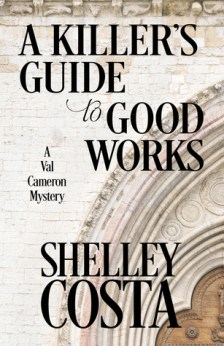
by Shelley Costa
I struggled a little with why I did not like the second book in the Val Cameron Mystery Series as much as I liked the first. Lest you dismiss this book out of hand, please hear me out. At no point did I entertain the idea of not finishing the book. I wanted to watch the main character, Val Cameron, discover who murdered her best friend Adrian. I could, however, put this book aside temporarily without regret–not a good sign.
A lot of A Killer’s Guide to Good Works seems forced (as does the title); I can see the author’s hand too much. I was put off by Shelley Costa’s too frequent usage of unfamiliar words or phrases, some of which are not used to best advantage. For example, the main character feels a “little frisson” three times in the course of the book. My distaste for the author’s application of her obviously extensive vocabulary is ironic because I love learning new words. Her manipulation of the characters within her plot structure are also too obvious.
I particularly enjoyed the character Tali, a young, orthodox Jewish teenage girl of independent and perceptive mind. Although her role is minor, she adds spice and a little humor. There is also a character who is a Jewish professor. In sections involving these characters, there are a number of Hebrew words. These references added interest for me and their usage seemed natural.
The weakest part of this plot is the cult that is the center of the mystery. The fifty handpicked, highly educated followers are known as the High Council. They seem unaware of the cult doctrine which, besides the basic principle, is never actually expanded on for the reader either. I find that an unbelievable scenario. Costa presented no persuasive information to convince me that these people would follow their leader Animus, the “soul of their secret organization,” without questioning the soundness of his unorthodox and esoteric philosophy.
There are definitely gaps in this story for the reader to complete. On the other hand, there are some interesting characters and good twists to the mystery. One of the perks of A Killer’s Guide to Good Works is the further development of Val Cameron’s persona and the introduction of Greta, the aunt who raised her. I liked the first book in the series well enough to give the author the benefit of the doubt and read a third before making a judgement about the series.
I would like to extend my thanks to netgalley.com and to Henery Press for the opportunity to read this book in exchange for an unbiased review.
Dead Man’s Rule–Great Legal Thriller
Dead Man’s Rule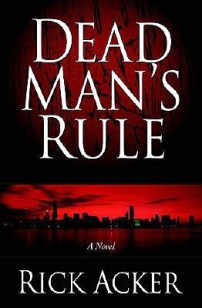
by Rick Acker
Some of the first comments I read about Rick Acker’s legal thrillers compared his work to that of John Grisham. I, along with many other more qualified critics, consider Grisham to be in the top in his genre. I snickered a little at this appraisal of Acker and said to myself, “Well, that’s a little overblown.” I am currently chewing away at my naysaying words. Grisham and Acker both write legal thrillers with interesting characters, exciting action, strong plot lines, and details arising from effective background research. The legal situations are integral to the plot, not inserted as an afterthought because the author is also a lawyer. Acker is not an imitator of Grisham; in fact, Acker is an excellent writer in his own right. There is always room for another good suspense writer!
Dead Man’s Rule had my attention right from the prologue, “A Relic of War,” which is not a typical background piece. It pushes the reader into the story, ready or not. The setting changes in the first chapter to Ben Corbin’s legal offices but the interest level doesn’t change, and immediately the reader begins mentally searching for the connection.
I like it when the main character is human (flawed but trying) and likable, and Ben Corbin fits into that category. If there is a weak character as far as the writing goes, it is found in the depiction of Ben’s wife, Noelle. She is two-dimensional in a world of three-dimensional characters, but her role in the novel is fairly small.
The archvillain, General Elbek Shishani, is fleshed out by Acker so that he is not just some “bad guy” to be dealt with by the hero and his CIA and FBI associates. The reader will probably not approve of Shishani’s actions, but the author does share how he became who he is.
Reader, be prepared to learn about legal procedures and an arcane law that becomes critical to one of Corbin’s cases. Acker avoids getting too technical so the read remains exciting, but the reader can understand all of the legal complications and how they affect both the innocent and the guilty. He also takes us into the world of bioterrorism and Russian and Chechen politics as well as the sometimes competing interests of the various law enforcement and investigative agencies in the U.S.
Dead Man’s Rule is my first experience with Rick Acker’s writing, but he has published four more suspenseful books. I can’t wait to try another. If it is like Dead Man’s Rule, I’ll have trouble putting it down.
I extend thanks to netgalley.com and to Waterfall Press for the opportunity to read this book in exchange for an unbiased review.
Leaving Independence–Western Romance
Leaving Independence 
by Leanne Wood Smith
Having just read and reviewed an emotionally difficult nonfiction book, I was ready for something lighter, but engaging. I found just what I was looking for in Leaving Independence by Leanne Wood Smith. Independence is the name of the town the Baldwyn family, composed of Abigail and her four children, travels to as the departure point for a wagon train going west. In an odd turn of events, the father of the family had been reported dead during the early days of the Civil War, but the war is now over and she receives word that he is serving at Fort Hall in the Idaho territory. Abigail is confused that he did not contact her personally, and the family is low on funds with the bank threatening repossession of their home. A woman of action, she takes her family in search of her missing husband.
There are background stories related to the social and political events surrounding the Civil War and Reconstruction. Abigail’s friend and former slave, Mimi, is unable to accompany the family on the trip. The author tells the story with third person narrative and through pieces of letters that Mimi and Abigail exchange during the trip. She creates an interesting tale with a combination of history, mystery, and romance. I found the dialogue to be reflective of the characters and the time except for one anachronism. As the family makes preparations to leave Independence, the teenage daughter, Corrine, is not happy about the trip. Her mother tells her “you’ll have a much better trip if you decide now to embrace this experience.” “Embrace this experience” strikes me as a modern phrase and not one that is typical of 1866. The use of this one expression does not ruin the novel for me, and I do recommend it to do what books do best–help you escape into a different time and place.
I would like to thank netgalley.com and Waterfall Press for the opportunity to read this book in exchange for an unbiased review.
Come Rain or Come Shine–love the book!
Come Rain or Come Shine 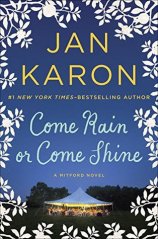
by Jan Karon
After somewhat disappointing results in her last book (see my previous post, a review of Somewhere Safe with Somebody Good), Jan Karon has once more hit the mark in her Mitford tale Come Rain or Come Shine. Readers are all invited to the wedding of Dooley and Lace and get to participate in the preparations as well.
The novels in the Mitford series are kind and gentle and this one is no exception. The characters are not without problems, and realistic, unfortunate situations do arise. Karon effectively uses a technique in this novel of sharing some of Lace’s journaling to show the reader her attitudes and the process she and Dooley had to go through to get to the point of marriage.
A new character, Jack Tyler, is introduced. It seems he will be important in future books as Karon continues to spin her magic with words as the younger Mitford generation becomes the focus. If you are not already a Mitford/Father Tim/Jan Karon fan, begin with the first Father Tim novel, At Home in Mitford. I strongly recommend joining the many readers happily anticipating the next events in Mitford.
Somewhere Safe with Somebody Good–love the title
Somewhere Safe with Somebody Good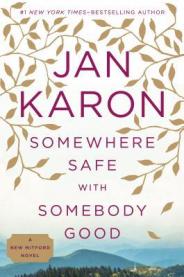
by Jan Karon
Continuing the saga of Father Tim, an Episcopal priest, the book Somewhere Safe with Somebody Good was eagerly awaited by fans of the Mitford series. I have lived out of the U.S. long enough for this book and another in the series both to be published in paperback. I say this to establish that the intervening time lapse has genuinely caused me to forget many of the details of the various subplots of the series. Karon tries to draw enthusiasm from people like me as well as perhaps those who pick up this book as their first taste of life in Mitford. Honestly, I think Karon has created too many characters to be able to update them all effectively. Perhaps she should have pared down the ones included in this book. That part of the book only earns two stars; I don’t fault Karon’s writing, just her taking on an impossible task.
When the reader gets past the clumsiness of character updates, Somewhere Safe with Somebody Good becomes the delightful tale that Karon’s readers have come to expect–interesting, but soothing; realistic, but attaining a moral high ground. I love to see how the characters deal with life; I delight in the carefully crafted words and the beautiful sentiments. It is a treat, as always, to watch Father Tim deal with people who are not always lovable and to sort out his own problems while supporting the community members who have grown to depend on his Godly wisdom.
As a teacher and book lover, I enjoy the focus on the local bookstore, Happy Endings, and the way people come together in the story to support it. Readers who love books (especially children’s literature) will be attracted to the many quotes encouraging reading that Mitford’s citizens post in the bookstore.
As the remainder of the book, including the raison d’être of the title, pleased to capacity, I award a full five stars to Somewhere Safe with Somebody Good.
Fixin’ to Die–Good Try, but…
Fixin’ to Die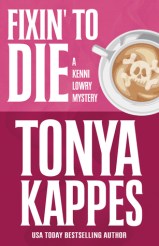
by Tonya Kappes
Fixin’ to Die is a murder mystery set in the small town of Cottonwood, Kentucky. It is the first novel in Tonya Kappes’ Kenni Lowry Mystery Series. My first impression as I was reading this tale is that I really liked the main character Kenni. She is the kind of person I could enjoy spending time with. That sense did not change as this young sheriff goes all out to solve her first murder case and the reader meets the quirky locals she interacts with.
Fixin’ to Die has many elements that aficionados of the cozy mystery genre relish–a strong feminine lead, a few handsome romantic interests, a plot with twists and turns, interesting townspeople, and a surprise ending. So why am I not a huge fan of this book? Mainly I attribute my attitude to a literary technique Kappes attempted: she creates the ghost of Kenni’s grandfather, a longtime Cottonwood sheriff himself, as a character who will aid in Kenni in her investigations. I applaud the effort, but it just didn’t work for me. Therefore I can not wholeheartedly recommend this book.
I would like to extend my thanks to netgalley.com and Henery Press for the opportunity to read this book in exchange for an unbiased review.
Tangled Lies–Will They Ever be Unraveled?
Tangled Lies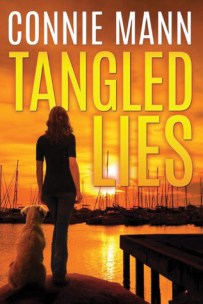
by Connie Mann
Sasha Petrov is a very likable main character in the book Tangled Lies. She is comfortable in the position of licensed boat captain, whether leading a chartered fishing tour, hauling cargo, or competing in a speed race. In fact, she is more comfortable in that role than in relating to family and potential romantic interests. Orphaned as a girl, her past hampers her current relationships but not her efforts to help those she loves.
Tangled Lies is one of those books you just don’t want to put down. The “tangled lies” make the reader want to return for more of the extreme adventure, mystery, and romance that would seem unbelievable for a small town setting. It is, actually, the unhealthy closeness of the denizens of little Safe Harbor, Florida, and its marina that make the playing out of this puzzle believable. As a reader, I wanted to know the answers to the odd intermingling of hateful attitudes and violent events in what was ostensibly pleasant small town America, but I was afraid to have the motives revealed.
Connie Man is a Christian author which, in this case, means characters who approach real issues in their lives without profanity and with self-imposed limitations on their sexual relationships. It more importantly means that they trust in God as their source of strength during difficult times. They have personal issues to work through, but they admit their weaknesses and try to do what is right.
Tangled Lies is Ms. Mann’s third novel. She is a boat captain in Florida herself, lending authenticity to this work.
I would like to extend my thanks to netgalley.com and to the publisher Waterfall Press for the opportunity to read this book in exchange for an unbiased review.
 education pathways