
Home » Classic
Category Archives: Classic
Frankenstein: The Modern Prometheus
Frankenstein
by Mary Shelley
with A Guide to Reading and Reflecting by Karen Swallow Prior

What do you think of when you hear the word “Frankenstein?” For many, that name conjures up an ugly monster pieced together from the flesh of others. A quick Internet search of images associated with that name bring up iconic pictures that are a part of our popular culture. Many movies have been made of the book Frankenstein as well as versions and spin-offs of the Gothic novel. In truth, Victor Frankenstein is the name of the scientist who created the monster who was never named in the book, but may be referred to as “The Creature.”
Clearly a classic, Frankenstein, was the creation of 18 year old Mary Shelley as a result of a dreary day’s writing contest with a small group of men, that included her husband the poet Percy Bysshe Shelley and Lord Byron. The little group fought to overcome the ennui of the season. Mary Shelley won and her story was first published anonymously.
The structure of the story is initially a little confusing, but it becomes clearer as the tale progresses. Captain Robert Walton’s narrative frames the story with his recounting, as his ship headed to the North Pole, of the sighting of an unknown creature and then the rescue of a man who was pursuing the creature. Much of the book is epistolary as Walton shares the story of Victor Frankenstein’s life with his sister in England.
The reader is also given the Creature’s viewpoint. At eight feet tall and very different looking, he is viewed as a threat. At times the reader might feel some sympathy for him as he wants love and acceptance, but he also reveals a murderous side. When he realizes he will never be integrated into human society, he approaches Victor with the idea of creating a woman to be his wife. This request ignites another ethical dilemma for Victor who has already ignored his moral obligations when he gave life to the Creature and then abandoned him. His bad decisions turn his life and that of his loved ones into tragedies.
The editor of this volume, Karen Swallow Prior, is a Professor of English and Christianity and Culture. She states that the major themes of Frankenstein are “creation, creator, guilt, ambition, reason vs. emotion, nature vs. nurture, friendship, sexuality.” She points out that Shelley does not write from a biblical point of view, but that these themes are timeless. This is obviously a complicated book and important in terms of its effects on our culture. The editor Prior attempts to make it more accessible in her introduction and in the background she presents about the time in which it was written. Not an easy read, Frankenstein offers a lot of food for thought. The reader will probably argue with the characters over their motivations and actions and will be hard pressed to find a likable character among them. Victor Frankenstein, in particular, proves over and over again that he is self-centered. His own happiness and a fulfilled ego are so important to him that his emotions swing wildly and greatly affect his health while he disregards how his actions hurt others.
Rating: 4/5
Category: Fiction, Gothic, Classic, Christian
Notes: 1. The editor ends each section (volume) with Reflection Questions which are a wonderful resource for individuals or groups studying Frankenstein. She also includes Questions for Further Reflection which address the whole book.
2. The appendix adds the introduction to the 1831 edition.
3. Prior has helpful footnotes on the appropriate pages to define words that are unfamiliar to readers in the twenty-first century.
4.Frankenstein is subtitled The Modern Prometheus pointing to the tension between a creation and its creator.
5. Although Frankenstein is not a Christian novel, Prior’s goal is to show readers how to approach it from a Christian viewpoint and to the glory of God
6. Prior has a series of classics that she has edited in a similar way. I have read several of these with my Book Club. Some have been more enjoyable than others, but all have resulted in good discussions.
7. This was written during the transitional period from Enlightenment to Romanticism.
Publication: 1818—Original publication
2021—(as edited by Prior) B&H Publishing
Memorable Lines:
I entered with the greatest diligence into the search of the philosopher’s stone and the elixier of life. But the latter obtained my most undivided attention: wealth was an inferior object; but what glory would attend the discovery. If I could banish disease from the human frame, and render man invulnerable to any but a violent death!
I was benevolent and good: misery made me a fiend. Make me happy and I shall again be virtuous.
“Hateful day when I received life!’’ I exclaimed in agony. ‘’Accursed creator! Why did you form a monster so hideous that even you turned from me in disgust? God, in pity, made man beautiful and alluring, after his own image; but my form is a filthy type of yours, more horrid even from the very resemblance. Satan had his companions, fellow-devils, to admire and encourage him; but I am solitary and abhorred.”
Hans Brinker, or The Silver Skates–historical look at Holland
Hans Brinker, or The Silver Skates
by Mary Mapes Dodge
illustrated by Edna Cooke
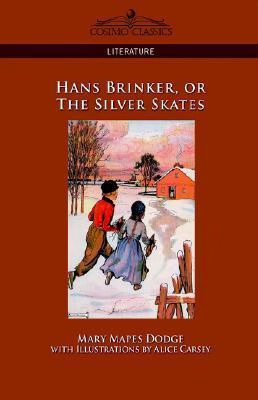
This children’s novel depicts life in Holland in the early 19th century and according to the author “aims to combine the instructive features of a book of travels with the interest of a domestic tale.” Dodge has done of lot of research so much of the book focuses on Dutch history and customs. Although Hans Brinker is the protagonist, he is not even a character in a large part of the book that describes a skating trip a small group of boys undertake traveling on frozen canals and rivers to various cities.
Hans and his family live in deep poverty because the father Raff had a work accident ten years prior that affected his brain. His wife also can not work because she has to stay home to look after her unpredictable husband. Hans and his sister Gretel are not always treated well because of their social standing. The author states that the circumstances of Raff’s situation were true.
Hans and Gretel have only inefficient wooden skates that Hans carved for them, but both are good skaters. Surprisingly, not much of the story deals with the race for silver skates. Hans is an honorable young man as is shown many times in the story.
The fictional part of Hans Brinker is interesting, even exciting, but the historical portions are less interesting. The boys visit museums on their trip and the history bounces from one item to another just as it would if you were visiting a museum. There are a lot of events referenced that students today do not have the historical background for (e.g. Prince William of Orange who freed Holland from Spain and became King of England). For further personal education on Dutch history or if working with homeschool students, Hans Brinker or the Silver Skates could be a valuable resource. Unless I were teaching a unit on Holland in a classroom, I doubt I would read this to or with Middle Grade students. I found the Preface to be a valuable introduction to what was to follow. I also liked the satisfying Conclusion which shared what happened to the characters as life moved on for them.
Rating: 4/5
Category: Children’s fiction, Historical fiction
Notes: 1. Intended for children 8-12 years old
2. I found this to be a slow read, but there were others in my book club who found the historical references very interesting.
Publication: 1865—George W. Jacobs & Co.
I obtained my copy from Gutenberg Press.
Memorable Lines:
“…the father and I saved and saved that we might have something laid by. ‘Little and often soon fills the pouch.’ ”
“We cannot say what we might have become under other circumstances. We have been bolstered up from evil, since the hour we were born. A happy home and good parents might have made that man a fine fellow instead of what he is. God grant that the law may cure and not crush him!”
Ten years dropped from a man’s life are no small loss; ten years of manhood, of household happiness and care; ten years of honest labor, of conscious enjoyment of sunshine and outdoor beauty, ten years of grateful life—One day looking forward to all this; the next, waking to find them passed, and a blank. What wonder the scalding tears dropped one by one upon your cheek!
Rebecca–fascinating classic with dark vibes
Rebecca
by Daphne du Maurier

First published in 1938, Rebecca has been republished multiple times and continues to gain new audiences. I read it as a young adult and remember being fascinated by it, but could no longer remember the details. When our book club decided to read it, I was excited to revisit this dark classic, and I was not disappointed.
The author’s technique is to begin the book with the situation of the characters at the end of the story. Then she deftly switches to current actions as she describes how the protagonist, who is never named, comes to meet Maxim de Winter, the owner of the magnificent Manderley estate. She is a shy young lady with less nobility in her background than Maxim. This suspenseful story is told from her point of view.
Manderley is almost a character in this book, not just a backdrop. The other important character is Rebecca, the dead wife of Maxim. Her presence is palpable to the new Mrs. de Winter as her touches are evident throughout the house in decor and in the general management of the household. Mrs. Danvers, Rebecca’s former maid and the current household manager, revered her first mistress who could do no wrong in her eyes. She is a leader among the servants in making the new Mrs. de Winter feel like an unworthy interloper.
Much mystery surrounds Manderley as the newlywed couple try to settle in. They have to endure proper welcoming visits from the locals who encourage them to host a costume party as Rebecca used to do. As the story progresses, the reader can feel the evil and sadness that has taken root in Manderley, but it is not obvious why.
Rebecca is certainly worth a reread. It has a complex plot with characters with hidden motivations. Secrets are gradually revealed as tension mounts. The climax is a gripping surprise. As an unusual twist for me, I found myself returning to the first two chapters to study how the author set the reader up for the rest of the book. Impressive craftsmanship!
Rating: 5/5
Category: Classic novel, Gothic, Suspense, Mystery
Notes: Goodreads refers to 864 editions!
Publication: 1938—Doubleday
Memorable Lines:
Last night I dreamt I went to Manderley again.
Describing Maxim’s sister Beatrice: She belonged to another breed of men and women, another race than I…If it had been Beatrice who had done this thing instead of me, she would have put on her other dress and gone down again to welcome her guests. She would have stood by Giles’s side, and shaken hands with people, a smile on her face. I could not do that. I had not the pride, I had not the guts. I was badly bred.
I wondered how many people there were in the world who suffered, and continued to suffer, because they could not break out from their own web of shyness and reserve, and to their blindness and folly built up a great distorted wall in front of them that hid the truth.This was what I had done. I had built up false pictures in my mind and sat before them. I had never had the courage to demand the truth.
Tess of the d’Urbervilles–new look at a classic
Tess of the d’Urbervilles
by Thomas Hardy (and Karen Swallow Prior)
First published in serialized form in 1892, this classic has been read and studied over the years. Summaries are available everywhere on the Internet, so I want to share with you the particular edition I read this summer with my book club. It includes “A Guide to Reading and Reflecting” by Karen Swallow Prior who is a literature professor and author herself. We have read other books that include her notes, but I think this is the best one of the series that we have read.
Prior gives a lot of background on Thomas Hardy and the times in which he lived that are essential for understanding Tess of the d’Urbervilles. Born to a working class family, he longed for a scholarly life which at times seemed out of his reach. For example, he desired ordination but was unable to afford the university costs and so became a draftsman for a church architect. He studied on his own, and this book is full of classical and Biblical references. He also read books that are contradictory to traditional Christianity. He became an agnostic who attended church all his life. These are a few of the conflicts that show up thematically in Tess of the d’Urbervilles along with sexual purity being essential to women, but not to men. The plight of agricultural workers can not be missed as well as the difficulties of overcoming class rules and status. Nature itself and self-determination are also central themes.
In this edition, Prior helps the reader delve into the deeper meanings of the book. Hardy creates interesting characters and a solid plot, but also a certain line to destruction and despair for Tess. Prior points out Hardy’s use of literary techniques but also how to read this novel from a Christian worldview. I think her comments would also be interesting to those with a secular point of view.
Prior does not change anything in the original text. She does include brief, helpful footnotes that explain words that might be unfamiliar to a modern reader as well as classical allusions. Hardy divided the book into seven sections called “Phases.” Prior ends each phase with reflection questions which are valuable in pointing out aspects the reader might miss and in demanding deeper introspection. Prior concludes the book with questions “For Further Reflection” which apply to the text as a whole.
Rating: 5/5
Category: Classic, Fiction
Notes: There are currently 6 classics in this series.
Publication: 2022—B&H Publishing Group
Memorable Lines:
From Prior: Tess of the d’Urbervilles is not merely dark and pessimistic but is tragic—tragic in the true literary sense.
From Hardy: The clock struck the solemn hour of one, that hour when fancy stalks outside reason, and malignant possibilities stand rock-firm as facts.
From Hardy: It is Tess Durbeyfield, otherwise d’Urberville, somewhat changed—the same, but not the same; at the present stage of her existence living as a stranger and an alien here, though it was no strange land that she was in. After a long seclusion she had come to a resolve to undertake outdoor work in her native village…
The Secret Garden–delightful classic
The Secret Garden
by Frances Hodgson Burnett
Illustrated by Tasha Tudor
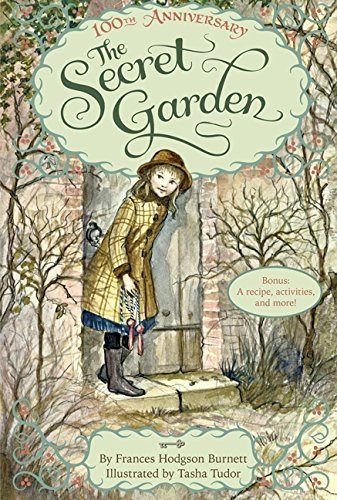
An avid reader as a child, I am surprised that I somehow missed out on the classic children’s tale The Secret Garden written by Frances Hodgson Burnett. For this reading with my book club, I chose an edition with delightful illustrations added to this 1911 book by Tasha Tudor in 1962. The Secret Garden is recommended by the publisher for ages nine and up, but I strongly recommend it for all readers. Please don’t relegate it to the “kiddie lit” genre.
The Secret Garden is the kind of book that instructs the reader in positivity without being preachy. Ten year old Mistress Mary (as in “quite contrary”) is a child who is both spoiled and neglected in her upbringing in India where she does not experience love. Things are not much better for her when her parents die, and she is shipped to Yorkshire to be under the care of her uncle. There she is still not loved as her uncle, Mr. Craven, has not dealt well with the death of his wife ten years prior and the illness of his son Colin who is physically cared for but also is not loved.
When Mary discovers that the mysterious crier in the night is Colin, she gradually creates a bond with her cousin. She is a curious girl who is given little freedom in the house, but almost total freedom in the gardens. She discovers the benefits of fresh air, sunshine, and natural exercise, and she explores the grounds looking for a secret garden that has been hidden away since Colin’s mother died.
Mary and Colin meet so many interesting people during the spring and summer. Dickon is a twelve year old who can converse with animals and plants. His older sister Martha is a sweet young lady who works at Misselthwaite Manor as a housemaid and helps take care of Mary. She has one day a month off, and she travels home by foot to help her kindly mother with laundry and baking. She gladly gives her mother her earnings to help support her large family of twelve happy siblings. Ben Weatherstaff is an elderly gardener who knew Colin’s mother and is eager to help restore the secret garden. While this tale is not full of goody two-shoes, it does have characters the reader will enjoy getting to know and in the cases of Mary and Colin watching their physical and emotional growth.
The Secret Garden is a pleasant read that begins with difficulties for the characters but progresses to a magical time in their lives. The author’s descriptions are wonderful to read as spring approaches in the garden. It is a book I would reread for the pleasure of the story and the language of the author.
Rating: 5/5
Category: Children, Fiction, Classics
Publication: 1911—Harper Collins
Memorable Lines:
The rainstorm had ended and the gray mist and clouds had been swept away in the night by the wind. The wind itself had ceased and a brilliant, deep blue sky arched high over the moorland. Never, never had Mary dreamed of a sky so blue. In India skies were hot and blazing; this was of a deep cool blue which almost seemed to sparkle like the waters of some lovely bottomless lake, and here and there, high, high in the arched blueness floated small clouds of snow-white fleece. The far-reaching world of the moor itself looked softly blue instead of gloomy purple-black or awful dreary gray.
“Half-witted!” said Colin angrily. “Who thought that?” “Lots o’ fools,” said Ben. “Th’ world’s full o’ jackasses brayin’ an’ they never bray nowt but lies.”
He had made himself believe that he was going to get well, which was really more than half the battle, if he had been aware of it.
The Girl Scouts at Rocky Ledge–a gem from 1922
The Girl Scouts at Rocky Ledge
by Lilian Garis
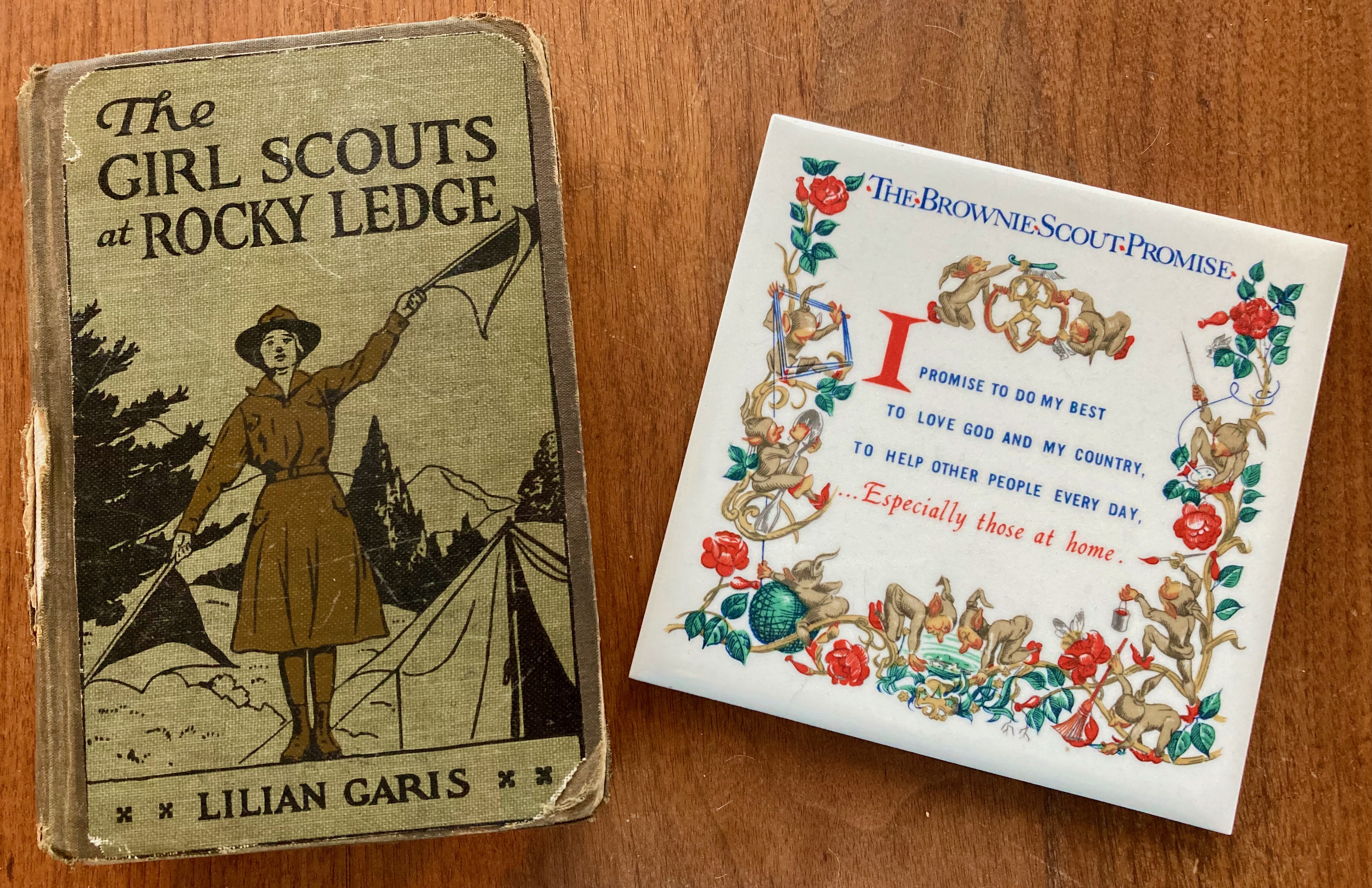
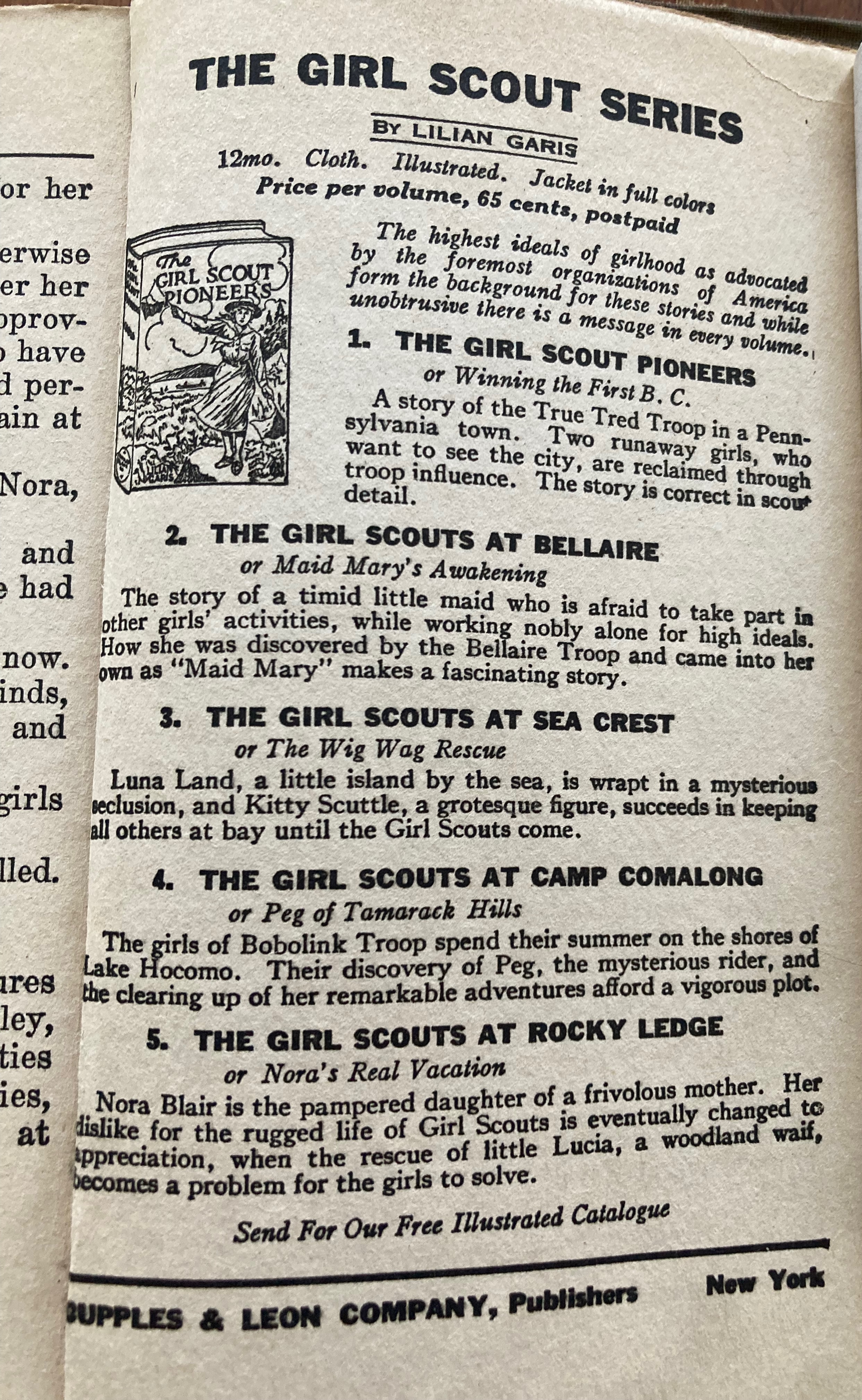
My sister-in-law, in downsizing, came across this book with my name written in the front. I was delighted when she offered to mail it to me. I remember buying it in sixth grade when the teachers opened up the book room and held a sale. From the markings, it appears that the local library had donated books to the school. This book with a copyright date of 1922 seems to have been formally checked out many times, but then informally checked out at the school in the 1948-1952 time period. I was born in 1952, so this book was sitting on a shelf, unread, for about 12 years before it landed in my hands and then literally a lifetime before it made it back to me.
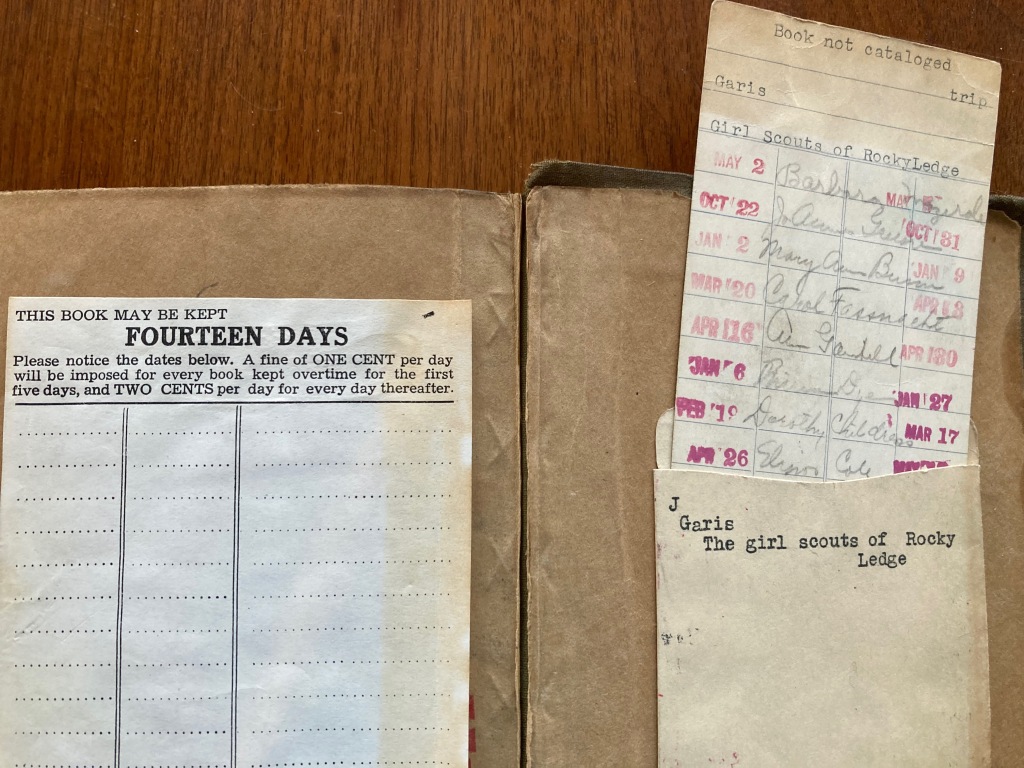
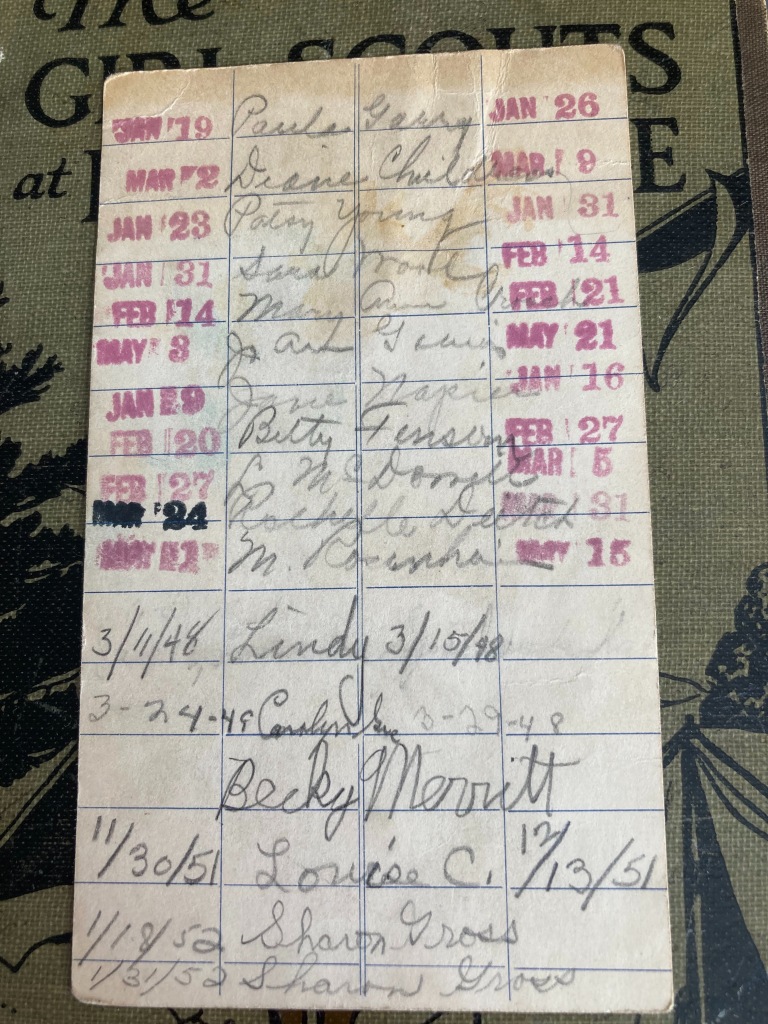
The Girl Scouts at Rocky Ledge is a delightful read. It is the tale of pretty little Nora, pampered with the best and most delicate of clothes. She has a vivid imagination that confounds most adults. She is sent for a month’s vacation with Jerry and Ted (Theodora). Jerry is a surveyor and Ted specializes in wildlife. They spend their days exploring the terrain around the house where they live. There are a group of Girl Scouts camping in their area, with khaki uniforms, rules, and lots of freedom. The Chickadee Patrol adopts Nora, and she discovers that there are many benefits to their way of passing the summer.
I would love to spend time with Jerry and Ted who are fun loving and accepting. The Girl Scouts are quite individualistic and indulge in friendly teasing. A mystery arises when Nora in her wanderings discovers Lucia, a frightened little girl and resolves to help her, leaving food for her until one day she disappears. Another mystery revolves around Vita, the Italian cook in the household. She engages in odd conversations with Nora about the attic as if she is trying to scare Nora.
I enjoyed the older but not stilted style of writing. The characters and narrator have a broader vocabulary than we are used to in children’s books, but it is quite understandable even to the modern ear. The first chapter is confusing because Nora wants to rename her hosts. They take it in good stride and then the story is in full swing. Cap (Captain) is a canine character who can be relied on to judge people well and to take care of Nora as she explores the woods.
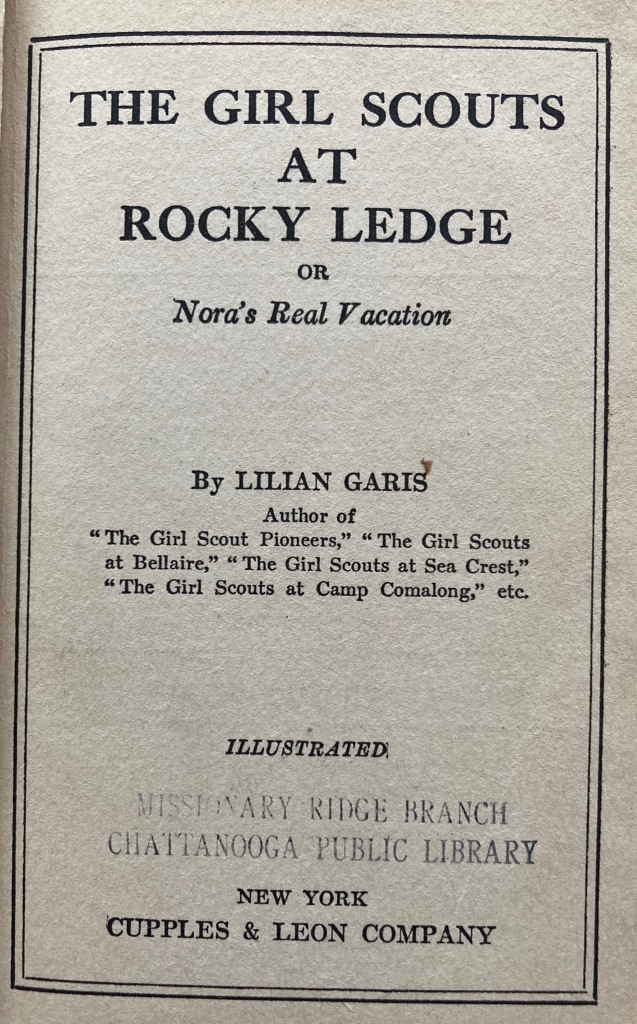
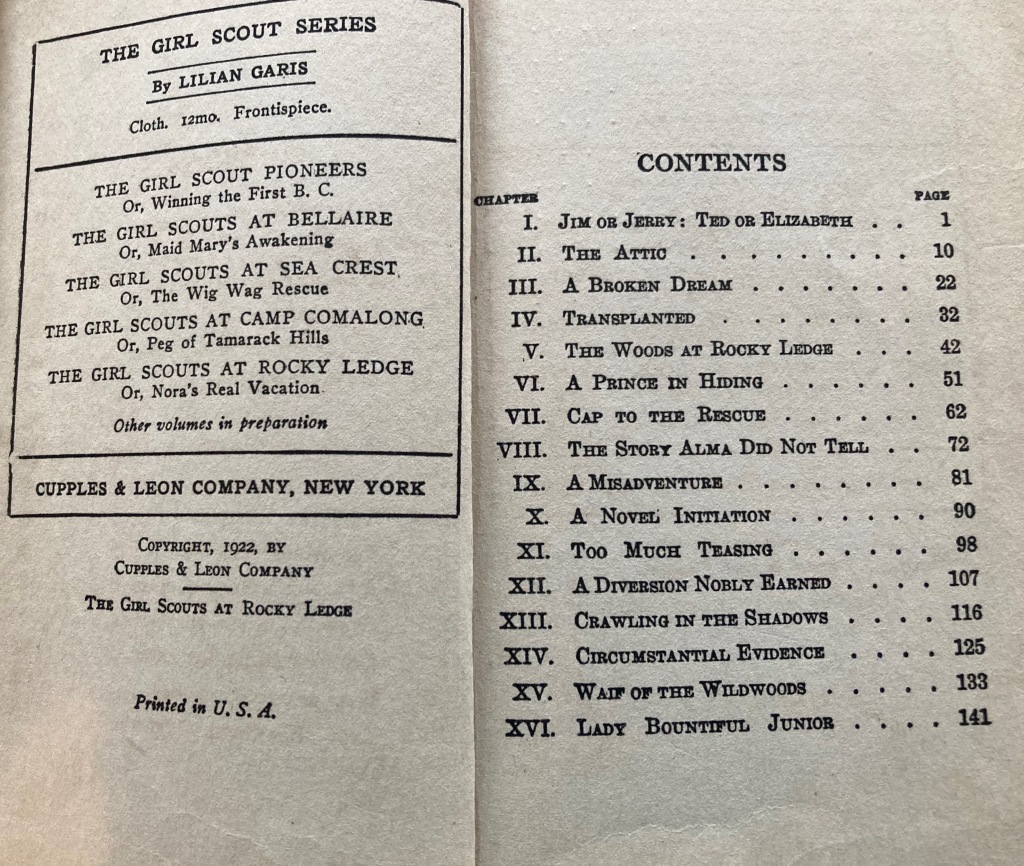
Lilian Garis (20 October 1873 – 19 April 1954) was a prolific American writer of juvenile fiction. She authored hundreds of books from 1915 to the early 1940’s. She was a newspaper reporter when she met her future husband Howard Garis, also a reporter. He was as prolific as his wife as he wrote the Uncle Wiggily Longears series. These stories first appeared daily in the newspaper, every day except Sunday, for almost 40 years—11,000 stories which were nationally syndicated and compiled into books. Both authors’ books have been reprinted over the years giving testament to their appeal and quality of writing.
Rating: 5/5
Category: Children’s Fiction
Notes: Part of the Girl Scout Series, but is a standalone. The intended audience is probably ages 8-12, but it would be fun for girls of all ages
Publication: 1922—Cupples and Leon Company
Memorable Lines:
If one could look pretty after a ducking in a strange lake, Nora did. Her curls liked nothing better, and her cheeks pinked up prettily, while her eyes—they were as blue as the violets that listened in the underbrush.
The day brings wisdom, and when Nora again dressed in the borrowed khaki suit (she had suddenly taken a dislike to her own fancy dresses), the glorious sunshine of the bright summer morning mocked the terrors of the night.
Nora was disconsolate. For two days the dainties left for Lucia had remained untouched. The bread box which Vita had given her to play with, and into which the food was deposited for Lucia, stood upon the tree stump with the sliced lamb, the piece of cake, and the big orange which comprised the last installment offered by the sympathetic Nora, just as she had left it.
Little House in the Big Woods–worth a reread
Little House in the Big Woods
by Laura Ingalls Wilder
illustrated by Garth Williams
Would you like to start off 2024 with an easy book that is a quick read? Do you ever wish you could go back to a simpler time? Reading or rereading Little House in the Big Woods might be the perfect beginning for your new year. I think you’ll quickly discover, however, that although the simple times could be joyous, they were not always easy. Most things were accomplished by hand with handmade tools.
Going into town was a rare adventure to purchase the few things that could not be made but were necessary to accomplish other tasks. Gunpowder was needed for hunting to feed the family. Cloth was essential to make clothes for the family—with stitching by hand.
Items were produced by the family that we would never in 2024 consider making ourselves. After the grain harvest, straw was braided and used to make hats for everyone in the family. Every part of an animal was used for food or something utilitarian. The skills to do these things were passed down or learned for the sake of survival. There was fun and artistry to their lives as well. For example, making butter was a lengthy process with the finished product completed in a butter mold which the father (Pa) had carved with flourishes.
Laura Ingalls Wilder shares the partially fictional story of her pioneer family in their log cabin in Pepin, Wisconsin in the early 1870’s. The setting is so well described that the reader can imagine what it was really like for the main character in the story, Laura, to live during that time period. There was a lot of hard work for Ma and Pa, and they were quite isolated from any neighbors. When friends and family got together to share work, they also made a fun occasion out of the event. Although there was no church near them, the family had a ritual of Saturday night baths. They would dress in their best clothes reserved just for Sundays. Ma and Pa would read from the Bible, and they would eat cold foods. The girls had to sit quietly for most of the day. The author shares the experiences she had that were dependent on the changes of the seasons. Their lives were driven by the seasons, spending summer and fall preparing food for the winter.
Wilder gives detailed descriptions of nature and the land where they lived. She was a gifted writer and her way with words makes the reader want to keep forward motion with the story just to revel in the words. She sprinkles in stories that Pa told to Laura and her sister Mary. He was a good storyteller, singer and fiddle player. Pa and Ma were consistent and loving parents with high expectations for moral values and work ethics.
Rating: 5/5
Category: Children, Fiction. This series is generally listed as intended for children, but many adults enjoy them as well. Actually, as a culture we are so far removed from the technology and methods of work of the 1800’s that there would need to be a lot of discussion for children to understand the story.
Notes: #1 in the Little House series which has 9 books and many spin-off stories.
Publication: 1932—Harper Collins
1953—beautiful illustrations by Garth Williams
were added
Memorable Lines:
The attic was a lovely place to play. The large, round, colored pumpkins made beautiful chairs and tables. The red peppers and the onions dangled overhead. The hams and the venison hung in their paper wrappings, and all the bunches of dried herbs, the spicy herbs for cooking and the bitter herbs for medicine, gave the place a dusty-spicy smell.
They were cosy and comfortable in their little house made of logs, with the snow drifted around it and the wind crying because it could not get in by the fire.
All day the icicles fell one by one from the eaves with soft smashing and crackling sounds in the snowbanks beneath. The trees shook their wet, black branches, and chunks of snow fell down.
A Tree Grows in Brooklyn–a no-nonsense coming of age story
A Tree Grows in Brooklyn
by Betty Smith
Sometimes publishers and reviewers have the audacity to promote a newly published book as a “classic.” In my opinion a classic is a book of excellence that has stood the test of time and is judged to be worthy of reading and rereading by future generations. First published in 1943, A Tree Grows in Brooklyn is such a book. Written by Betty Smith, it is fiction but it has its basis in Betty Smith’s own coming of age in Brooklyn.
The protagonist is Francie, a girl who grows up in difficult circumstances of poverty with an alcoholic father who is nonetheless likable. Her mother favors her younger brother over Francie knowing she will be able to succeed in spite of her background. Francie, like Betty Smith herself, from a young age is a reader and a writer. Francie’s mother, Katie, works cleaning houses and believes with all of her being that education is the route to success for her children. She insists that her children read a page from Shakespeare and the Bible each night. She evens barters piano lessons for herself and Francie, with little brother Neeley, who inherited his father’s musical aptitude, watching. Their father Johnny worked as a singing waiter when he could get employment.
There is not a plot per se in A Tree Grows in Brooklyn; it is a recounting of a family’s struggle to survive. The reader is immersed in the setting, the culture, and the characters. Despite the lack of twists, cliff hangers, climax, and denouement, this novel is a page turner of a gentle sort. Ripe with symbolism, this book is perfect for discussion and introspection. It opens the door to an era gone by and good hearted, imperfect people who want to keep their dysfunctional families intact and give their children a better life than they had. It is the fight for the American Dream set down on paper.
Rating: 5/5
Category: Classic, Literary Fiction
Publication: 1943—Harper Collins
Memorable Lines:
Mama explained: “Francie is entitled to one cup each meal like the rest. If it makes her feel better to throw it away rather than to drink it, all right. I think it’s good that people like us can waste something once in a while and get the feeling of how it would be to have lots of money and not have to worry about scrounging.”
“Who wants to die? Everything struggles to live. Look at that tree growing up there out of that grating. It gets no sun, and water only when it rains. It’s growing out of sour earth. And it’s strong because its hard struggle to live is making it strong. My children will be strong that way.”
Oh, the last time how clearly you see everything; as though a magnifying light had been turned on it. And you grieve because you hadn’t held it tighter when you had it every day.
The Importance of Being Earnest : A Trivial Comedy for Serious People
The Importance of Being Earnest
by Oscar Wilde
There is probably no better work to evoke book club discussion than Oscar Wilde’s famous satirical play The Importance of Being Earnest. The extreme characters as well as the situation are the source of humor as Wilde mocks the customs and manners of Victorian England. In our discussion we examined parody, satire, and sarcasm, when each is appropriate, and their potential hurtful nature. We also talked about what constitutes humor.
Wilde’s characters border on the absurd. The women are fluff, the men are profligates who nevertheless think highly of themselves, and no one tells the truth. In fact, the lies that both male protagonists have told are the basis of the humorous confusions in the story. Jack lives in the country, but pretends to need to go frequently to the city because of a younger brother named Ernest who gets into scrapes. When he is in the city, Jack goes by the name of Ernest. Jack’s friend Algernon wants to meet Jack’s ward so he goes to Jack’s house as Ernest. It just happens that Cecily, Jack’s ward, and Gwendolen, Jack’s fiancee agree that they could only love someone whose name is Ernest. The two young ladies’ diaries are a source of amusement as the events in the diary are fictional. For example, Cecily records the marriage proposal of Algernon as Ernest, their breakup, and subsequent reunion even though they have never met.
The Importance of Being Earnest was first presented on February 14, 1895. It continues to amuse audiences today in live theater presentations and in a number of video productions.
Rating: 5/5
Category: Drama, Satire
Publication: February 14, 1895—original production
March 1, 1997—Project Gutenberg
Memorable Lines:
The amount of women in London who flirt with their own husbands is perfectly scandalous. It looks so bad. It is simply washing one’s clean linen in public.
I never travel without my diary. One should always have something sensational to read in the train.
Cecily: That certainly seems a satisfactory explanation, does it not? Gwendolen: Yes, dear, if you can believe him. Cecily: I don’t. But that does not affect the wonderful beauty of his answer. Gwendolen: True. In matters of grave importance, style, not sincerity is the vital thing.
Jane Eyre–a classic
Jane Eyre
by Charlotte Brontë
with a Guide to Reading and Reflecting
by Karen Swallow Prior

Occasionally I will read a sentence plugging a newly released book that describes it as a “classic.” For me, a book has to not only be of high quality or a good example of a type of literature, but most importantly has to have stood the test of time to be considered a classic. Charlotte Brontë’s Jane Eyre is one of these books. Karen Swallow Prior, a professor of English literature, is editing a series of classical books and has chosen Jane Eyre as one of her subjects. In her introduction, she discusses the author and provides background of the work and its publication. She also addresses the themes found in the book and how to read Jane Eyre through a current Christian perspective. Prior includes footnotes on archaic or unfamiliar terms and references to other works both secular and religious at the bottom of the pages where they occur. The novel is divided into three volumes; each is followed by insightful discussion questions. Also there are questions for reflection at the end which are appropriate for addressing overarching themes and issues.
Jane Eyre is a long and complex book; straight summarizing would not do it justice and would certainly contain spoilers. The volumes progress chronologically through Jane’s life, and she is the narrator. She includes the struggles she as endured that have formed her into an intellectual woman of strong moral character. She frequently quotes people as referring to her as “plain” in her physical attributes.
The novel includes social themes regarding the treatment of the poor and of women. Neither of these groups had great expectations of rising above their current status. At its heart, Jane Eyre is a romance, but it has aspects of mystery, adventure, and theology. Brontë’s treatment and development of the various characters are excellent, and there is liberal use of foreshadowing and symbolism. This is truly a classic that can be read for pure enjoyment or studied as a work of art.
Rating: 5/5
Category: Fiction, Christian, Classic, Romance
Notes: Manuscript used by editor was published in 1848
Publication: 2021—B & H Publishing
Memorable Lines:
I regained my couch, but never thought of sleep. Till morning dawned I was tossed on a buoyant but unquiet sea, where billows of trouble rolled under surges of joy. I thought sometimes I saw beyond its wild waters a shore, sweet as the hills of Beulah; and now and then a freshening gale, wakened by hope, bore my spirit triumphantly towards the bourne: but I could not reach it, even in fancy—a counteracting breeze blew off land, and continually drove me back. Sense would resist delirium; judgment would warn passion. Too feverish to rest, I rose as soon as day dawned.
This was very pleasant; there is no happiness like that of being loved by your fellow-creatures, and feeling that your presence is an addition to their comfort.
Laws and principles are not for the times when there is no temptation: they are for such moments as this, when body and soul rise in mutiny against their rigor; stringent are they; inviolate they shall be. If at my individual convenience I might break them, what would be their worth?
 education pathways