
Home » Children (Page 2)
Category Archives: Children
Pax–a boy and his fox
Pax
by Sara Pennypacker
illustrated by Jon Klassen
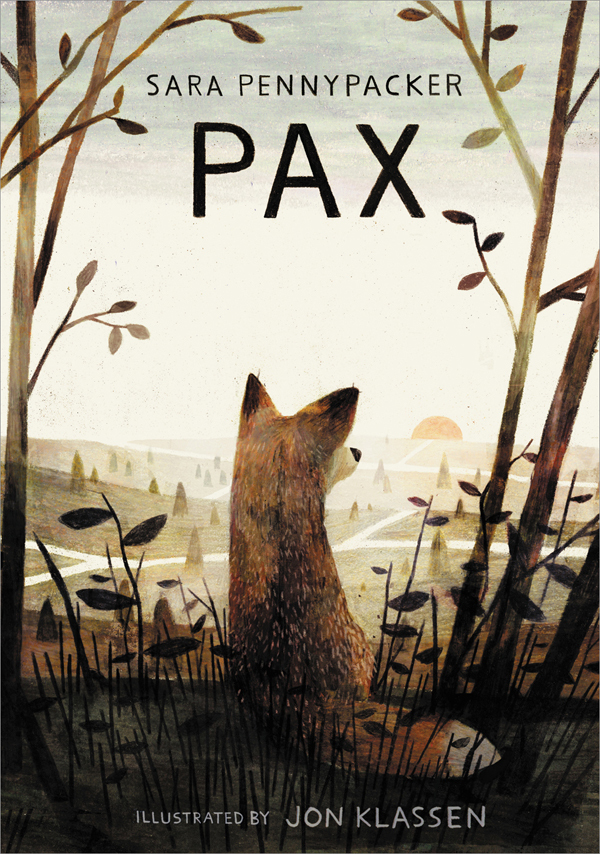
Pax is supposed to be a middle grade book, but its themes require more maturity than most young people of that age can muster. The costs of war are central to the book as the characters have to deal with its emotional effects on individuals and families. Trust and treachery, anger and emotional abuse, and love, promises, guilt and truthfulness are all issues that come into play in this book.
With a purposely vague setting in terms of location and time, the author uses two points of view to tell this story—that of Peter, a twelve year old boy whose mother has recently passed away and of Pax, the fox Peter rescued when Pax was just an orphaned kit. Peter’s father goes away to war leaving him with his grandfather, but making him desert his pet. That is so much grief for a boy!
Wracked with guilt and worry, Peter sets out to find Pax while Pax waits and then searches for Peter. The reader follows both characters through adventures and misadventures. Another interesting character is Vola, a wounded veteran who has difficulty recovering from the physical and emotional traumas of war, but tries to help Peter. Several characters in the book suffer from what we would call PTSD or shell shock. There are also generational issues as Peter’s father has difficulty with anger and Peter doesn’t want to follow in his footsteps.
The writing is excellent, and Pax is ripe with topics for discussion. Our book group debated various issues related to the book and reread passages to clarify our understanding of some underlying meanings. When it was time to close down our meeting, we still had concerns we could have pursued.
Rating: 4/5
Category: Children’s Fiction
Notes: 1. Ages 9-11
Grades 3-7
In looking at reviews in Amazon after I finished writing my review, I found that readers were mixed on the appropriate reading level for the subject matter. Whereas my book club of adults found it to be emotionally challenging, many readers in online statements thought it was appropriate. This is not the kind of book you want to hand to a child to read on their own. Instead, it needs to be read with an adult at home or in a classroom and include lots of discussion.
2. I was unhappy that some of the storylines seemed incomplete, but the author published a sequel: Pax, Journey Home in 2023 which I have checked out from my library to read.
Publication: 2016—HarperCollins (Balzer + Bray)
Memorable Lines:
“I have more than everything I need.” Vola sat. “I have peace here.” “Because it’s so quiet?” “No. Because I am exactly where I should be, doing exactly what I should be doing. That is peace.”
“So which is it? You going back for your home or for your pet?” “They’re the same thing,” Peter said, the answer sudden and sure, although a surprise to him. “And you’re going to do this no matter who tries to stop you? Because it’s the right thing for you, at your core?” Vola made a fist and thumped her chest. “Your core. Is that true?”
Peter remembered Vola asking him which side his father was fighting on. Peter had answered her, stunned that she would even have to ask. “The right side,” he’d added, indignantly. “Boy,” Vola had said, and then “Boy!” again, to make sure she had his attention. “Do you think anyone in the history of this world ever set out to fight for the wrong side?”
Zeus: Water Rescue
Zeus: Water Rescue
by W. Bruce Cameron

Do you know a kid who loves dogs? They just might be interested in Zeus: Water Rescue. Written for Middle Grade children, this book shares the story of Zeus, a puppy who watches his littermates find new homes while he is left desperately wanting a person of his own. It is charmingly told from Zeus’ point of view as the puppy tries to understand what the people are doing and to please them.
In Hawaii, Marco pieces a living together between jobs focusing on Search and Rescue and as an Emergency Responder. He especially needs the income he receives when he trains a dog in water rescue and sells it in Europe. Not many dogs are right for the job especially when they are given the final test—jumping from a helicopter.
Kimo lives with his dad Marco and his grandmother and wants a puppy of his own as much as Zeus wants a boy of his own. Because of the financial need to sell a trained dog, even if Kimo can train the rambunctious Zeus, there doesn’t seem to be a way forward for the pair to stay together. Kimo’s cousin Giana is smart and not intimidated by adults. She helps Kimo in his efforts to keep Zeus. Their banter is fun and lightens the sadness that naturally occurs as the impending separation looms on the horizon.
I received a complimentary copy of this book in exchange for an honest review. Opinions expressed in this review are completely my own.
Rating: 4/5
Category: Children’s Fiction
Notes: #1 in the series Dogs with a Purpose
Publication: September 26, 2023—Tor Publishing Group
Memorable Lines:
“Giana’s the only person in history to be kicked off the debate team for arguing,” Kimo informed me.
I could feel some of the fear leaving her as I lay there, so I didn’t try to change position. Having a dog nearby always makes things better.
I did not know why he had shouted Bear’s name. Bear obviously wasn’t here. Anyone could smell that.
Two Stories for Children
The Quilt Story—love across generations
by Tony Johnston
illustrated by Tomie dePaola
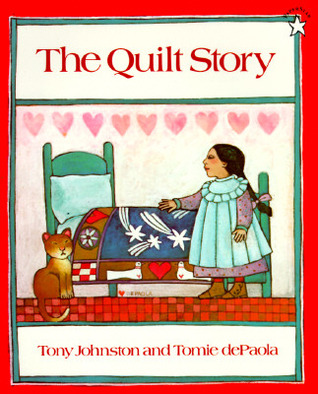
Over the years I have enjoyed sharing legends as presented by Tomie dePaola with my Kindergarten and First Grade classes. Today I reread The Quilt Story written by children’s author Tony Johnston. Tomie dePaola illustrated this book as beautifully and as appropriately as he does his own texts.
The Quilt Story begins in the days of covered wagons as Abigail’s mother makes her a quilt that Abigail uses and enjoys in many ways. It becomes a special comfort to Abigail when her family leaves their old life behind to begin a new one in the woods where her father builds a log cabin. Many years later a descendent of Abigail discovers the quilt, having suffered varmint attacks and natural aging, in the attic. She takes it to her mother and asks her to fix it.
The story is sweet and touching. Ms. Johnston and Mr. dePaola share so much contextually. Abigail’s sadness is apparent and understandable when the rest of the family is happy. The passage of time is indicated by the types of transportation, the clothing, and the homes, but both mothers are kind and comforting. The Quilt Story is reassuring to children in our minimalist and disposable age indicating that some objects do hold emotional memories of times and people of the past.
Rating: 5/5
Category: Children’s Literature, Historical Fiction
Publication: 1985—Putnam Publishing Group
October 1990—Scholastic
Memorable Lines:
So her mother rocked her
as mothers do.
Then tucked her in.
And Abigail felt at home again
under the quilt.
The Cowboy and the Black-Eyed Pea
by Tony Johnston
illustrated by Warren Ludwig
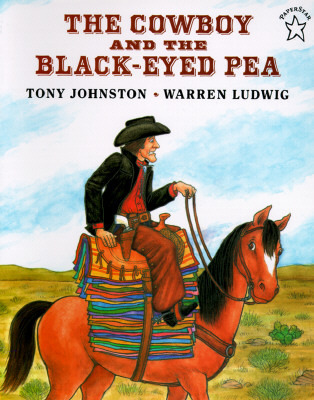
What a delightful reimagining of “The Princess and the Pea!” Set on the “biggest spread in the great state of Texas,” there is humor all the way through. The main character, who is also the heroine of this tale, is Farethee Well, “a young woman of bodacious beauty.” She is also clever and devises a plan to execute her father’s final wishes to “Find a real cowboy who’ll love you for yourself, not just for your longhorn herd.”
Her plan involves hiding a black-eyed pea under a saddle blanket because only a real cowboy would be “sorely troubled” by it. Watching the various suitors as they ride out to unknowingly perform the test is very funny—both in text and in the illustrations. Harkening back to the original fairy tale, a young cowboy arrives in the rain without knowing about the contest for the young cowgirl’s hand. One stampede and a pile of saddle blankets later, the real cowboy is discovered.
Rating: 5/5
Category: Children’s Fiction, Humor
Notes: 1.Don’t look for realism in the cowgirl’s test. If she put a black-eyed pea under the saddle blanket, it would be the horse that felt it, not the cowboy. Just remember it is a remake of a fairy tale and have yourself a Texas-sized good time!
2. Contains humor on both an adult and children’s level so all readers will enjoy this!
Publication: 1992—Putnam & Grosset
Memorable Lines:
Sure enough, quick as you can say “set another place at table,” cowboys from hither and yon came seeking Farethee Well’s hand.
The Secret Garden–delightful classic
The Secret Garden
by Frances Hodgson Burnett
Illustrated by Tasha Tudor
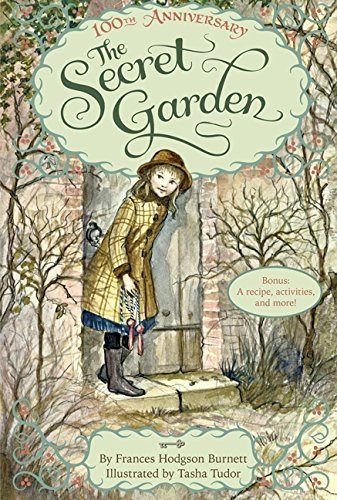
An avid reader as a child, I am surprised that I somehow missed out on the classic children’s tale The Secret Garden written by Frances Hodgson Burnett. For this reading with my book club, I chose an edition with delightful illustrations added to this 1911 book by Tasha Tudor in 1962. The Secret Garden is recommended by the publisher for ages nine and up, but I strongly recommend it for all readers. Please don’t relegate it to the “kiddie lit” genre.
The Secret Garden is the kind of book that instructs the reader in positivity without being preachy. Ten year old Mistress Mary (as in “quite contrary”) is a child who is both spoiled and neglected in her upbringing in India where she does not experience love. Things are not much better for her when her parents die, and she is shipped to Yorkshire to be under the care of her uncle. There she is still not loved as her uncle, Mr. Craven, has not dealt well with the death of his wife ten years prior and the illness of his son Colin who is physically cared for but also is not loved.
When Mary discovers that the mysterious crier in the night is Colin, she gradually creates a bond with her cousin. She is a curious girl who is given little freedom in the house, but almost total freedom in the gardens. She discovers the benefits of fresh air, sunshine, and natural exercise, and she explores the grounds looking for a secret garden that has been hidden away since Colin’s mother died.
Mary and Colin meet so many interesting people during the spring and summer. Dickon is a twelve year old who can converse with animals and plants. His older sister Martha is a sweet young lady who works at Misselthwaite Manor as a housemaid and helps take care of Mary. She has one day a month off, and she travels home by foot to help her kindly mother with laundry and baking. She gladly gives her mother her earnings to help support her large family of twelve happy siblings. Ben Weatherstaff is an elderly gardener who knew Colin’s mother and is eager to help restore the secret garden. While this tale is not full of goody two-shoes, it does have characters the reader will enjoy getting to know and in the cases of Mary and Colin watching their physical and emotional growth.
The Secret Garden is a pleasant read that begins with difficulties for the characters but progresses to a magical time in their lives. The author’s descriptions are wonderful to read as spring approaches in the garden. It is a book I would reread for the pleasure of the story and the language of the author.
Rating: 5/5
Category: Children, Fiction, Classics
Publication: 1911—Harper Collins
Memorable Lines:
The rainstorm had ended and the gray mist and clouds had been swept away in the night by the wind. The wind itself had ceased and a brilliant, deep blue sky arched high over the moorland. Never, never had Mary dreamed of a sky so blue. In India skies were hot and blazing; this was of a deep cool blue which almost seemed to sparkle like the waters of some lovely bottomless lake, and here and there, high, high in the arched blueness floated small clouds of snow-white fleece. The far-reaching world of the moor itself looked softly blue instead of gloomy purple-black or awful dreary gray.
“Half-witted!” said Colin angrily. “Who thought that?” “Lots o’ fools,” said Ben. “Th’ world’s full o’ jackasses brayin’ an’ they never bray nowt but lies.”
He had made himself believe that he was going to get well, which was really more than half the battle, if he had been aware of it.
The Girl Scouts at Rocky Ledge–a gem from 1922
The Girl Scouts at Rocky Ledge
by Lilian Garis
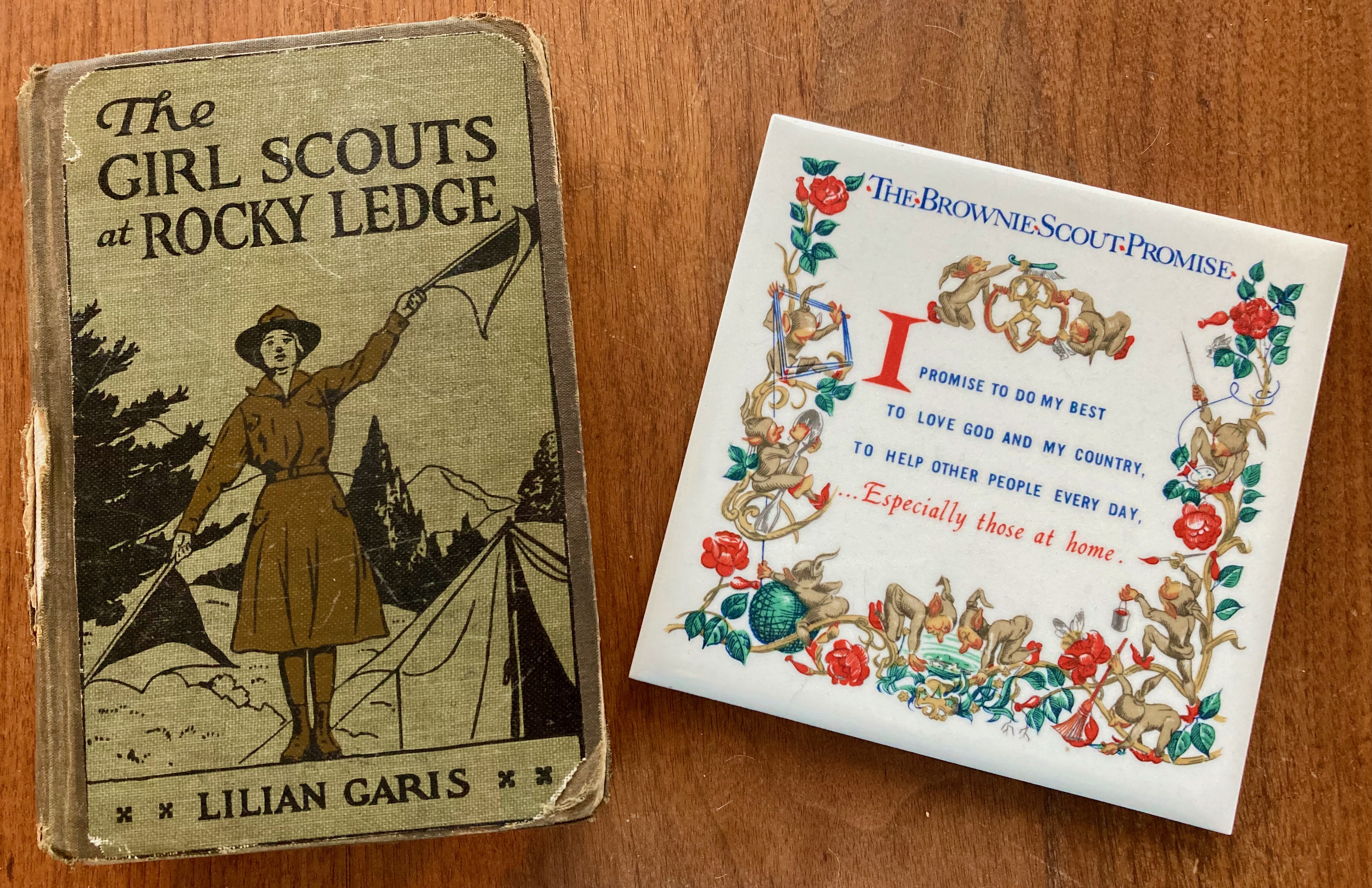
My sister-in-law, in downsizing, came across this book with my name written in the front. I was delighted when she offered to mail it to me. I remember buying it in sixth grade when the teachers opened up the book room and held a sale. From the markings, it appears that the local library had donated books to the school. This book with a copyright date of 1922 seems to have been formally checked out many times, but then informally checked out at the school in the 1948-1952 time period. I was born in 1952, so this book was sitting on a shelf, unread, for about 12 years before it landed in my hands and then literally a lifetime before it made it back to me.
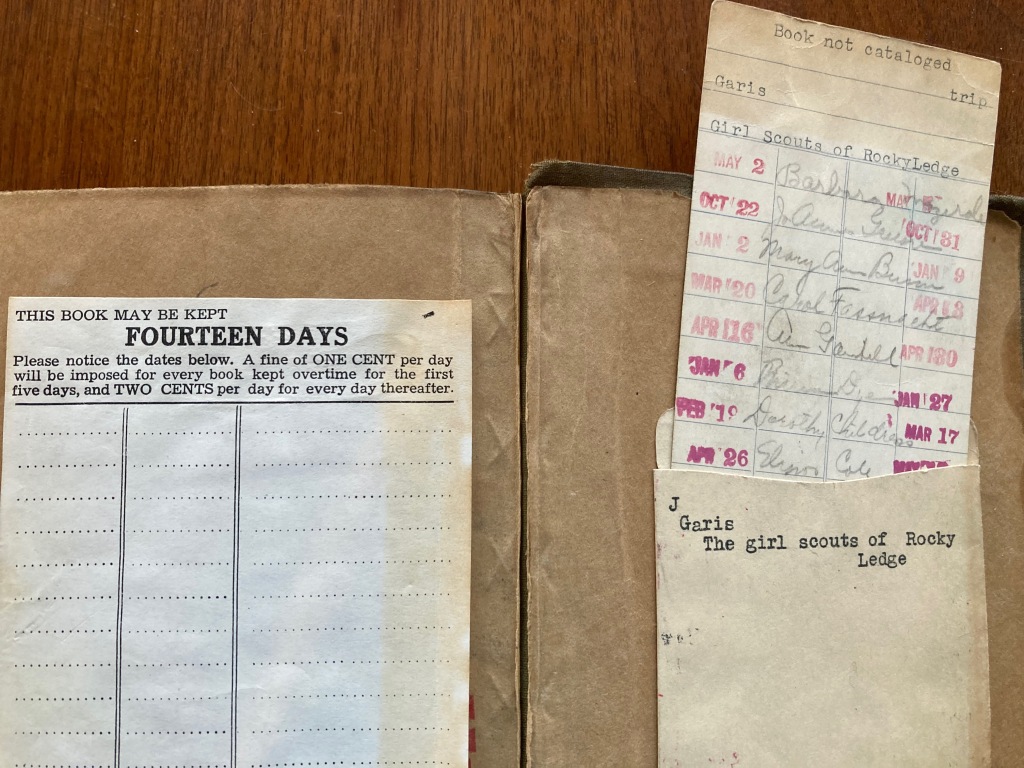
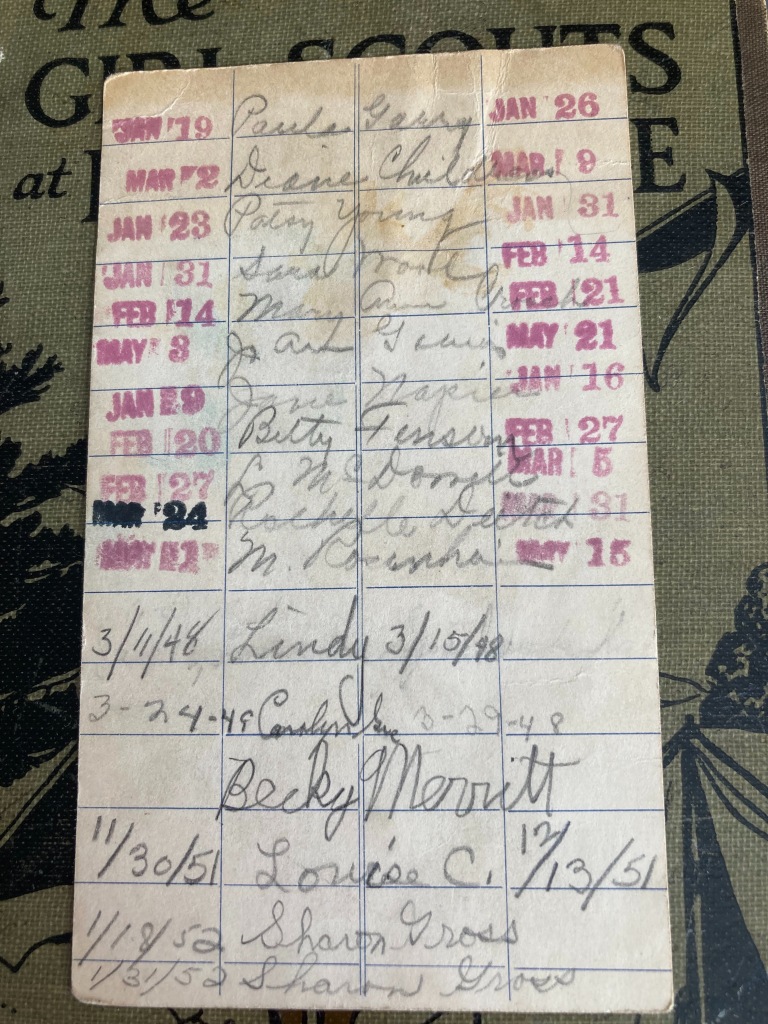
The Girl Scouts at Rocky Ledge is a delightful read. It is the tale of pretty little Nora, pampered with the best and most delicate of clothes. She has a vivid imagination that confounds most adults. She is sent for a month’s vacation with Jerry and Ted (Theodora). Jerry is a surveyor and Ted specializes in wildlife. They spend their days exploring the terrain around the house where they live. There are a group of Girl Scouts camping in their area, with khaki uniforms, rules, and lots of freedom. The Chickadee Patrol adopts Nora, and she discovers that there are many benefits to their way of passing the summer.
I would love to spend time with Jerry and Ted who are fun loving and accepting. The Girl Scouts are quite individualistic and indulge in friendly teasing. A mystery arises when Nora in her wanderings discovers Lucia, a frightened little girl and resolves to help her, leaving food for her until one day she disappears. Another mystery revolves around Vita, the Italian cook in the household. She engages in odd conversations with Nora about the attic as if she is trying to scare Nora.
I enjoyed the older but not stilted style of writing. The characters and narrator have a broader vocabulary than we are used to in children’s books, but it is quite understandable even to the modern ear. The first chapter is confusing because Nora wants to rename her hosts. They take it in good stride and then the story is in full swing. Cap (Captain) is a canine character who can be relied on to judge people well and to take care of Nora as she explores the woods.
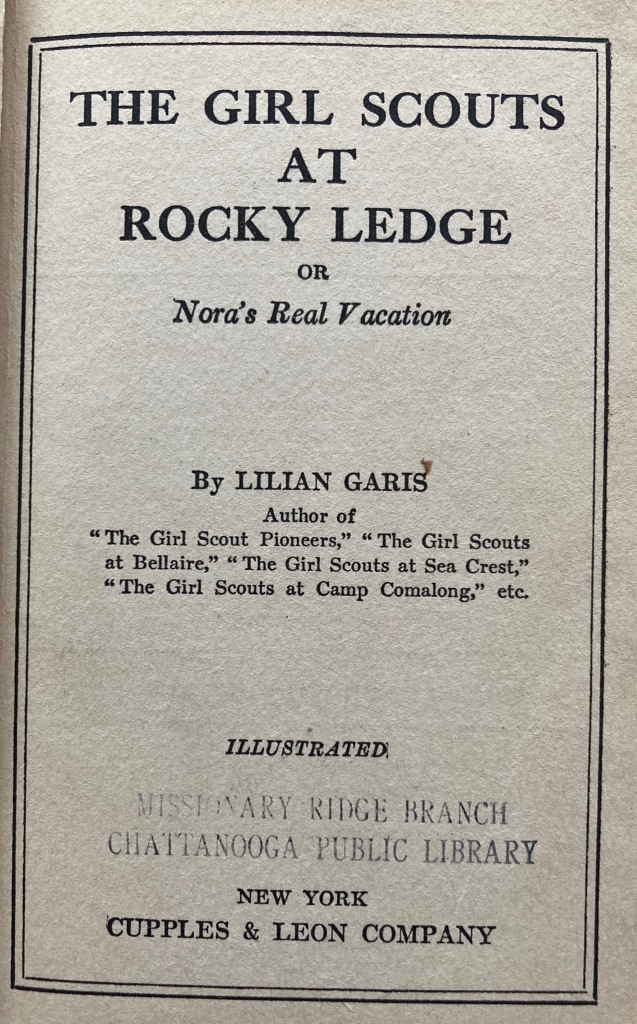
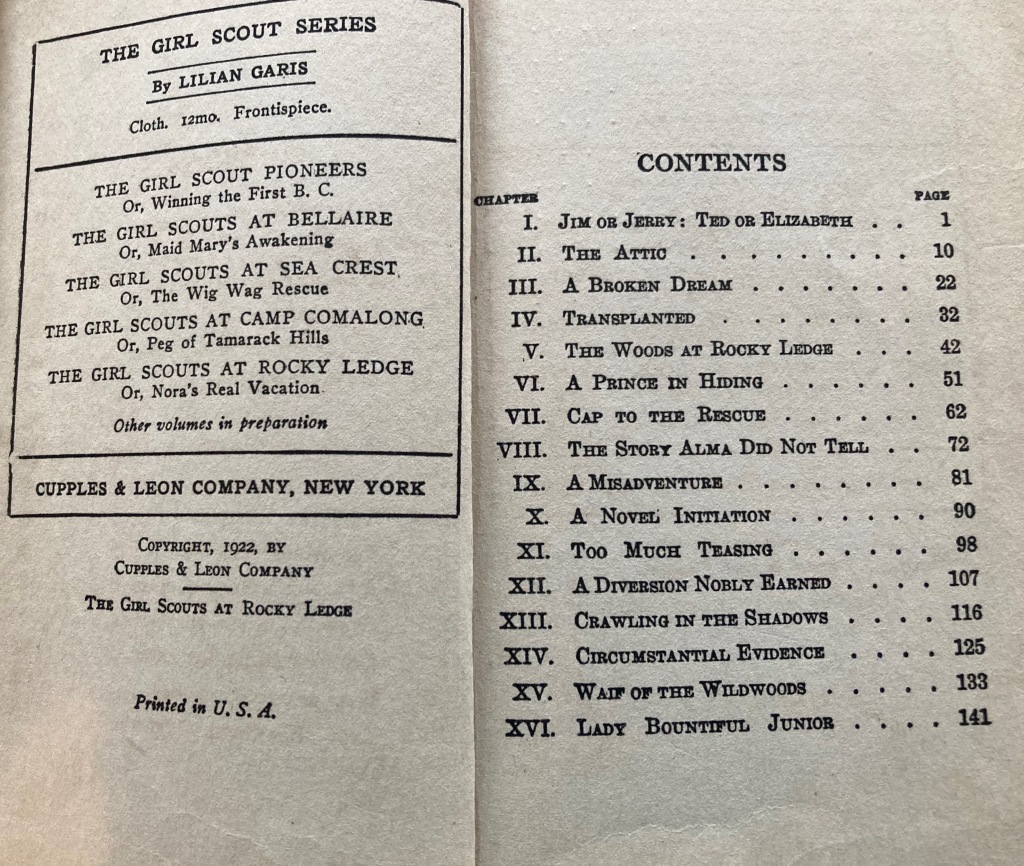
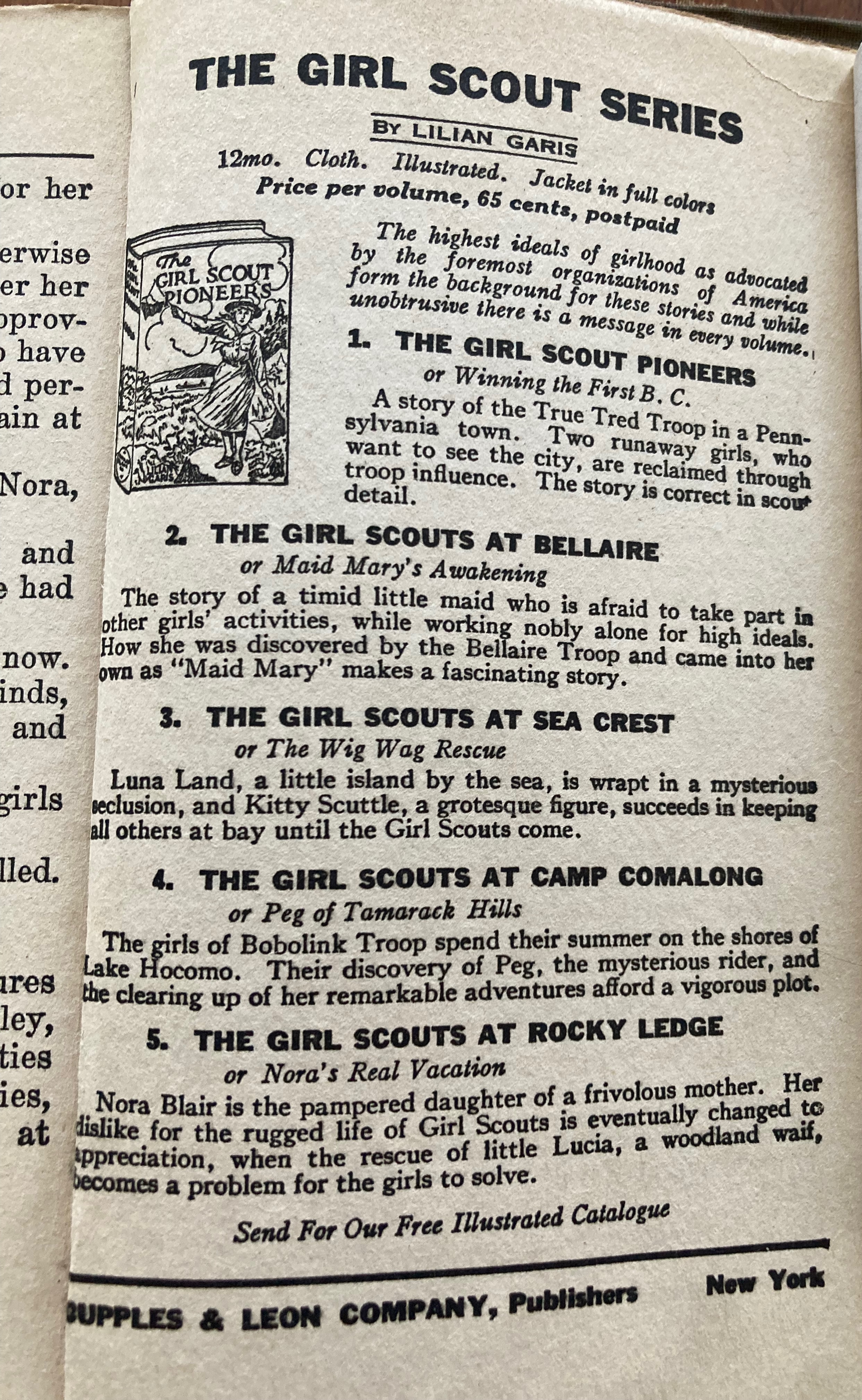
Lilian Garis (20 October 1873 – 19 April 1954) was a prolific American writer of juvenile fiction. She authored hundreds of books from 1915 to the early 1940’s. She was a newspaper reporter when she met her future husband Howard Garis, also a reporter. He was as prolific as his wife as he wrote the Uncle Wiggily Longears series. These stories first appeared daily in the newspaper, every day except Sunday, for almost 40 years—11,000 stories which were nationally syndicated and compiled into books. Both authors’ books have been reprinted over the years giving testament to their appeal and quality of writing.
Rating: 5/5
Category: Children’s Fiction
Notes: Part of the Girl Scout Series, but is a standalone. The intended audience is probably ages 8-12, but it would be fun for girls of all ages
Publication: 1922—Cupples and Leon Company
Memorable Lines:
If one could look pretty after a ducking in a strange lake, Nora did. Her curls liked nothing better, and her cheeks pinked up prettily, while her eyes—they were as blue as the violets that listened in the underbrush.
The day brings wisdom, and when Nora again dressed in the borrowed khaki suit (she had suddenly taken a dislike to her own fancy dresses), the glorious sunshine of the bright summer morning mocked the terrors of the night.
Nora was disconsolate. For two days the dainties left for Lucia had remained untouched. The bread box which Vita had given her to play with, and into which the food was deposited for Lucia, stood upon the tree stump with the sliced lamb, the piece of cake, and the big orange which comprised the last installment offered by the sympathetic Nora, just as she had left it.
Little House in the Big Woods–worth a reread
Little House in the Big Woods
by Laura Ingalls Wilder
illustrated by Garth Williams
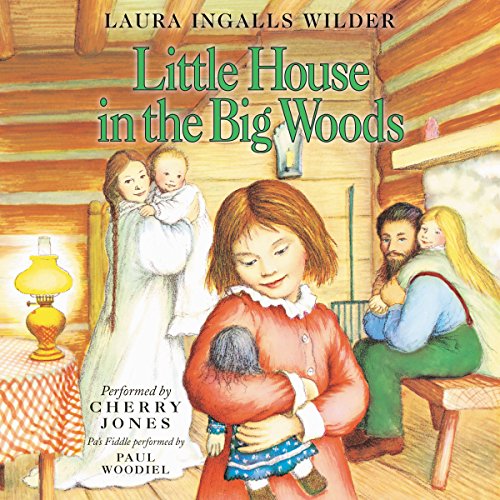
Would you like to start off 2024 with an easy book that is a quick read? Do you ever wish you could go back to a simpler time? Reading or rereading Little House in the Big Woods might be the perfect beginning for your new year. I think you’ll quickly discover, however, that although the simple times could be joyous, they were not always easy. Most things were accomplished by hand with handmade tools.
Going into town was a rare adventure to purchase the few things that could not be made but were necessary to accomplish other tasks. Gunpowder was needed for hunting to feed the family. Cloth was essential to make clothes for the family—with stitching by hand.
Items were produced by the family that we would never in 2024 consider making ourselves. After the grain harvest, straw was braided and used to make hats for everyone in the family. Every part of an animal was used for food or something utilitarian. The skills to do these things were passed down or learned for the sake of survival. There was fun and artistry to their lives as well. For example, making butter was a lengthy process with the finished product completed in a butter mold which the father (Pa) had carved with flourishes.
Laura Ingalls Wilder shares the partially fictional story of her pioneer family in their log cabin in Pepin, Wisconsin in the early 1870’s. The setting is so well described that the reader can imagine what it was really like for the main character in the story, Laura, to live during that time period. There was a lot of hard work for Ma and Pa, and they were quite isolated from any neighbors. When friends and family got together to share work, they also made a fun occasion out of the event. Although there was no church near them, the family had a ritual of Saturday night baths. They would dress in their best clothes reserved just for Sundays. Ma and Pa would read from the Bible, and they would eat cold foods. The girls had to sit quietly for most of the day. The author shares the experiences she had that were dependent on the changes of the seasons. Their lives were driven by the seasons, spending summer and fall preparing food for the winter.
Wilder gives detailed descriptions of nature and the land where they lived. She was a gifted writer and her way with words makes the reader want to keep forward motion with the story just to revel in the words. She sprinkles in stories that Pa told to Laura and her sister Mary. He was a good storyteller, singer and fiddle player. Pa and Ma were consistent and loving parents with high expectations for moral values and work ethics.
Rating: 5/5
Category: Children, Fiction. This series is generally listed as intended for children, but many adults enjoy them as well. Actually, as a culture we are so far removed from the technology and methods of work of the 1800’s that there would need to be a lot of discussion for children to understand the story.
Notes: #1 in the Little House series which has 9 books and many spin-off stories.
Publication: 1932—Harper Collins
1953—beautiful illustrations by Garth Williams
were added
Memorable Lines:
The attic was a lovely place to play. The large, round, colored pumpkins made beautiful chairs and tables. The red peppers and the onions dangled overhead. The hams and the venison hung in their paper wrappings, and all the bunches of dried herbs, the spicy herbs for cooking and the bitter herbs for medicine, gave the place a dusty-spicy smell.
They were cosy and comfortable in their little house made of logs, with the snow drifted around it and the wind crying because it could not get in by the fire.
All day the icicles fell one by one from the eaves with soft smashing and crackling sounds in the snowbanks beneath. The trees shook their wet, black branches, and chunks of snow fell down.
My Elephant Is Blue–sadness
My Elephant Is Blue
written by Melinda Szymanik
illustrated by Vasanti Unka
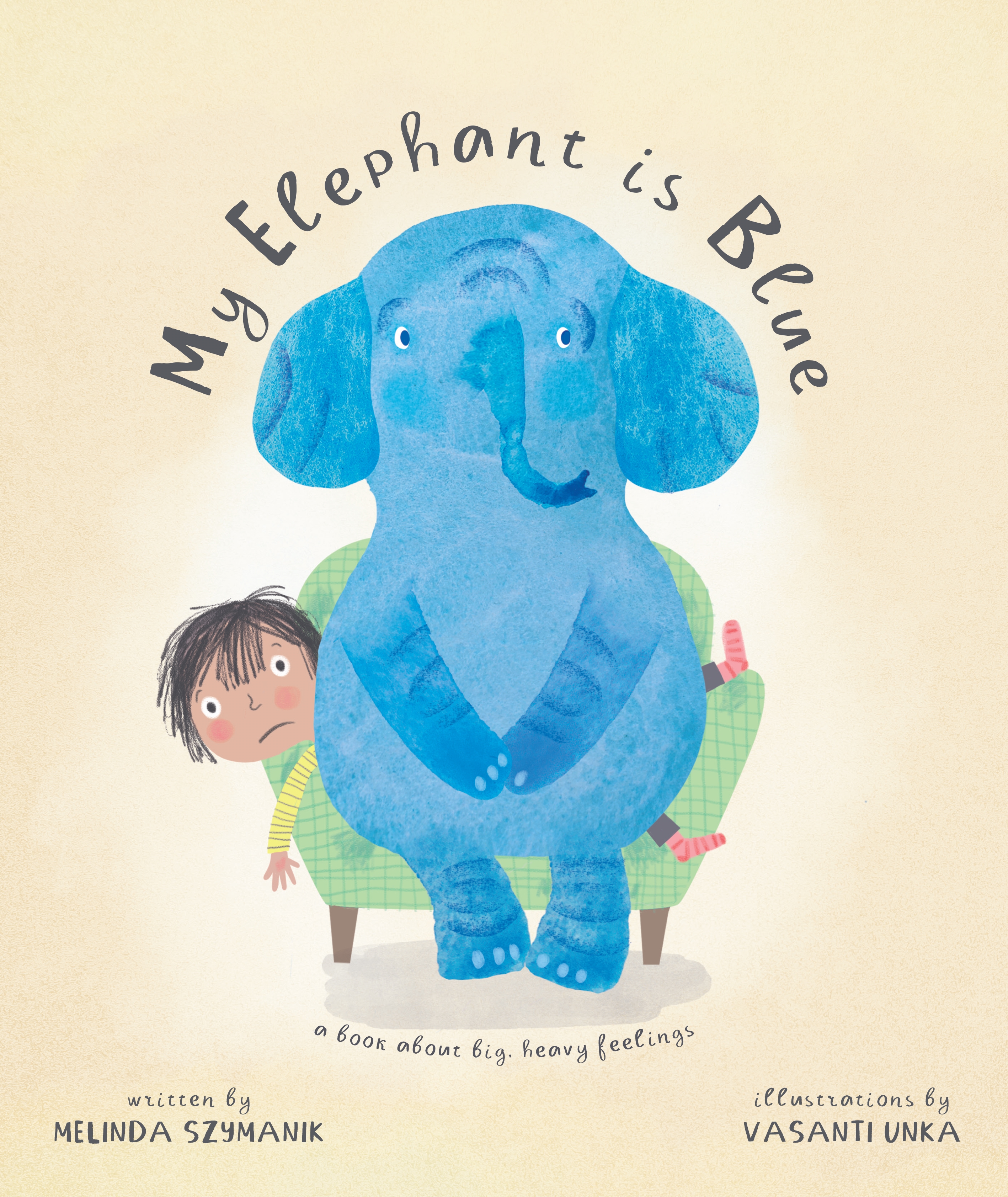
Children sometimes have trouble verbalizing their feelings and managing them. My Elephant Is Blue was written to help children deal with sadness. “Big, heavy feelings” are represented by the crushing weight of the elephant Blue. The child’s family members try to help in various ways, and gradually the child does feel the weight of sadness lifting. This is Mental Health Awareness month, and My Elephant Is Blue is one of many picture books published by Flyaway Books to help young children and their families deal with emotions.
I received a complimentary copy of this book in exchange for an honest review. Opinions expressed in this review are completely my own.
Rating: 4/5
Category: Children’s Fiction, Health
Notes: 1. Ages 3-7
2. Supporting resources linked to this book are found at http://www.flyawaybooks.com/resources. There is a Discussion and Activity Guide that helps the reader understand the symbolism in the book. This guide includes Discussion Starters, Activities, a list with links of organizations that offer support, and a coloring sheet. There is also a book trailer if you would like a preview of the book.
Publication: April 11, 2023—Flyaway Books
Memorable Lines:
They said, “Perhaps if you cheered up a bit…or smiled at it.” But it’s hard to cheer up or smile with an elephant sitting on your chest.
“It’s an elephant,” Mom and Dad said. “Surely it can’t stay forever. It’s bound to move on sometime.” I hoped sometime was soon.
The Little Books of the Little Brontës–creativity in childhood
The Little Books of the Little Brontës
by Sara O’Leary
illustrated by Briony May Smith

This little book of historical fiction introduces children to the famous Brontë family. The girls, Charlotte, Emily, and Anne, and their brother Branwell are raised by their father who is a vicar, their aunt, and a housekeeper. They grow up in relative poverty, but have a fun life with much time to exercise their creativity as they are homeschooled and spend a lot of time exploring the moors. Almost anywhere they go would be by foot.
The Little Books of the Little Brontës tells how they loved to read and as children they made tiny books for each other and for their toy soldiers. As they grew older, their reading passion was turned to writing. The sisters died young, but their books are still eagerly read today.
I enjoyed this fictional view of the Brontës’ childhood. It is easy for children to follow. I particularly liked the illustrations; they are delicate, detailed, and whimsical. After explaining that the sisters had short lives, the author takes the reader back to their happy early years which is a sweet ending and very appropriate to a children’s book.
I received a complimentary copy of this book in exchange for an honest review. Opinions expressed in this review are completely my own.
Rating: 5/5
Category: Children’s Fiction, Historical Fiction
Notes: 1. Includes directions on how to make a little book.
2. There are Author’s Notes containing information about the family for adults.
3. The book ends with an extensive Bibliography.
4. Ages 5-9, Grades K-4
5. Print length: 40 pages.
Publication: October 17, 2023—Tundra (Penguin, Random House Canada)
Memorable Lines: (which is also the first sentence)
Many years before you were born,
sometime in the long ago,
a child named Charlotte Brontë
made a little book for her little sister Anne.
Saint Patrick the Forgiver–The History and Legends of Ireland’s Bishop
Saint Patrick the Forgiver
retold and illustrated by Ned Bustard
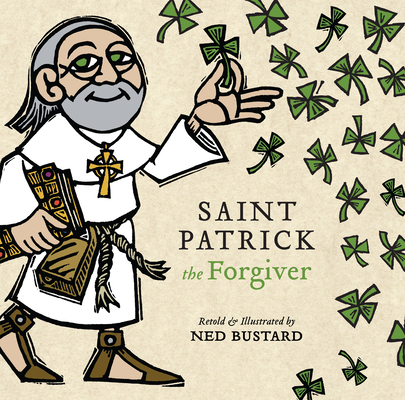
Is Saint Patrick’s Day just a great time of celebrating Irish heritage with parades, green beer, and shamrocks? Ned Bustard shares the real story of St. Patrick along with some of the tall tales that have surrounded his legacy. In his book Saint Patrick the Forgiver, Ned Bustard retells the ancient story in poem format that is suitable for young and old.
Patrick was born in 385 in England. He was kidnapped and sold as a slave in Ireland where he worked as a shepherd. He had an encounter with God and became a follower of Christ. Later God spoke to him in a vision, provided a boat, and led him safely on the long journey back to his family.
After this escape he had another vision that he was to return to the land and people who had enslaved him. He was able to forgive them because God had forgiven him.
This book is a treasure of spiritual truths, beautiful poetry, and fitting illustrations. Saint Patrick the Forgiver would be a wonderful addition to your St. Patrick’s Day celebration. It shares history and legend differentiating between the two. Most importantly it teaches the lesson of forgiveness.
I received a complimentary copy of this book in exchange for an honest review. Opinions expressed in this review are completely my own.
Rating: 5/5
Category: Children’s Fiction, Christian, Religion and Spirituality
Notes: 1. The author’s note at the end summarizes the book in prose and has two discussion questions, a verse from Ephesians on forgiveness, and two resources for further reading.
2. Intended Ages—4-8, but it would make great family reading for all ages.
3. Currently Amazon has a special pre-order price for this hardback that is almost 50% off. (I have no financial connection with Amazon; I just noticed the price when I looked for the age range.)
Publication: 2/21/2023—InterVarsity Press (IVP Kids)
Memorable Lines:
Hello, my name is Patrick—
you may have heard my story.
I walked the span of Ireland
to tell of God’s great glory.
To the Irish I returned
to preach of love and grace.
I spoke first to the High King’s son
—our Lord he did embrace.
I saw the Spirit moving
all across the Emerald Isle.
It wasn’t luck—it was God’s grace,
and that always makes me smile!
How to Train Your Dad–the art of dumpster diving
How to Train Your Dad
by Gary Paulsen

Carl is the twelve year old narrator of this middle grade book which has a very conversational style. The vocabulary is somewhat advanced for a twelve year old, but that is because Pooder, Carl’s best friend who helps him write the story, goes through phases of interest (British, Navy seal, etc.). His various fascinations show up in his speech. Pooder admires Carl’s dad who, besides a few odd jobs, lives by bartering. Carl’s dad is very intelligent, mechanically inclined, and very kind. He trades energy (labor) for goods. He considers himself rich as he recycles from dumpsters or his neighbor Oscar’s junk piles. He built a whole truck from discarded spare parts. He prizes function over form; so if an invention works, it doesn’t matter how it looks.
His dad’s philosophy has been fine with Carl until he reaches middle grades and suddenly becomes aware of Peg as “the” girl. His summer goal is to become “lookatable” by the time school starts which is hard to do when your dad barters for XL camo T-shirts and pink bib overalls decorated with words like “juicy.”
The book explores Carl’s efforts to train his father using the methods in a puppy training pamphlet. His efforts are hilarious as are the contraptions his father builds and the objects he brings home. A lot of the dumpster diving food goes to the pigs and chickens. Carl and his dad have a rescue pit bull Carol who is an integral part of their family and, despite her stinky habit of shredding skunks, is allowed to accompany them everywhere.
How to Train Your Dad is a fun story that tweenagers will enjoy. Its casual style and over the top anecdotes are sure to appeal.
I received a complimentary copy of this book in exchange for an honest review. Opinions expressed in this review are completely my own.
Rating: 4/5
Category: Children’s Fiction, Middle Grades
Notes: Contains a very small amount of cussing
Intended ages: 10-14
Publication: October 5, 2021—Macmillan Children’s Publishing Group
Memorable Lines:
She’s in my grade at school and everyone likes her and I have never ever ever seen her be catty or crabby or phony to anyone ever which is something like a miracle in middle school, if you ask me.
Sometimes Pooder jumping from phase to phase without warning can be a little confusing. He might start things off an English lord before suddenly becoming an advertising mogul looking to make some coin and then turn into a Viking biting deep on a tomato-apple so the juice runs down into his beard-if-he-had-one while he’s thinking of pillaging a coast somewhere.
My father loved to barter. To trade, as he thought of it, energies, abilities, knowledge. Trade everything he could so as not to use money. “I have a widget,” he explained to me when I was very small, “and John Doe has an extra electric frying pan he doesn’t need, but he needs a widget and so we trade. We barter. Simple and clean. It’s the very best and purest way to do business.”

