Home » Children (Page 2)
Category Archives: Children
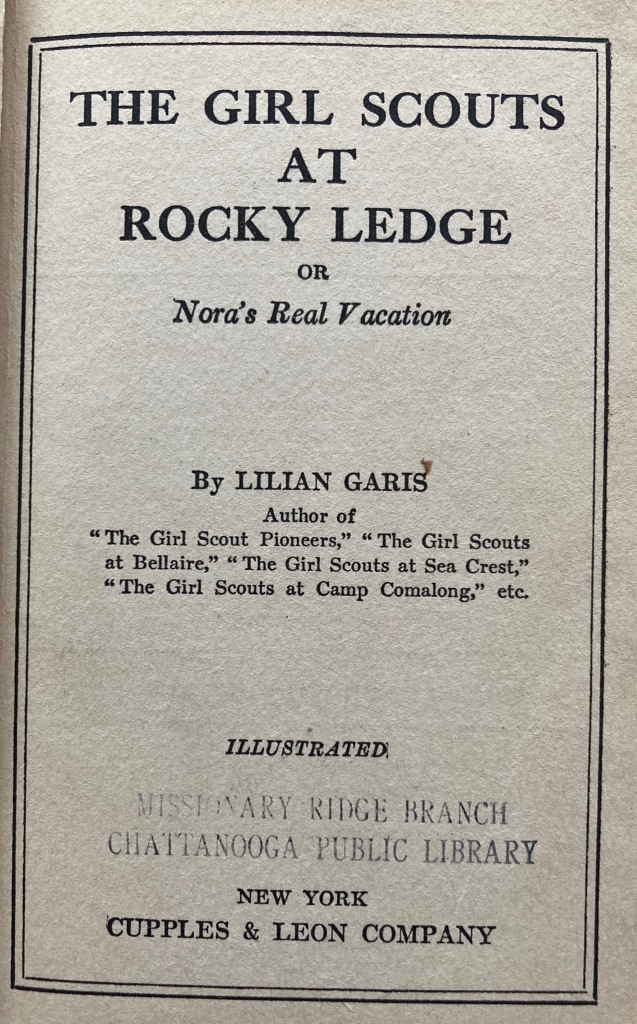
The Girl Scouts at Rocky Ledge–a gem from 1922
The Girl Scouts at Rocky Ledge
by Lilian Garis
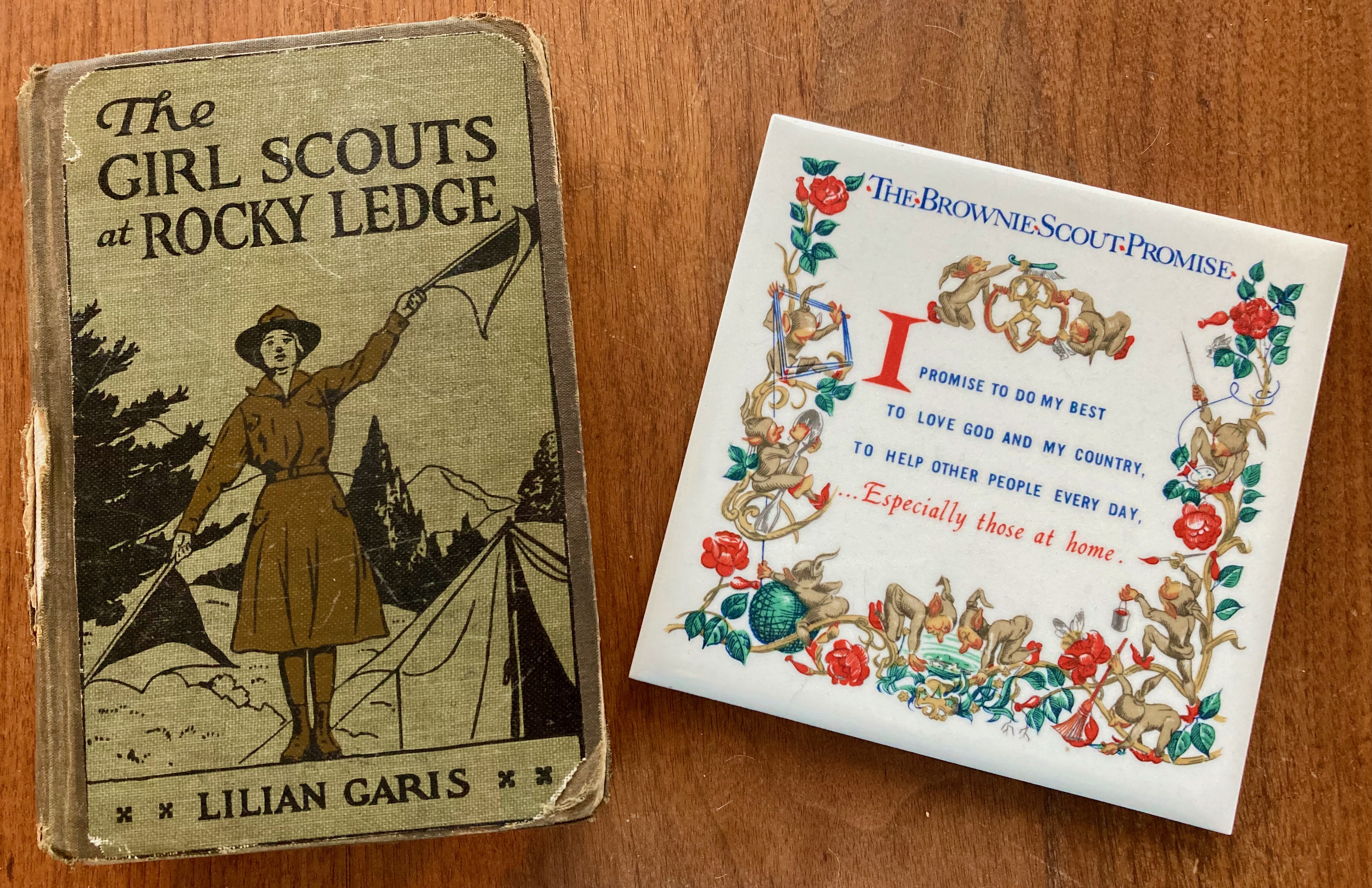
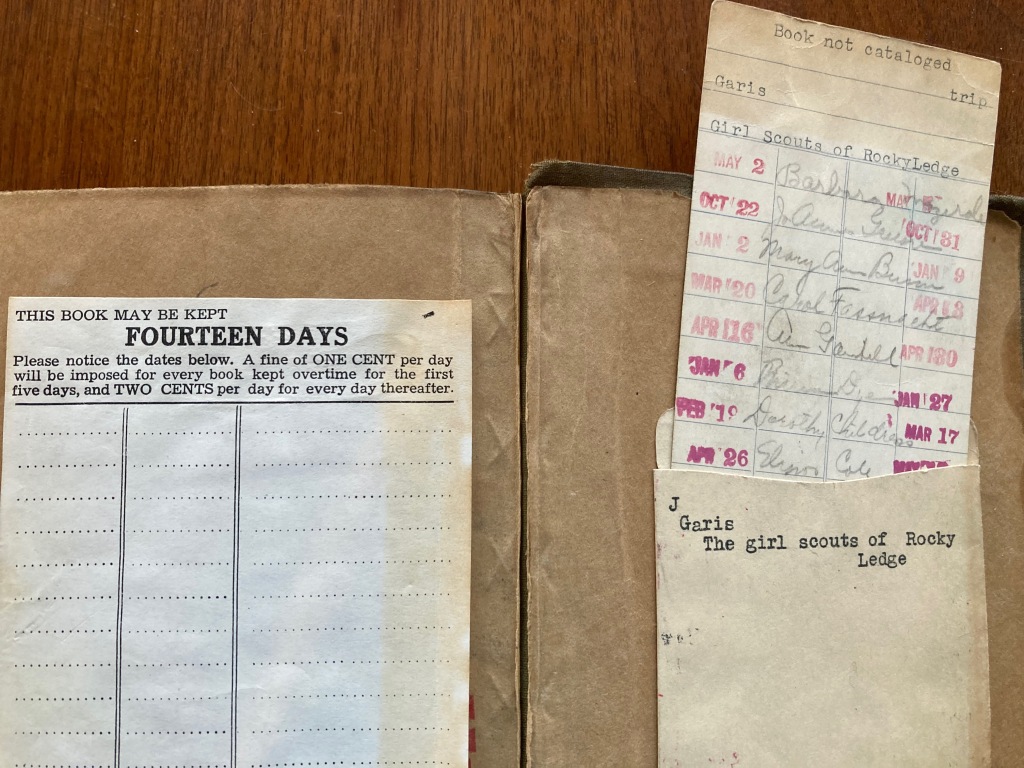
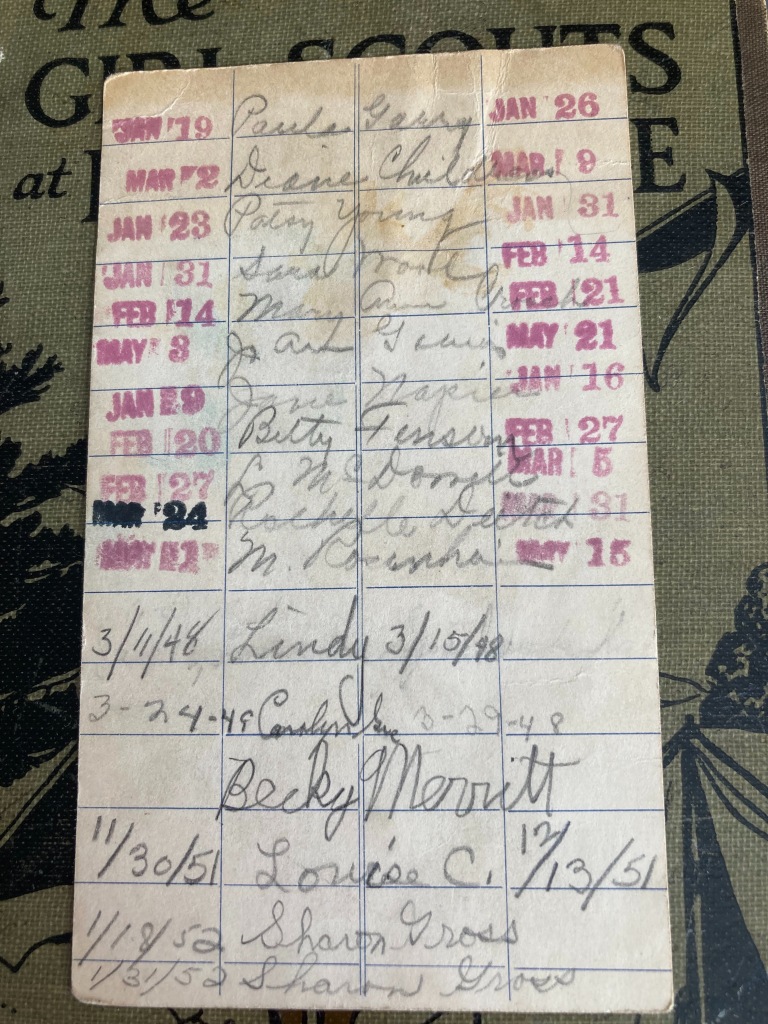
My sister-in-law, in downsizing, came across this book with my name written in the front. I was delighted when she offered to mail it to me. I remember buying it in sixth grade when the teachers opened up the book room and held a sale. From the markings, it appears that the local library had donated books to the school. This book with a copyright date of 1922 seems to have been formally checked out many times, but then informally checked out at the school in the 1948-1952 time period. I was born in 1952, so this book was sitting on a shelf, unread, for about 12 years before it landed in my hands and then literally a lifetime before it made it back to me.
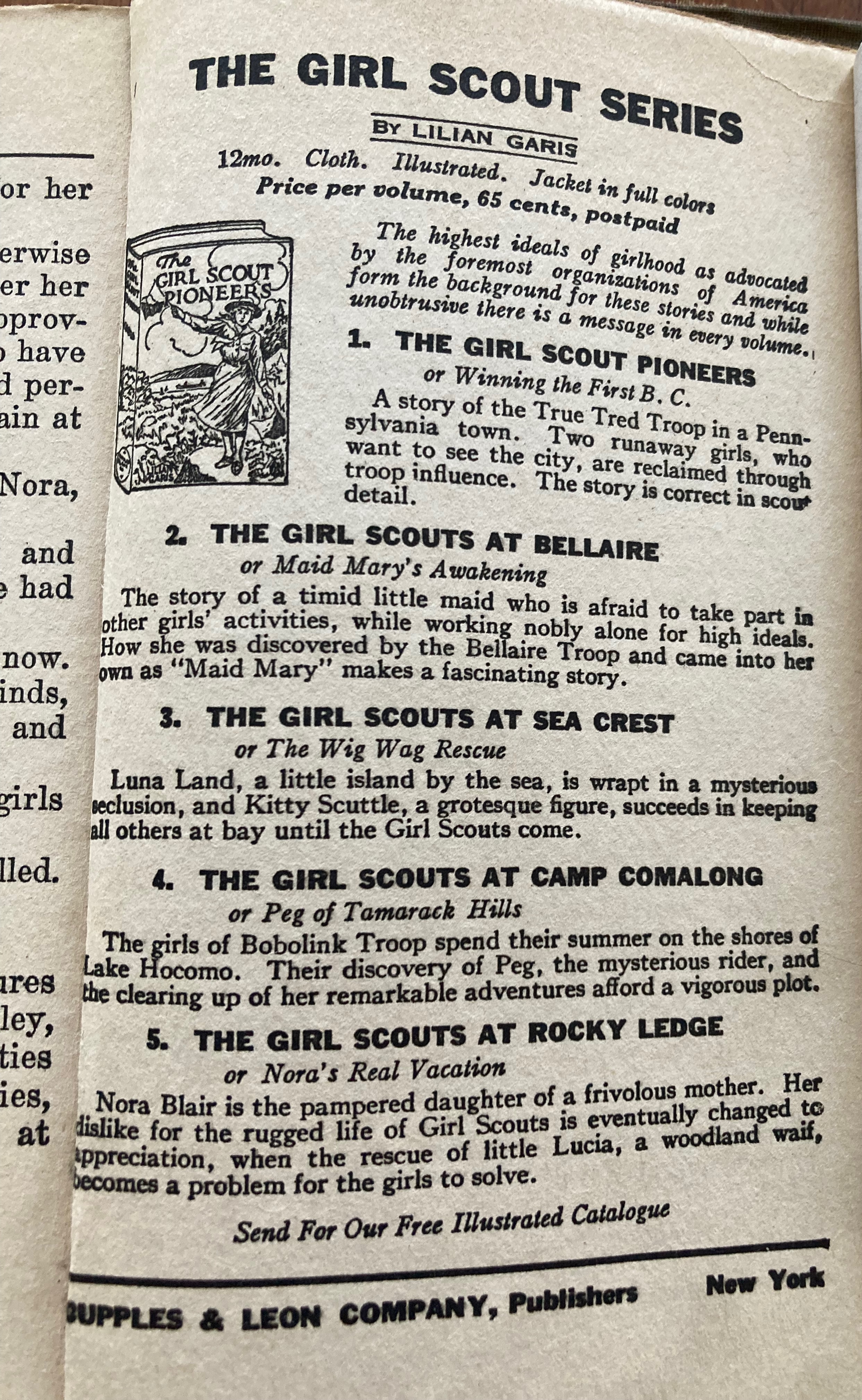
The Girl Scouts at Rocky Ledge is a delightful read. It is the tale of pretty little Nora, pampered with the best and most delicate of clothes. She has a vivid imagination that confounds most adults. She is sent for a month’s vacation with Jerry and Ted (Theodora). Jerry is a surveyor and Ted specializes in wildlife. They spend their days exploring the terrain around the house where they live. There are a group of Girl Scouts camping in their area, with khaki uniforms, rules, and lots of freedom. The Chickadee Patrol adopts Nora, and she discovers that there are many benefits to their way of passing the summer.
I would love to spend time with Jerry and Ted who are fun loving and accepting. The Girl Scouts are quite individualistic and indulge in friendly teasing. A mystery arises when Nora in her wanderings discovers Lucia, a frightened little girl and resolves to help her, leaving food for her until one day she disappears. Another mystery revolves around Vita, the Italian cook in the household. She engages in odd conversations with Nora about the attic as if she is trying to scare Nora.
I enjoyed the older but not stilted style of writing. The characters and narrator have a broader vocabulary than we are used to in children’s books, but it is quite understandable even to the modern ear. The first chapter is confusing because Nora wants to rename her hosts. They take it in good stride and then the story is in full swing. Cap (Captain) is a canine character who can be relied on to judge people well and to take care of Nora as she explores the woods.
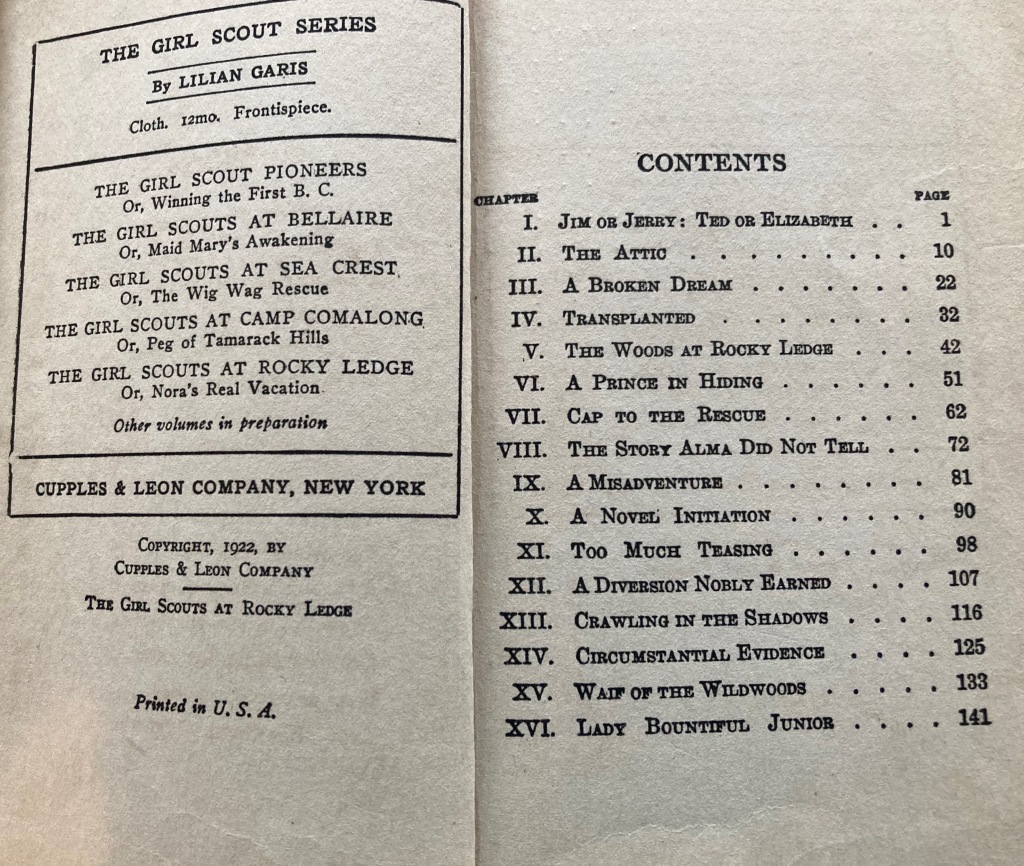
Lilian Garis (20 October 1873 – 19 April 1954) was a prolific American writer of juvenile fiction. She authored hundreds of books from 1915 to the early 1940’s. She was a newspaper reporter when she met her future husband Howard Garis, also a reporter. He was as prolific as his wife as he wrote the Uncle Wiggily Longears series. These stories first appeared daily in the newspaper, every day except Sunday, for almost 40 years—11,000 stories which were nationally syndicated and compiled into books. Both authors’ books have been reprinted over the years giving testament to their appeal and quality of writing.
Rating: 5/5
Category: Children’s Fiction
Notes: Part of the Girl Scout Series, but is a standalone. The intended audience is probably ages 8-12, but it would be fun for girls of all ages
Publication: 1922—Cupples and Leon Company
Memorable Lines:
If one could look pretty after a ducking in a strange lake, Nora did. Her curls liked nothing better, and her cheeks pinked up prettily, while her eyes—they were as blue as the violets that listened in the underbrush.
The day brings wisdom, and when Nora again dressed in the borrowed khaki suit (she had suddenly taken a dislike to her own fancy dresses), the glorious sunshine of the bright summer morning mocked the terrors of the night.
Nora was disconsolate. For two days the dainties left for Lucia had remained untouched. The bread box which Vita had given her to play with, and into which the food was deposited for Lucia, stood upon the tree stump with the sliced lamb, the piece of cake, and the big orange which comprised the last installment offered by the sympathetic Nora, just as she had left it.
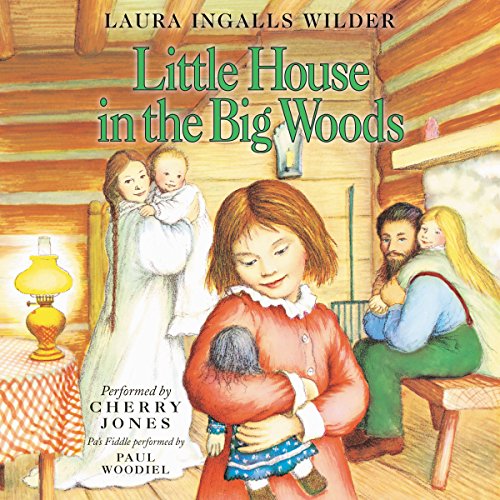
Little House in the Big Woods–worth a reread
Little House in the Big Woods
by Laura Ingalls Wilder
illustrated by Garth Williams
Would you like to start off 2024 with an easy book that is a quick read? Do you ever wish you could go back to a simpler time? Reading or rereading Little House in the Big Woods might be the perfect beginning for your new year. I think you’ll quickly discover, however, that although the simple times could be joyous, they were not always easy. Most things were accomplished by hand with handmade tools.
Going into town was a rare adventure to purchase the few things that could not be made but were necessary to accomplish other tasks. Gunpowder was needed for hunting to feed the family. Cloth was essential to make clothes for the family—with stitching by hand.
Items were produced by the family that we would never in 2024 consider making ourselves. After the grain harvest, straw was braided and used to make hats for everyone in the family. Every part of an animal was used for food or something utilitarian. The skills to do these things were passed down or learned for the sake of survival. There was fun and artistry to their lives as well. For example, making butter was a lengthy process with the finished product completed in a butter mold which the father (Pa) had carved with flourishes.
Laura Ingalls Wilder shares the partially fictional story of her pioneer family in their log cabin in Pepin, Wisconsin in the early 1870’s. The setting is so well described that the reader can imagine what it was really like for the main character in the story, Laura, to live during that time period. There was a lot of hard work for Ma and Pa, and they were quite isolated from any neighbors. When friends and family got together to share work, they also made a fun occasion out of the event. Although there was no church near them, the family had a ritual of Saturday night baths. They would dress in their best clothes reserved just for Sundays. Ma and Pa would read from the Bible, and they would eat cold foods. The girls had to sit quietly for most of the day. The author shares the experiences she had that were dependent on the changes of the seasons. Their lives were driven by the seasons, spending summer and fall preparing food for the winter.
Wilder gives detailed descriptions of nature and the land where they lived. She was a gifted writer and her way with words makes the reader want to keep forward motion with the story just to revel in the words. She sprinkles in stories that Pa told to Laura and her sister Mary. He was a good storyteller, singer and fiddle player. Pa and Ma were consistent and loving parents with high expectations for moral values and work ethics.
Rating: 5/5
Category: Children, Fiction. This series is generally listed as intended for children, but many adults enjoy them as well. Actually, as a culture we are so far removed from the technology and methods of work of the 1800’s that there would need to be a lot of discussion for children to understand the story.
Notes: #1 in the Little House series which has 9 books and many spin-off stories.
Publication: 1932—Harper Collins
1953—beautiful illustrations by Garth Williams
were added
Memorable Lines:
The attic was a lovely place to play. The large, round, colored pumpkins made beautiful chairs and tables. The red peppers and the onions dangled overhead. The hams and the venison hung in their paper wrappings, and all the bunches of dried herbs, the spicy herbs for cooking and the bitter herbs for medicine, gave the place a dusty-spicy smell.
They were cosy and comfortable in their little house made of logs, with the snow drifted around it and the wind crying because it could not get in by the fire.
All day the icicles fell one by one from the eaves with soft smashing and crackling sounds in the snowbanks beneath. The trees shook their wet, black branches, and chunks of snow fell down.
My Elephant Is Blue–sadness
My Elephant Is Blue
written by Melinda Szymanik
illustrated by Vasanti Unka
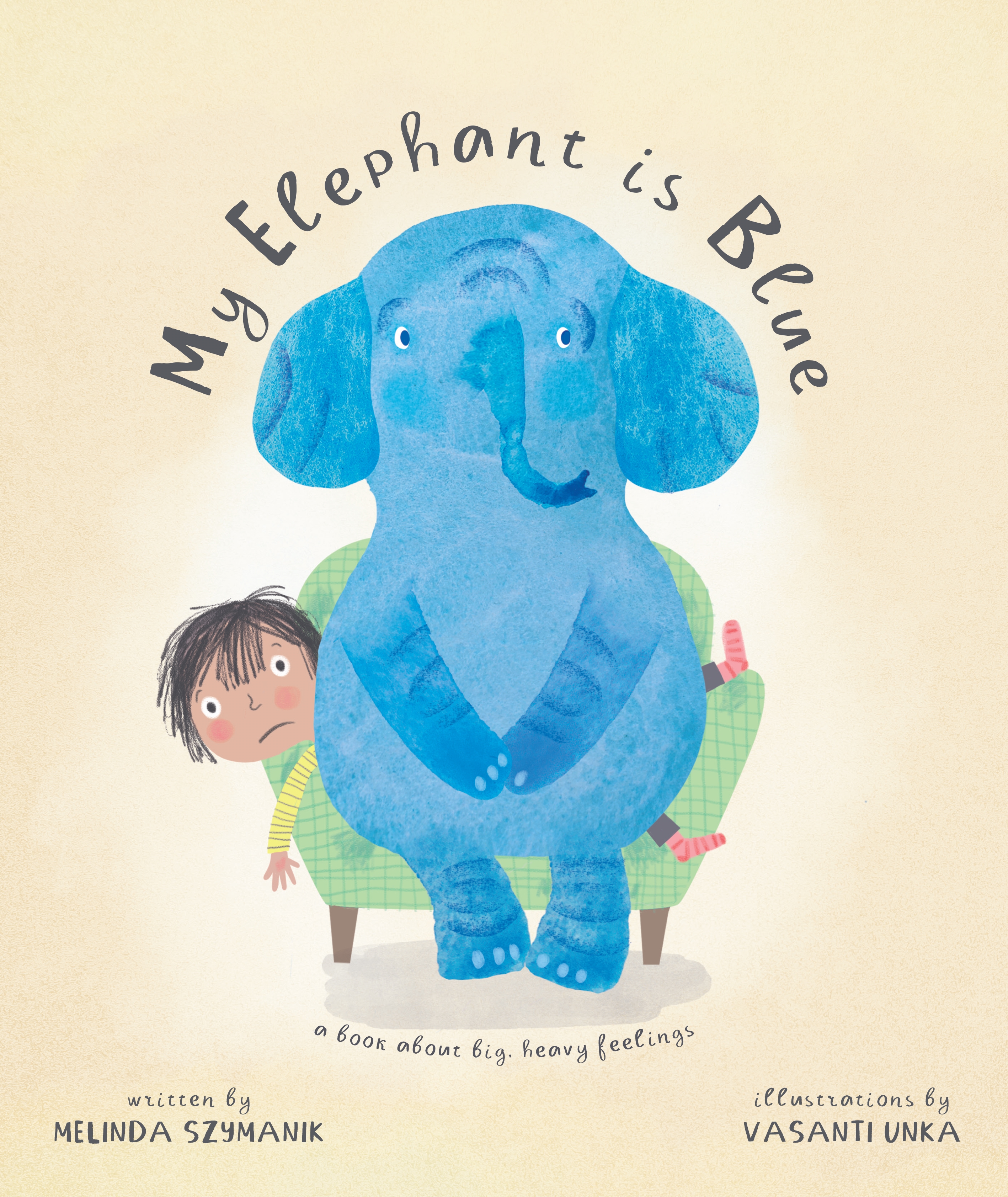
Children sometimes have trouble verbalizing their feelings and managing them. My Elephant Is Blue was written to help children deal with sadness. “Big, heavy feelings” are represented by the crushing weight of the elephant Blue. The child’s family members try to help in various ways, and gradually the child does feel the weight of sadness lifting. This is Mental Health Awareness month, and My Elephant Is Blue is one of many picture books published by Flyaway Books to help young children and their families deal with emotions.
I received a complimentary copy of this book in exchange for an honest review. Opinions expressed in this review are completely my own.
Rating: 4/5
Category: Children’s Fiction, Health
Notes: 1. Ages 3-7
2. Supporting resources linked to this book are found at http://www.flyawaybooks.com/resources. There is a Discussion and Activity Guide that helps the reader understand the symbolism in the book. This guide includes Discussion Starters, Activities, a list with links of organizations that offer support, and a coloring sheet. There is also a book trailer if you would like a preview of the book.
Publication: April 11, 2023—Flyaway Books
Memorable Lines:
They said, “Perhaps if you cheered up a bit…or smiled at it.” But it’s hard to cheer up or smile with an elephant sitting on your chest.
“It’s an elephant,” Mom and Dad said. “Surely it can’t stay forever. It’s bound to move on sometime.” I hoped sometime was soon.
The Little Books of the Little Brontës–creativity in childhood
The Little Books of the Little Brontës
by Sara O’Leary
illustrated by Briony May Smith

This little book of historical fiction introduces children to the famous Brontë family. The girls, Charlotte, Emily, and Anne, and their brother Branwell are raised by their father who is a vicar, their aunt, and a housekeeper. They grow up in relative poverty, but have a fun life with much time to exercise their creativity as they are homeschooled and spend a lot of time exploring the moors. Almost anywhere they go would be by foot.
The Little Books of the Little Brontës tells how they loved to read and as children they made tiny books for each other and for their toy soldiers. As they grew older, their reading passion was turned to writing. The sisters died young, but their books are still eagerly read today.
I enjoyed this fictional view of the Brontës’ childhood. It is easy for children to follow. I particularly liked the illustrations; they are delicate, detailed, and whimsical. After explaining that the sisters had short lives, the author takes the reader back to their happy early years which is a sweet ending and very appropriate to a children’s book.
I received a complimentary copy of this book in exchange for an honest review. Opinions expressed in this review are completely my own.
Rating: 5/5
Category: Children’s Fiction, Historical Fiction
Notes: 1. Includes directions on how to make a little book.
2. There are Author’s Notes containing information about the family for adults.
3. The book ends with an extensive Bibliography.
4. Ages 5-9, Grades K-4
5. Print length: 40 pages.
Publication: October 17, 2023—Tundra (Penguin, Random House Canada)
Memorable Lines: (which is also the first sentence)
Many years before you were born,
sometime in the long ago,
a child named Charlotte Brontë
made a little book for her little sister Anne.
Saint Patrick the Forgiver–The History and Legends of Ireland’s Bishop
Saint Patrick the Forgiver
retold and illustrated by Ned Bustard
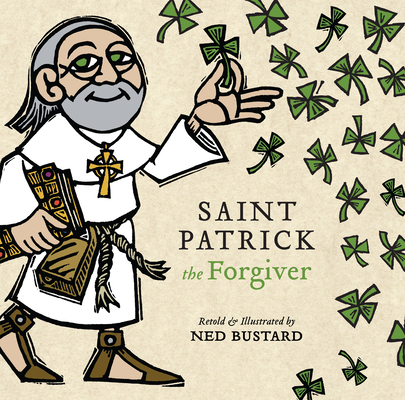
Is Saint Patrick’s Day just a great time of celebrating Irish heritage with parades, green beer, and shamrocks? Ned Bustard shares the real story of St. Patrick along with some of the tall tales that have surrounded his legacy. In his book Saint Patrick the Forgiver, Ned Bustard retells the ancient story in poem format that is suitable for young and old.
Patrick was born in 385 in England. He was kidnapped and sold as a slave in Ireland where he worked as a shepherd. He had an encounter with God and became a follower of Christ. Later God spoke to him in a vision, provided a boat, and led him safely on the long journey back to his family.
After this escape he had another vision that he was to return to the land and people who had enslaved him. He was able to forgive them because God had forgiven him.
This book is a treasure of spiritual truths, beautiful poetry, and fitting illustrations. Saint Patrick the Forgiver would be a wonderful addition to your St. Patrick’s Day celebration. It shares history and legend differentiating between the two. Most importantly it teaches the lesson of forgiveness.
I received a complimentary copy of this book in exchange for an honest review. Opinions expressed in this review are completely my own.
Rating: 5/5
Category: Children’s Fiction, Christian, Religion and Spirituality
Notes: 1. The author’s note at the end summarizes the book in prose and has two discussion questions, a verse from Ephesians on forgiveness, and two resources for further reading.
2. Intended Ages—4-8, but it would make great family reading for all ages.
3. Currently Amazon has a special pre-order price for this hardback that is almost 50% off. (I have no financial connection with Amazon; I just noticed the price when I looked for the age range.)
Publication: 2/21/2023—InterVarsity Press (IVP Kids)
Memorable Lines:
Hello, my name is Patrick—
you may have heard my story.
I walked the span of Ireland
to tell of God’s great glory.
To the Irish I returned
to preach of love and grace.
I spoke first to the High King’s son
—our Lord he did embrace.
I saw the Spirit moving
all across the Emerald Isle.
It wasn’t luck—it was God’s grace,
and that always makes me smile!
How to Train Your Dad–the art of dumpster diving
How to Train Your Dad
by Gary Paulsen

Carl is the twelve year old narrator of this middle grade book which has a very conversational style. The vocabulary is somewhat advanced for a twelve year old, but that is because Pooder, Carl’s best friend who helps him write the story, goes through phases of interest (British, Navy seal, etc.). His various fascinations show up in his speech. Pooder admires Carl’s dad who, besides a few odd jobs, lives by bartering. Carl’s dad is very intelligent, mechanically inclined, and very kind. He trades energy (labor) for goods. He considers himself rich as he recycles from dumpsters or his neighbor Oscar’s junk piles. He built a whole truck from discarded spare parts. He prizes function over form; so if an invention works, it doesn’t matter how it looks.
His dad’s philosophy has been fine with Carl until he reaches middle grades and suddenly becomes aware of Peg as “the” girl. His summer goal is to become “lookatable” by the time school starts which is hard to do when your dad barters for XL camo T-shirts and pink bib overalls decorated with words like “juicy.”
The book explores Carl’s efforts to train his father using the methods in a puppy training pamphlet. His efforts are hilarious as are the contraptions his father builds and the objects he brings home. A lot of the dumpster diving food goes to the pigs and chickens. Carl and his dad have a rescue pit bull Carol who is an integral part of their family and, despite her stinky habit of shredding skunks, is allowed to accompany them everywhere.
How to Train Your Dad is a fun story that tweenagers will enjoy. Its casual style and over the top anecdotes are sure to appeal.
I received a complimentary copy of this book in exchange for an honest review. Opinions expressed in this review are completely my own.
Rating: 4/5
Category: Children’s Fiction, Middle Grades
Notes: Contains a very small amount of cussing
Intended ages: 10-14
Publication: October 5, 2021—Macmillan Children’s Publishing Group
Memorable Lines:
She’s in my grade at school and everyone likes her and I have never ever ever seen her be catty or crabby or phony to anyone ever which is something like a miracle in middle school, if you ask me.
Sometimes Pooder jumping from phase to phase without warning can be a little confusing. He might start things off an English lord before suddenly becoming an advertising mogul looking to make some coin and then turn into a Viking biting deep on a tomato-apple so the juice runs down into his beard-if-he-had-one while he’s thinking of pillaging a coast somewhere.
My father loved to barter. To trade, as he thought of it, energies, abilities, knowledge. Trade everything he could so as not to use money. “I have a widget,” he explained to me when I was very small, “and John Doe has an extra electric frying pan he doesn’t need, but he needs a widget and so we trade. We barter. Simple and clean. It’s the very best and purest way to do business.”
The Coat–sacrificial giving
The Coat
by Séverine Vidal and Louis Thomas
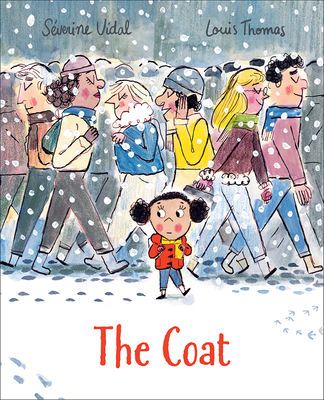
The Coat is a children’s picture book that tells the story of Elise who waits longingly for the day when her big sister Mia will outgrow her perfect red coat and pass it on to Elise. It also is the story of a homeless child dressed in a few layers of summer clothes sitting with her mother on cardboard on the sidewalk…in the snow. Elise passes her by the first day she wears her new red coat, but after a restless night, she can’t look away again. The second day she is late to school, coatless, and happy.
The Coat is a touching way to teach children about sacrificial giving. The homeless child is not given a name in the story which seems appropriate because there are so many “nameless” children who need help and hope. The pictures are colored line drawings, simple and almost cartoonish with an appeal to the reader to join the story. The snowy scenes and dialogue about “penguin cold” are perfect for this story. It is a book that children will request rereads on, and as they hear it again and again its message will make its way into their hearts.
I received a complimentary copy of this book in exchange for an honest review. Opinions expressed in this review are completely my own.
Rating: 5/5
Category: Children’s Fiction
Notes: Reading age: 3 – 7 years
Grade level: 1 – 2
Publication: October 11, 2022—Flyaway Books
Memorable Lines:
It was bitterly cold. Penguin cold!
But now when Elise thought about the warm, soft, red coat, it hurt a little, kind of like a pinch.
Her thoughts were enough to keep her warm.
The Princess and the Goblin–multi-layered fairy tale for all ages
The Princess and the Goblin
by George MacDonald

Ready for another, good-for-all-ages fairy tale? My book club read The Princess and the Goblin by George MacDonald, a Scottish minister, poet, and novelist, who inspired and influenced many authors through the ages including C.S. Lewis, Lewis Carroll, J.R.R. Tolkien, G.K. Chesterton, and Madeleine L’Engle. Like The Chronicles of Narnia, The Princess and the Goblin is first and foremost a fun fantasy tale, beautifully written. As it progresses, layers of symbolism are added with themes of courage, honor, belief, trust, virtue, and faith. As any good fairy tale does, The Princess and the Goblin differentiates between good and evil. Children and adults are living in a rather messy world today where ethics often are blurred, but there are still truths that need to be valued. There are morals that hold us to a standard that forms a good society.
With the author’s great descriptive powers, all of the characters are detailed both physically and morally. The goblins are all evil with designs on the full destruction of the human race. The humans in the story are not perfect, but demonstrate character development based on their experiences.
Irene is a little princess who lives in a country castle. Her noble king-papa visits her regularly as he tours his kingdom staying in touch with his people. Irene discovers her great-great-grandmother living in a section of the castle. No one else has seen her or her rooms. She acts as a God figure in the story, guiding Irene to safety and to belief. A very wise woman, she helps Irene understand that not everyone is ready to believe at the same time. This is apparent in Lootie, Irene’s nurse, who has responsibility for the child’s safety and in Curdie, a clever and brave young miner who befriends and helps Princess Irene. The goblins desire the little princess as a mate for their prince.
There is a lot of adventure in this tale as Curdie works underground (literally) to discover the goblin plots and thwart them. The Princess and Curdie are at odds as he does not initially see what Irene sees because the great-great-grandmother does not actually disclose herself to him.
The settings include a castle with lots of hallways, some beautiful mountains, a small miner’s cottage, pitch black caves where miners toil away picking out ore, and goblin caverns and tunnels. These are the backdrops for the dramatic action of the goblins’ convocation, the Princess’ wanderings, and Irene and Curdie’s courageous rescues of each other. The battle scenes are well played out as Curdie defeats them with poetry and foot stomping.
This is a book that I am sorry I missed earlier in my life. I would love to have shared it with my children and grandchildren when they were younger, but I am happy to pass on the word now to new generations looking for well-written books with substance and value. I look forward to reading The Princess and Curdie, which was written eleven years later, as well as some of MacDonald’s other works (numbering over 50) which encompass a variety of genres. I believe that even reading a biography of this author’s life and influence would be quite interesting as his work did not take a straight forward path. He and his family were plagued with health issues, and despite his success and the admiration of his colleagues, he was not always financially solvent.
Rating: 5/5
Category: Fairy Tale, Fantasy
Publication: November 16, 2010—Project Gutenberg (which includes beautiful illustrations by Jessie Willcox Smith from the 1920 version.
First published by Strahan & Co. 1872
Also published by David McKay Co. 1920
Memorable Lines:
Her fear vanished: once more she was certain her grandmother’s thread could not have brought her there just to leave her there…
“But it wasn’t very good of him not to believe me when I was telling him the truth.” “People must believe what they can, and those who believe more must not be hard upon those who believe less. I doubt if you would have believed it all yourself if you hadn’t seen some of it.”
…Lootie had very foolish notions concerning the dignity of a princess, not understanding that the truest princess is just the one who loves all her brothers and sisters best, and who is most able to do them good by being humble toward them.
The Last Battle–the end
The Last Battle
by C.S. Lewis
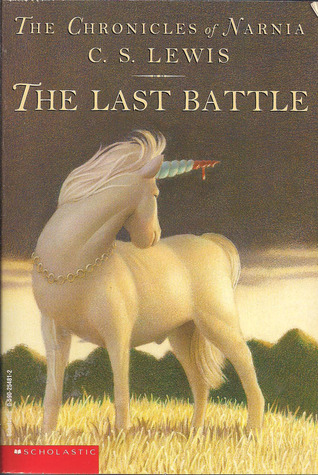
The final installment of The Chronicles of Narnia is as interesting, exciting, and thought provoking as the other six books. I read the last part slowly, eager to know what would happen next but not wanting to arrive at the end of the magnificent tale by C.S. Lewis, the consummate storyteller.
There are many important and timely themes including freedom vs. socialism, manipulation, deception, power and control, sacrifice, good vs. evil, and seeking God. Lewis brings together the characters and elements of all the books into a grand and surprising, but satisfying finale.
There are new characters added to the series. Shift is an ape who keeps Puzzle the donkey controlled by undermining his self-confidence. Old characters are present too as King Tirian calls out to Aslan the lion for help and “the seven friends of Narnia” from our world are whooshed into Narnia where they prepare to do battle against Shift, the Calormenes led by Rishda, and Tash the Calormene god. Shift devises elaborate schemes to deceive the Narnians and convince them that Puzzle, dressed in a lion’s skin and only appearing in the dark, is Aslan. This false Aslan through Shift’s directives is a cruel ruler, unlike the real Aslan. He enslaves the Dwarfs and Talking Horses making them work to accrue wealth for himself. Shift and Rishda convince the Narnian Talking Animals that Tash and Aslan are the same god and that they should now worship “Tashlan.”
Speaking further of the plot would disclose too many events that readers will surely want to discover on their own. The Last Battle is an adventure story replete with easy to understand symbolism and ageless themes. Quoting the last paragraph of the book would be the ultimate spoiler, but don’t fly to it first when you read the book. When you reach the ending, having experienced adventures alongside the characters and learned more of the attributes of the real Aslan, you will smile and savor the thoughts in that last beautifully composed paragraph.
Rating: 5/5
Category: Fiction, Christian
Notes: 1. #7 in The Chronicles of Narnia series. This is the final book in the series and should be read last.
2. This series is often listed as Children’s Fiction, but is really appropriate for all ages with adults reading it on a different level from children. It is perfect for a read-aloud.
3. I can’t believe I had never read the full series. If you are in a similar position, I urge you to delve into this treasure of a series. You will not regret it.
Publication: Original copyright is 1956. My copy was printed by Scholastic in 1995.
Memorable Lines:
“I was with him in his last hour and he gave me this message to your Majesty: to remember that all worlds draw to an end and that noble death is a treasure which no one is too poor to buy.” “So,” said the King, after a long silence “Narnia is no more.”
And then she understood the devilish cunning of the enemies’ plan. By mixing a little truth with it they had made their lie far stronger.
“They will not let us help them. They have chosen cunning instead of belief. Their prison is only in their own minds, yet they are in that prison; and so afraid of being taken in that they cannot be taken out.”
The Magician’s Nephew–another C.S. Lewis masterpiece
The Magician’s Nephew
by C.S. Lewis
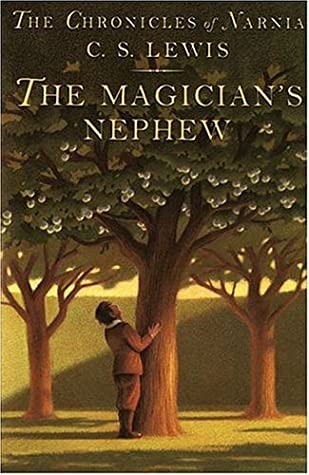
I entered The Magician’s Nephew not really knowing what to expect. It was written by C.S. Lewis the year prior to the publication of the last book in the series, The Last Battle, which I have not read yet. At the suggestion of a member of our book club who was actually rereading the series, we inserted The Magician’s Nephew immediately before The Last Battle—not because it belongs there chronologically, but because it could perhaps be appreciated better at that point in our reading. I don’t think you could go wrong with any sequence of these books! C.S. Lewis intended it to be read first in his Chronicles of Narnia, but by the time it was first published, many of his readers would have already greedily devoured the first five books. It is indeed a prequel to the delightful The Lion, Witch, and the Wardrobe, but for those who have already read that first classic tale, you will enjoy the “ah ha” moments that arise as Lewis gives you a backstory that renders both subtle and obvious connections. It never has the feel of a book written at the instigation of a publisher who just wants to squeeze more out of a popular series. It seems that it is Lewis’ desire to bring the pictures he has painted in his novels together with cohesion and forward looking vision.
In The Magician’s Nephew, a story which begins in London, you will learn of the creation of the world Narnia, meet Aslan the Lion, and witness the awakening of the Witch. There are many connections to the creation of Earth and its population as found in the Bible; but of course it is Narnia and in this fictional realm we learn how the animals came to talk and see the never changing character of Aslan who reigns with power and love, who grieves for the things that grieve us, and gives us hope during times of devastation.
This book has sad and fearful moments as well as happy and triumphant ones. The humor as the animals plant and water Uncle Andrew in hopes that the poor “plant” will revive is more refreshing to the reader than to Uncle Andrew! The pure evil of Jadis the Witch is the stuff of ancient fairy tales as is the conflict of good and evil. The characters are ones you can feel strongly about. The setting, as always with C.S. Lewis, is so vividly and well described that you can visualize both the “real” world of London and fictional worlds to which the children (main characters Digory and Polly) can transport themselves. As to plot, it constantly throws in surprises, but events are always connected. It becomes a quick read, not because it is short or light reading, but because it is so much fun to read. As with all the books in the series, it can be read as a child enjoys fiction or as an adult looking for deeper meaning. I suggest you read it both ways at once. Come to the story for entertainment and leave with the enrichment of a well-told tale imbued with rich symbolism.
Rating: 5/5
Category: Fiction, Christian
Notes: #1 in The Chronicles of Narnia series, but can be read at any time in the reading of the series. Warning: If this book is your first experience with this series, you will probably want to read more!
This series is often listed as Children’s Fiction, but is really appropriate for all ages with adults reading it on a different level from children. It is perfect for a read-aloud.
Publication: 1955—Harper Collins
Memorable Lines:
For what you see and hear depends a good deal on where you are standing; it also depends on what sort of person you are.
She has won her heart’s desire; she has unwearying strength and endless days like a goddess. But length of days with an evil heart is only length of misery and already she begins to know it. All get what they want; they do not always like it.
For the rest of that day, whenever he looked at the things about him, and saw how ordinary and unmagical they were, he hardly dared to hope; but when he remembered the face of Aslan he did hope.
 education pathways