
Lessons from Madam Chic–humorous look at living well
Lessons from Madam Chic
by Jennifer L. Scott

This nonfiction tome is part advice and part memoir. This delightful book draws on Scott’s experiences as a college student living with a family in Paris for six months. I first encountered Jennifer L. Scott in a YouTube video series The Daily Connoisseur. She has written several books that mesh with the stories on her channel. A proponent of the ten-item wardrobe and gracious living, many of her writings and videos center around how to “be classy.”
Jennifer shares some of her many ideas on how to live a passionate life “filled with love, art, and music” where “no moment was wasted.” She dispenses her advice with her trademark, sometimes self-deprecating, gentle humor. She lived with two families, each with their own variety of a fulfilled life. Madame Chic ran a sophisticated, orderly household with a minimalist style that displayed an appreciation for the simple, finer things in life. Madame Bohemienne had a more free flowing joi de vivre approach to life. Both women were role models to Jennifer.
This book is divided into three parts: Diet and Exercise, Style and Beauty, and How to Live Well. One of my favorite chapters is “Snacking Is So Not Chic.” It tells the story of newly arrived Jennifer trying to sneak down to the kitchen for a snack. She soon learned that French people don’t snack or eat on the go. Another of Jennifer’s memorable chapters is “Look Presentable Always” that goes against what many of us in the United States revert to, seeking the comfort of sweats and ragged tees. “Practice the Art of Entertaining” is a chapter this introvert found quite interesting. I’ve focused on three standout portions of the book, but I enjoyed the entire read, and I highly recommend it.
Rating: 5/5
Category: Nonfiction, Humor, Travel
Notes: subtitled: 20 Stylish Secrets I Learned While Living in Paris
Publication: 2011—Simon & Schuster
Memorable Lines:
And when you’re not doing housework…Dance! I love to put on music in the morning and dance with my children. They find it quite amusing, I get a good workout in, and we all laugh. It’s a mood booster.
Famille Chic had impeccable manners and used them on a daily basis. They applied the “use your best” philosophy to their behavior toward their guests, of course, but also to their behavior toward each other every day.
There are few things better, in my opinion, than attending a proper dinner party—with apéritifs, hors d’oeuvres, music, a properly set table, interesting guests, excellent cuisine, dessert, cheese course, coffee, and digestif. The experience can be divine. Throwing a dinner party, on the other hand, can be very daunting.
Beneath a Turquoise Sky–educating the Navajos
Beneath a Turquoise Sky
By Kiersti Giron

As Beneath a Turquoise Sky begins, the author introduces Caroline Haynes, a young lady in 1910 in Pennsylvania. After five years of playing the role of mother to her two younger brothers, she feels replaced by her father’s new wife Lillian. Her best friend’s brother, whom she had long adored, moved to China to be a missionary, without Caroline, and later married. Recognizing that she really doesn’t have a home or is needed in Pennsylvania, Caroline follows up on an article in the Home Mission Monthly seeking a teacher for the younger students at the Hebron Navajo Mission. She was drawn to “children in need of schooling, of the light of Jesus.”
When she arrives at the Territory of New Mexico after a long, arduous journey, she is shown to her tiny room attached to the girls’ dormitory and meets the handsome, but rigid, Rev. Willis Abernathy and his aunt Miss Spencer. Both have their own strict ways of running a school which are typical of schools set up for Native Americans at that time. The goal is conversion, but not just spiritual conversion. The white men wanted to get rid of Navajo culture and replace it with European customs all while making it clear that the Navajos are second class people. The motto of some was: “Kill the Indian, save the man.” To this end, the Navajo students were often punished if they spoke their own language. Haircuts were forced on them. Their traditional clothes were taken away, and they were supplied with uniforms.They were assigned Anglo names and removed from their families. The parents were told this was “all for their own good.”
Caroline’s interactions with the students and the other staff is a major part of the story, but just as important is Willis’ relationship with Tse, a Navajo two years younger. They grew up together and were friends for many years, but that all changed and we see it play out as Tse needs a job to help support his parents. Willis gives it to him but treats him in a very condescending way. As was typical of that time period, he seems to have no concept of the value of cultural differences. Tse is a Christian, but because he has reverted to Navajo dress and culture, Willis feels that he has turned his back on God.
Caroline “disobeys” Willis in her efforts to teach the children and give them the emotional support they need. Tse is her “accomplice” and both of them are chastised by Willis.
There are a number of well-executed plot twists that culminate in decisions these characters have to make that will affect their future and the future of the mission. Although I had a hard time liking Willis, I could understand him as a product of his time. That does not excuse most of his behavior, however. The story concludes with many loose ends tied up, but there are still systemic problems that are not worked out regarding how the Navajos and the white men interact with each other. Caroline and Tse are both very likable characters portrayed with some depth. They live out the kindness of Jesus in their everyday lives. Willis thinks he is doing the right things, but is missing the mark in his goals and how he treats others. All of the characters experience growth and positive change, and Tse especially comes to understand how he can honor his Navajo heritage and also be a follower of Jesus.
Rating: 5/5
Category: Historical Fiction, Christian, Romance
Notes: 1. The book includes a Glossary of Navajo Words, Historical Notes, and Acknowledgements of people and organizations that have contributed to the author’s understanding of the complicated historical and cultural background of this story.
2. Giron states that she has “shown only the milder side” of the trauma children experienced under this “education” system, but it is certainly sufficient to expose the reader to the damage even well meaning individuals caused in imposing Euro-American culture and customs in the name of religion.
Publication: April 14, 2025—Story Architect
Memorable Lines:
Perhaps being set apart did mean rejecting all that was Navajo and taking on the white man’s ways. But where was that ordained in Scripture? Not like the people of ancient Israel were European, after all.
But no, the bilagáanas were always right—government officials, Indian agents, or missionaries. No matter how many broken treaties, broken promises, broken families. Broken children’s hearts.
He sang as he bridled his horse, praising Jesus in his language, letting the tune follow the natural pattern of the tones, as in the chants. It sounded genuinely Navajo, yet the truth of the words lent a wholeness to his tongue he’d never heard before.
A Very English Murder–good mystery with sophisticated humor
A Very English Murder
By Verity Bright
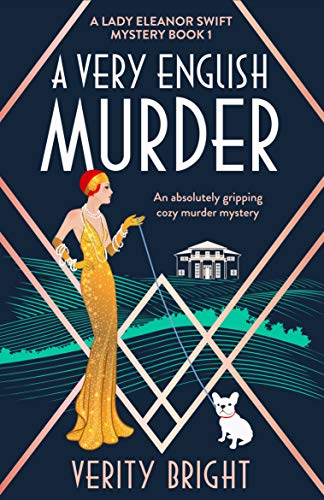
When Ellie’s uncle dies, she leaves her life of adventure and world travel and returns to Henley Hall in the little town of Chipstone in the 1920’s. Even though she did not know her uncle well and had not been to Chipstone in many years, everyone in town recognizes her as Lady Swift. She is somewhat overcome by her life changes and that is complicated by her witnessing what appears to be a murder, but it is hard to convince the police of that because there is no body.
Clifford is her butler and she soon recognizes that he had a special relationship with her uncle and the townspeople and will be just as helpful to her in her investigation. She is not quite sure what the pair did, but as the story develops, the scope of their “work” starts to come into focus.
The mystery is fascinating and was quite a puzzle. The staff at Henley Hall are supportive of her and were clearly a trusted part of the projects her uncle and Clifford pursued. Clifford is a favorite character but takes some getting used to. Ellie is not sure if she can trust him. She can definitely trust Gladstone, her uncle’s bulldog. He adds humor to the book along with Ellie’s musings and misadventures. Danger comes her way as someone tries to impede their investigation. There is definite closure to the mystery, but it certainly leaves readers wanting to read more of Ellie’s adventures. If you like “Britishisms,” a strong and impulsive female lead, and a 1920’s setting, you’ll enjoy A Very English Murder, a stellar start to this extensive cozy mystery series.
Rating: 5/5
Category: Mystery
Notes: #1 in the Lady Eleanor Swift Mystery Series. The author is actually a husband and wife team and the series has 25 books so far.
Publication: April 7, 2020—Bookouture
Memorable Lines:
“Give a man a badge and an official title and he thinks he’s the sole decider of right and wrong. Which would be fine if power didn’t corrupt.”
“Clifford, how did my uncle ever swallow your unwavering advice on his every daily action?” “With Darjeeling and lemon, my lady.”
Eleanor laughed, her bad mood broken. “You are very perceptive, Mrs. Butters. Clifford has a fabulously analytical mind, but it drives me to absolute distraction! But you know, you always bring me a basket full of feel-good each morning.”
The Harmony Series (audio version)
I don’t listen to audio books very often, but I think I have found a comfortable niche that works for me—Philip Gulley’s Harmony Series. It’s an easy series to come back to when walking my dogs. If my thumb hits the wrong place on my phone and I’m suddenly back a few chapters, it is not a problem. I can just enjoy that portion again. So, when I listen to a book from the series, I will share it here, but only with a brief reflection because the books are like reading short stories or collected anecdotes. The members of the Harmony Friends Meeting show up in all the books, and the setting is always the fictional small town of Harmony, Indiana. The tone of the book is generally light-hearted, containing some sarcasm and some thoughts about the ways people get along with each other. Think of Harmony as a Mayberry come to life with characters that will make you chuckle, and sometimes reach out with empathy.
Just Shy of Harmony
By Philip Gulley
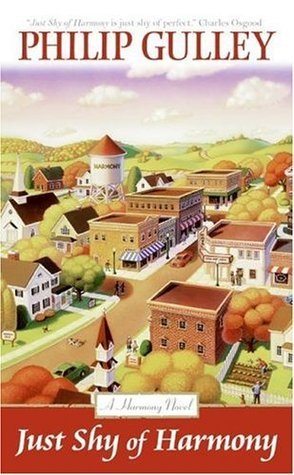
The second book in the Harmony Series is Just Shy of Harmony. It has a lot of humor in its tales. Dale Hinshaw’s new outreach is his “scripture eggs” project inspired by an article about a chicken that supposedly laid an egg that had a message inside because the chicken ate a piece of paper. He’s off to evangelize the world, but he has trouble getting others excited about his idea!
The whole town “knows” about Jessie and Asa’s marital problems because the editor of the local paper writes weekly about what he sees out his window and he saw Jessie going into the building that houses the counselor’s office. You can see where that one is going, but poor Jessie and Asa don’t know why everyone is asking how they are doing.
Framing the humor, however, are two deeper subjects. Sam, the Quaker pastor, is depressed and feels like he has lost his faith. The whole town knows about it; word of mouth is as good as the local newspaper in Harmony. He is experiencing burn-out, for sure, but doesn’t know what to do about it. Avoiding spoiler details, a member of the congregation has leukemia and we see a different side of the Quaker Friends as the church rallies around in prayer and fund raising.
Rating: 4/5
Category: Christian, Fiction, Religion, Inspiration
Notes: Read by Norman Dietz who had a lot of different voices to employ and did it well.
Publication: 2002—Harper One
Memorable Lines:
After all, life is so fleeting, so tenuous, that if you can do someone even the smallest good, you ought to do it.
So Into You–too many secrets
So Into You
by Kathleen Fuller
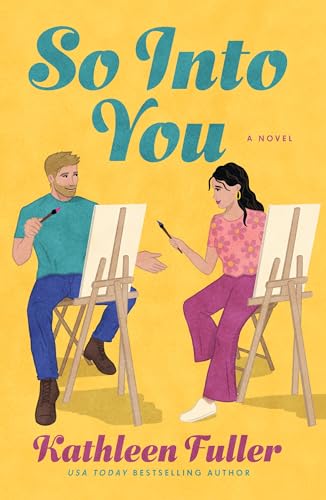
Britt is a talented artist and art teacher in her late twenties who makes a living creating YouTube tutorials for art. She has extreme social anxiety which she has addressed in various ways, but none of the treatments or recommendations have had long-term benefits. Although she supports herself financially, she still lives with her mom Amy, a high school math teacher. Britt’s parents divorced when she was young because her father Daniel had problems with alcohol and anger.
Hunter comes from a wealthy, successful family but got mixed up with alcohol and drugs as a pre-teen. Some tough love from his parents resulted in a stint in jail where he turned his life around with the help of a chaplain who introduced him to Jesus. After his release, Hunter got a job at a warehouse and worked on getting his life in order. He happens onto Britt’s YouTube channel and becomes interested in her tutorials. He also thinks she is very cute. Now he just has to meet her without coming across as a creepy stalker.
All of the major characters have secrets that they resist sharing; and, as might be expected, those secrets cause major problems. Hunter, who used to be a “player,” becomes a sensitive, respectful friend to Britt and wants to help her with her social anxiety issues. Other family members and friends are involved in the story as well. The author connects the characters in a way that the reader can see coming. I held my breath as I watched the relationships develop and anticipated how the secrets would be revealed and what blow-out would result.
I received a complimentary copy of this book in exchange for an honest review. Opinions expressed in this review are completely my own.
Rating: 4/5
Category: Romance, Women’s Fiction, Christian
Notes: Discussion Questions included.
Publication: December 3, 2024—Thomas Nelson
Memorable Lines:
A year ago when they signed the lease together, he’d made a pact with Sawyer that he would stay clean and sober, and he’d kept it. That was in the past, and it was a road he never wanted to travel again.
Immediately she was hit with a blast of heat, and it was a only May. The next few months would be brutal. Otherwise known as summer in Texas.
“We love each other more deeply now than we ever have. But love isn’t all you need to make a relationship work. You must have communication, patience, and empathy, along with understanding and honesty. Above all, you have to be willing to make it work. If you give up, the relationship is over.
The Silver-Haired Sisterhood–Saving the B&B
The Silver-Haired Sisterhood
By Judy Leigh
As you can tell from the title, this novel is about a group of women in their seventies and eighties. Each has a “story” that is a little different from the others, but they are understanding and supportive of each other. The oldest, Rose, is an excellent pianist. She performs in a drag club in Paris. Tess, one of the main characters is newly divorced from a lowlife philanderer and is faced with needing to find a new home. Pam is comfortable with her life as a single, doting on her dog Elvis. Four years prior, the ladies who call themselves the Hens, had accompanied Jen to Paris before her wedding which she ultimately cancelled. When Della’s husband passes away leaving her in the throes of grief as they had a longtime loving marriage, she decides to temporarily get away from the memories in her home and accompany Tess on a trip to Scotland.
The bed and breakfast the pair sign up for on the Internet is in a state of disrepair and the owner is not ready for them as he is going through his own divorce. The plot proceeds from the ruins of Roddy’s ancestral home, his failed marriage, and an evil wife and her boyfriend. The Silver-Haired Sisterhood is full of interesting characters living on the island of Skye. There are poignant moments and humorous times that make the book stand out as a fun, memorable read.
I received a complimentary copy of this book in exchange for an honest review. Opinions expressed in this review are completely my own.
Rating: 4/5
Category: Fiction, Women’s Fiction, Romance
Notes: This novel develops some relationships from friendships into romance. A few of these pairings are not acceptable in more traditional circles, but the physical aspects are implied and always “closed door.”
Publication: December 3, 2024—Boldwood Books
Memorable Lines:
“And she’d miss a bad cold more than she’d miss living with Alan.”
Two figures were running towards them over croft land; they were handsome, rugged young men jogging in woollen hats, layers of clothes, tracksuits, padded jackets. As they passed, Tess noticed their icy breath and their determined expressions. She called out, “You can stop running after your dreams—we’re right here,” and burst out laughing. One of the men muttered something: “Right y’are, darlin.’ ”
She had no romantic feelings for him—she knew that now. It had simply been the need to reach out to another person, to feel wanted. But that wasn’t enough for Tess. She realised that she needed to be one half of a magnet, equally tugged and tugging.
A Moment’s Shadow–Danger in Ireland
A Moment’s Shadow
by Anna Lee Huber

Having finished The Cold Light of Day, I was delighted to find that although I had missed getting A Moment’s Shadow as an ARC, my library had copies of this book in various formats. I grabbed the ebook to dive right in. It is even more interesting than the previous book which set the stage for Verity and Sidney Kent’s informal assignments in Ireland. They have several goals. Verity wants to find Alec, her former colleague during the Great War, who seems to have disappeared in Ireland. The pair has also been asked to investigate some missing phosgene cylinders, and they have determined that Verity’s nemesis, Lord Ardmore, who is always two steps ahead of them, is responsible. While they are in Ireland, a jewel thief visits one posh house after another. How he can accomplish these daring heists is baffling, but as Verity and Sidney already move in the social circles of the victims and have a reputation for solving mysteries, they are pulled into the investigation.
As the story progresses, it is difficult to know which side characters are on, and by the end the Kents are not sure which group they identify with. Both sides are committing heinous acts of murder, destruction, and torture. Both sides use deeply embedded spies to accomplish their goals. Verity disguises herself to pass as an Irish worker when needed and then as the socialite she is when that is appropriate to her sleuthing. Other than the social events they attend, nothing is glamorous about their lives in Dublin. Many of the wealthier class have escaped the turmoil by fleeing to their country homes, to England, and even abroad. Verity is “recalled” as some powerful person is unhappy with her inquiries. Since she is not working as a spy anymore, the government doesn’t really have the power or authority to demand her return. The people in charge, however, make it plain that they have been providing her with a measure of safety and can withdraw that protection if she does not return. A Moment’s Shadow has plot action that crescendos at the book’s conclusion with a hook that leaves the reader hanging and ready to devour the next book in the series.
Rating: 5/5
Category: Historical Fiction, Mystery
Notes: 1.#8 in the Verity Kent Mystery Series. The author reintroduces characters from #7 and previous books in the series but I think it would be hard to jump in with #8. If you really want to read just the ones dealing with the Irish Revolution, then start with #7 and plan on reading at least two more—#8 and #9.
2. A good plan for reading books #7-9 would be to list the characters and acronyms along with a basic note about each. There are a lot of characters, and you might find it helpful to comment on where you think their alliances lie.
3. The book ends with a teaser chapter from the next book in the series, The Bravest Hour, with a projected publication date of August 25, 2026!
Publication: 2025—Kensington
Memorable Lines:
These sights were always discomforting to me, for instinctively I wanted to cheer on our Tommies, and yet the Crown Forces’ behavior reminded me painfully of the Germans lording over the Belgians when they’d occupied their country during the war.
Everyone was trying to avoid the notice of the Black and Tans, to survive in a place where affordable housing was scarce, sanitation was abominable, and a stray bullet could end your life at any moment.
With all the dry and sunny weather we’d enjoyed in September, it was easy to forget how damp Ireland could be. October elected to remind us of this with a vengeance. It lashed, it bucketed, it showered, it drizzled, it misted—but at all times some sort of precipitation was falling from the sky.
The Teacher of Nomad Land–a child’s survival
The Teacher of Nomad Land: A World War II Story
by Daniel Nayeri

This is the story of two Iranian siblings, thirteen year old Babak and eight year old Sana, orphaned and separated during a time when their neutral country is being invaded by forces competing for Iranian oil—British, Soviet, and German. Add to that mix the Poles, the Jews, and the native nomads who don’t recognize any country as delineated on a map. Their various languages play an important role in this story. Babak has two goals—to become a teacher like his father and to take care of and stay with his sister.
Written for children, this is a fast read for adults. Instead of the horrors of concentration camps, The Teacher of Nomad Land focuses on the lives of the children as they to try to find “family” and dig within themselves to find what it takes to survive. In the Traveler, a friend of their father, they discover a kind man who tries to help. There is also a British soldier they bond with. Their lives are complicated by a mysterious man who is seeking a Jewish boy. All three children are put in danger by this situation. Babak’s resourcefulness is successful in dealing with the Soviets who halt the progress of the nomads in transitioning their herds to their winter home thus demonstrating his value to the nomads.
This is an age appropriate book that does not go into detail about concentration camps and home invasions. On the other hand, it does not shy away from the hunger the children suffer and the danger they face from other people. It highlights the communication problems when there are so many languages; and it shows how, despite being part of an army, individual soldiers can be nice to the local population. While Babak, as the older child, has much of the spotlight in this book, Sana also shines in certain situations with her creativity and ability to step up when things go bad. I was impressed by both characters at their positive attitudes, not allowing themselves to be overpowered by a victim mentality even when cold, hungry, tired or aching from long walks or sleeping on the hard ground.
Rating: 4/5
Category: Historical Fiction, Middle Grades
Notes: 1. Written for children Ages 8-12. Even though the reading level is for that age group, it may be too advanced in terms of understanding the political, geographical, linguistic, and social backgrounds. Discussion with an adult would be helpful for some children.
2. Included some helpful additions: a map, author’s notes about the political setting and the language barrier, and information on the Persian alphabet.
3. The book ends with “Further Reading” which lists nonfiction books for various ages.
Publication: 2025—Levine Querido
Memorable Lines:
“It might have been fair, but it wasn’t right.”
Everything is all at once. Our lives, these moments that change our lives, they all happen so fast.
Teaching is like sitting with a young person and encouraging them to only listen to the good angels in their mind and not the evil ones. But you can’t force them.
The Joshua Code: 52 Scripture Verses Every Believer Should Know
The Joshua Code: 52 Scripture Verses Every Believer Should Know
by O. S. Hawkins
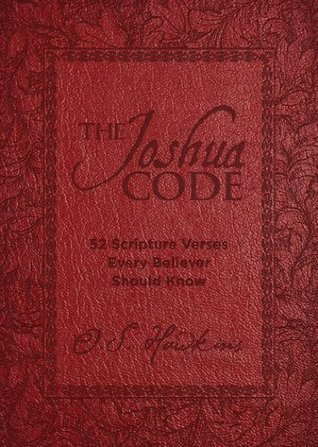
Have you ever felt like you should have more Bible verses committed to memory than you already have? That thought was the impetus for me to purchase and read this book. The goal is to memorize one verse each week. At first that seemed doable, but as life brought some ups and downs, I found myself unable to remember, over the long haul, all the Scripture references that went with each verse. So, about half way through the book, I switched to using it solely as a devotional and that worked well for me in that season.
My first reaction to The Joshua Code was to question the author’s choice of Scriptures. Many of my “favorites” were not included, and I wasn’t sure I saw the importance of those that were selected. As I stayed with it for a few weeks, I began to understand the process. With each verse there is a devotional, a short homily. As I read each chapter I could see why the verse was important. Since then, I have been surprised at how these verses come up in various contexts and provide an “Ah, ha” moment or a “God wink,” a term used by some for seeming “coincidences.”
According to the author, the title Joshua Code refers to Joshua 1:8 and is a “challenge to keep God’s Word in our mouths through memorization and keep it in our hearts through meditation ‘day and night.’ ” In the Introduction, Hawkins gives his practical method for committing verses to memory. He also explains what meditation is for Christians and how valuable meditation can be when applied to these verses.
I recommend this book for Christians and also for those seeking a relationship with Jesus. This book will show readers how to find Jesus in the Scriptures despite the chaos of daily life and digital content that constantly bombards us.
Rating: 5/5
Category: Christian, Nonfiction
Notes: 1. 52 Scriptures and devotionals to encourage memorization
2. A note at the end of the book states that all of the author’s royalties and any other proceeds from the book go to Mission Dignity which “enables thousands of retired ministers (and, in most cases, their widows) who are living below the poverty level, to live out their days with dignity and security.” Small churches are often unable to contribute to a pastor’s retirement, and Hawkins is using his book to financially fill that need.
Publication: 2012—Thomas Nelson
 education pathways