
Home » 2016 (Page 7)
Yearly Archives: 2016
Saving Graces–Review AND Reflections
Saving Graces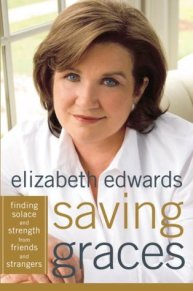
by Elizabeth Edwards
Elizabeth Edwards was the wife of John Edwards, a Democratic senator, an unsuccessful presidential primary candidate in 2004 and 2008, and running mate for John Kerry in the 2004 presidential election. Elizabeth was a popular and sympathetic public figure because of the death of her son at age sixteen in a car accident, her courageous battle with breast cancer, and revelations of her husband’s ongoing affair during her health struggles.
Elizabeth Edwards published the book Saving Graces in 2006, two years after she was diagnosed with cancer and the same year her husband began his infamous affair with Rielle Hunter, which he did not publicly admit to until August of 2008. I am laying out the dates carefully because I found it a bit confusing as Edwards begins telling her story at the same place in her life that she ends this book. Also, because she was such a family-oriented person, I had to wonder at what point in her painful saga was she unknowingly being betrayed by her husband. There is no foreshadowing of the affair.
No spoiler alert is needed on this review. Edwards in this memoir is sharing very personal insights into the events of her life up through the close of her treatment for the cancer that was discovered in November of 2004. The facts along with all the rumors of the time are readily available on the Internet.
I must warn potential readers that the first half of this book is a very difficult read. Most of it deals with the very raw grief which Edwards and her family experienced upon the sudden and unexpected death of her sixteen year old son Wade in a car accident. Although the distance of time helps, when she wrote the book she was still experiencing deep sorrow over his absence. Although Elizabeth Edwards worked as a lawyer, author and speaker, the job that was most important to her was that of mother. She loved the presence of her children and their friends filling her home. She loved interacting with them. When Wade died she seemed to lose a part of herself, of her reason for living. I hope the writing of this book proved cathartic for her. Her grief is so real and so painful that I had to put it aside for a few days.
Upon returning to Saving Graces I was relieved to find a turn of focus away from the pain of Wade’s death and toward the future as Elizabeth and John Edwards decide to extend their family and continue to be deeply involved in political races. Even reading about her first battle with cancer was not as painful as the discussion of the aftermath of her son’s death. Though fearful of losing to breast cancer, Edwards knew it was something she could fight. Speaking of the diagnosis she said “…it wasn’t, by a sad and huge distance, the worst news we had ever heard. Wade’s death had spared us that…”
As the United States is currently pushing toward presidential elections, I found glimpsing the campaigns from behind the scenes to be an interesting endeavor. It made me like Elizabeth Edwards better and most of the rest of the political players and the process even less. That outcome was certainly not Edwards’ intention or attitude in writing, but I am too jaded to view the political process through her rose-colored glasses of “John (Edwards) just wants to help people” (not a direct quote, but a phrase that certainly reflects her thoughts). In my opinion, based on later evidence available after this book was written, John Edwards had one goal–to enrich himself. His desires were for money, power, sex, and the flattery of younger women. During the last half of the book, I kept wanting to yell across the pages to Elizabeth that she was living in a house of cards about to collapse on her. I wanted to warn her that her wonderful family man was going to cheat on her, destroying the family she adored so much. I wanted to shout out a danger signal–this man you thought you could count on is going to pay you the ultimate disrespect while you are on the campaign trail telling others how wonderful he is.
Saving Graces has a very appropriate subtitle: Finding Solace and Strength from Friends and Strangers. In the first half of the book, the solace and strength come from others who have lost children. In the second part, she shares the outpouring of love and concern she received when she publicly announced her battle with cancer.
Elizabeth Edwards wrote another book, Resilience: Reflections on the Burdens and Gifts of Facing Life’s Adversities, which continues her story including the return of cancer and the Hunter affair. Although Edwards is a good writer and I sympathize with the tremendous pain she endured physically, mentally, and emotionally, I just don’t know if I will choose to read her detailing of it in Resilience. It seems bad enough that she had to live it.
Come Rain or Come Shine–love the book!
Come Rain or Come Shine 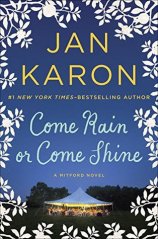
by Jan Karon
After somewhat disappointing results in her last book (see my previous post, a review of Somewhere Safe with Somebody Good), Jan Karon has once more hit the mark in her Mitford tale Come Rain or Come Shine. Readers are all invited to the wedding of Dooley and Lace and get to participate in the preparations as well.
The novels in the Mitford series are kind and gentle and this one is no exception. The characters are not without problems, and realistic, unfortunate situations do arise. Karon effectively uses a technique in this novel of sharing some of Lace’s journaling to show the reader her attitudes and the process she and Dooley had to go through to get to the point of marriage.
A new character, Jack Tyler, is introduced. It seems he will be important in future books as Karon continues to spin her magic with words as the younger Mitford generation becomes the focus. If you are not already a Mitford/Father Tim/Jan Karon fan, begin with the first Father Tim novel, At Home in Mitford. I strongly recommend joining the many readers happily anticipating the next events in Mitford.
Somewhere Safe with Somebody Good–love the title
Somewhere Safe with Somebody Good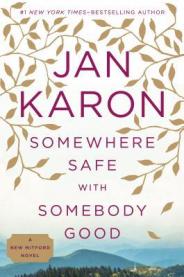
by Jan Karon
Continuing the saga of Father Tim, an Episcopal priest, the book Somewhere Safe with Somebody Good was eagerly awaited by fans of the Mitford series. I have lived out of the U.S. long enough for this book and another in the series both to be published in paperback. I say this to establish that the intervening time lapse has genuinely caused me to forget many of the details of the various subplots of the series. Karon tries to draw enthusiasm from people like me as well as perhaps those who pick up this book as their first taste of life in Mitford. Honestly, I think Karon has created too many characters to be able to update them all effectively. Perhaps she should have pared down the ones included in this book. That part of the book only earns two stars; I don’t fault Karon’s writing, just her taking on an impossible task.
When the reader gets past the clumsiness of character updates, Somewhere Safe with Somebody Good becomes the delightful tale that Karon’s readers have come to expect–interesting, but soothing; realistic, but attaining a moral high ground. I love to see how the characters deal with life; I delight in the carefully crafted words and the beautiful sentiments. It is a treat, as always, to watch Father Tim deal with people who are not always lovable and to sort out his own problems while supporting the community members who have grown to depend on his Godly wisdom.
As a teacher and book lover, I enjoy the focus on the local bookstore, Happy Endings, and the way people come together in the story to support it. Readers who love books (especially children’s literature) will be attracted to the many quotes encouraging reading that Mitford’s citizens post in the bookstore.
As the remainder of the book, including the raison d’être of the title, pleased to capacity, I award a full five stars to Somewhere Safe with Somebody Good.
Fixin’ to Die–Good Try, but…
Fixin’ to Die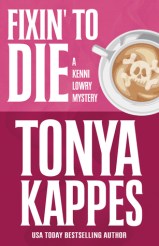
by Tonya Kappes
Fixin’ to Die is a murder mystery set in the small town of Cottonwood, Kentucky. It is the first novel in Tonya Kappes’ Kenni Lowry Mystery Series. My first impression as I was reading this tale is that I really liked the main character Kenni. She is the kind of person I could enjoy spending time with. That sense did not change as this young sheriff goes all out to solve her first murder case and the reader meets the quirky locals she interacts with.
Fixin’ to Die has many elements that aficionados of the cozy mystery genre relish–a strong feminine lead, a few handsome romantic interests, a plot with twists and turns, interesting townspeople, and a surprise ending. So why am I not a huge fan of this book? Mainly I attribute my attitude to a literary technique Kappes attempted: she creates the ghost of Kenni’s grandfather, a longtime Cottonwood sheriff himself, as a character who will aid in Kenni in her investigations. I applaud the effort, but it just didn’t work for me. Therefore I can not wholeheartedly recommend this book.
I would like to extend my thanks to netgalley.com and Henery Press for the opportunity to read this book in exchange for an unbiased review.
Tangled Lies–Will They Ever be Unraveled?
Tangled Lies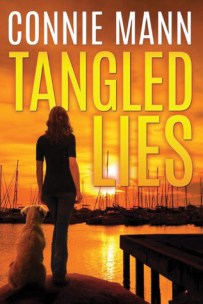
by Connie Mann
Sasha Petrov is a very likable main character in the book Tangled Lies. She is comfortable in the position of licensed boat captain, whether leading a chartered fishing tour, hauling cargo, or competing in a speed race. In fact, she is more comfortable in that role than in relating to family and potential romantic interests. Orphaned as a girl, her past hampers her current relationships but not her efforts to help those she loves.
Tangled Lies is one of those books you just don’t want to put down. The “tangled lies” make the reader want to return for more of the extreme adventure, mystery, and romance that would seem unbelievable for a small town setting. It is, actually, the unhealthy closeness of the denizens of little Safe Harbor, Florida, and its marina that make the playing out of this puzzle believable. As a reader, I wanted to know the answers to the odd intermingling of hateful attitudes and violent events in what was ostensibly pleasant small town America, but I was afraid to have the motives revealed.
Connie Man is a Christian author which, in this case, means characters who approach real issues in their lives without profanity and with self-imposed limitations on their sexual relationships. It more importantly means that they trust in God as their source of strength during difficult times. They have personal issues to work through, but they admit their weaknesses and try to do what is right.
Tangled Lies is Ms. Mann’s third novel. She is a boat captain in Florida herself, lending authenticity to this work.
I would like to extend my thanks to netgalley.com and to the publisher Waterfall Press for the opportunity to read this book in exchange for an unbiased review.
Perilous Judgment–can a federal judge stay within the law and still save those closest to him?
Perilous Judgment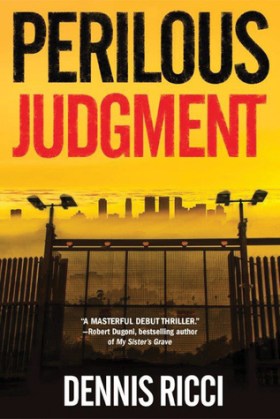
A Real Justice Thriller Series, Book 1
by Dennis Ricci
Perilous Judgment is the first book in Dennis Ricci’s Real Justice Thriller Series. I don’t know what Mr. Ricci’s plans for future books in this series are. I can envision his successfully either creating more tales revolving around his main character, Judge Edward Lamport, or departing from the characters in his first book to write more thrillers continuing to focus on the theme of real justice. Is justice achieved only through the law or can individuals define it as something found in a higher good, a morality above and beyond human created systems of rules?
Perilous Judgment is a story of federal laws, political struggles for power and money, and international narcotics cartels. The main characters have made mistakes in their pasts for which there are consequences. They have decisions to make which affect others and through prayer they try to decipher the will of God in their unique situations. Following the “real justice” theme, many tough but ethical people have to decide at what point there is a higher law to follow.
As a current resident of Mexico, I find reading about the violence of drug cartels difficult because their actions are at such odds with the individuals I have met in the general population. They are kind, friendly and eager to help others. They too dislike corruption in the government and fear the kidnapping and cruelty of gangs. Then as I look back to my home country, I wonder if we are so very different. The political corruption north of the border is more sophisticated and subtle, but is widespread. Large cities are racked with high violent crime rates. I look forward to Mr. Ricci’s next thriller and wonder if his search for real justice will have its focal point solely in the U.S. or if he will once again cross international borders.
I would like to extend my thanks to netgalley.com and to the publisher Waterfall Press for allowing me to read Perilous Judgment in exchange for an unbiased review.
Ghost of Africa– don’t miss this medical action suspense
The Ghost of Africa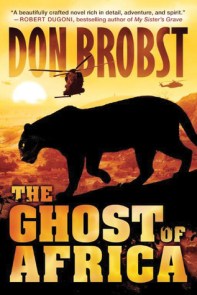
by Don Brobst
Don Brobst has created a fast paced adventure set in Africa. Although The Ghost of Africa is fiction, Don Brobst’s background lends a definite authenticity to the story. Like his protagonist, Dr. Paul Branson, the author is a medical doctor who travels to Africa frequently to provide medical assistance. The reader can assume the comparison ends there as the fictional doctor becomes entangled in a deadly struggle over oil between local forces in North Sudan and South Sudan.
Although Waterfall Press publishes Christian fiction, this novel does not fall anywhere near the category of historical romantic fiction that can be so typical of fictional works from a Christian publishing house. The author has obviously thoroughly researched special forces and military equipment. The result is a very detailed and physical fight for survival with a ruthless antagonist. There is a Christian theme as Dr. Branson is viewed by the natives as The Chosen One, a label he struggles with and tries to put into perspective for the native population.
I strongly recommend The Ghost of Africa. It does have a strong element of violence, but it is not gratuitous. This book stands up well with other action adventures. It also provides a realistic look at life in Africa for the innocents who are caught up in others’ struggles for wealth and power.
I want to extend thanks to netgalley.com and Waterfall Press for the opportunity to read this book in exchange for an unbiased review.
Cliff Notes for American History???
 Everything You Need to Ace American History in One Big Fat Notebook is geared to Middle School Students, but makes an excellent reference for adults as well. The text is marked up with various colors of highlighter to emphasize the most important points. Periods are outlined so students can visualize a timeline of events, but are fleshed out enough that cause and effect are included making history more understandable and thus more memorable. Out of approximately 500 pages, I chose to read about the Civil War and Reconstruction periods because of a discussion with a colleague. I was not disappointed: I came away with answers to some questions and a better overall understanding of the events in a fairly brief amount of time. Obviously, since it was written for middle school students, it was not an exhaustive treatise on the Civil War, but it was a great summary and beginning place for more in-depth research. One of the difficulties of studying American History at any grade level is that is nearly impossible to cover the full history of America in one school year. With this supporting text, one could independently study periods that are not studied in class.
As an independent reviewer, I usually read a book one time and then move on to the next book. In this case I was looking forward to having Everything You Need to Ace American History in One Big Fat Notebook on my iPad as a reference and work through the various periods as a side hobby. As a tribute to the book’s usefulness, I must say I was disappointed to discover that this book has an expiration date and is no longer available to open. Who knew a book could be like a carton of milk? I guess I will purchase a copy!
Everything You Need to Ace American History in One Big Fat Notebook has a proposed publication date of August 9, 2016. I would like to extend my thanks to netgalley.com and to Workman Publishing for allowing me to read and review this book in exchange for an unbiased review.
Riveting Memoir of a Romanian Lawyer– Could be Used in Christian High School?
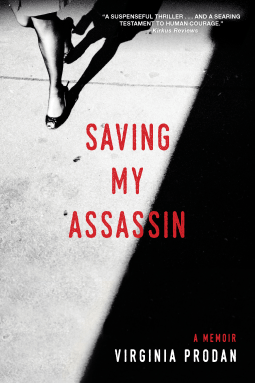 Saving My Assassin
by Virginia Prodan
Virginia Prodan has written a riveting memoir Saving My Assassin. It was difficult to read many parts of this book because of its troubling, torturous content, but the triumphant spirit of this tiny powerhouse of a woman kept me returning to discover how God could possibly use the evil that surrounded her for His greater purpose.
Virginia Prodan was formerly a lawyer during the cruel Communist dictatorship of Romanian leader Nicolae Ceausescu. Currently she is an international lawyer residing in the U.S. where she continues her work representing Christians who find themselves in legal difficulties because of their stand for Christ.
Saving My Assassin begins with a brief glimpse at a pivotal moment in Prodan’s life. That part of the story ends abruptly, but is repeated and continued later in the appropriate time sequence. This is a technique which could be annoying, but is used here to skillfully draw the reader into the critical nature of the happenings in Prodan’s life. Next we learn of mysteries and events in her younger years which help us understand how she became such a determined adult. She endured a cruel childhood which left her determined to discover the truth on all levels. Why was she so mistreated by her own family? Why did she look so different from them? Why were people in Romania not allowed to worship God when their laws said they could? What motivated the cold violence of the Securitate, the Communist government agents who stalked her, interrogated her, and threatened the lives of her and her children? Why were they so willing to torture and kill their own citizens, innocent of crimes, many of whom apparently disappeared into the night?
Although this book is written for adults, I think mature high school students would appreciate it as well. I taught high school English in a Christian school before I became an elementary public school teacher. This is the kind of book I would have used with my seniors. It would be particularly appropriate for reading in conjunction with a history or civics class as it deals with a Communist dictatorship during the Reagan era and shows the power and influence the U.S. can choose to wield in supporting Christians around the world. Because Saving My Assassin has a strong Biblical message, I assume it could not be assigned for reading in a public school setting, but I would be interested in feedback from teachers with more recent public high school experience than I have.
Saving My Assassin has a proposed publication date of June 7, 2016. I would like to extend my thanks to netgalley.com and to the publisher Tyndale House for allowing me to read and review this book in exchange for an unbiased review.
Perfect Chapter Book for Beginning Readers
 As a teacher of early learners, K-2 in particular, I was always on the lookout for useful books for the classroom. I have found one that is great for students to read at home and at school. I am not a fan of the “guided reading” programs currently pushed in many school districts. A large number of the book selections are frankly boring. Reading should be fun! Pedro, First Grade Hero is a book young readers will enjoy. Its anticipated release date by Capstone Press is September 1, 2016, and I highly recommend it! I personally would use it in reading groups and then send it home for kids to enjoy there as well.
Pedro, First Grade Hero
by Fran Manuskin
Pedro, First Grade Hero, is a delightful “chapter book” for early readers. Children usually want to read chapter books like their teacher models for them. Unfortunately most chapter books are just too difficult for them to read independently. Pedro, First Grade Hero, however, comes to the rescue for the beginning reader. It is actually a collection of four stories, all about Pedro. The readability level, length of the stories, and interest level is perfect for first graders as is the focus of each story.
Pedro is a very likable little boy. In the first story, “Pedro Goes Buggy,” Pedro has to find a bug to write about in school. Discussions about the best bug ensue in the classroom and at home. Even his little brother Paco gets involved in the fun. The story has a nice resolution and ends on a humorous note. For the teacher who likes to integrate learning strands, language arts, math and science provide easy tie-ins.
“Pedro’s Big Goal” draws in boys and girls who love soccer. This chapter has “bigger is not always better” as well as “keep trying” as its themes. Children will enjoy the ending and teachers can help them appreciate the play on words.
Most people love a good mystery as do Pedro and his friends who form a mystery club in the third story, trying to find a missing locket and cell phone. Good vocabulary words include sparkle, locket, and chirping.
The final story, “Pedro for President,” teaches Pedro and his friend Katie Woo what is involved in being class president. As they ponder what they have to offer the class, little brother Paco “helps” with the election poster and Pedro creatively turns that effort into a positive. Pedro, who always encourages his classmates and promotes fairness in the election, is the obvious favorite for president.
The illustrations by Tammie Lyon are colorful, appealing, and depict well the characters’ emotions and reactions. Teachers interested in promoting multi-cultural cohesiveness in their classrooms will appreciate the inclusion of children of various backgrounds. At the end of this book are four pages of jokes in the riddle format that will delight first graders.
I would like to thank netgalley.com and the publisher, Capstone Press, for the opportunity to read this book in exchange for an unbiased review.
 education pathways